Castlepook Hyaena Toothmarks30930 BCE
About 30,930 BCE, Ireland’s history is reconstructed from uncertain environmental and faunal evidence rather than dated events. Derryvree, County Fermanagh, preserves freshwater sediments indicating treeless, tundra-like wetlands during a cold pre-maximum glacial interval, although conditions elsewhere remain uncertain. Castlepook Cave, County Cork, contains time-mixed remains of mammoth, reindeer, giant deer and carnivores, demonstrating intermittent cold-stage animal communities. A reindeer femur bearing a possible stone-tool cut mark may indicate brief Upper Palaeolithic butchery, but cannot prove settlement. Subsequent ice expansion destroyed or obscured much evidence, leaving a fragmentary, revisable record of changing Late Pleistocene Ireland across the island over millennia thereafter.
Dateline
30,930 BCE is not a date at which Ireland can be described year by year. No written record, settlement sequence or event horizon permits that kind of precision. Indeed, this modern calendar label is only a retrospective waypoint: it falls roughly 32,900 years before AD 1950, the conventional baseline for “before present” dating. At this depth in time, radiocarbon determinations must be calibrated and normally yield ranges rather than a single calendar year. The responsible history of Ireland at this point is therefore one of deposits, bones, pollen and changing ice, not rulers, peoples or dated events.
The closest evidence comes from two very different archives. At Derryvree, near Maguiresbridge in County Fermanagh, a road cutting exposed freshwater silts and organic material sealed between glacial deposits. At Castlepook Cave near Doneraile in north County Cork, excavations recovered a large but time-mixed collection of Ice Age animal remains. Neither archive is a snapshot of 30,930 BCE. Together, however, they illuminate a Late Pleistocene Ireland within Marine Isotope Stage 3 (MIS 3), a long, climatically unsettled part of the last glacial period before the maximum expansion of the British–Irish Ice Sheet.
A Date Without a Calendar
It is important not to turn the numbered year into false certainty. The Derryvree organic deposit produced a conventional radiocarbon age of 30,500 ± roughly 1,100 radiocarbon years before present. Modern calibration places such an age broadly in the mid-30,000s calibrated years before present, with a substantial range rather than a point on a calendar. Castlepook animals have likewise been dated across a long interval. Improved chemical pretreatment of bone collagen has shown that some earlier results were too young by several thousand radiocarbon years. These revisions are a warning: scientific dates are evidence to be assessed, not labels to be copied unchanged into a timeline.
For this reason, 30,930 BCE should be treated as approximately within, or near, the environmental world represented by Derryvree and the older part of the Castlepook faunal record. It does not establish that material from Fermanagh and Cork was deposited in the same century, season or generation. The sites are separated by more than 250 kilometres and record different processes: fine sediment settling in freshwater at one, animal bones entering a limestone cave at the other.
Fermanagh’s Treeless Wetland
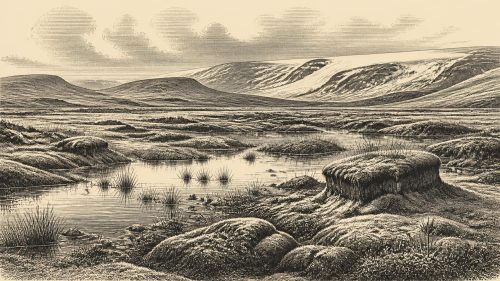
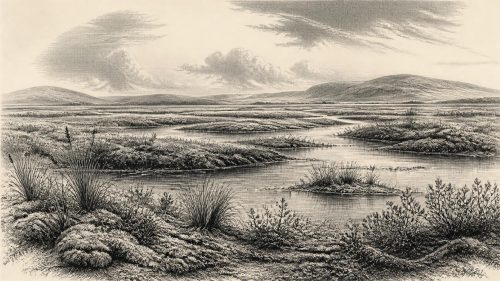
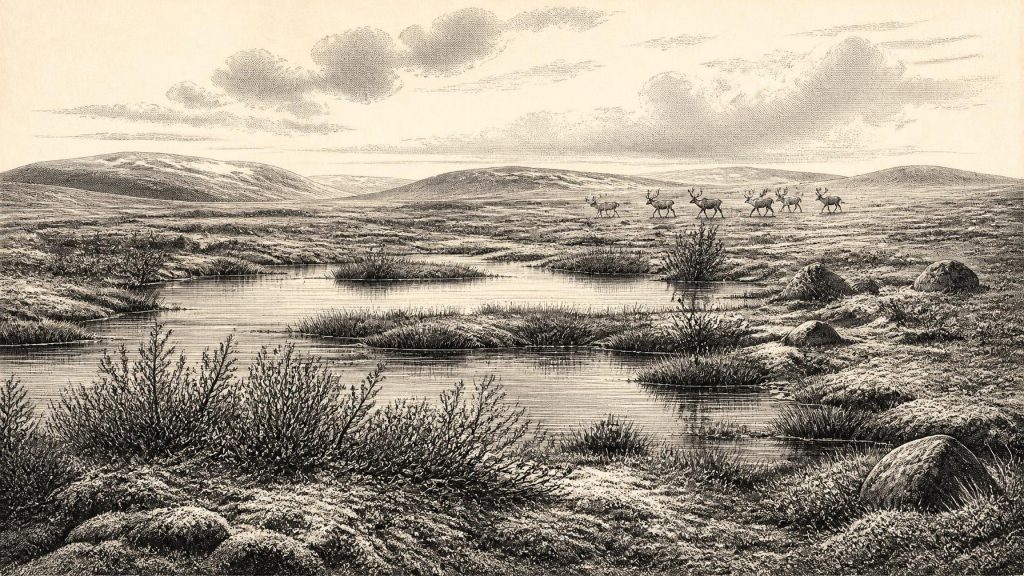
Derryvree supplies the clearest direct evidence for conditions on part of the Irish landmass. Beneath the drumlin were silts and fine sands laid down in freshwater, containing fossil pollen, plant macrofossils and insects. The assemblage indicates open, treeless tundra or tundra-like vegetation in a periglacial climate. Mosses, sedges and cold-adapted herbs mattered more in this landscape than woodland. Finds including bogbean, mountain-avens, dwarf willow and lesser clubmoss have been used to reconstruct a mosaic of shallow water, wet ground and exposed mineral soil.
This was not an unchanging white desert. “Periglacial” means a land shaped by severe cold and seasonal freezing near ice, not necessarily a place permanently buried beneath it. Water could pool, plants could grow during short summers, and insects could occupy particular ecological niches. Yet trees were absent locally or extremely scarce. A few pollen grains from tree species cannot securely demonstrate nearby forest: pollen may travel far, be redeposited, or survive unevenly. The stronger conclusion is that south Fermanagh supported sparse open vegetation and freshwater habitats at some point during a cold, non-glacial interval.
The sediments also preserve a larger geological argument. Because the organic bed lay between deposits interpreted as tills, it has long been understood as evidence for an ice-free or less heavily glaciated interlude between phases of ice advance in the north of Ireland. The extent, timing and character of early Midlandian glaciation remain debated, partly because tills are difficult to correlate over long distances and good absolute dates are scarce. What can safely be said is that the later Last Glacial Maximum, when ice covered almost all Ireland, still lay in the future. What cannot safely be said is that every region of the island was simultaneously free of ice in 30,930 BCE.
Castlepook’s Time-Mixed Fauna
At Castlepook, also called Mammoth Cave, the evidence is more dramatic but less neatly stratified. The cave yielded remains attributed to woolly mammoth, reindeer, giant deer, brown bear, wolf, Arctic fox, stoat, mountain hare, lemmings and spotted hyaena. This is not a complete list of animals living together in one place on one day. Cave assemblages are formed by many agencies: animals die, carnivores carry portions of carcasses into dens, water moves sediment, roof openings admit material, and excavators recover bones from deposits that may have accumulated over millennia. Early twentieth-century excavation methods also recorded context less precisely than modern fieldwork would require.
Nevertheless, the fauna shows that Ireland could support an intermittent cold-stage animal community before the Last Glacial Maximum. Reindeer and lemmings point to open, cold environments; mammoth and giant deer evoke extensive grazing country; predators demonstrate that food webs included scavenging and hunting carnivores. Spotted hyaena is especially significant, both because it is rare in the Irish record and because hyaenas can alter and transport bones. A mammoth bone bearing marks consistent with hyaena tooth damage offers a reminder that carnivores, not people, may explain much of what reached the cave.
These animals should not be imagined as inhabitants of a single uniform “mammoth steppe”. The Derryvree wetland and the Castlepook cave represent different local settings, while MIS 3 climates fluctuated repeatedly across centuries and millennia. Open grass-herb terrain, wet hollows, rocky limestone ground and patchy sheltered vegetation could coexist. The island’s position on Europe’s Atlantic edge also meant that weather, sea level, ice margins and routes for animal movement were constantly consequential.
The Marked Reindeer Bone
Castlepook has particular importance because a reindeer femur in the National Museum of Ireland’s Natural History collections carries a deep linear mark interpreted by zooarchaeologist Ruth Carden as damage made by a sharp stone tool during carcass processing. The bone has been publicly associated with an age of about 31,000 BCE. If the interpretation is upheld, it is evidence that a person handled a reindeer carcass in Ireland during the Upper Palaeolithic, vastly earlier than the island’s formerly accepted human record.
That is a major possibility, but its limits must be kept clear. The femur is not a human skeleton, a dwelling, hearth, occupation floor, stone-tool assemblage, burial or repeatedly used camp. No tool responsible for the mark has been recovered with it. The animal bone came from an old cave collection rather than a freshly excavated, securely layered archaeological context. Nor can the date of the animal’s death automatically date the moment when a mark was made. The most cautious statement is that one modified reindeer bone raises a serious prospect of brief human activity, perhaps butchery, in pre-maximum Ireland; it does not demonstrate a permanent resident population.
Even if people did visit, nothing identifies their language, ancestry, social organisation or relation to later inhabitants of Ireland. They could have been a small and mobile Upper Palaeolithic party, operating at the far western edge of wider European worlds. A visit might have involved following migrating animals, exploiting a carcass, scouting terrain or sheltering briefly. Those are interpretations based on the bone, the wider European record and the ecology of reindeer; they are not things directly observed in Ireland.
Life, Belief and Exchange Beyond the Evidence
Political affairs, diplomacy and warfare cannot be recovered for Ireland at this date. There are no polities, leaders, territories, weapons caches or fortifications in the evidence. Likewise, there is no Irish evidence for religion, ritual, art, formal learning, trade networks or domestic life around 30,930 BCE. It would be misleading to supply them from later Irish prehistory, or to transfer them wholesale from better-preserved Upper Palaeolithic sites in France, Britain or central Europe.
There is also no evidence for farming, herding, pottery, metalworking, villages or maritime commerce. The only conceivable economy indicated locally is the ecological economy of wild animals and plants. If the Castlepook femur does record butchery, it implies the acquisition or processing of meat, hide, marrow or sinew from a reindeer. It does not reveal whether the animal was hunted, found dead, taken from another predator or processed by one person rather than a group. Derryvree, meanwhile, tells us about natural resources available in a wetland landscape, not about people using them.
An Island Before Its Ice Maximum
The greatest development appropriate to this date is environmental. Ireland was not yet the wholly ice-dominated land of the later Last Glacial Maximum, but it was heading towards a much harsher glacial world. Across the following millennia, ice expanded and reworked the landscape so powerfully that it destroyed, buried or displaced much earlier evidence. This helps explain why the record is so fragmentary: absence of a camp or tool may reflect genuine absence, but it may also reflect erosion, later glaciation, submerged former coastlines and the rarity of suitable deposits.
Thus Ireland around the nominal year 30,930 BCE is best understood through disciplined uncertainty. Derryvree demonstrates a cold, open freshwater landscape in Fermanagh during a pre-maximum interval. Castlepook demonstrates that varied large mammals, including reindeer, occupied or reached southern Ireland over a broad span of MIS 3. One marked femur offers a potentially transformative trace of human action, while still falling short of proof of settlement. This is not a lost kingdom awaiting names and dates. It is a changing Ice Age environment, reconstructed from fragile evidence and still capable of revising Ireland’s deepest human past.
Primary Sources
- A reconsideration of the radiocarbon dating of the Marine Isotope Stage 3 fauna from southern Ireland
- The Irish Quaternary Fauna Project
- Quaternary Deposits and Glacial Stratigraphy in Ireland
- Figure 6.— The Subdivision of the Quaternary Period in Ireland
- Palaeoecology
- Phylogeographic, Ancient DNA, Fossil and Morphometric Analyses Reveal Ancient and Modern Introductions of a Large Mammal: The Complex Case of Red Deer (Cervus elaphus) in Ireland
- First Evidence of a Late Upper Palaeolithic Human Presence in Ireland
- New Insights on the Fauna of Ireland's Younger Dryas and Early Holocene from Alice & Gwendoline Cave
- The IntCal20 Northern Hemisphere Radiocarbon Age Calibration Curve (0–55 cal kBP)
- The IntCal20 Approach to Radiocarbon Calibration Curve Construction: A New Methodology Using Bayesian Splines and Errors-in-Variables
- IntCal Publications
- Heritage Artefacts of County Cork
- Archaeology Research Excavation Grant 2022
- New Data for the Last Glacial Maximum in Great Britain and Ireland
- A Critical Review and Re-Investigation of the Pleistocene Deposits Between Cranfield Point and Kilkeel, Northern Ireland: Implications for Regional Sea-Level Models and Glacial Reconstructions of the Northern Irish Sea Basin
- The Late Quaternary History of East-Central Ireland
- Upper Pleistocene Facies Sequences and Relative Sea-Level Trends Along the South Coast of Ireland
- Advances in Irish Quaternary Studies
- A Palaeo-Glaciological Reconstruction of the British-Irish Ice Sheet
- The Archaeology of Caves in Ireland