

Questions Asked & Answered
Recent Questions Answered
Archived: 27th October 2026
Airwave Nation
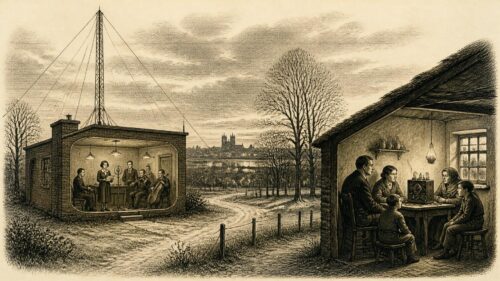
RTÉ’s centenary is a history not merely of technical progress, but of how the Irish state and its people learned to hear themselves at national scale. From 2RN’s first broadcast in 1926, radio carried language, music, faith, farming, sport and public information into homes unequally served by modern infrastructure. Television expanded that influence while intensifying arguments about culture, commercialism, editorial independence and censorship. This article traces institutional change from departmental control to public corporation, considers the distinctive place of Irish language services, and treats archives as evidence rather than nostalgia. Its conclusion is cautious: broadcasting created audiences, but never one Ireland.
Archived: 27th October 2026
Edwardian Ireland
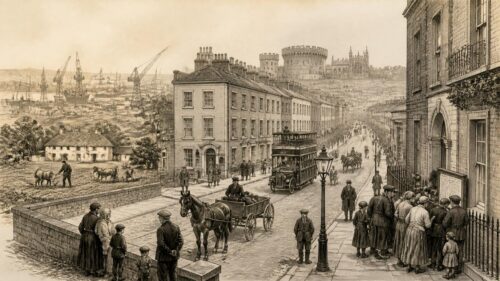
This article examines Ireland during the Edwardian years, understood strictly as 1901–1910 while following the political consequences into 1914. It traces a society still governed from Westminster yet being reshaped by tenant purchase, migration, industrial expansion, cultural revival, unionist mobilisation and women’s activism. Census evidence reveals neither a simple national awakening nor a uniform decline: rural districts, Dublin tenements and Belfast factories experienced sharply different conditions. The article separates archival record from later interpretation and folklore, explaining how apparently incremental Edwardian developments helped make constitutional compromise, partition, revolution and social conflict imaginable. It situates Irish choices within imperial structures, cautiously.
Archived: 27th October 2026
State Papers
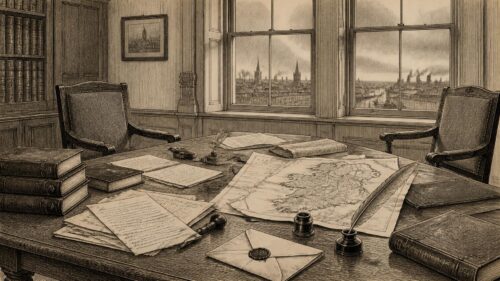
State papers illuminate the peace process not as a single secret design but as a contested record of governments, parties, civil servants and citizens confronting violence, sovereignty and mutual fear. This article traces how British and Irish official files, alongside parliamentary texts, party papers and public ephemera, document the route from failed settlements to the Belfast Good Friday Agreement. It considers what archives reveal, what they conceal, and why access, provenance and competing memories matter. The result is a history of negotiation and record-keeping that remains essential to understanding Ireland’s unfinished work of reconciliation, accountability, constitutional change and shared citizenship.
Archived: 27th October 2026
Bordered Networks
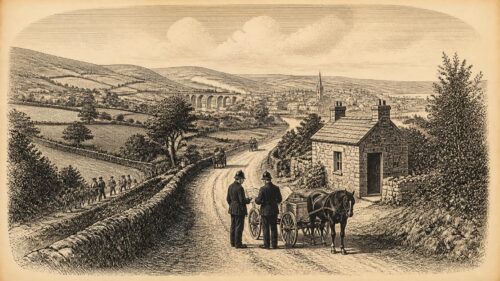
This article traces the evolution of policing across Ireland’s border from partition to contemporary organised crime investigations. It explains why jurisdictional division, conflict, political distrust and an open everyday frontier made cooperation both necessary and difficult. It examines the gradual shift from informal contact between the Garda and RUC to treaty based cooperation, post Agreement policing reform, shared strategies and the Joint Agency Task Force. It assesses drugs, revenue fraud, laundering, trafficking and paramilitary linked criminality without collapsing distinct histories into one narrative. It argues that durable cooperation rests less on a borderless police force than on law, trust, intelligence, accountability and patience.
Archived: 27th October 2026
Shannon Tragedy
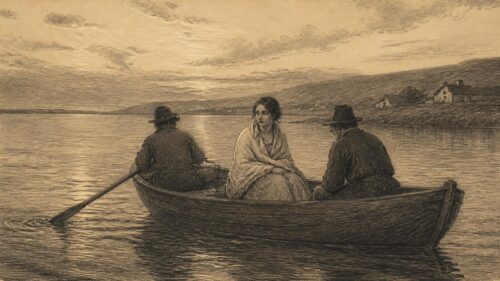
Ellen Hanley’s murder in 1819 became one of Ireland’s most enduring nineteenth-century tragedies. Known after her death as the Colleen Bawn, she was a young Limerick woman killed on the Shannon, while the men convicted of the crime were executed in 1820. This article separates surviving legal evidence from later testimony, literary invention and local folklore. It follows the transformation of Hanley’s death through Gerald Griffin’s novel, Dion Boucicault’s spectacular play, opera, tourism and remembrance. It argues that the legend reveals much about class, gender, law, landscape and the commercial remaking of Irish memory in the nineteenth and twentieth centuries.
Archived: 27th October 2026
European Passage
This article traces Ireland’s passage from economic dependence on Britain to membership of the European Communities and later the European Union. It examines the applications of 1961 and 1967, the 1972 accession referendum, agricultural and regional funding, legal change after Crotty, treaty referendums, the euro, Northern Ireland, and Brexit. It argues that membership was neither a simple rescue nor a surrender of independence: it altered markets, law, public administration and political horizons while exposing persistent disagreements over neutrality, representation, fisheries and sovereignty. Ireland’s European story is a history of negotiated interdependence, shaped by voters, courts, officials, farmers and border communities.
Archived: 27th October 2026
Shared Belonging
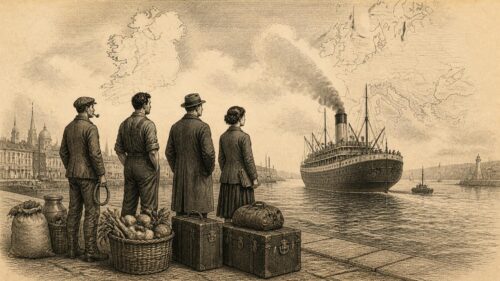
This article examines how immigration has shaped Irish identity from medieval settlement and colonial movement to refugees, workers and citizens in the contemporary state. It argues that Ireland was never simply an island of emigrants or a homogeneous national community, although emigration became central to popular memory. Evidence from archives, censuses, legislation and scholarship reveals recurring encounters between welcome, economic utility, assimilation, exclusion and political belonging. Huguenots, Palatines, Jews, Black residents, Travellers, returning emigrants and recent migrants each complicate inherited narratives. Irish identity emerges not as a fixed ancestry but as a contested historical practice formed across the island, diaspora and changing institutions.
Archived: 26th October 2026
Rebel Republic
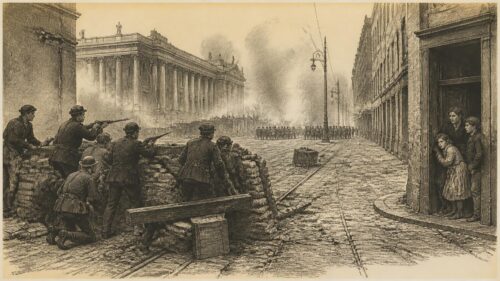
The Easter Rising of April 1916 was a militarily unsuccessful insurrection that became decisive in Ireland’s political transformation. This article locates the rebellion in the entangled worlds of Home Rule, wartime mobilisation, labour radicalism, cultural nationalism and clandestine republicanism. It reconstructs the disrupted plan, the principal Dublin garrisons, provincial actions, civilian ordeal, surrender, courts martial and executions. It also examines women’s work, conflicting loyalties and the problem of casualty evidence. Finally, it separates the Rising’s documented history from later devotional memory, arguing that its lasting power derived not from inevitable national consensus but from violence, state repression, political organisation and commemoration.
Archived: 26th October 2026
Spring Sovereignty
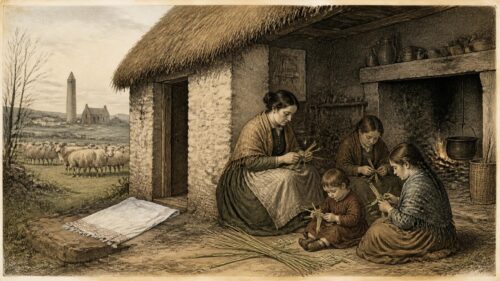
This article examines the historical relationship between St Brigid of Kildare and Imbolc, Ireland’s early February seasonal observance. It separates early medieval hagiography, medieval literary references to the goddess Brigit, later folklore, and modern public commemoration. Brigid’s earliest surviving Lives reveal the priorities of seventh century Kildare more securely than the details of a fifth century biography. Imbolc’s agricultural associations are plausible, but its prehistoric rituals cannot be reconstructed confidently. Irish household customs surrounding 1 February demonstrate vibrant religious tradition without proving unchanged pagan survival. The article argues that Brigid’s enduring power lies in layered reinterpretation, not a simplistic conversion narrative across Irish history.
Archived: 26th October 2026
Playing Ireland
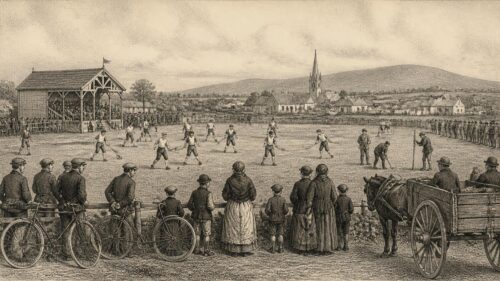
Sport has long supplied Irish communities with more than recreation: it has organised neighbourhoods, parishes, schools, workplaces, diasporas and public memories. This article traces the formation of modern sporting associations from eighteenth-century clubs through the Gaelic revival, examining Gaelic games alongside rugby, soccer, athletics and women’s sport. It argues that clubs became influential local institutions because they combined competition with voluntary labour, sociability and identity. The record also shows exclusions shaped by class, gender, religion and partition. Rather than treating sport as a timeless national essence, the article distinguishes evidence from folklore and considers how communities remade sporting traditions amid change.