
Year by Year
Explore Year by Year articles from the most modern historical year back to the oldest.
3,308 Articles Archived

Palaeolithic Encounters
Archived: 14 September 2026
Labelled 31,791 BCE, this period in Ireland belongs to later Marine Isotope Stage 3, not a recoverable calendar year. Fluctuating climates, lower seas and changing ice shaped an exposed, treeless landscape before the Last Glacial Maximum. Castlepook Cave in north Cork yielded a reindeer femur bearing a possible stone-tool cut mark, suggesting a brief human encounter around 33,000 radiocarbon years ago. However, disturbed deposits and absent hearths, tools or human remains preclude claims of settlement. Cave fauna, Fermanagh wetland deposits and Kerry speleothems indicate cold, variable habitats supporting mammals and intermittent liquid water. Evidence permits cautious speculation on hunter-gatherer visits.

Cork Vertebrates
Archived: 14 September 2026
Around 33,700 calibrated years before present, Ireland lay within the unstable Late Pleistocene, as ice advanced towards the Last Glacial Maximum. Open grasslands, shrubs and bare ground supported grazing animals, while lower sea levels altered coastlines without proving migration routes. Castlepook Cave, County Cork, preserves Ireland’s richest pre-maximum vertebrate archive, including mammoth, reindeer, giant deer, bear and hyaena, though its disturbed bones represent episodes. A 33,000-year-old reindeer femur bears a possible stone-tool cut mark, suggesting but not confirming an early human visit. No occupation evidence establishes settlement, hunting practices or continuity. It chiefly records environmental change and unresolved human presence.

Femoral Scoring
Archived: 14 September 2026
31,793 BCE is a modern filing date, roughly 33,700 years before present, within climatically unstable Marine Isotope Stage 3. Ireland was cold, treeless and regionally varied, with tundra-like wetlands, periglacial terrain and advancing, uneven ice. Castlepook Cave, County Cork, preserves fauna including mammoth, giant deer, reindeer, bears, hyaenas, wolves, foxes and lemmings, showing ecological links beyond Ireland. A marked reindeer femur may record stone-tool use and an early human visit, but disturbed deposits and uncertain dating prevent firm conclusions. Secure butchery evidence at Clare is far later. No settlement, culture, trade or society can be reconstructed; faunal evidence remains paramount.
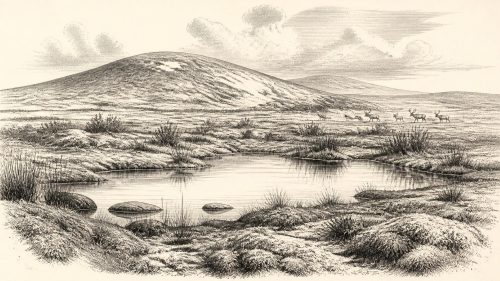
Maguiresbridge Freshwater
Archived: 14 September 2026
31,794 BCE cannot be treated as a precise Irish historical year, but falls within a fluctuating Late Glacial interval. At Derryvree near Maguiresbridge, Fermanagh, freshwater silts between glacial tills preserve evidence of an ice-free phase: open tundra, wetlands, sedges, mosses and cold-adapted insects. Conditions varied regionally as ice advanced and retreated before later extensive glaciation. Castlepook Cave, Cork, contains reindeer, mammoth and spotted hyena remains, showing a productive cold-stage fauna. A marked reindeer bone may indicate brief human activity around 33,000 years ago, but cannot prove settlement. The sparse record depicts a living, precarious landscape, reconstructed through deposits and probabilities.
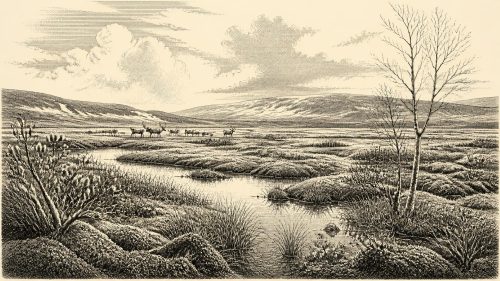
Fermanagh Sedges
Archived: 14 September 2026
Around 31,795 BCE, Ireland lay within an unstable Late Pleistocene cold phase, rather than the later Last Glacial Maximum. At Derryvree, County Fermanagh, sediments between glacial tills preserve evidence of treeless tundra wetlands, with mosses, sedges, dwarf birch, insects and freshwater pools. Lower sea levels altered coasts, but no certain land bridge or travel routes can be identified. Castlepook Cave, County Cork, records cold-adapted mammals, including reindeer, mammoth and hyaena. A possibly cut-marked reindeer bone suggests an early human visit, not settlement. No securely dated occupation exists; any presence was likely brief, mobile and vulnerable to severe advancing glacial ice.

Glacial Ecosystems
Archived: 14 September 2026
At the nominal date 31,796 BCE, Ireland lay within climatically unstable Marine Isotope Stage 3, not a precisely datable historical year. Fermanagh sediments between glacial tills record cold, treeless freshwater wetlands during ice-free intervals. Castlepook Cave in County Cork preserves a long-lived assemblage of Ice Age animals, including mammoth, reindeer, giant deer, bear, wolf and hyaena, demonstrating open-country ecosystems before and after the Last Glacial Maximum. A marked reindeer femur may indicate stone-tool butchery by visitors, but cannot prove settlement. No evidence supports detailed human history at all; environmental archives instead reveal shifting ice, habitats, fauna and uncertain human presence.

Pleistocene Vertebrates
Archived: 14 September 2026
Around 31,797 BCE, Ireland lay within the climatically unstable Late Pleistocene, before the Last Glacial Maximum, rather than a date permitting year-specific history. Castlepook Cave in north Cork preserves Ireland’s principal pre-maximum faunal archive, with mammoth, reindeer, giant deer, predators and lemmings indicating cold, open habitats connected to wider north-west Europe. Northern Irish organic deposits similarly reveal fluctuating treeless wetlands and occasional milder woodland. Growing ice sheets and lower sea levels reshaped environments and dispersal routes. A possibly tool-marked Castlepook reindeer femur may indicate early human butchery, but lacks secure archaeological context and cannot prove settlement. The evidence records ecosystems.

Reindeer Taphonomy
Archived: 14 September 2026
Around 31,798 BCE, Ireland formed part of a changing Late Pleistocene landscape, with fluctuating ice, lower seas and intermittently exposed cold, open terrain. Evidence is regional and uncertain, since later glaciation destroyed or disturbed much of the record. Castlepook Cave in County Cork yielded reindeer, hyaena, bear, fox, hare, lemming and mammoth remains, accumulated at different times through natural and animal processes. A reindeer leg bone, dated roughly 33,000 years ago, bears a possible stone-tool cut mark, suggesting human activity. It cannot prove settlement, population continuity or social life. Castlepook instead highlights Ireland’s Ice-Age fauna and evidence for Palaeolithic visitors.

Maguiresbridge Wetland
Archived: 14 September 2026
Although 31,799 BCE is an artificial precise label, it denotes later Marine Isotope Stage 3, when parts of Ireland were ice-free before the Last Glacial Maximum. At Derryvree near Maguiresbridge, freshwater silts sealed between glacial tills, radiocarbon dated broadly to 36,900–31,700 calibrated years BP, reveal cold open tundra, wetlands and periglacial conditions. Southern caves preserve remains of mammoth, reindeer, giant deer and predators, though mixed deposits cannot provide a single-time census. A possibly tool-marked Castlepook reindeer bone suggests an early human visit, not settlement. Subsequent British–Irish Ice Sheet expansion transformed and obscured these fragile prehistoric landscapes over the following millennia.

Tundra Bogbean
Archived: 14 September 2026
Circa 31,800 BCE, Ireland lay within the climatically unstable Marine Isotope Stage 3, not a precisely datable historical year. Calibrated evidence from Derryvree, County Fermanagh, records freshwater tundra sediments, including bogbean, between glacial tills, showing locally ice-free, periglacial conditions before later ice expansion. Cave and speleothem records indicate shifting cold environments and intermittent habitats for mammoth, reindeer, giant deer, carnivores and other fauna. A cut-marked Castlepook reindeer bone may suggest a brief Upper Palaeolithic visit, but disturbed context prevents confirmation. No secure evidence supports permanent human settlement, society, culture or political life. Ireland remained an ecologically demanding Ice Age fringe.
Some records do not yet have a verified historical year and are awaiting chronological placement.