Awbeg Valley Faunal Archive31796 BCE
At the nominal date 31,796 BCE, Ireland lay within climatically unstable Marine Isotope Stage 3, not a precisely datable historical year. Fermanagh sediments between glacial tills record cold, treeless freshwater wetlands during ice-free intervals. Castlepook Cave in County Cork preserves a long-lived assemblage of Ice Age animals, including mammoth, reindeer, giant deer, bear, wolf and hyaena, demonstrating open-country ecosystems before and after the Last Glacial Maximum. A marked reindeer femur may indicate stone-tool butchery by visitors, but cannot prove settlement. No evidence supports detailed human history at all; environmental archives instead reveal shifting ice, habitats, fauna and uncertain human presence.
Dateline
Modern calendar precision is not available for Ireland in 31,796 BCE. The numbered year is a useful point of orientation, not an event-date: expressed in the archaeological convention of calibrated years before present, with “present” fixed at 1950, it falls roughly 33,700–33,800 cal BP. That estimate must not be mistaken for an anniversary. At this depth in time, radiocarbon measurements have substantial ranges, calibration curves are uneven, and Irish deposits are rarely continuous. The responsible subject is therefore Ireland during the later part of Marine Isotope Stage 3 (MIS 3), a climatically unstable phase of the Late Pleistocene, rather than a recoverable year in the lives of identifiable people.
A Landscape Before the Ice Maximum
Ireland stood well before the Last Glacial Maximum, when the British–Irish Ice Sheet expanded to cover most of the island. That later maximum is generally placed around 27,000 years ago in the British–Irish record, although its timing and extent varied from one ice-sheet sector to another. Around the nominal date used here, ice, water, vegetation and animal ranges were already changing on long and sometimes abrupt timescales. It is unsafe to picture a single fixed national landscape. Some places may have supported exposed ground and freshwater habitats during milder intervals; others lay nearer active or advancing ice; still others have left no surviving environmental record at all.
The familiar Ireland of wooded hills, peatlands, enclosed fields and coasts did not exist. Sea level was much lower globally than today, and the outlines of the Irish Sea basin and Atlantic shelf were consequently very different. Yet lower seas do not automatically prove an easy land route for people or animals at every moment. Access between Ireland, Britain and continental Europe depended on changing coastlines, marine channels, ice margins and ecological corridors. The evidence establishes that Ice Age animals reached Ireland; the exact routes, seasons and frequency of movement remain matters of reconstruction rather than direct observation.
Wetlands Beneath Fermanagh
Northern Ireland preserves some of the clearest evidence for environments broadly relevant to this date. At Derryvree, near Maguiresbridge in County Fermanagh, organic-rich freshwater sediments occur between an older and a younger layer of glacial till. Their position is crucial. Ice deposited the lower till; a non-glacial freshwater environment then existed long enough for silts, plant remains and insects to accumulate; later ice covered the sequence with upper till. The deposit is not a diary and cannot be assigned to 31,796 BCE, but it demonstrates that a cold, ice-free interval occurred between glacial advances.
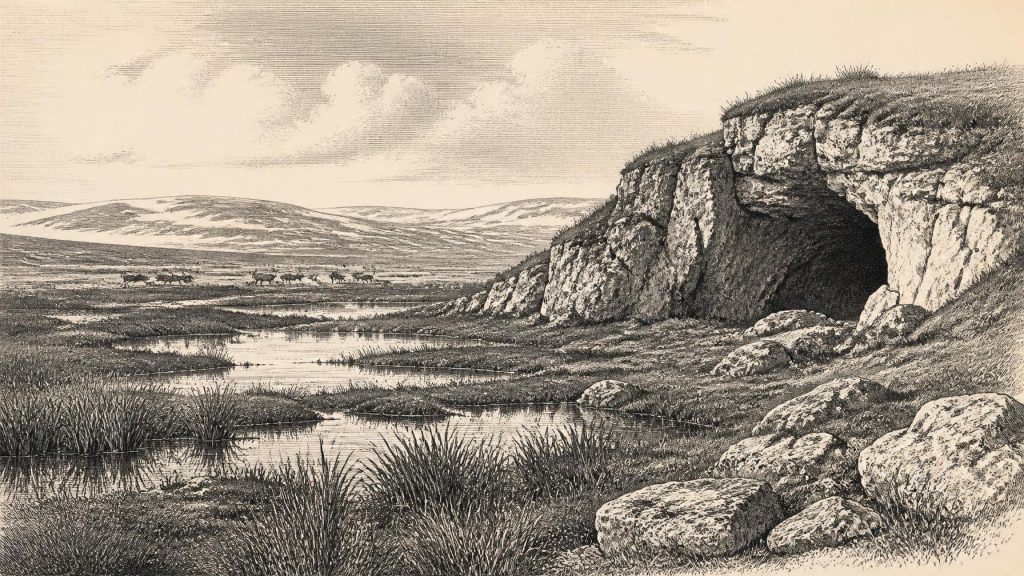
Derryvree’s fossils point towards an open, treeless wetland or muskeg landscape. Freshwater mosses and sedges, together with insect species of cold northern affinity, indicate shallow pools, saturated ground and low vegetation rather than closed forest. A radiocarbon determination of about 30,500 radiocarbon years BP from the organic layers has a broad calibrated significance rather than year-level precision. It overlaps a long later-MIS-3 environmental window, not a single moment. Nearby sites at Hollymount, Greenagho and Aghnadarragh add important corroboration: they preserve organic horizons between tills and show that Ireland’s glacial history included episodes of cold but non-glacial terrain.
Such deposits illuminate everyday ecology rather than human society. Mosses, sedges, pollen and beetles can show the sort of habitats available to animals, the severity of winters and the presence of standing water. They cannot tell us what language anyone spoke, whether a camp stood nearby, or how long any group remained. Their value lies precisely in this restraint: they give Ireland an environmental history where conventional historical sources are impossible.
Castlepook’s Mixed Cave Record
The most striking southern Irish archive is Castlepook Cave, also called Mammoth Cave or Doneraile Cave, in the Awbeg Valley of north County Cork. Its limestone passages yielded more than 2,000 animal bones during investigations undertaken principally between 1904 and 1918. The cave is exceptionally important because it contains remains spanning a long part of the Ice Age, including material from before and after the Last Glacial Maximum. It is also difficult evidence. Water movement, carnivore activity, natural deaths, sediment disturbance and early excavation all helped produce the collection. A bone from one named gallery is not necessarily contemporary with every other bone from that gallery.
Even so, the assemblage establishes an Irish fauna far removed from that of the present island. Identified remains include woolly mammoth, reindeer, giant deer, brown bear, wolf and spotted hyaena; later cold-stage material includes Arctic fox and lemmings. Not all these species need be placed in the same century, still less the same season, and revised radiocarbon work has shown that some older dates from Irish cave collections were too young because of limitations in earlier laboratory preparation. The secure conclusion is a long-lived, changing animal record. Reindeer and mammoth are consistent with extensive open grazing country, while predators and scavengers show that carcasses were contested resources in an active Ice Age food web.
Spotted hyaena is particularly informative, though it should not be romanticised. Castlepook is Ireland’s only known site for the species, and the cave may have served as a carnivore repository or den during part of its history. Hyaenas, wolves, flowing water and gravity could all move bones into passages. Consequently, an animal’s presence in the cave proves neither that it died there nor that people encountered it there. The Awbeg Valley archive is most useful as evidence of regional ecological possibility: large herbivores and formidable carnivores were able to occupy Ireland during portions of MIS 3.
The Reindeer Femur Question
One Castlepook object has made this period especially important for Irish prehistory: a reindeer femur reported as bearing a deep mark interpreted as having been made by a sharp stone tool during carcass processing. County Cork heritage material has associated the bone with about 31,000 BCE. If the mark is correctly identified and contemporary with the animal’s fresh bone, it would be evidence for an Upper Palaeolithic person handling a reindeer in Ireland many millennia before the island’s long-established post-glacial settlement record. It would be an extraordinary result, but it is not a licence to invent a settled community in 31,796 BCE.
The limits are exact and important. The specimen comes from an old cave collection rather than a modern excavation of a sealed occupation floor. Its date concerns the animal bone, not independently the making of the incision, the place where the animal was killed, or the length of any human visit. No securely associated hearth, dwelling surface, stone-tool assemblage, burial, art object or sequence of repeated camps of comparable antiquity has yet been published from Castlepook. Recent licensed work has sought surviving deposits and has underlined both the cave’s potential and the disruption caused by earlier exploration.
Accordingly, the best interpretation is deliberately modest. The femur may record a brief human incursion: perhaps one or more highly mobile visitors used a lithic cutting edge to remove meat, hide, sinew or marrow from a carcass. It does not tell us whether they hunted the reindeer, scavenged it, traded for it, or found it already dead. Nor can it demonstrate permanent settlement, a named people, a population size, family life or descent from later inhabitants of Ireland. The difference between a possible act of butchery and proof of colonisation is the central historical distinction for this date.
What Cannot Yet Be Written
There is no responsible political history for Ireland in this year. No kings, chiefs, territories, laws, alliances, battles, diplomatic exchanges or institutions can be identified. There is equally no direct evidence for religion, ritual, art, learning, language, trade networks, domestic architecture or social rank. Continental Europe certainly contained Upper Palaeolithic communities with varied stone technologies and cultural practices, but those broader realities cannot simply be transferred across the sea to Ireland. Irish evidence must lead the account, and at present it does not support a detailed human narrative.
If people did reach Ireland during this broad interval, survival would have depended upon mobility, careful knowledge of animals and terrain, and the practical use of perishable materials as well as stone. That is an inference from the conditions and from the possible modified femur, not a demonstrated reconstruction of an Irish economy. Reindeer, other large mammals, hides, bone, antler, plant foods and perhaps driftwood or local scrub might have offered resources, but no excavated campsite allows their collection, processing or sharing to be described. “Trade” and “diplomacy” are not merely undocumented here; they are concepts for which the evidence provides no foothold.
An Archive of Possibility
Ireland around the nominal year 31,796 BCE was not empty of history, but it is known through deep environmental and faunal archives rather than chronicles. Fermanagh’s sub-till wetlands show that cold, open freshwater landscapes existed between ice advances. Castlepook shows that a diverse Ice Age fauna ranged through southern Ireland across a long span before the glacial maximum. The marked reindeer femur raises the possibility that people were present too, perhaps briefly. Future excavation, refined dating and microscopic study of bone surfaces may test that possibility. For now, the honest history is one of tundra wetlands, cave-borne bones, shifting ice and a single contested trace of human action.
Primary Sources
- Early Midlandian–Middle Midlandian, Pleistocene, Northern Ireland
- A Reconsideration of the Radiocarbon Dating of the Marine Isotope Stage 3 Fauna from Southern Ireland
- Castlepook Cave: Cork County Geological Site Report
- Late Pleistocene Chronostratigraphy and Ice Sheet Limits, Southern Ireland
- Radiocarbon Constraints on the History of the Western Irish Ice Sheet Prior to the Last Glacial Maximum
- Timing and Pace of Ice-Sheet Withdrawal Across the Marine–Terrestrial Transition West of Ireland During the Last Glaciation
- Dimensions and Chronology of the Last Ice Sheet in Western Ireland
- Pattern and Timing of Retreat of the Last British-Irish Ice Sheet
- The IntCal20 Northern Hemisphere Radiocarbon Age Calibration Curve (0–55 cal kBP)
- Freshwater Organic Deposits and Stratified Sediments Between Early and Late Midlandian (Devensian) Till Sheets, at Aghnadarragh, County Antrim, Northern Ireland
- Middle Midlandian Interstadial Deposits at Greenagho, Near Belcoo, County Fermanagh, Northern Ireland
- Clogher Valley
- Aghnadarragh
- Heritage Artefacts of County Cork
- Archaeology Research Excavation Grant 2022
- 2022:564 – Castlepook Cave, Castlepook South, Cork
- Guide to the National Museum of Ireland
- New Insights on the Fauna of Ireland’s Younger Dryas and Early Holocene from Alice & Gwendoline Cave
- Could Brown Bears (Ursus arctos) Have Survived in Ireland During the Last Glacial Maximum?
- The Irish Quaternary Fauna Project