Castlepook’s Faunal Crossroads31797 BCE
Around 31,797 BCE, Ireland lay within the climatically unstable Late Pleistocene, before the Last Glacial Maximum, rather than a date permitting year-specific history. Castlepook Cave in north Cork preserves Ireland’s principal pre-maximum faunal archive, with mammoth, reindeer, giant deer, predators and lemmings indicating cold, open habitats connected to wider north-west Europe. Northern Irish organic deposits similarly reveal fluctuating treeless wetlands and occasional milder woodland. Growing ice sheets and lower sea levels reshaped environments and dispersal routes. A possibly tool-marked Castlepook reindeer femur may indicate early human butchery, but lacks secure archaeological context and cannot prove settlement. The evidence records ecosystems.
Dateline
For a date expressed as 31,797 BCE, Ireland cannot be described year by year in the ordinary historical sense. No written record, calendar, ruler, settlement sequence or event can be fixed to this particular year. The number is a modern conversion, useful chiefly as a point of orientation. In archaeological terms it falls broadly within Marine Isotope Stage 3, a long and climatically unstable part of the Late Pleistocene, before the Last Glacial Maximum. The responsible evidence consists of caves, buried sediments, animal bones, pollen, insects, geological landforms and scientific dates with margins of uncertainty. It can illuminate environments and possibilities over centuries or millennia; it cannot supply an Irish diary for one year.
Dating a Deep Past
Radiocarbon laboratories conventionally report age in years before AD 1950, and a radiocarbon determination is not automatically a calendar age. Atmospheric carbon levels varied through time, so measurements must be calibrated against independently dated records. IntCal20, the current Northern Hemisphere calibration curve extending to 55,000 calendar years before present, has improved this process but has not made the far past precise to individual years. Thus 31,797 BCE is best treated as approximately 33,746 calendar years before AD 1950, not as a date at which a particular Irish occurrence happened. Where published scholarship provides ranges, those ranges matter more than a calculated BCE label. The Last Glacial Maximum, for example, is generally placed at about 28,200–20,400 calibrated years before present, while the date considered here belongs to the preceding interval.
This distinction is particularly important for Irish evidence. A bone date establishes when the animal died within a statistical range; it does not necessarily date a cut, a visit to a cave, a kill-site or a human presence. Sediment layers can record an episode of deposition rather than a continuously inhabited landscape. Even a cave rich in fossils may have served, at different moments, as a carnivore den, a natural trap, a drainage channel, a shelter, or a place where bones accumulated after being washed in. At this depth of time, interpretation has to remain visibly separate from observation.
The North Cork Cave Archive
The most important Irish locality for this broad period is Castlepook Cave, also known historically as Mammoth Cave, near Doneraile in north County Cork. Excavations in the early twentieth century recovered a remarkable collection of animal remains from a complex limestone cave system above the Blackwater catchment. Later reassessment and improved radiocarbon methods demonstrated that some Castlepook fauna belongs to Marine Isotope Stage 3, substantially older than formerly recognised. The cave is among Ireland’s principal pre-Last Glacial Maximum faunal archives, though its old excavations and complicated deposits make it difficult to reconstruct exact associations between individual bones.
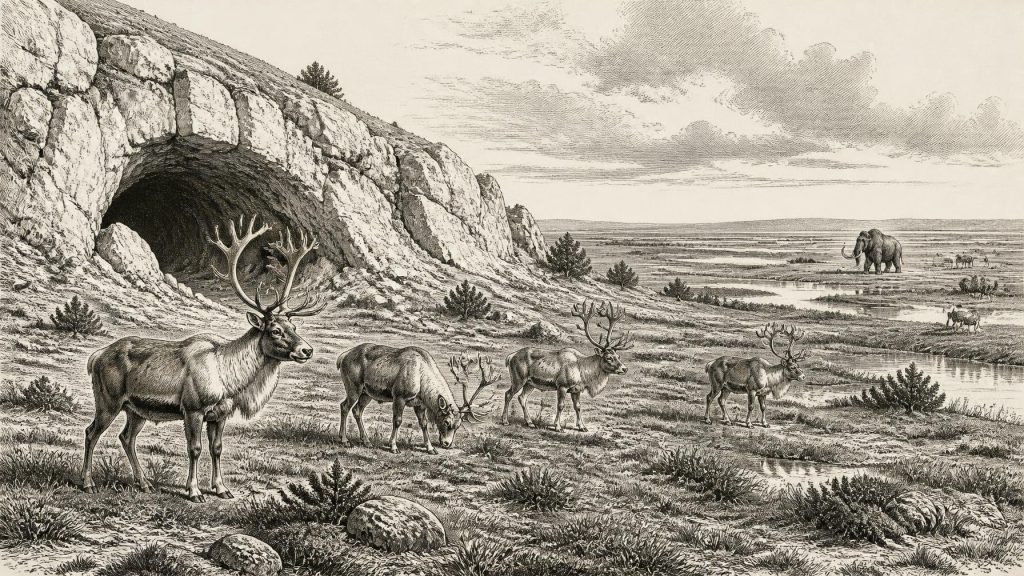
The assemblage documents a landscape inhabited by large herbivores and formidable predators or scavengers. Recorded or reported Pleistocene taxa include woolly mammoth, reindeer, giant deer, wolf, red fox, arctic fox, brown bear, spotted hyaena and lemmings. Not every specimen need be contemporary, and the precise age of each bone must be assessed separately. Yet the combined record securely shows that Ice Age Ireland was not uniformly barren. At intervals before the most extensive late glacial ice cover, suitable habitats existed for a varied cold-climate fauna, including animals requiring substantial food resources and wide territories.
Castlepook is therefore more than a catalogue of extinct mammals. Mammoth implies extensive grazing opportunity; reindeer indicate open, seasonal country; lemmings point towards northern ecological conditions; and hyaenas, wolves and bears reveal a food web in which carcasses could be hunted, scavenged, dragged underground or reworked by later processes. The cave itself was part of that food web. Bones found within it do not prove that all the animals lived beside the entrance, nor that they died there. They do, however, preserve a rare Irish window onto an ecosystem almost wholly erased by subsequent ice advances.
Open Ground, Wet Hollows
Evidence from northern Ireland complements the Cork cave record. At Derryvree near Maguiresbridge, County Fermanagh, organic-rich freshwater silts and fine sands survived between two tills beneath a drumlin. Their pollen, plant and insect evidence indicates a cold, open and treeless wetland environment: mosses, sedges, grasses, juniper and herbs around shallow pools rich in plant matter. The deposits have traditionally been linked to a middle Midlandian cold phase and have been associated with a radiocarbon age around 30,500 BP, although their chronology is not fine enough to identify a single equivalent calendar year.
Other buried organic deposits at Hollymount and Greenagho in Fermanagh, and at Aghnadarragh in County Antrim, demonstrate that the last glaciation contained substantial environmental variation. Some records indicate cold open ground and marked seasonality; Aghnadarragh also preserves evidence of an earlier, relatively milder woodland episode with birch, pine and spruce. These sites should not be assembled into one seamless map for 31,797 BCE. They are snapshots from different phases and locations. Taken together, however, they show that Ireland experienced oscillations between ice expansion, ice-free or partly ice-free terrain, wetland formation, sparse vegetation and, at other times, more wooded conditions.
For the period around this modern date, the strongest interpretation is of a periglacial Irish landscape with exposed ground, herb-rich vegetation and wet depressions, rather than a forested island resembling later Ireland. Winters were harsh, growing seasons short and weather highly seasonal. The precise extent of ice across every region remains debated because ice sheets later scoured, buried and rearranged earlier deposits. It is safer to speak of local habitable patches and changing corridors than to claim that the whole island was either open or ice-covered at once.
Before the Ice Maximum
The date also belongs to the long build-up towards the Last Glacial Maximum. Modern reconstructions of the British–Irish Ice Sheet indicate growth from roughly 31,000 to 26,000 years ago, followed by changing and asynchronous advances across Irish, British and North Sea sectors. The maximum extent of the Irish and British sectors was reached later, broadly around 26,000 years ago, not at the point represented by 31,797 BCE. In other words, this was not yet the fullest ice-bound Ireland of popular imagination, but it was a world in which glaciation was becoming an increasingly decisive force.
Lower sea levels altered the geography beyond the modern coast. Continental shelves now submerged were dry or shallower ground in places, and animal dispersal between Ireland, Britain and continental Europe occurred under conditions very different from those of the present island. This does not justify a simple claim of a permanent land bridge, still less a claim that people necessarily walked into Ireland. It does explain why Castlepook’s fauna belonged to wider north-west European populations rather than to an isolated island menagerie. Recent sedimentary ancient-DNA work from Castlepook, presently reported as a preprint, supports broad faunal connectivity but remains supplementary rather than conclusive evidence.
The Human Question
Human activity is the most arresting and most uncertain issue. A reindeer femur from the Castlepook collection has been reported as bearing a deep mark interpreted by zooarchaeologist Ruth Carden as damage made by a sharp stone tool during butchery. Public presentations of the specimen place the animal at about 33,000 years ago, often rendered broadly as c.31,000 BCE. If the mark is genuinely a fresh tool cut and is contemporary with the bone, it would be potentially momentous evidence that Upper Palaeolithic people reached Ireland far earlier than the island’s previously accepted late-glacial record.
That possibility must not be converted into a settled story of colonisation. The femur comes from an old cave collection, not a modern excavation of an undisturbed occupation surface. There is no securely associated hearth, dwelling, lithic assemblage, human skeleton, burial, repeated food-processing floor or art of comparable antiquity in Ireland. The radiocarbon result dates the death of the reindeer, not independently the mark or the duration of any human visit. Moreover, taphonomic analysis must distinguish intentional cutting from carnivore damage, sediment abrasion, breakage, excavation disturbance and later handling. The specimen is thus a serious and provocative clue, not proof of a resident population in north Cork.
Accordingly, there can be no responsible account here of Irish political affairs, diplomacy, tribes, named leaders, warfare or religious institutions. There is no evidence for them. Nor is there evidence for farming, domesticated animals, trade systems, monuments, formal learning, pottery or permanent villages. If people did enter the Irish landscape during this broad interval, they would have been mobile Upper Palaeolithic hunter-gatherers operating within a dangerous, seasonal world. That is an inference from contemporaneous European societies and the possible Castlepook butchery trace, not a directly demonstrated description of an Irish community.
A Landscape Before Social History
The economic reality demonstrable in Ireland was ecological rather than agricultural: grazing, browsing, predation, scavenging, seasonal movement and the accumulation of animal remains. Reindeer and mammoth formed part of a wider living landscape, while hyaenas and other carnivores competed for carcasses and shelter. For any human visitors, a reindeer carcass would have offered meat, marrow, fat, hide, sinew and bone, but the one marked femur cannot establish a routine hunting economy. Equally, there is no basis for identifying cultural identity, language, ceremony or a route of arrival.
The enduring significance of the period is therefore not an invented event but a threshold of evidence. Castlepook, Derryvree and related deposits show that Ireland around this broad point in the Late Pleistocene was a changing northern landscape connected to wider ecological processes, inhabited by animals later eliminated locally by climate change, ice-sheet advance and geographic isolation. The question of whether people briefly shared that landscape remains open. Future work on intact cave deposits, better dating, microscopic damage analysis and sedimentary DNA may narrow the uncertainty. For now, the most compelling history of 31,797 BCE is one of animals, ice, exposed ground and a single bone that asks more than it can yet answer.
Primary Sources
- A reconsideration of the radiocarbon dating of the Marine Isotope Stage 3 fauna from southern Ireland
- The Irish quaternary fauna project
- Growth and retreat of the last British–Irish Ice Sheet, 31,000 to 15,000 years ago: the BRITICE-CHRONO reconstruction
- Maximum extent and dynamic behaviour of the last British–Irish Ice Sheet west of Ireland
- Early Midlandian–Middle Midlandian, Pleistocene, Northern Ireland
- A Middle Midlandian Freshwater Series at Derryvree, Maguiresbridge, County Fermanagh, Northern Ireland
- The Subdivision of the Quaternary Period in Ireland
- Introduction to the Late Quaternary and Holocene of Northern Ireland
- First Evidence of a Late Upper Palaeolithic Human Presence in Ireland
- Heritage Artefacts of County Cork
- UCD School of Archaeology Research Day 2022
- What Was on the Menu in Prehistoric Ireland?
- The IntCal20 Northern Hemisphere Radiocarbon Age Calibration Curve (0–55 cal kBP)
- The IntCal20 Northern Hemisphere Radiocarbon Age Calibration Curve (0–55 cal kBP)
- Pleistocene Vertebrates in the British Isles
- Irish Cave Exploration
- Irish Pleistocene Biostratigraphy
- Cenozoic: Tertiary and Quaternary (until 11,700 BP)
- Sedimentary Ancient DNA Reveals Late Pleistocene Faunal Connectivity Between Ireland and Eurasia
- New Insights on the Fauna of Ireland’s Younger Dryas