Mosses Between the Tills31795 BCE
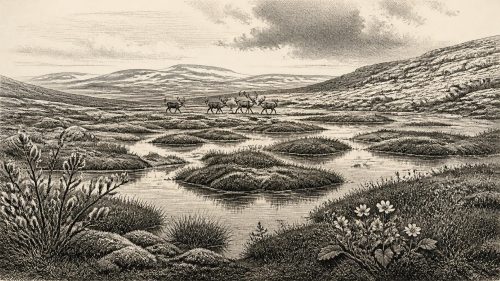
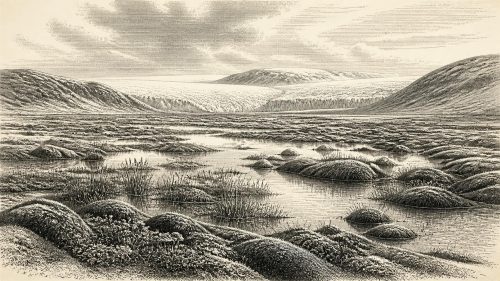
Around 31,795 BCE, Ireland lay within an unstable Late Pleistocene cold phase, rather than the later Last Glacial Maximum. At Derryvree, County Fermanagh, sediments between glacial tills preserve evidence of treeless tundra wetlands, with mosses, sedges, dwarf birch, insects and freshwater pools. Lower sea levels altered coasts, but no certain land bridge or travel routes can be identified. Castlepook Cave, County Cork, records cold-adapted mammals, including reindeer, mammoth and hyaena. A possibly cut-marked reindeer bone suggests an early human visit, not settlement. No securely dated occupation exists; any presence was likely brief, mobile and vulnerable to severe advancing glacial ice.
Dateline
Modern calendar-year precision is not available for Ireland in 31,795 BCE. The number is a convenient point on a modern chronological scale, not a date recorded by people living then. Archaeologists instead work with radiocarbon ages, calibrated ranges and long environmental sequences. Expressed in the conventional archaeological measure of years before AD 1950, 31,795 BCE lies approximately 33,745 calendar years before present (cal BP). It falls within the Late Pleistocene, in Marine Isotope Stage 3, during the long, unstable cold period before the Last Glacial Maximum.
For Ireland, the responsible history of this moment is therefore not a story of named communities, rulers or events. It is a reconstruction from sediment beneath later glacial deposits, bones preserved in limestone caves, pollen, mosses, insects, landforms and the changing relationship between ice, sea and land. Those records can illuminate conditions across broad intervals. They cannot tell us what happened in one particular year, nor can they justify assigning a precise season, settlement or migration to 31,795 BCE.
A Cold-Phase Landscape
The closest Irish environmental evidence comes from Derryvree near Maguiresbridge in County Fermanagh. Roadworks there in 1969 exposed organic silts and fine sands enclosed between two layers of glacial till. The deposit yielded a radiocarbon result of 30,500 ± c.1,100 radiocarbon years BP; later calibration places it broadly between about 36,900 and 31,700 cal BP. That range overlaps the chronological point represented by 31,795 BCE, but it is much too wide to make Derryvree a snapshot of that year.
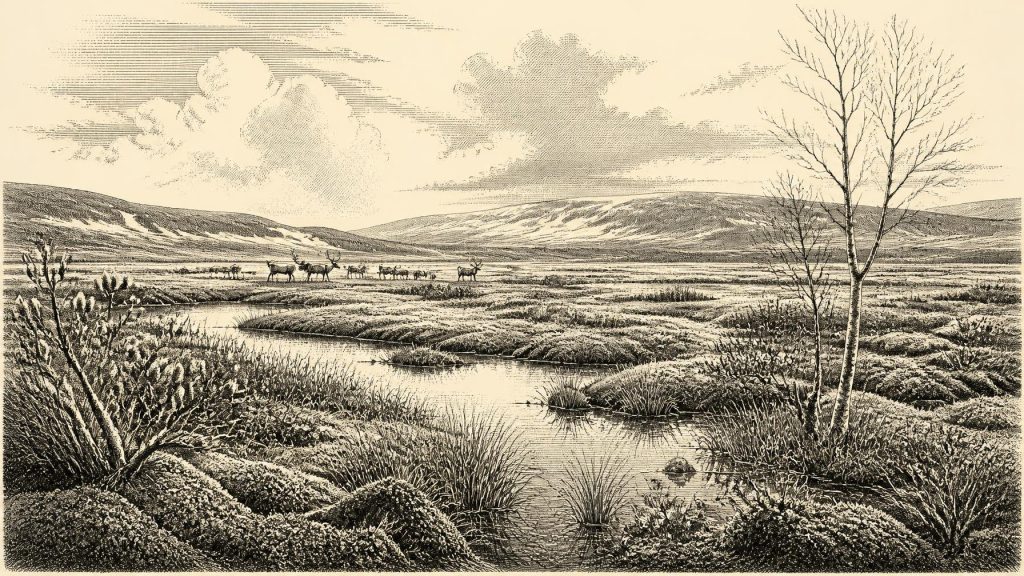
Its evidence is nonetheless unusually vivid. Pollen, plant macrofossils and beetle remains indicate open, treeless tundra or muskeg: wet ground with pools, mosses, sedges and herb-rich vegetation, rather than the familiar wooded Irish landscape of later millennia. Bogbean, dwarf birch, willows, grasses, sedges and other cold-adapted plants point to a raw, seasonal environment. Insects support the picture of exposed ground and shallow freshwater habitats. Winters were severe; summers may still have allowed a short but productive growing season in sheltered wet places.
Derryvree was not all Ireland. It is one local sequence in Fermanagh, and its organic sediments were deposited in a particular basin between glacial episodes. Yet it demonstrates an essential fact about Ireland around this broad period: parts of the island could sustain tundra vegetation and freshwater ecosystems even as the climate moved towards the more extensive glaciation of the Last Glacial Maximum. The land was neither a timeless white wilderness nor a landscape comparable with modern Ireland.
Ice, Water and Uneven Ground
The eventual Last Glacial Maximum, conventionally placed around 27,000–23,000 cal BP for maximum British-Irish Ice Sheet extent, lay in the future. Evidence from landforms, offshore sediments and exposure dating shows that the growth, flow and retreat of ice varied considerably by region. At the point represented here, Ireland was in an earlier cold phase rather than securely within the later maximum. It would be misleading to claim that the whole island was either ice-free or uniformly ice-covered on this particular date.
Glaciers and ice sheets had already shaped the terrain profoundly. Their advances eroded older deposits, redistributed stone and sediment, and repeatedly destroyed or buried traces that people or animals might have left. This is one reason why the Irish Palaeolithic record is so sparse. The absence of a camp site may reflect genuine absence, but it can also reflect erosion, later ice movement, rising seas and the limited survival of suitable deposits.
Sea level was substantially lower than today during glacial conditions, exposing areas now beneath the Irish and Celtic Seas. Ireland’s coastlines and distances from neighbouring lands were therefore different. But lowered sea level should not be simplified into an assured, open land bridge to Britain or continental Europe. Ice margins, rivers, estuaries, relief and changing relative sea levels mattered, while the timing of any usable terrestrial connection remains complex. Movement by animals or people may have been easier at some times than today, but the exact routes available around 33,745 cal BP cannot be reconstructed with confidence.
Cave Bones and Mobile Animals
Irish caves supply another important, though complicated, archive. Castlepook Cave near Doneraile in north Cork has produced remains of mammals associated with Late Pleistocene cold environments. Earlier work identified such animals as reindeer, woolly mammoth and spotted hyaena, alongside smaller mammals and carnivores. Published radiocarbon determinations on a mammoth bone and a hyaena bone have been reported at roughly 33,500 ± 1,200 and 34,300 ± 1,800 radiocarbon years BP respectively. These are broad dates, not dates for a single shared occupation of the cave, but they show that cold-stage fauna reached southern Ireland during the wider period.
The animals should not be imagined as a single harmonious herd. Reindeer were highly mobile grazers and browsers adapted to open country. Mammoths required large ranges and substantial forage. Spotted hyaenas were powerful carnivores and scavengers, capable of accumulating bones in den sites. Caves were not necessarily domestic shelters; they could be predator lairs, natural traps, places where carcasses were dragged, or locations where bones were later disturbed by water, sediment and excavation. Each specimen must therefore be assessed taphonomically: by considering how it entered the deposit and what altered it afterwards.
For human history, Castlepook matters because a reindeer femur from the old cave collection has been interpreted by zooarchaeologist Ruth Carden as carrying a deep modification made by a sharp stone tool during fresh-bone processing. The bone has been publicised as approximately 33,000 years old, and, if both the age and human origin of the mark are confirmed, it may represent evidence for a remarkably early human visit to Ireland. That possibility is important, but it remains more limited than popular retellings suggest.
The Human Question
There is no securely excavated settlement floor, hearth, stone-tool assemblage, human burial or stratified sequence of repeated occupation in Ireland dated to around 31,795 BCE. The Castlepook bone derives from an antiquarian collection, not from a modern excavation with full three-dimensional context and associated deposits. A mark consistent with butchery is not the same as proof of permanent residence. It could indicate a brief encounter: perhaps one or a few people processing an animal, if the interpretation survives further testing.
The distinction matters because the next securely dated Palaeolithic evidence currently published for Ireland is much later. A cut-marked brown-bear patella from Alice and Gwendoline Cave in County Clare has been independently dated to about 12,810–12,590 cal BP. It demonstrates human presence after the worst of the last glaciation, but does not establish continuity with any much earlier Castlepook episode. The substantial and recurrent archaeological record begins later again, with Mesolithic hunter-gatherer settlement after the Pleistocene had ended.
Thus there is no evidential basis for describing an Irish people, tribe, language or enduring settlement at this date. If humans entered the island during this cold phase, the most cautious inference is that they were members of small, highly mobile Upper Palaeolithic hunting groups moving through north-west Europe. Such groups elsewhere used sophisticated stone tools, clothing, fire and detailed knowledge of animal behaviour. But those are comparisons from better-documented regions, not discoveries from a 31,795 BCE Irish camp.
Society Without States
Political affairs, diplomacy and organised warfare are invisible here. No monuments, boundaries, settlements, weapons assemblages or burials from this Irish horizon permit discussion of leaders, alliances or conflict. Nor is there evidence for a local religious institution, formal learning, craft tradition or trade network. The proper conclusion is not that people lacked social lives, but that the surviving Irish evidence cannot identify them.
Should the Castlepook modification prove anthropogenic, it would speak most directly to economy: the use of a large animal for meat, marrow, hide, sinew or bone. It might also imply technological knowledge embodied in a sharp stone edge and social knowledge involved in hunting or scavenging. Even this interpretation must stay conditional. A single altered bone cannot reveal whether an animal was hunted, found dead, shared among a group, or processed during a one-off stop.
Environmental evidence offers firmer ground. In Fermanagh, freshwater pools and wet mossy ground supported specialised plants and insects. Across more open terrain, animal movements would have followed food, shelter and snow conditions. Caves in limestone country preserved a fragmentary record of those movements. The pattern is one of ecological opportunity constrained by cold, seasonality and advancing ice—not of a settled island society.
What This Date Can Mean
31,795 BCE is best treated as a point within a wide archaeological horizon. Ireland then belonged to a changing north-west European world of tundra wetlands, exposed ground, large herbivores, predators and shifting ice margins. Derryvree provides direct evidence for a periglacial freshwater landscape within a calibrated range that reaches this time. Castlepook preserves evidence that cold-adapted mammals occupied southern Ireland during the broader interval, while one marked reindeer bone raises the unresolved prospect of a human visit.
The most important development was not a political event but environmental instability. Ireland had not yet reached the fullest extent of the last ice sheet, yet the conditions that would make long-term occupation extraordinarily difficult were intensifying. Any human presence was, at most, fragile and episodic. The island’s deep past at this point is accordingly written not in chronicles but in silts between tills, fossil mosses, beetles and cave bones—rare survivals from a landscape repeatedly remade by ice.
Primary Sources
- First Evidence of a Late Upper Palaeolithic Human Presence in Ireland
- First Evidence of a Late Upper Palaeolithic Human Presence in Ireland (PDF)
- The Colonization of Ireland: A Human Ecology Perspective
- Ireland: Submerged Prehistoric Sites and Landscapes
- Ireland: Submerged Prehistoric Sites and Landscapes (PDF)
- The Island of Ireland: Drowning the Myth of an Irish Land-Bridge?
- The Island of Ireland: Drowning the Myth of an Irish Land-Bridge? (PDF)
- Pattern and Timing of Retreat of the Last British-Irish Ice Sheet
- Response of the Irish Ice Sheet to Abrupt Climate Change During the Last Deglaciation
- Dimensions and Chronology of the Last Ice Sheet in Western Ireland
- Last Glacial Maximum Cirque Glaciation in Ireland and Implications for Reconstructions of the Irish Ice Sheet
- Trimlines, Blockfields and the Vertical Extent of the Last Ice Sheet in Southern Ireland
- Advance and Retreat of the Marine-Terminating Irish Sea Ice Stream into the Celtic Sea During the Last Glacial: Timing and Maximum Extent
- Stratigraphic and Palaeo-Geomorphological Evidence for the Glacial-Deglacial History of the Last British-Irish Ice Sheet in the North-Western Irish Sea
- Figure 6—The Subdivision of the Quaternary Period in Ireland
- Palaeoecology
- Cenozoic: Tertiary and Quaternary
- Irish Pleistocene Biostratigraphy
- The Irish Quaternary Fauna Project
- Occurrence of Mammalia Relicts at Site Castlepook Cave
- The Exploration of Castlepook Cave, County Cork
- Advances in Irish Quaternary Studies
- New Age Constraints for the Maximum Extent of the Last British-Irish Ice Sheet (NW Sector)
- Heritage Artefacts of County Cork