Murchad’s Defeat at Durrow1059 CE
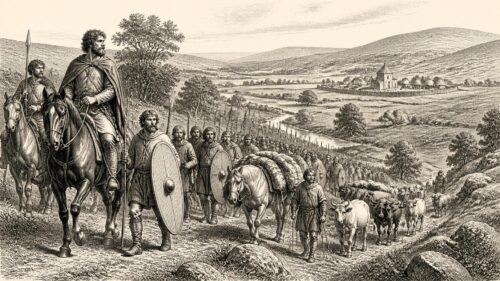
In 1059, Irish annals record widespread warfare, raiding and dynastic upheaval amid a politically fragmented island. Diarmait mac Máel na mBó of Leinster campaigned in Mide and pressured Munster, while his son Murchad killed rival heirs but was defeated by Conchobar Ua Máelshechlainn at Durrow. Northern rulers seized cattle and captives in Airgíalla and Dál Araide. Connacht and neighbouring regions saw multiple killings and deaths among ruling lineages. Obituaries of church leaders underline ecclesiastical power and learning. Despite conflict, rural farming, herding, crafts, trade and Dublin’s Norse-Gaelic economy sustained society, supplying the wealth and resources contested by kings across Ireland.
Dateline
The surviving Irish chronicles present 1059 as a year of raids, dynastic killings and political realignment. Their notices are terse, usually naming a leader, a territory and the human or material cost. They rarely supply a day or month. Moreover, the annals survive in manuscripts compiled or copied long after the events, and their chronological arrangements do not always agree. The Annals of Ulster and Annals of Tigernach provide the strongest contemporary framework, while the later Annals of the Four Masters preserve additional material but occasionally duplicate or relocate events. What can responsibly be reconstructed is therefore not a continuous narrative, but a revealing picture of power being exercised through expeditions, cattle-taking, hostages, personal submission and control of prestigious places.
A Divided Political Order
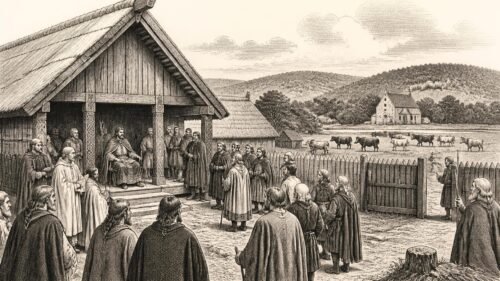
Ireland had no monarch whose commands were universally obeyed. Provincial overkings and ambitious regional rulers competed for tribute and recognition, while numerous lesser kingdoms retained their own dynasties. Titles such as king of Leinster, king of Connacht or heir-designate of Tara expressed claims within a hierarchy rather than authority over a modern territorial state. A ruler’s effective strength depended upon his household, allied kindreds, clients, access to cattle and the willingness of subordinate kings to provide troops and hostages.
The most formidable southern ruler was Diarmait mac Máel na mBó of Uí Chennselaig. From a base in south-eastern Leinster, Diarmait had extended his influence over much of Leinster and the Hiberno-Norse town of Dublin. His son Murchad acted as an energetic lieutenant and is described in the Four Masters under 1059 as lord of the foreigners, meaning the Norse-Gaelic inhabitants of Dublin. Their combined position joined the manpower of Leinster to the ships, merchants and military resources of Ireland’s leading port.
War Between Leinster and Mide
The Annals of Tigernach place a major expedition by Diarmait into Mide in 1059. The campaign was costly: a substantial part of his following was left dead, including Muirchertach, a son or descendant of Dalbach son of Máel Ruanaid. The Four Masters likewise describe a great war between the Leinstermen and the men of Mide, in which many Leinstermen were killed. This was not a border disturbance alone. Mide contained Tara, whose kingship carried exceptional prestige, and was ruled by the Clann Cholmáin branch of the Southern Uí Néill under Conchobar Ua Máelshechlainn.
Murchad, Diarmait’s son, was deeply involved. Congalach Ua Riacáin, described as an heir-designate of Tara, was killed by him. Murchad also killed Gilla Cóemgein son of Gilla Comgaill, an heir-designate of Leinster, together with Máel Mórda, a descendant of Fáelán. Tigernach attributes these deaths to Murchad, while the Four Masters explicitly characterise at least some of them as treacherous. Such language reflects both the violence of succession politics and an annalist’s moral judgement: rivals could be eliminated outside formal battle as readily as upon the field.
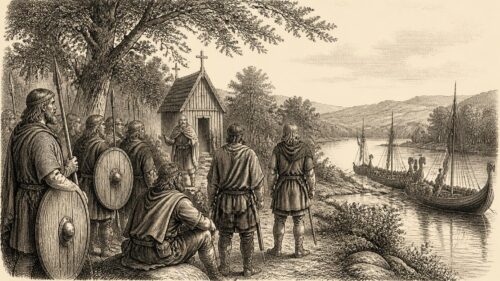
The Four Masters add that Conchobar Ua Máelshechlainn defeated Murchad, styled lord of the foreigners, and that the Leinstermen suffered another reverse at Durrow, the ecclesiastical foundation associated with Colum Cille. The entry credits the victory to divine and saintly intervention. Although its details cannot be checked independently, it shows how warfare, royal rivalry and the honour of major churches were understood as parts of the same moral landscape.
Pressure on Munster
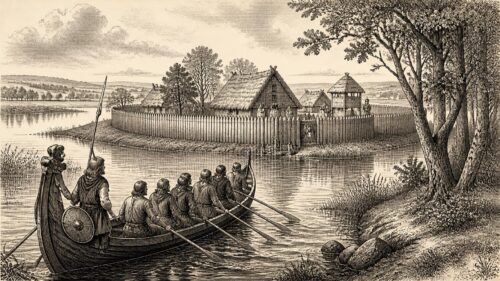
Diarmait also pressed westwards against Munster. Tigernach assigns to 1059 a raiding expedition in which his forces burned Dún Mac nIngair, Óenach Tédi and Dún Furudráin. The exact identification of every place remains uncertain, and the Four Masters place a closely matching notice under an earlier year. The event should therefore be connected cautiously with 1059 rather than treated as precisely dated. Its form is nevertheless credible: destroying a fortified residence and an assembly or fair site attacked both a ruler’s defences and the places through which authority, exchange and public gathering were organised.
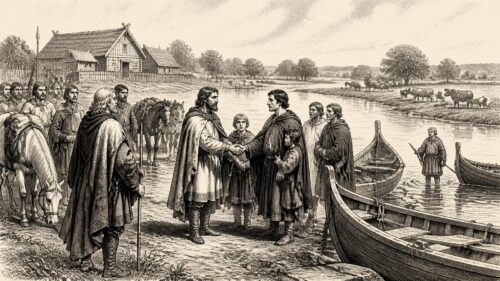
Donnchad son of Brian Bóruma still claimed the kingship of Munster, but his power had been declining. He faced Diarmait’s intervention and the hostility of his nephew Tairdelbach Ua Briain, Diarmait’s foster-son and protégé. Annalistic versions differ over a reported act of submission: the Four Masters say that Brian’s son entered the house of Áed Ua Conchobair, king of Connacht, while Tigernach names Ruaidrí Ua Conchobair. The safest conclusion is that Donnchad was seeking accommodation or protection from Connacht as pressure upon him increased. The exact host and terms cannot be established securely.
Raiding in the North
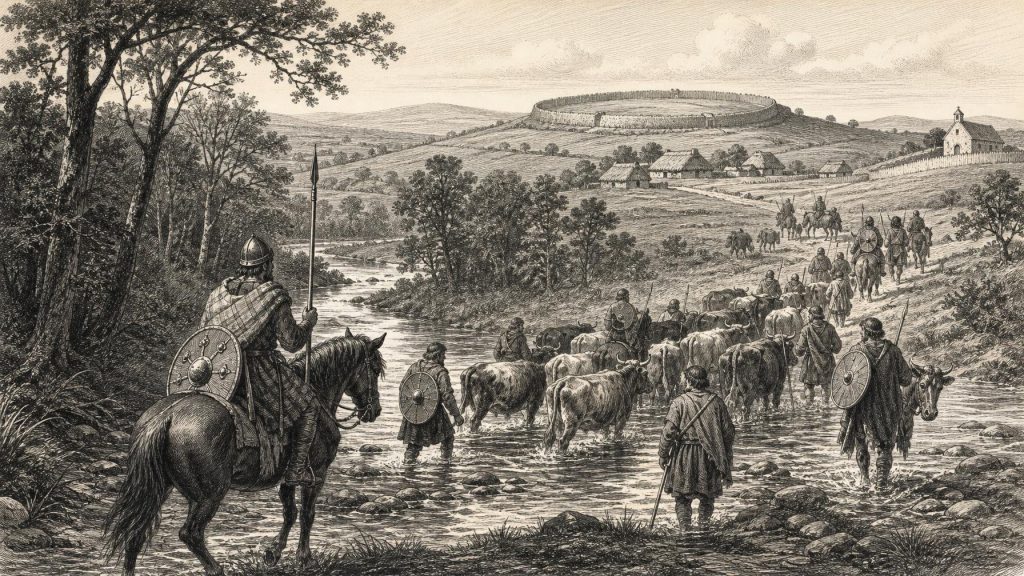
The Annals of Ulster record two large northern raids. Máel Sechlainn Ua Motadáin attacked Airthir, in the eastern part of Airgíalla, took slightly more than 300 cows and killed Gilla Muire son of Airechtach, chief of Clann Sínaigh. Ardgar son of Lochlainn then led Cenél nEógain into Dál Araide. His force carried away a great cattle-prey and killed or captured 200 people. Ardgar was the father of Domnall Ua Lochlainn, who would later become one of Ireland’s strongest kings, but in 1059 the entry principally demonstrates the growing reach of Ardgar’s own northern dynasty.
These expeditions combined economic gain with political intimidation. Cattle could feed warriors, reward followers, replenish a lord’s herds and force the injured community to negotiate. Captives might be ransomed, exchanged, retained as dependants or enslaved. The stated totals probably conveyed the scale and success of an expedition rather than an audited count, yet the annalists clearly considered the seizure of herds and people worthy of permanent record.
Violent Successions in Connacht
Connacht and its neighbouring kingdoms experienced several changes among their ruling families. Áed Ua Dubda, king of Uí Amalgada in the lower Moy region, was killed by his own people. Cathal son of Tigernán, whom different annals describe as ruling Bréifne, eastern Connacht or part of western Connacht, was killed by Áed Ua Ruairc. Duarcán Ua hEgra, king of Luigne, was also killed, while Ruaidrí Ua Gadhra, another claimant among the Luigne, either died or was slain according to the differing records. Tomaltach Ua Máel Brénainn, chief of Síl Muiredaig, died during the year.
The density of these notices reveals that Connacht was not a single compact kingdom governed without challenge. Uí Briúin Aí, Uí Fiachrach, Uí Amalgada, Luigne and Bréifne possessed distinct ruling lineages and local interests. A king might fall to a neighbouring dynasty, a competing branch of his own wider kindred or the people whom he nominally ruled. Succession was restricted to eligible royal families but was not automatically inherited by the eldest son, making brothers, cousins and designated heirs potential rivals.
Churches and Learned Communities
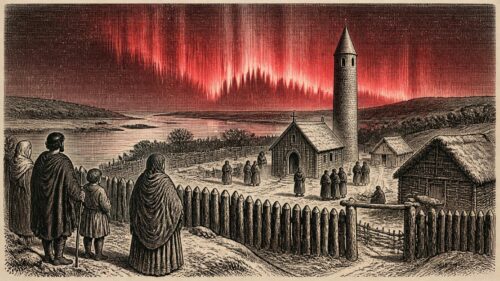
The year’s obituaries preserve another side of Irish society. Domnall son of Eodus, superior of Monasterboice; Eochaid Ua Cinaeda of Trim; Aneslis son of Odar of Lusk; and Conaing Ua Fairchellaig of Druim Lethan all died. Conaing was also remembered as a successor of Máedóc, with authority recognised in Connacht and Leinster. The Four Masters additionally record the deaths of Ua Lorcáin, abbot of Cell Achaid, and the anchorite Domnall Déiseach. Conn na mBocht, praised as the glory and dignity of Clonmacnoise, was said to have died at an advanced age.
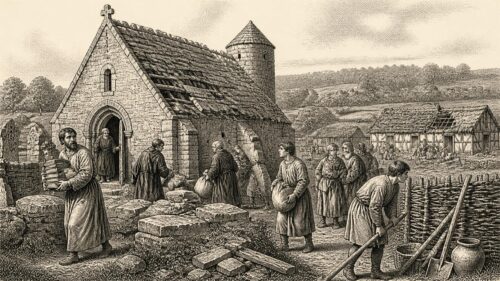
Terms translated as superior, successor or airchinnech could encompass spiritual leadership, guardianship of a founder’s legacy and administration of church lands. Major ecclesiastical settlements were centres of worship, education, hospitality, craft production and estate management. Their leading offices consequently carried political and economic importance. The prominence given to their deaths also reflects the annalists’ own institutional world: learned church communities preserved genealogies, calculated calendars and maintained the records from which later compilations descended.
Work, Wealth and Settlement
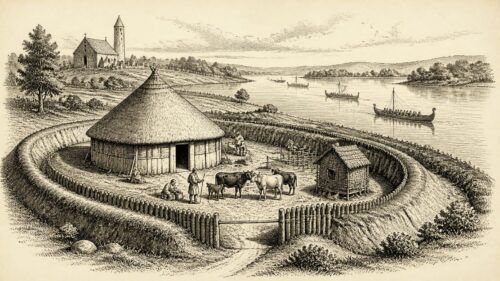
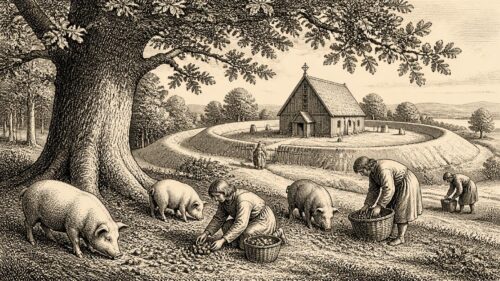
For most inhabitants, 1059 passed not in royal halls but amid farming, herding and household production. Archaeology indicates an overwhelmingly rural population living in ringforts, cashels, crannógs and unenclosed farmsteads. Families cultivated grain, kept cattle, sheep and pigs, processed milk, spun wool and flax, worked wood and repaired iron tools. The Four Masters’ report of “great fruit” throughout Ireland may preserve a memory of an abundant harvest or productive season, but it appears only in that later compilation and cannot be quantified.
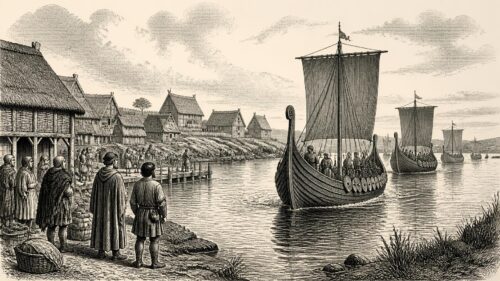
Dublin offered a markedly different setting. Its post-and-wattle houses, workshops, lanes and waterfront supported metalworkers, carpenters, comb-makers, leatherworkers, textile producers, fishers and merchants. Silver pennies had been struck there since around the end of the tenth century, although cattle, services and customary renders remained fundamental to the wider economy. Goods and artistic ideas moved between Dublin, Britain, Scandinavia and continental Europe. Irish and Scandinavian traditions were increasingly intertwined, visible in personal ornaments and in the Ringerike and Urnes-inspired decoration influencing eleventh-century metalwork.
No surviving manuscript, shrine or building can be assigned confidently to this calendar year alone. Nevertheless, the people recorded in 1059 inhabited a culturally active society in which poets, clerics, craftspeople and seaborne traders served competing courts and churches. The year’s violence was real, but it did not halt cultivation, teaching, prayer, manufacture or exchange. Rather, raids and dynastic struggles depended upon that productive world: rulers fought to command its herds, labour, settlements, roads, ports and sacred centres.
Primary Sources
- The Annals of Ulster: Year U1059
- The Annals of Ulster
- Annals of Tigernach: Part 18
- Annals of Tigernach
- The Annals of Tigernach: English Translation
- Annals of the Four Masters, Volume II
- Annals of Inisfallen
- Chronicon Scotorum
- Kronos: Edition Directory of the Irish Annals
- Diarmait (Diarmait mac Maíl (Máel) na Mbó)
- Donnchad
- Ua Briain, Tairdelbach
- Ua Lochlainn (Mac Lochlainn), Domnall
- Donnchad Máel Na Mbó
- Domnall Remur
- Viking
- 950–1450: Vikings, Normans and Medieval Mints
- Early Medieval
- Guide to the National Museum of Ireland – Archaeology
- Early Medieval Ireland, AD 400–1100: The Evidence from Archaeological Excavations
- Western Stone Forts Project
- The Dublin Region in the Middle Ages: Settlement, Land-use and Economy
- Animals and the Economy of Medieval Ireland: A Zooarchaeological Analysis of the Faunal Remains from Caherconnell Cashel, Co. Clare
- Landscapes of Kingship in Early Medieval Ireland, AD 400–1150
- Transformation from Pre-Norman Monasticism to the Introduction of the Religious Orders into Ireland in the Twelfth Century
- The Metrical Dindshenchas