Battle of Sliabh gCrot1058 CE
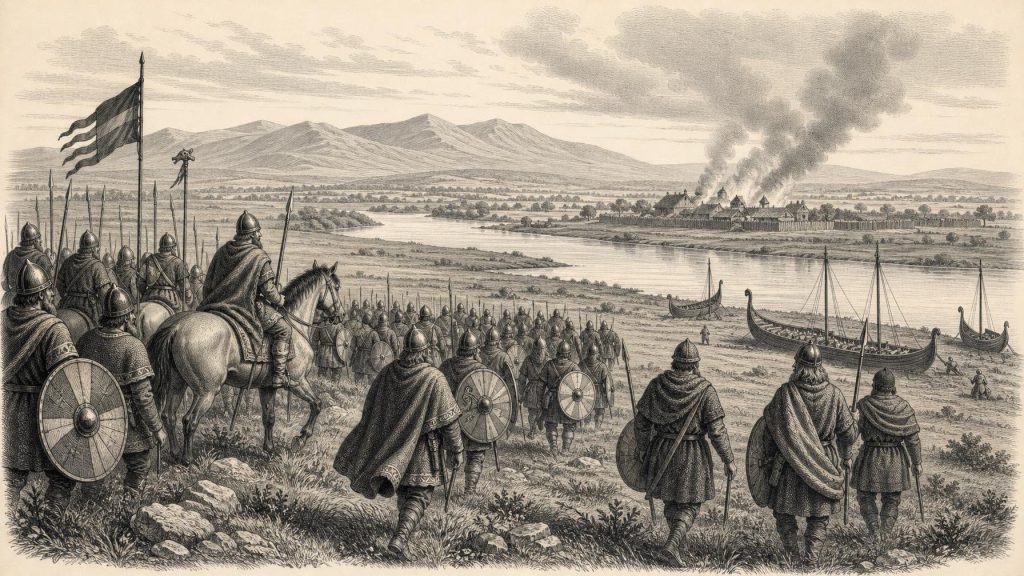
In 1058, Toirdelbach Ua Briain and Diarmait mac Máel na mBó led Leinster, Osraige and Hiberno-Norse forces against Munster’s Donnchad mac Briain. Limerick was burned, perhaps by its defenders, and Diarmait defeated Donnchad at Sliabh gCrot in the Galtees, accelerating his decline. Emly’s church and monastic settlement also burned, while churchmen, regional rulers, poets and ascetics figured in annalistic notices. In Mide, Gallbrat Ua Cerbaill was killed amid dynastic rivalry. Dublin crews joined Magnus Haraldsson’s unsuccessful English expedition, demonstrating Irish Sea connections. The fragmented records portray interconnected warfare, religion, commerce and politics across Ireland and neighbouring lands during the year.
Dateline
The surviving Irish annals make 1058 unusually visible for an eleventh-century year. They record a major campaign in Munster, the burning of Limerick and Emly, a decisive battle in the Galtee region, political killing in Mide, and the participation of Dublin seafarers in an expedition across the Irish Sea. They also preserve notices of church leaders, anchorites, poets and royal women. These terse entries do not provide a continuous narrative, and some disagree over details, but together they reveal an island whose kingdoms were connected by warfare, fosterage, diplomacy, trade and ecclesiastical networks.
A Coalition Against Donnchad
The central event was an invasion of Munster directed against Donnchad mac Briain, son of Brian Bóruma and the long-ruling head of the Dál Cais. Donnchad had inherited only part of his father’s authority after the losses at Clontarf in 1014. By the late 1050s his position was being undermined by external rivals and by his nephew Toirdelbach Ua Briain, whose father, Tadc, had been killed in 1023 at Donnchad’s instigation.
The Annals of Inisfallen give the fullest account. Toirdelbach brought Diarmait mac Máel na mBó, king of Leinster, into Munster with forces from Leinster, Osraige and the “foreigners”, a term normally used here for the Hiberno-Norse troops of towns such as Dublin. Diarmait was already one of Ireland’s most formidable rulers. He controlled Leinster and exercised power over Dublin through his son Murchad, giving him access to ships, experienced warriors and the resources of Ireland’s richest port.
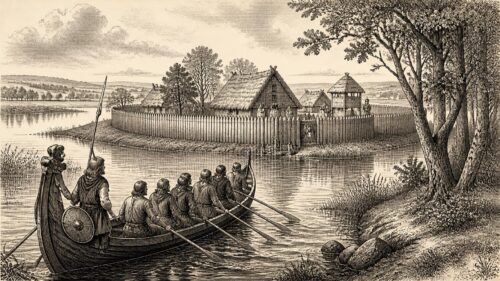
The coalition’s breadth is significant. This was not simply a border raid by one neighbouring kingdom. Toirdelbach supplied an internal claimant from the Uí Briain dynasty; Diarmait contributed the authority and military strength of Leinster; Osraige provided forces from the approaches to Munster; and Hiberno-Norse contingents added men accustomed to campaigning by land and water. Their shared immediate objective was the weakening of Donnchad, although each participant had separate ambitions.
Fire at Limerick
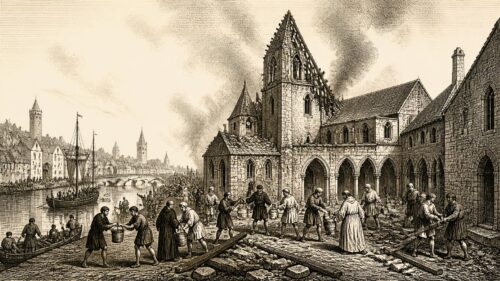
The invaders devastated much of In Machaire, the broad settled plain extending towards Limerick. The Annals of Tigernach state simply that Diarmait’s hosting burned Limerick. The Munster-based Annals of Inisfallen preserve a more complicated and revealing version: the Munstermen themselves burned the town so that the approaching enemy could not burn or occupy it. It was a harsh defensive measure, sacrificing buildings, supplies and commercial assets to deny them to the coalition.
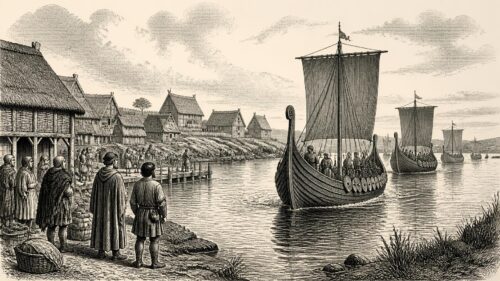
Limerick was much more than a former Scandinavian stronghold. By 1058 its inhabitants belonged to a mixed Hiberno-Norse and Irish world, and the town occupied a strategic position near the Shannon estuary and the heartlands of the Dál Cais. Its landing places connected inland Munster with maritime routes leading to Dublin, Britain, the Isles and continental Europe. Control of Limerick therefore offered revenue, shipping and access to the river system, as well as political prestige.
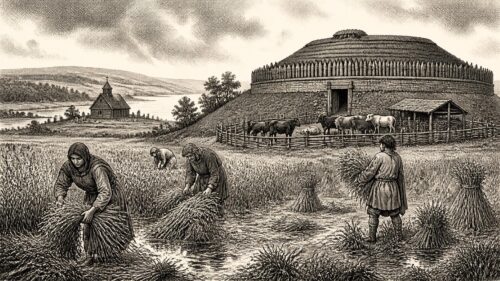
The annals do not describe the experiences of ordinary inhabitants. Nevertheless, burning on this scale must have disrupted households, workshops, storehouses and riverside activity. Townspeople may have attempted to remove portable goods, livestock and tools before the fires spread. The destruction also affected surrounding rural communities, because a town depended upon grain, animals, timber, fish and other produce supplied from its hinterland.
The Battle of Sliabh gCrot
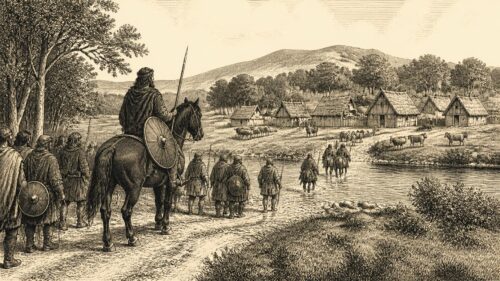
As the coalition withdrew from Limerick, Donnchad caught up with it and battle was joined at Sliabh gCrot, generally identified in the Galtee region of County Tipperary. Diarmait defeated the Munster army. The Annals of Inisfallen suggest that only a few of the invaders were killed, while many Munstermen fell. The result did not immediately depose Donnchad, but it exposed his vulnerability and strengthened both Diarmait and Toirdelbach.
Among the dead was Rígbardán son of Cú Coirne, king of Éile, whose territory lay in the north Tipperary and south Offaly region. Another fallen ruler, named by the Annals of Inisfallen, was Ua Gébennaig, king of the small Déisi territory known as In Déis Bec. Their deaths show that Donnchad’s army was assembled from several regional kingdoms and client peoples rather than from a permanent central force.
Cairpre Ua Lígdai, the erenagh or superior of Emly, was also killed. An erenagh managed the landed and secular interests of an ecclesiastical community and could be a substantial regional lord. Cairpre’s presence on the battlefield illustrates how difficult it is to separate church and politics in this period. Major monasteries controlled land, dependants and wealth; their leading families participated in alliances and could accompany kings on campaign.
The defeat was one stage in a longer struggle rather than a final settlement. Donnchad retained power for several more years, but Toirdelbach now possessed a proven alliance with Diarmait. The events of 1058 established the pattern by which pressure from Leinster and internal Uí Briain opposition would eventually bring Donnchad’s reign to an end.
Emly and the Church
Emly, one of Munster’s foremost ecclesiastical centres and the community associated with St Ailbe, suffered a separate disaster. The Annals of Ulster say that it was completely burned, including its stone church and bell tower. The Annals of Inisfallen specify the stone church and the southern part of the monastic settlement. Whether the fire resulted directly from warfare is not stated, so it should not automatically be attributed to Diarmait’s campaign.
The references to a stone church and bell tower indicate a substantial religious complex. Around it would have stood timber buildings used for residence, hospitality, storage, teaching and craft production. The loss of structures, books, vestments or stored food is not itemised, but any major fire threatened the economic as well as the devotional life of a community. Emly’s difficulties were compounded by the death of Cairpre Ua Lígdai in battle and the recorded death of the learned senior Máel Ísu Ua Flainn Chua.
Other obituaries reveal the variety of Irish religious life. Colmán Ua hAirechtaigh, successor of Comgall at Bangor, died, as did Máelfinnen Ua Guaire, an anchorite of Devenish. Anmchad Ua Dúnchada, described as an anchorite of God, died on Inis Uasal. Such notices distinguish office-holders from ascetics who pursued lives of withdrawal, prayer and discipline while remaining connected to major communities.
At Ardfert, a centre associated with St Brendan, the annals place the deaths of two notable people. Ben Muman, daughter of a son of Congal and styled queen of western Ireland, died there. Flaithem son of Máel Gaimrid, called chief poet of Ireland, also died at Ardfert. His obituary is evidence for the high standing of professional learning and poetry. Poets preserved genealogy, praise, political memory and claims to legitimacy, and the greatest among them moved within the same elite world as kings and senior clergy.
Violence and Surety in Mide
In Mide, Gallbrat Ua Cerbaill, described as an heir-designate of Tara, was killed by Conchobar Ua Máelshechlainn. The Annals of Ulster merely record Gallbrat’s death, whereas the Annals of Tigernach and the Four Masters attribute it to treachery. The title “heir-designate of Tara” expressed elevated dynastic status, but it did not mean that Gallbrat was certain to become high-king. Irish succession remained competitive, with several eligible men often seeking support.
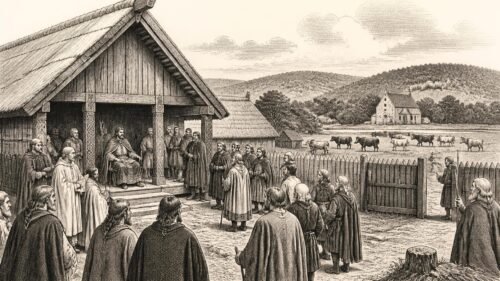
The Four Masters add that Diarmait mac Máel na mBó received the Sword of Carlus and other treasures because Gallbrat had been under his protection or surety. The precise transaction is obscure, but the notice is important. Prestigious weapons and valuables could embody lordship, compensation and political obligation. Diarmait’s role as guarantor also shows that his influence reached beyond Leinster into the disputes of Mide.
The same compilation records the plundering of a shrine of Colum Cille by men of Tethba and Cairbre, followed by retaliation from the men of Mide. Relic shrines were devotional objects, containers of sacred power and symbols of institutional rights. An attack upon one could therefore provoke both religious condemnation and armed vengeance.
Dublin and the Irish Sea
Ireland’s connections beyond the island appeared dramatically in a fleet led by Magnus, son of Harald Hardrada, king of Norway. The Annals of Tigernach say that it included forces from Orkney, the Hebrides and Dublin and sailed to take the kingdom of England, although the attempt failed in that larger aim. English evidence associates the fleet with the exiled Earl Ælfgar and his Welsh ally Gruffudd ap Llywelyn.
Dublin’s participation demonstrates that the town remained part of an active Norse-Gaelic maritime world. Its crews could serve Irish rulers, Scandinavian princes or British allies according to political advantage. It is possible that Diarmait permitted or encouraged their involvement, since he dominated Dublin, but the surviving record does not prove his personal direction of the expedition.
Archaeology supplies the broader setting that annals omit. Eleventh-century Dublin contained timber houses, workshops, lanes and property boundaries. Its craftspeople worked wood, iron, antler, amber, textiles and precious metals. Silver, coins, weights and imported objects attest exchange with Britain, Scandinavia and continental Europe. Rural Ireland remained overwhelmingly agricultural, with cattle central to wealth and status, yet ports such as Dublin and Limerick linked that livestock-based economy to far wider markets.
A Year Preserved in Fragments
Irish chroniclers also recorded the death of Lulach, king of Alba, at the hands of Máel Coluim, reflecting the close attention paid to the wider Gaelic world. Some annals place Macbeth’s death in 1058 as well, although stronger Scottish and English chronology assigns it to 15 August 1057. This discrepancy is a reminder that annalistic year headings cannot always be treated as exact modern dating.
Even with such cautions, the outline of 1058 is clear. The year accelerated Donnchad mac Briain’s decline, advertised Diarmait mac Máel na mBó’s expanding reach and advanced Toirdelbach Ua Briain’s ambitions. Fire struck both an urban centre and a major monastery; churchmen stood beside kings in war; poets and ascetics remained honoured figures; and Dublin ships moved through an Irish Sea arena in which Irish, Norse, Scottish, Welsh and English affairs were inseparable.
Primary Sources
- The Annals of Ulster: Year U1058
- The Annals of Ulster: Irish Text, Year U1058
- Annals of Inisfallen: Annal AI1058
- The Annals of Tigernach
- Annals of the Four Masters: Part 16
- Annals of the Four Masters: Irish Text, Part 16
- Chronicon Scotorum
- CELT Project: Annals of Tigernach
- CELT Project: Annals of Inisfallen
- The Annals of Ulster
- Kronos: Edition Directory of the Irish Annals
- Irish Script on Screen
- Diarmait Mac Maíl na mBó
- Donnchad, Son of Brian
- Ua Briain, Tairdelbach (1009–86)
- Ua Máelshechlainn, Conchobar
- Kingship, Society, and Sacrality: Rank, Power, and Ideology in Early Medieval Ireland
- Medieval Ireland: Territorial, Political and Economic Divisions
- Viking Collections
- Viking Videos
- Animals and the Economy of Medieval Ireland
- Earl Thorfinn of Orkney and the Forgotten Battle of 1058
- Go West: Contextualizing Scandinavian Royal Naval Expeditions into the Insular World, 1013–1103
- Macbeth (r. 1040–1057)
- Ardfert Cathedral
- Caithreim Cellachain Caisil: The Victorious Career of Cellachan of Cashel