Kingship Under Pressure1063 CE
In 1063, Tairdelbach Ua Briain, backed by his foster-father Diarmait of Leinster and Dublin, secured recognised kingship in Munster, although Donnchad mac Briain remained until 1064. Ardgar mac Lochlainn’s military progress through Connacht compelled regional rulers to acknowledge his temporary superiority, while an assault on a refuge at Cera caused heavy loss of life. Deaths among kings and churchmen altered local politics. Pilgrimage and ecclesiastical centres retained political importance. Later annals report sickness and scarcity, cautiously interpreted. Warfare, billeting, hostage-taking and raids, including Limerick’s burning, burdened rural communities, revealing Ireland’s fragmented, coercive kingship and interconnected trade, church and rural life.
Dateline
The year 1063 stands out as a moment when several regional struggles reached a decisive stage. In Munster, Tairdelbach Ua Briain emerged as king with the support of Diarmait mac Maíl na mBó of Leinster, gravely weakening the long rule of Donnchad mac Briain. In Connacht, Ardgar mac Lochlainn demonstrated northern power through an imposing military progress, while a separate conflict at a cave in Cera ended in mass death. The year also brought the loss of prominent kings and churchmen, reports of sickness and scarcity, and further evidence of the close relationship between warfare, cattle, hospitality, pilgrimage and ecclesiastical authority.
The surviving chronicles do not provide a complete diary of Ireland. The Annals of Ulster and Annals of Loch Cé are strongest for northern and Connacht affairs, while the Munster-centred Annals of Inisfallen preserve the crucial statement that Tairdelbach took the kingship of Munster. The much later Annals of the Four Masters offer additional detail, but their unique claims must be treated more cautiously. Firmly recorded events can therefore be distinguished from broader conditions reconstructed from archaeology and the history of the surrounding decades.
A New King in Munster
The most consequential political development was the rise of Tairdelbach Ua Briain. A grandson of Brian Bóruma, he was the son of Tadc, who had been killed in 1023 at the instigation of Brian’s ruling son, Donnchad. Tairdelbach consequently had both a dynastic claim and a powerful personal reason to oppose his uncle. His chief patron was Diarmait mac Maíl na mBó, king of Leinster and ruler of Dublin, who was also his foster-father.
The alliance had been attacking Donnchad’s authority for years. Diarmait could bring the resources of Uí Chennselaig Leinster and the Hiberno-Norse towns into the contest, while Tairdelbach supplied a credible alternative within the Dál Cais dynasty. The Annals of Inisfallen record attacks by the allies in 1062 and then state simply that Tairdelbach took the kingship of Munster in 1063. That concise notice is the strongest evidence for a formal change in royal standing during the year.
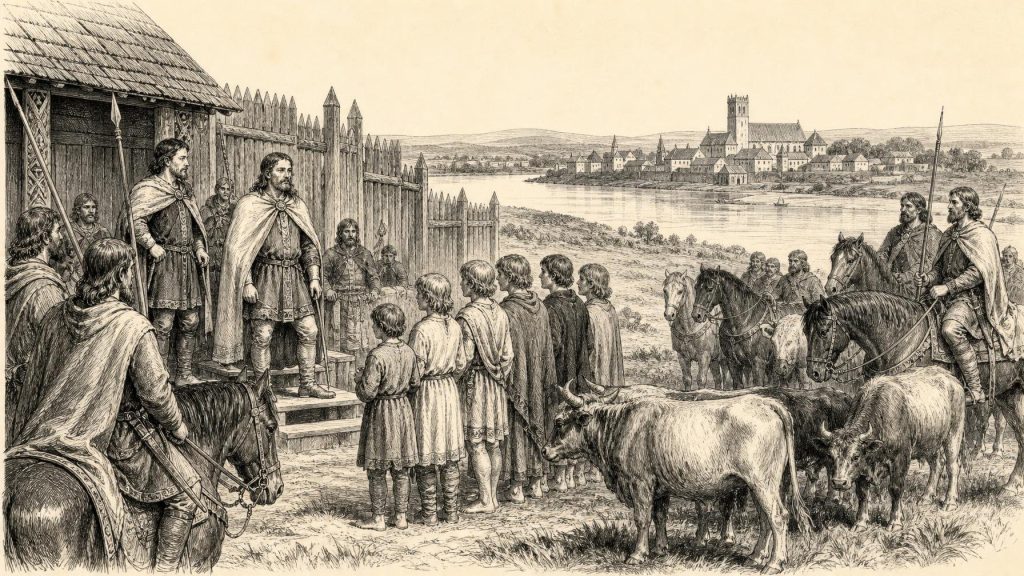
The Four Masters give a more elaborate account. They place the burning of Limerick by Tairdelbach and Diarmait in 1063, followed by a major Leinster expedition into Munster. According to this version, rulers from the Munster plain entered Diarmait’s house and surrendered hostages. Donnchad and his son Murchad of the Short Shield then attacked Tairdelbach after Diarmait’s withdrawal, but Tairdelbach defeated Murchad and killed many of his followers. Diarmait returned and obtained hostages from a broad stretch of Munster, handing them to his foster-son.
Hostages were not merely prisoners. Their surrender publicly acknowledged submission and helped guarantee future obedience. Even so, Tairdelbach’s accession did not instantly remove Donnchad. The older king’s deposition, pilgrimage to Rome and death are placed in 1064 by the Annals of Ulster and Annals of Inisfallen. It is therefore safest to see 1063 as the year in which Tairdelbach established a recognised kingship, while Donnchad’s final departure belongs to the following year.
Power Displayed in Connacht
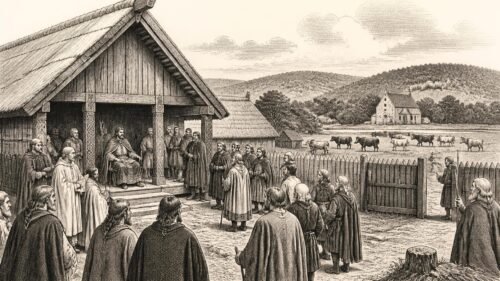
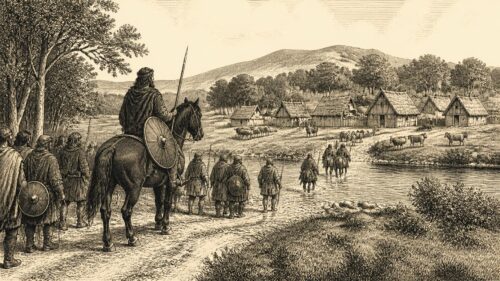
Another great hosting entered Connacht under Ardgar mac Lochlainn, king of Ailech and a leading ruler of Cenél nEógain. The annals say that he imposed an extensive billeting from Glenn Suilidhe in the north-west through western Luigne to the River Moy in Uí Amalgada. The kings of Connacht came into his house, including Áed in Gaí Bernaig Ua Conchobair, Áed Ua Ruairc and a son of Art Ua Ruairc.
Billeting required communities to maintain a king and his travelling army with food, fodder and lodging. It was a heavy economic demand and a political demonstration: the host could live from the resources of the country through which it passed. The attendance of Connacht’s competing dynasts suggests a compelled recognition of Ardgar’s superiority, at least for the duration of the expedition. It does not prove that he permanently conquered Connacht. Áed Ua Conchobair remained provincial king, while the Ua Ruairc presence reflected the continuing strength of Bréifne and the divided nature of Connacht politics.
Death in the Cave
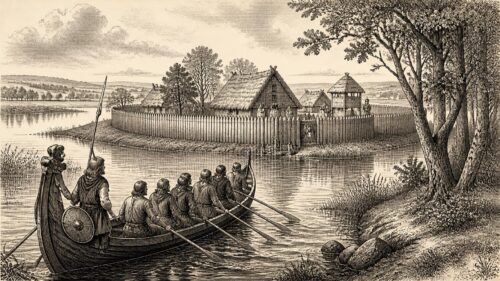
A grim event occurred at the cave of Aill in Cera, a territory broadly associated with the later barony of Carra in County Mayo. The Annals of Ulster and Loch Cé report that the Connachta captured the cave from followers of Áed Ua Conchobair and that 160 people were suffocated inside. This may have been a natural cave, souterrain or fortified refuge used by a threatened group and its valuables.
The Four Masters preserve a conflicting version in which the Conmaicne attacked, demolished the refuge and carried away 160 people and the “jewels of Connacht”. The identity of the attackers and the exact fate of those inside are therefore uncertain. What can responsibly be said is that a refuge in Cera was stormed during an internal Connacht struggle, with exceptionally heavy loss. The episode shows that resistance to Áed’s authority continued even while he was dealing with Ardgar’s intervention.
Kings Lost
Several regional rulers died or were killed. Cathal Ua Donnchada, overking of Uí Echach Muman and king of Raithlinn in southern Munster, was slain. The Four Masters add that his own son, called Finnshúilech, killed him, but the earlier annals do not preserve that detail. His death mattered because the Éoganacht of Raithlinn remained an important power in south-west Munster at the very moment when Tairdelbach was attempting to consolidate the province.
Cú Duilig Ua Taidc, king of Fir Lí in the north, also died or was killed. Máel Sechlainn Ua Motodáin, heir-designate of Ailech, was killed by Cenél Conaill, evidence that Ardgar’s authority did not end rivalry among the northern Uí Néill. In Ulaid, Niall son of Eochaid, the Dál Fiatach overking, died on 13 November. The unusually precise annalistic notice names the day as a Thursday and records the lunar age. His death removed an established ruler from a kingdom already exposed to pressure from Cenél nEógain and neighbouring dynasties.
Pilgrims and Churchmen
Armagh appears prominently in the year’s religious record. Gormlaith, daughter of Cathal son of Ruaidrí, died there while on pilgrimage. Her presence illustrates how Irish pilgrimage could involve travel to a great domestic shrine as well as journeys overseas. Armagh’s association with Patrick made it a place where aristocrats might seek prayer, penance, burial or spiritual protection.
Motodán Ua Celecáin, prior of Armagh, also died. Elsewhere, Cinaed son of Aicher, head of Lismore associated with St Mochutu, and Eochaid Ua Dalláin, head of Connor, were commemorated. The Four Masters additionally name lectors connected with Clonmacnoise and Kildare. Although some of these notices are absent from earlier chronicles, together they reflect the importance attached to teachers, readers and administrators within major ecclesiastical communities.
These centres were not isolated collections of monks. They contained churches, workshops, farms and substantial lay populations, and they interacted constantly with ruling families. Kings sought their prayers and prestige, but could also tax, billet or plunder their lands. Churchmen preserved Latin learning and written Irish traditions, trained students and maintained the chronological records from which much of the political history of 1063 is known.
Scarcity and Everyday Life
The Four Masters alone report that “colic and lumps” prevailed first in Leinster and then across Ireland. The expression is too imprecise for a modern medical diagnosis, and the scale of the outbreak cannot be established. The same source records a shortage of cattle fodder, corn and foods eaten with bread. These notices should be treated as evidence of remembered distress rather than proof of a uniformly nationwide epidemic or famine.
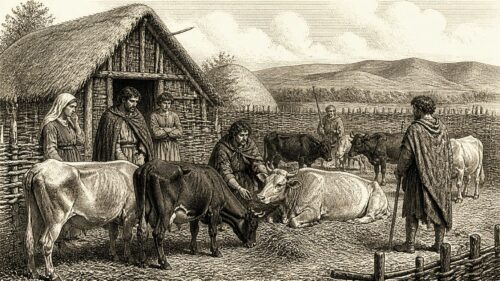
Any failure of grain and winter fodder would have been serious. Most people lived in dispersed rural households, cultivating cereals, keeping cattle, sheep and pigs, and producing much of what they consumed. Cattle were food resources, stores of wealth and units in tribute, compensation and royal exactions. Warfare magnified shortages because armies seized animals, burned grain, destroyed buildings and required communities to feed men and horses. Ardgar’s billeting and the taking of Munster hostages belonged to a political system ultimately supported by rural labour and agricultural surplus.
Towns, Trade and Culture
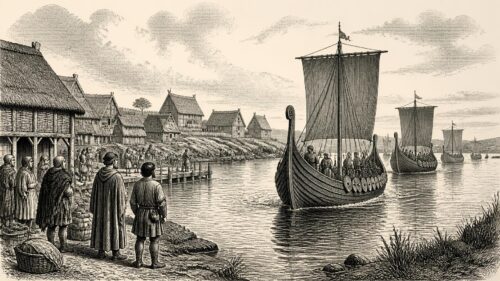
Dublin, Waterford, Wexford, Cork and Limerick connected Ireland with Britain and continental Europe. By 1063 Dublin lay under Diarmait mac Maíl na mBó’s political dominance, with his son Murchad exercising authority there. Its craftsmen worked in wood, bone, antler and precious metals, while merchants handled silver, textiles, pottery and other imported goods. Silver pennies had been struck in Dublin since the reign of Sitric Silkbeard, although barter, weighed silver and payments in livestock remained important.
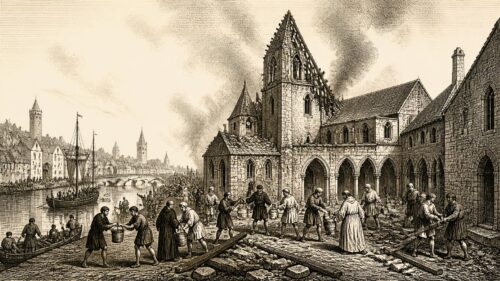
Limerick’s reported burning was therefore more than a symbolic blow. Its position on the Shannon linked the Atlantic approaches, the lower river and the territories of north Munster. The annal does not establish that every building was destroyed or that urban life ceased; medieval notices of burning often describe severe raiding rather than permanent abandonment. The attack nevertheless underlined Tairdelbach’s challenge to Donnchad in one of Munster’s most valuable strategic centres.
No surviving manuscript or metalwork masterpiece can be assigned securely to the calendar year itself. Yet 1063 belonged to a period of vigorous Irish learning and artistic production. Ecclesiastical scriptoria continued to copy religious, legal and historical texts, while Irish and Scandinavian styles merged in metalwork. The same society that experienced local warfare and food insecurity could sustain skilled lectors, poets, metalworkers, merchants and long-distance pilgrims.
A Decisive Transition
The year did not create a unified Ireland. Instead, it exposed a political order built from overlapping kingships, personal alliances, fosterage, hostages and military coercion. Tairdelbach’s recognised accession in Munster was its most lasting development, achieved through Diarmait’s intervention rather than uncontested provincial consent. Ardgar’s progress showed that northern rulers could impose themselves deep in Connacht, while the cave disaster revealed violence within the province itself. Amid these struggles, churches remained centres of memory and pilgrimage, and ordinary communities carried the material burden of kingship.
Primary Sources
- The Annals of Ulster
- Annals of Inisfallen
- Annals of the Four Masters, Volume 2
- Annals of Loch Cé
- Annals of Tigernach
- Chronicon Scotorum
- Exploring the Irish Annals
- Diarmait (Diarmait mac Maíl na mBó)
- Ua Briain, Tairdelbach (1009–86)
- Donnchad
- Ua Lochlainn (Mac Lochlainn), Domnall
- Ua Ruairc, Áed
- Mac Duinnsléibe, Ruaidrí
- Viking Collections
- 950–1450: Vikings, Normans and Medieval Mints
- Early Medieval Collections
- Guide to the National Museum of Ireland
- Irish School of Illumination, c. 650–1100
- High Crosses
- Medieval Ireland: Territorial, Political and Economic Divisions
- Theme and Variations: Christianity and Regional Landscapes in Early Medieval Ireland
- Animals and the Economy of Medieval Ireland
- Loch Ceara/Lough Carra
- Irish Texts at CELT