
Connacht Under Pressure1062 CE
In 1062, Ireland remained divided among competing dynasties. In Connacht, Áed Ua Conchobair defeated western rivals but lost his son in retaliatory violence, before Ardgar Mac Lochlainn raided the province for cattle and captives. Killings destabilised successions in Mughdorna, Fernmag and Ulaid. In Munster, campaigns by Diarmait of Leinster and Toirdelbach Ua Briain further undermined Donnchad mac Briain. Deaths of leading Columban and northern churchmen marked ecclesiastical change. Annalistic dating varies, particularly for Connacht events. Warfare damaged households through livestock seizures, captivity, destruction and disrupted farming, while urban trade and church networks linked Ireland to Britain, Alba and maritime worlds.
Dateline
The surviving Irish annals present 1062 as a year of fractured authority rather than island-wide transformation. Connacht endured dynastic warfare followed by a major northern raid; prominent churchmen died; and lesser kingdoms in Ulster and Airgíalla experienced lethal succession disputes. In the south, the long struggle for Munster continued to weaken Donnchad mac Briain and strengthen the alliance between Diarmait mac Máel na mBó of Leinster and Toirdelbach Ua Briain. No single king controlled Ireland. Power rested upon overlapping claims, personal followings, hostages, tribute and the ability to carry an army into another ruler’s territory.
Dating a Difficult Year
Although 1062 lies within the relatively well-recorded eleventh century, its chronology is not perfectly straightforward. The Annals of Ulster, Annals of Tigernach, Annals of Inisfallen, Annals of Loch Cé and later Annals of the Four Masters sometimes place connected events under different years. Their entries descended from distinct chronicle traditions, and omissions or adjustments in their calendrical frameworks could shift an event by a year.
This is especially important in Connacht. The Annals of Ulster place the killing of Ruaidrí Ua Flaithbertaig, king of western Connacht, under 1062, while several other chronicles assign it to 1061. It is safest, therefore, to understand the fighting recorded in 1062 as part of a campaign extending across the turn of the year, rather than to claim an exact day or month that the sources do not securely provide.
War Within Connacht
The dominant Connacht ruler was Áed in Gaí Bernaig Ua Conchobair, whose epithet is usually translated as ‘of the gapped spear’. He belonged to Síl Muiredaig, the expanding royal line from which the later O’Connor kings emerged. His authority, however, was contested by regional dynasties, particularly the Uí Flaithbertaig and their associates in western Connacht.
Ruaidrí Ua Flaithbertaig had briefly displaced Áed in the west before being defeated and killed. The conflict did not end with Ruaidrí’s death. The Four Masters record a further victory by Áed over a son of Ruaidrí, with eighty members of Clann Choscraig reportedly slain. Annalistic casualty figures should not be treated as precise battlefield returns, but the entry conveys the chronicler’s impression of a substantial defeat.
Revenge followed. Tadc, a son of Áed Ua Conchobair, was killed treacherously by the son of Áed son of Ruaidrí, acting with the people of western Connacht or Clann Choscraig. The wording varies between chronicles, but the essentials are well supported: Áed’s family suffered a serious personal loss at the hands of the western coalition. This was not simply rebellion by an anonymous district. It was a struggle between identifiable dynastic networks, sustained by kinship, local loyalties and the obligation to avenge defeated relatives.
Áed remained the leading king of Connacht, but the year exposed the limits of provincial kingship. Victory in battle did not guarantee obedience, and killing one regional king could create new claimants bound by honour and family interest to continue the war.
Ardgar’s Great Raid
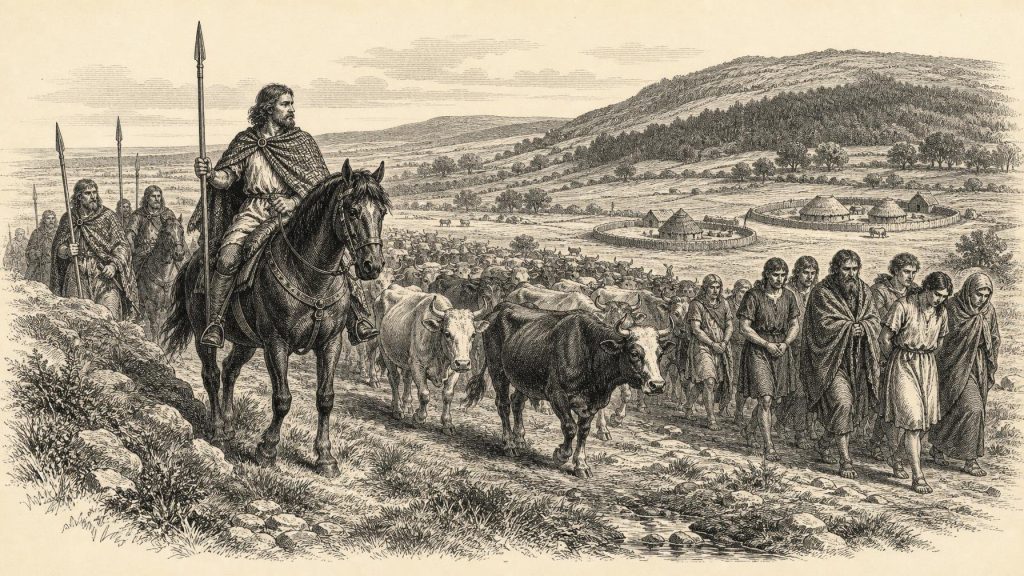
Connacht’s internal divisions invited intervention. Ardgar Mac Lochlainn, king of Ailech and a member of the northern Uí Néill dynasty of Cenél nÉogain, led a predatory expedition into the province. The Annals of Ulster, Loch Cé and the Four Masters say that his force carried away six thousand cattle and one thousand people.
Those numbers may be conventional or magnified, but the reported combination of livestock and captives reveals the raid’s purpose. Cattle represented food, dairy production, movable wealth, social standing and the means to reward followers. Captured people could be held for ransom, redistributed as dependants or reduced to servitude; some captives taken in Irish warfare also entered trading networks connected with the Irish Sea.
Ardgar’s expedition was therefore both economic and political. By penetrating Connacht and returning with a celebrated spoil, he demonstrated military reach, enriched his following and diminished Áed’s claim to protect the province. His later career was short—he died in 1064—but the raid anticipated the greater ambitions of his son Domnall Ua Lochlainn, who would become one of the most powerful Irish rulers of the early twelfth century.
Deaths and Rivalries in the North
Other northern entries show similarly unstable successions. Donn Cuan Ua Machainéin was killed by Gilla Ciaráin Ua Machainéin, king of Mughdorna. The sources provide too little information to reconstruct the quarrel, but the shared family name suggests violence within or between branches of the local ruling kindred. Mughdorna then lay within the politically fragmented borderlands associated with Airgíalla.
Ruaidrí son of Cú Chairrge, designated heir of Fernmag, was killed by a son of Niall Ua Ruairc. Fernmag, remembered in the modern barony name Farney in County Monaghan, was another Airgíallan kingdom. The killing of an acknowledged royal heir could redirect a succession, weaken alliances and provoke retaliation long after the immediate event.
The chronicles also record the death of Eochaid son of Niall son of Eochaid, described in the Annals of Ulster as heir designate of Ulaid and in another tradition as its king. A related Niall and Eochaid are treated differently by the Four Masters, which attach an exact September date to their deaths. Because the accounts are not fully reconcilable, it is more responsible to note that the ruling house of Ulaid suffered an important loss around this year than to impose a single confident reconstruction.
The Southern Struggle
Munster remained under severe pressure. Donnchad mac Briain, a son of Brian Bóruma, still held its principal kingship, but his authority had been eroded by repeated attacks and by opposition within the Dál Cais. His nephew Toirdelbach Ua Briain had allied himself with Diarmait mac Máel na mBó, the formidable king of Leinster who also controlled Dublin through his son Murchad.
Scholarly reconstruction places another plundering of Munster by Diarmait and Toirdelbach in 1062, overcoming resistance from Donnchad’s family. The Four Masters also associate the year with a Leinster incursion and destruction in the Limerick region, although other annalistic traditions place the burning of Limerick in the following year. The secure conclusion is that the campaign of 1062 formed part of the decisive pressure that soon drove Donnchad from power. By 1064 he had departed on pilgrimage to Rome, leaving Toirdelbach to dominate Munster under Diarmait’s patronage.
Church Leadership and Learning
Among the year’s most significant deaths was Gilla Críst Ua Máel Doraid, successor or coarb of Colum Cille ‘in Ireland and Alba’. This title did not mean that he was merely the resident abbot of one isolated monastery. He stood at the head of a Columban federation whose churches and cult connections extended through Ireland and western Scotland. Its principal Irish centres included Kells and Derry, while Iona retained immense spiritual and historical importance.
His obituary demonstrates that Irish ecclesiastical institutions could cross political and maritime frontiers. The Irish Sea and North Channel were not simply barriers: clerics, pilgrims, books, relics, merchants and aristocratic families moved through a connected world embracing Ireland, Alba, the Isles and Britain.
Máel Ruanaid Ua Daigre, described as the chief confessor or spiritual adviser of northern Ireland, also died. The Four Masters add Murchad Ua Laidgnen, erenagh of Ferns. An erenagh managed hereditary church lands and their obligations, occupying a position in which ecclesiastical, economic and local political interests met. Ferns was especially important because of its association with St Máedóc and the ruling Uí Chennselaig dynasty of Leinster.
The annals preserve no securely dated literary composition for 1062, but their obituaries reveal the infrastructure that sustained learning. Churches maintained clergy, scholars, estate managers, relics and manuscript traditions. The very survival of notices from this year depended upon generations of monastic record-keeping, copying and comparison.
Life Behind the Annals
Ordinary households appear only indirectly in accounts written chiefly about rulers and churchmen. Archaeology supplies the broader setting. Most people lived in dispersed farmsteads, many enclosed by earthen ringforts, while crannógs and ecclesiastical settlements remained important in some regions. Families herded cattle, sheep and pigs and cultivated cereals, especially oats and barley. Cattle dominated measures of wealth, but arable production was also essential; the destruction of stored grain or standing crops could be as damaging as the seizure of livestock.
Dublin, Waterford, Wexford, Cork and Limerick provided a contrasting urban and maritime environment. Dublin was the island’s leading commercial centre and was firmly within Diarmait mac Máel na mBó’s political sphere. Craftspeople worked in wood, leather, bone and metal, while merchants linked Ireland with Britain, Scandinavia and continental Europe. Silver pennies had been struck in Dublin since the reign of Sitriuc Silkbeard around the end of the tenth century, although coin remained far less important in much of rural Ireland than livestock, tribute, gifts and services.
For communities in the path of Ardgar’s raid or the Connacht wars, the consequences were immediate: lost animals, displaced families, captives, burned buildings and disrupted harvest work. The year’s political history cannot be separated from these costs. A king’s prestigious cattle spoil represented another household’s winter security.
A Year Without Settlement
No conflict recorded in 1062 produced a lasting peace. Áed Ua Conchobair survived the western challenge but lost a son and failed to prevent Ardgar’s invasion. Northern kingdoms continued to eliminate heirs and rivals. In Munster, Donnchad’s authority moved closer to collapse, while Diarmait and Toirdelbach enlarged their influence. The year’s importance lies in this accumulation of pressure: provincial kings were becoming more ambitious, yet their power still depended upon repeated campaigning, negotiated submission and the fragile loyalty of competing dynasties.
Primary Sources
- The Annals of Ulster: Year 1062
- Annals of the Four Masters: 1059–1071
- The Annals of Tigernach
- Chronicon Scotorum: Annals 1060–1064
- Annals of Loch Cé, Part 3
- Annals of Inisfallen: Annals 1059–1061
- CELT Document Details: Annals of Inisfallen
- Diarmait (Diarmait mac Maíl na mBó)
- Donnchad
- Ua Conchobair, Ruaidrí na Saide Buide
- Ua Lochlainn (Mac Lochlainn), Domnall
- Ua Ruairc, Áed
- The Archaeology of Early Medieval Ireland, c.400–1169: Settlement and Economy
- Landscapes of Kingship in Early Medieval Ireland, AD 400–1150
- The Economy of Early Medieval Ireland
- The Archaeology of Livestock and Cereal Production in Early Medieval Ireland, AD 400–1100
- Agriculture, Settlement and Society in Early Medieval Ireland
- The Zooarchaeology of Medieval Ireland
- 950–1450: Vikings, Normans and Medieval Mints
- Viking Ireland
- The Slave Trade of Dublin, IXth to XIIIth Century
- Regnal Succession in Early Medieval Ireland
- The Chronology and Sources of the Early Irish Annals
- Iona and the Shrine of Columba, c. 800–1200