Institutional Children(c.1930s)
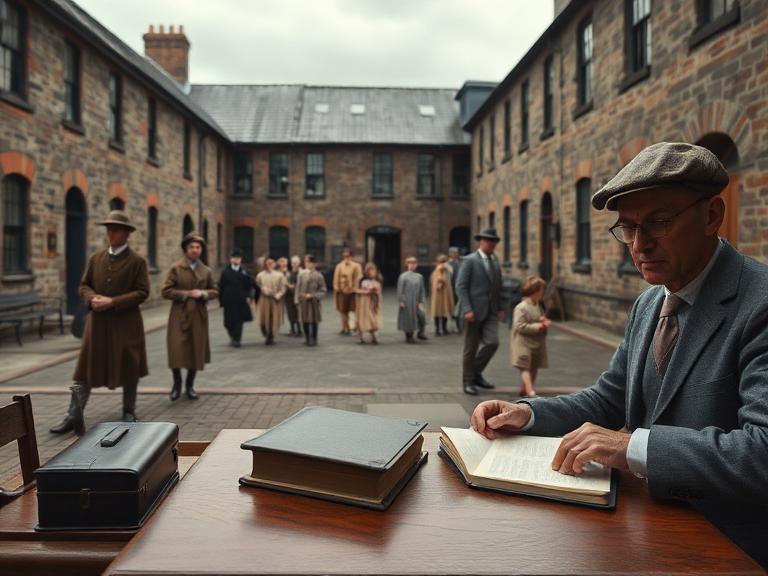
Limerick children sent to industrial schools and reformatories appear within Corporation financial records because the Borough Council was responsible for maintenance payments. Presentment applications could record the child’s name, school register number, place and court of sentence, maintenance dates and total number of days supported. These details connect individual children with Limerick’s courts, rates and administrative decisions. They also show how a local judgement could create a continuing financial relationship with an institution elsewhere in Ireland. Although written as accounts, the files preserve important traces of young people whose personal experiences might otherwise remain difficult to recover from surviving records.
The files name several Limerick institutions, including Saint George’s Industrial School, Saint Joseph’s Boys Industrial School, Saint Vincent’s Industrial School and Saint Joseph’s Reformatory School. They also contain applications from establishments in Cork, Dublin, Galway, Kerry, Kilkenny, Louth, Offaly, Tipperary and other counties. From 1931 onward, applications from Saint Joseph’s Industrial School at Glin appear. This geographical spread demonstrates that children connected with Limerick could be maintained far from their families and communities. Municipal responsibility followed them through recurring claims for payment, linking the Corporation to a national network of residential institutions across Ireland during this period across several decades.
Maintenance applications converted each period of confinement into a calculated liability for Limerick Borough Council. Schools stated when payment should begin and end, how many days were involved and which child the claim concerned. Register numbers connected applications with institutional records, while sentencing details linked them to legal proceedings. These elements can help researchers compare Corporation files with court registers, school archives and other surviving sources. Yet the financial language remains limited. It records duration and cost more readily than family circumstances, treatment or personal testimony. The evidence must therefore be handled carefully, recognising both its value and its silences.
Funding for institutional maintenance came through the General Purposes Rate alongside expenditure on hospitals, roads, bridges, courts, policing, inquests and compensation claims. Children’s maintenance fees therefore appeared within a broad schedule of statutory civic responsibilities. Printed Presentment Schedules and supporting applications allowed officials to verify claims before authorising payment. The routine format can make institutionalisation appear administratively ordinary: a child became a name, registration number, period and charge. Historians must look beyond that structure to consider the separation and discipline represented by the entries. The accounts document a financial process, but they point toward consequences experienced by children and families.
For family historians, these records may establish a direct connection between a named child, a Limerick court and a particular industrial school or reformatory. For social historians, they demonstrate how local taxation helped sustain institutional systems through maintenance payments. The files do not provide complete biographies, and the catalogue does not reproduce every application, but it identifies important surviving evidence. Used with census returns, court documents and institutional collections, they may restore fragments of lives otherwise obscured. Limerick’s presentment records therefore reveal a system administered through schedules and fees, although its deepest effects were personal and carried beyond the city.
Primary Sources
- Limerick Archives, L/FM/4/67, Schedule of Presentments File, 12 March–31 December 1920.
- Limerick Archives, L/FM/4/68, Schedule of Presentments File, 1 January–31 December 1921.
- Limerick Archives, L/FM/4/78, Schedule of Presentments File, 1 January–31 December 1930.
- Limerick Archives, L/FM/4/79, Presentment Applications from Saint Joseph’s Industrial School, Glin, January 1931.
- Limerick Archives, L/FM/4/80, Printed Schedule of Presentments for July and August 1932.