
Articles
Explore the written record of Limerick through articles examining the people, places, events and everyday experiences that shaped the city and county. Browse the archive and select any record to read the complete article.
Archive Records
Social Ranks
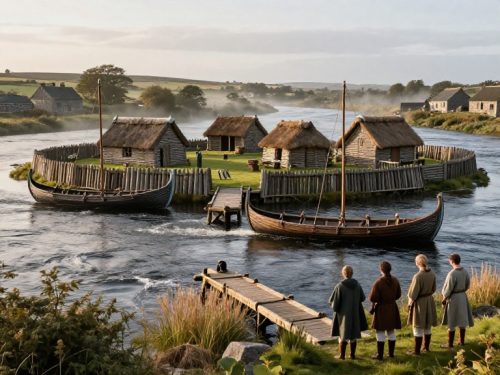
Limerick’s urban origins are tied to a Viking foundation on King’s Island, where longphorts and river moorings concentrated maritime activity. Contemporary annals and later archaeological reports indicate Norse captains, kin-groups and traders established bases that controlled shipping and river trade along the Shannon. These early…
Read Article
Ranks Mills
Ranks Mills became central to Limerick’s industrial life after Joseph Rank’s company acquired Goodbody’s existing flour works and redeveloped the Dock Road site in 1930. The new complex combined modern roller milling technology with large concrete silos and riverside receiving facilities for imported wheat and…
Read Article
Soda Cakes
People from Thomondgate in Limerick are commonly called sodacakes or soda cakes in local speech. The name links to the plain soda bread once central to working class kitchens across Ireland where yeast was scarce and quick leavening mattered. In Limerick the term evolved into…
Read Article
Curraghgower Falls
The Curraghgower Falls take their name from the anglicised placename applied to the bend of the River Shannon beside King John’s Castle. Curraghgower represents an English rendering of older Gaelic elements such as currach or corrach and dobhar or dhobhair. These Gaelic elements describe marshy…
Read Article
Limerick Foundation
Limerick occupies a strategic bend of the River Shannon where an island at the river throat provided defensive advantage and a focal point for settlement. Archaeological, annalistic and cartographic evidence indicate human occupation here before the medieval period. Medieval sources record monastic houses and Gaelic…
Read Article
Luimneach Origins
Early Christian tradition attributes the foundation of Luimneach to Saint Mainchín, often anglicised as Munchin, who is said to have established a church on an island in the Shannon during the sixth or seventh century. Local hagiography and diocesan memory continue to identify him as…
Read Article
Luimneach Meaning
Luimneach is the Gaelic name from which the English placename Limerick derives. Scholars trace Luimneach to Old Irish elements such as loimeanach or lom, words glossed as bare, marshy, or exposed ground beside water in place‑name discussions. That derivation emphasises a landscape description rather than…
Read Article
Limerick Treaty
On 3 October 1691 the city of Limerick surrendered and commissioners signed what is known as the Treaty of Limerick. The agreement comprised separate military and civil articles negotiated between Williamite commanders led by Baron de Ginkel and Jacobite leaders in the garrison. It ended…
Read Article
Wild Geese
The Wild Geese were Irish soldiers and accompanying civilians who left Ireland after the Treaty of Limerick in October 1691 to enter foreign military service in France, Spain and elsewhere in continental Europe. In Limerick the movement grew from the city surrender and promised military…
Read Article
Youth Leadership
Limerick-born Con Colbert stands as a striking example of youth leadership in Ireland’s revolutionary period, forging a legacy from his early days in rural County Limerick to becoming a central figure in the 1916 Easter Rising. His role in fostering republican values among young people…
Read Article