Henry Of London’s Return1,221 CE
In 1221, Ireland was neither a single kingdom nor a territory securely ruled from Dublin. It was a country of overlapping powers: Gaelic kings and lordships, Anglo-Norman barons, royal officials, bishops, monasteries and ambitious local families. The English crown claimed lordship over Ireland, but its effective authority was strongest in a network of towns, castles and estates, particularly in Leinster, Meath and parts of Munster. Beyond those centres, political control depended on negotiation, military pressure and the willingness of Irish rulers to make or break alliances.
The year’s surviving evidence is uneven. Some events are securely fixed by royal administration or are independently entered in several annals; others come from annalistic compilations whose chronological systems occasionally shift events by a year or more. Yet the records together show a revealing year: royal government changed hands in Dublin, a papal representative travelled through Ireland, a major expedition damaged Desmond, and a crisis of succession disturbed Connacht.
Change in Dublin Government
The most firmly documented political development was the removal of Geoffrey de Marisco as justiciar, the king’s chief officer in Ireland. Geoffrey had held office since 1215. A substantial landholder in Munster, Leinster and Offaly, and connected by marriage and patronage to leading colonial families, he was exceptionally powerful. He was also under sustained pressure to account for royal income. The minority government of Henry III in England had received complaints about Irish revenues, while Geoffrey had previously been ordered to pay crown receipts into the Dublin exchequer and to answer for his conduct.
In July 1221, Henry of London, archbishop of Dublin, was appointed to replace him. Henry was not merely a churchman pressed into secular duty. He had already served as justiciar between 1213 and 1215, had managed the completion of Dublin Castle, and was a skilled royal administrator. His return placed both ecclesiastical authority and civil government in the hands of the archbishop at a moment when the crown wished to restore closer oversight of its Irish lordship.
The transition was not instantaneous. On 15 July John Marshal, a royal servant and kinsman of the great Marshal family, was sent to Ireland to receive Geoffrey’s surrender of office. Geoffrey formally relinquished the justiciarship on 4 October. The staged handover matters. It suggests that the government was concerned not simply with replacing a man, but with securing castles, revenues, documents and the obedience of officials and magnates whose interests had become entangled with Geoffrey’s rule. The new regime inherited a lordship where political loyalty could not be assumed merely because an order had been issued in England.
Financial administration lay at the heart of the change. Royal income came from demesne lands, rents, fines, feudal incidents, customs and the profits of courts; it paid for castles, garrisons, messengers and the machinery of government. Disputes over such revenue were therefore also disputes about power. The replacement of Geoffrey did not end his influence—he remained a formidable Munster lord—but it demonstrated that the young king’s advisers intended the Irish exchequer and royal castles to answer more directly to the crown.
War and Building in Desmond
While the political centre was changing in Dublin, conflict reached deeply into Munster. The Annals of Inisfallen record a hosting by Geoffrey de Marisco into Desmond. His force camped at Áth na hUama, devastated the corn crop of the country, and built a castle at Mag Rátha. The annal does not provide a day or month, nor does it explain every local alignment behind the expedition. It nevertheless gives an unusually clear picture of how warfare worked.
Destroying grain was not incidental damage. A growing crop represented the food supply of households, retainers and livestock for the following season, as well as the surplus from which dues, hospitality and armed followings could be maintained. An army that cut or burned it could impose submission without having to seize every settlement or win a pitched battle. The suffering would have been experienced most sharply by cultivators and their dependants, people whom the chronicles rarely name. Cattle, stored food, tools and homes could also be vulnerable when an army passed through, but the annal specifically emphasises corn, and it is important not to claim more than it says.
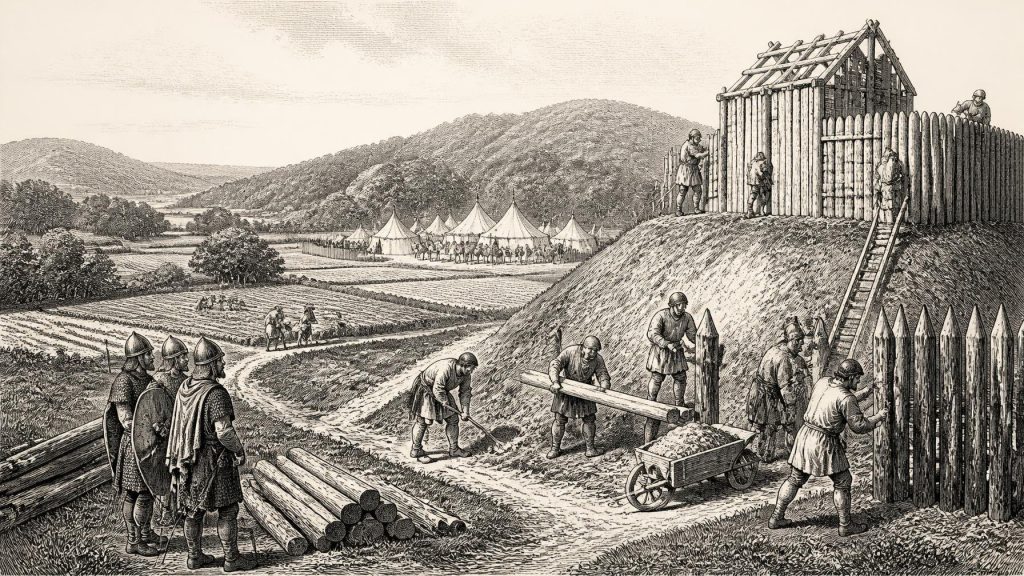
The castle at Mag Rátha was equally significant. A new fortification could provide a defended base, store provisions, oversee movement and signal a fresh territorial claim. Its construction required timber, earthwork, labour, transport and protection. In early thirteenth-century Ireland, castles were not simply military buildings: they were centres from which lordship could be organised, dues collected and surrounding land reshaped. The record does not permit a confident identification of Mag Rátha with a particular surviving ruin, but it securely places castle-building among the consequences of Geoffrey’s 1221 campaign.
This episode also complicates any simple opposition between “English” and “Irish”. Geoffrey’s army was an Anglo-Norman-led force operating in a region governed through many local relationships; Gaelic rulers themselves likewise relied on alliances and clientage. The immediate human reality, however, was one of coercion. For communities in the path of the hosting, high politics meant a threatened harvest and a new strongpoint in the landscape.
Church, Legation and Authority
Ecclesiastical affairs were unusually visible in 1221. The Annals of Ulster and the Annals of Inisfallen both record the arrival in Ireland of James, described as papal penitentiary, chaplain and legate for Ireland. A legate carried delegated papal authority. His coming connected Irish church affairs directly to the wider administration of Pope Honorius III, at a time when reform, clerical discipline, ecclesiastical jurisdiction and the financing of crusading commitments were live concerns throughout Latin Christendom.
The fuller account in the Annals of Loch Cé says that James came from Rome to settle and arrange ecclesiastical business, then departed in the same year. It adds that money in gold and silver was collected from Irish clergy, using the charged word “simony”. That accusation should not be repeated as an established fact: it is an annalist’s hostile judgement, not a surviving audit. It does, however, preserve an important contemporary perception—that visiting ecclesiastical authority could bring financial demands, and that such demands provoked resentment.
James’s presence came amid continuing competition over the Irish church. Henry of London had worked to strengthen Dublin’s position, to secure royal influence over episcopal elections and to advance his own claim to primatial standing. In March 1221 the pope approved Henry’s reorganisation of the Dublin diocese, including the elevated status of St Patrick’s. His appointment as justiciar later that year thus joined a major churchman’s institutional ambitions to the practical business of royal rule.
The annals also note the death of St Dominic in 1221. This was not an Irish event, and no Dominican foundation in Ireland should be placed in this year: the order reached Ireland only later. Its notice nonetheless shows that Irish annalists followed major developments in the international church. The same year is also entered in the Roscommon Dominican annals as the year in which Friar Jordan became master of the Order of Preachers, another reminder that religious networks linked Irish writers to events far beyond the island.
Connacht’s Unsettled Succession
In the west, the stability of Cathal Crobderg Ua Conchobair’s kingship of Connacht was tested by rivalry within his own dynasty. The Annals of Ulster record that Diarmait, son of Ruaidrí Ua Conchobair, was killed in 1221. The Annals of Loch Cé gives the larger story: Diarmait was killed by Tomás Mac Uchtraigh while travelling in the Western Isles, where he was gathering a fleet to seek the kingship of Connacht. Máel Ruanaid Ua Dubhda, king of Uí Amhalgaid in north Mayo, drowned in the same naval venture.
The account reveals the importance of the sea lanes between Ireland and western Scotland. Ships could carry warriors, political exiles, mercenaries, livestock and supplies; the Western Isles were part of the strategic world of Irish dynastic conflict, not a distant fringe. Diarmait’s death removed a potential challenger, but it did not settle the wider question of succession. Cathal was ageing and would die in 1224; the tensions visible in 1221 belonged to the larger struggle that would follow his death.
One caution is needed. The later Annals of the Four Masters place Diarmait’s killing and Máel Ruanaid’s drowning under 1220, whereas the Annals of Ulster and Loch Cé place them in 1221. The balance of this article follows the latter dating, while recognising that medieval annalistic chronology is not always exact. What is beyond doubt is the political meaning of the episode: Connacht’s ruling house faced a serious internal challenge involving seaborne mobilisation.
Learning Remembered
Amid campaigns and administrative change, an obituary preserves another side of Irish society. The Annals of Loch Cé record the death of Diarmait Ua Cú Lecháin, praised as a learned man of history and writing, exceptionally skilled in his time. The annal credits him with writing a missal for Cnoc and another for Diarmait mac Oireachtaigh, his tutor, and for Gilla Pátraic, his fellow pupil and successor at Achadh Abla.
Such a notice is valuable because it shows learning as a lived, local activity. Books were costly objects, produced through trained labour, and a missal was central to the performance of the Mass. The named relationships of teacher, pupil and successor suggest institutional continuity in a church community. Warfare and lordly politics could disrupt regions, but they did not erase the schools, scriptoria and religious houses in which literacy, memory and devotional practice were sustained.
Thus 1221 was a year of hard power and fragile authority. Dublin saw a contested administrative transfer; Desmond suffered a destructive hosting and acquired a new castle; a papal legate brought the wider church into Irish affairs; and Connacht’s dynastic tensions reached across the sea. Yet the year’s record also remembers clerics, books and the careful work of religious communities. Ireland’s history in 1221 was made not only in councils and campaigns, but in fields threatened at harvest, on ships gathering men, and at writing desks where prayers and historical knowledge were copied for the future.
Primary Sources
- Annals of Ulster: Year U1221
- Annals of Inisfallen: Annal AI1221
- Annals of Loch Cé: Annal LC1221
- Annals of the Four Masters: Annal M1221
- Annales Dominicani de Roscoman
- Henry of London
- Marisco, Geoffrey de
- Ua Conchobair, Cathal Mór Crobderg
- O'Connor (Ó Conchobair), Áed
- Butler (le Botiller, fitz Walter, Pincerna, Walter), Theobald
- Burgh, Richard de
- FitzGerald, Maurice fitz Gerald
- Dictionary of National Biography, 1885–1900: Marisco, Geoffrey de
- Dictionary of National Biography, 1885–1900: Marshal, John
- Dictionary of National Biography, 1885–1900: Norwich, Ralph de
- Civil Disobedience: The Citizens and Archbishop of Dublin During Hugh de Lacy’s Rebellion
- Mark Hagger, PhD Thesis
- Leinster and the Marshal Lordship, 1190–1245
- Excavations at Adare Castle, County Limerick
- Concilia Scotiae: Ecclesiae Scoticanae Statuta Tam Provinciala Quam Synodalia Quae Supersunt, MCCXXV–MDLIX
- Corpus of Scottish Medieval Parish Churches: Dunblane and Dunkeld Dioceses
- A History of the Irish Dominicans, Volume 1