A Cut on Cork Bone31804 BCE
Labelled 31,804 BCE, this period falls within unstable Marine Isotope Stage 3, for which only broad calibrated chronologies are defensible. Irish sediments show that some areas were ice-free before the later Last Glacial Maximum, supporting cold, open tundra environments and mobile fauna. Castlepook Cave in County Cork preserves diverse, time-layered Pleistocene animal remains. A reindeer femur, dated broadly to about 33,000 years ago, bears a mark interpreted as stone-tool damage during butchery. If confirmed, it suggests a brief human encounter with a carcass, not settlement. No evidence supports continuous occupation, identities, politics, religion, or culture, while expanding ice transformed Ireland.

Dateline
The label 31,804 BCE is a modern chronological convenience, not a date that can be matched to a recorded Irish year, season or lifetime. At this depth of time, calendar-year precision is unavailable. The most responsible setting is the later part of Marine Isotope Stage 3 (MIS 3), a highly unstable interval of the Last Glacial Period. The label falls roughly 33,750 years before AD 1950, but dates from this era are normally expressed as calibrated ranges, often spanning centuries or millennia. Ireland’s evidence is geological and archaeological rather than narrative: buried lake sediments, pollen, insects, cave calcite, animal bones and the traces of advancing ice.
There were no states, rulers, borders, written laws or named peoples in Ireland that can be identified at this time. Nor can the evidence sustain a history of continuous human settlement. Yet one object from north County Cork gives this otherwise silent period an exceptional human possibility: a reindeer femur from Castlepook Cave, near Doneraile, bearing a deep mark interpreted by its researcher as damage caused by a sharp stone tool during carcass processing. The bone and the landscape around it must be approached with care. They reveal a changing Ice-Age Ireland, and perhaps a brief encounter between people and prey; they do not furnish a conventional year-by-year chronicle.
A Date Within Ranges
Radiocarbon ages are not calendar dates in themselves. Atmospheric carbon-14 has varied through time, so laboratory determinations must be calibrated against independently dated environmental records. The current IntCal20 curve reaches back to 55,000 calibrated years before present, but uncertainty remains substantial in its older sections. Consequently, converting a prehistoric label such as 31,804 BCE into an apparently exact moment can mislead. The figure should be read as a point within broader chronological bands, not as an anniversary.
For Ireland, one important bracket comes from Derryvree in County Fermanagh. There, organic-rich silts lay between two deposits of glacial till. A legacy radiocarbon determination from the silts has been calibrated to approximately 36,900–31,700 cal BP. The date range includes the general time represented by 31,804 BCE and demonstrates that, at some point within that broad interval, freshwater and plant-rich ground existed in north-central Ireland before later ice overran the site. Greenagho, also in Fermanagh, produced organic material from beneath till calibrated to approximately 37,200–35,700 cal BP. Neither sequence dates a particular day in the life of an animal or person. Together, however, they rule out a simple picture of an island continuously sealed beneath an ice sheet.
Climate did not progress steadily towards the glacial maximum. MIS 3 contained abrupt North Atlantic shifts between relatively milder interstadials and colder stadials. Greenland ice cores provide the best-resolved record of these oscillations, while Irish deposits show their local consequences only imperfectly. The Derryvree sediments are generally interpreted as evidence for a cold, treeless freshwater setting, rather than woodland. In south-west Ireland, uranium-series dates from speleothems in Crag Cave show that liquid water sometimes percolated through shallow cave systems during episodes of climatic amelioration. Such evidence indicates that freezing conditions, vegetation cover and ice extent varied greatly through time and place.
Open Ground Before the Ice Maximum
At roughly this stage of the Last Glacial Period, the Irish Ice Sheet had not yet reached the all-island extent associated with the Last Glacial Maximum. Geological syntheses place the maximum cover of Ireland and its continental shelf broadly around 27,000–23,000 cal BP. Evidence from Derryvree and Greenagho indicates ice-free conditions in parts of north-central Ireland until at least about 34,000 years ago, before the main build-up of the last ice sheet. In southern Ireland, deposits beneath later glacial sediments likewise show that the coast remained outside the final advance until after about 24,000 cal BP.
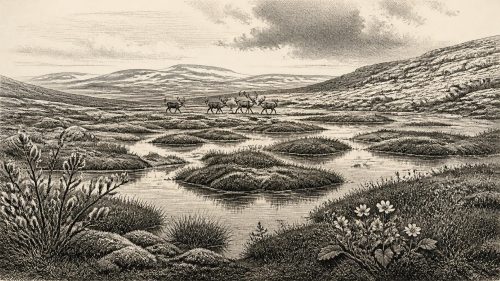
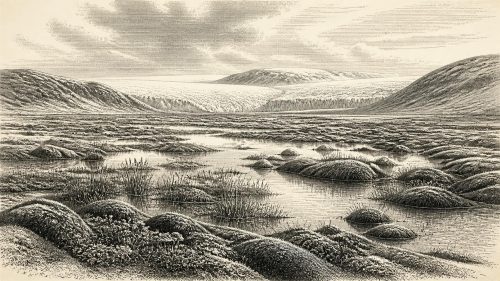
That does not mean a temperate or hospitable island. Ice margins may have occupied other regions; frost, snow, seasonal thaw, strong winds and permafrost affected exposed terrain. The land was not the familiar wooded Ireland of later millennia. Pollen, plant macrofossils and insect evidence from Irish Late Pleistocene sequences point instead to varied cold-stage environments: wet hollows, pools, sedge-rich ground, patches of low shrubs and open mineral soils. A landscape of sparse but productive tundra or steppe-tundra vegetation could support grazing mammals, especially in sheltered valleys and during favourable phases, while remaining punishingly seasonal for any human visitor.
Sea level was lower than today because enormous quantities of water were held in global ice sheets, and the coastlines and shelves around Ireland were therefore configured differently. But lowered sea level should not be casually translated into a proven land bridge. Local relative sea level depended upon both global ocean volume and the movement of the Earth’s crust under changing ice loads. The bathymetry of the Irish Sea, changing ice fronts and incomplete chronological control make a specific route into Ireland uncertain. The secure inference is ecological connectivity: land mammals repeatedly reached Ireland during Late Pleistocene intervals. Whether every movement required dry land, shore-hugging passages, winter ice or short water crossings is not established for this particular time.
Castlepook’s Animal Archive
Castlepook Cave, also known as Mammoth Cave or Doneraile Cave, lies in limestone country above the Awbeg Valley in north Cork. Excavations beginning in the early twentieth century recovered one of Ireland’s richest Pleistocene faunal collections. Identified remains include woolly mammoth, giant deer, reindeer, brown bear, wolf, fox, mountain hare, collared lemming, Norwegian lemming and spotted hyaena. The National Museum of Ireland records the cave as the only Irish locality known for spotted hyaena remains. This is compelling evidence that Ireland formed part of a wider north-west European world of cold-adapted and open-country animals during portions of the Late Pleistocene.
It is not, however, a single assemblage from one moment. Caves accumulate bones over long periods. Carnivores drag in prey; animals die naturally; water moves material; later excavators disturb deposits; and material from younger levels can become mixed with older remains. Some Castlepook specimens were recovered in an era when excavation recording did not meet modern standards. The cave fauna must therefore be treated as a time-layered archive, not as a scene in which mammoth, hyaena, giant deer, reindeer and every smaller animal stood together on the same day.
Recent reassessment has made this caution still more important. Improved pretreatment of bone collagen has shown that some older radiocarbon results from Irish cave faunas were misleadingly young. Ruth Carden’s 2020 re-evaluation concluded that parts of the southern Irish MIS 3 fauna were considerably older than earlier estimates had suggested, and that species such as giant deer and spotted hyaena may have disappeared locally before the Last Glacial Maximum, perhaps around 40,000 cal BP. Castlepook therefore records repeated ecological episodes, not a straightforward sequence that can be assigned in full to 31,804 BCE.
The Reindeer Femur
The reindeer femur is the most directly relevant archaeological object. Found during the historic excavations and subsequently studied anew, it has been reported as dating to around 33,000 years ago. Its prominent linear mark has been interpreted as a cut or chopping mark made on fresh bone by a sharp stone implement. If that interpretation is correct, it would provide evidence that people processed a reindeer carcass in Ireland during MIS 3, enormously earlier than the island’s previously accepted terminal-Pleistocene evidence for human activity.
The distinction between evidence and interpretation is essential. The bone is evidence: a reindeer lived, died and was preserved in the Castlepook cave system during the broader Ice-Age period. The mark is physical evidence as well. Its attribution to a human tool, and therefore to butchery, is an expert interpretation open to testing against carnivore damage, trampling, sediment abrasion, excavation damage and the microscopic characteristics of known stone-tool cuts. Even an anthropogenic mark would demonstrate an event of carcass processing, not necessarily a camp, a resident population, a family group or a settled community. No securely associated hearth, stone-tool assemblage, dwelling, burial or human skeletal remains establishes such a settlement at Castlepook.
At most, the marked bone permits a restrained reconstruction. During a time when reindeer ranged across suitable open country, one or more mobile Upper Palaeolithic people may have reached Ireland and obtained access to a carcass, whether by hunting, scavenging or taking an animal already killed by another predator. They may have removed meat, tendons, marrow or hide. This would have been an economy of immediate survival and mobility, not agriculture, livestock keeping, metalworking, markets or long-distance trade networks recognisable from later prehistory. The cave itself need not have been their home: it was also used by animals, including hyaenas, and could have received bones through several routes.
What Cannot Be Recovered
No evidence supports political affairs, diplomacy, organised warfare, religious institutions, formal education, monuments or artistic traditions in Ireland at this date. It would be equally unjustified to project later Gaelic identities, Celtic languages, tribes or Irish kingdoms backwards into this Ice-Age world. If people were present, they belonged to mobile hunter-gatherer populations whose material culture and social relationships are almost entirely unrecovered on the island. Comparison with Upper Palaeolithic groups elsewhere in Europe can suggest broad possibilities, including small groups, sophisticated knowledge of animals and stone technology, and extensive seasonal movement. It cannot supply missing Irish evidence.
Conflict is likewise visible only indirectly in the competition of predators and scavengers around carcasses. Spotted hyaenas, wolves and bears were part of the wider faunal record; people, if present, would have faced the risks posed by cold, exposure and large carnivores as much as any competition for food. There is no basis for describing battles or alliances. Religion and culture cannot be inferred from the Castlepook mark. A tool cut proves neither a ritual nor a language, and a cave bone is not cave art.
What can responsibly be said is significant enough. Around the broad period represented by 31,804 BCE, Ireland was an environmentally dynamic part of Ice-Age north-west Europe, with ice-free ground in some regions before the later expansion of the British-Irish Ice Sheet. Animal movement connected it to neighbouring lands at intervals. The Castlepook reindeer femur raises the serious possibility of a human visit or brief use of animal resources, while also demonstrating how much remains unresolved. Its single mark is not the beginning of a continuous national story. It is a rare, fragile clue to a human-scale act in a landscape that would soon be transformed again by ice.
Primary Sources
- A reconsideration of the radiocarbon dating of the Marine Isotope Stage 3 fauna from southern Ireland
- The Irish quaternary fauna project
- Castlepook Cave
- Spotted Hyena Skull
- Growth and retreat of the last British–Irish Ice Sheet, 31,000 to 15,000 years ago: the BRITICE-CHRONO reconstruction
- Trimlines, blockfields and the vertical extent of the last ice sheet in southern Ireland
- The timing and magnitude of the British–Irish Ice Sheet between Marine Isotope Stages 5d and 2: implications for glacio-isostatic adjustment, high relative sea levels and ‘giant erratic’ emplacement
- Late Pleistocene chronostratigraphy and ice sheet limits, southern Ireland
- Radiocarbon constraints on the age of the maximum advance of the British–Irish Ice Sheet in the Celtic Sea
- Ireland: Submerged Prehistoric Sites and Landscapes
- The IntCal20 Northern Hemisphere Radiocarbon Age Calibration Curve (0–55 cal kBP)
- The IntCal20 Approach to Radiocarbon Calibration Curve Construction: A New Methodology Using Bayesian Splines and Errors-in-Variables
- A stratigraphic framework for abrupt climatic changes during the Last Glacial period based on three synchronized Greenland ice-core records: refining and extending the INTIMATE event stratigraphy
- The Greenland Ice Core Chronology 2005, 15–42 ka. Part 1: constructing the time scale
- Episodic speleothem deposition tracks the terrestrial impact of millennial-scale last glacial climate variability in SW Ireland
- Spatio-temporal dynamics of speleothem growth and glaciation in the British Isles
- Middle Midlandian Interstadial Deposits at Greenagho, Near Belcoo, County Fermanagh, Northern Ireland
- Figure 6.— The subdivision of the Quaternary Period in Ireland
- Pleistocene vertebrates in the British Isles
- New insights on the fauna of Ireland's Younger Dryas and Early Holocene from Alice & Gwendoline Cave