Castlepook’s Hyena Corridor31803 BCE
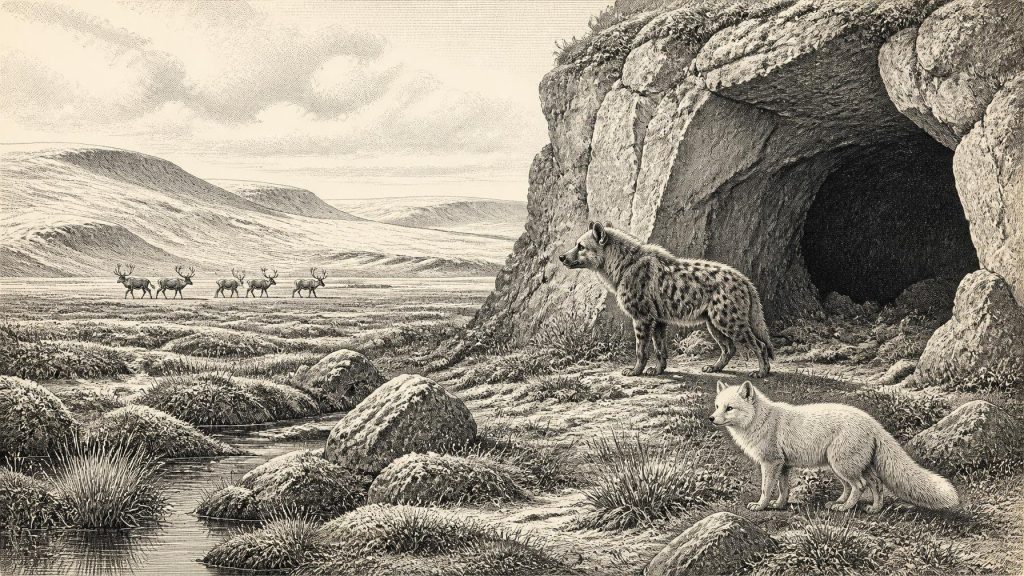
Although 31,803 BCE cannot denote a documented Irish event, it falls within MIS 3, before the Last Glacial Maximum. Ireland then experienced unstable cold conditions, with exposed tundra, wetlands and advancing ice rather than uniform glaciation. Derryvree sediments in Fermanagh indicate periglacial vegetation and freshwater habitats. Castlepook Cave, Cork, preserves a long, disturbed fossil record including mammoth, reindeer, giant deer, predators and lemmings, demonstrating access for Ice Age mammals. A marked reindeer femur may indicate brief Upper Palaeolithic butchery, but lacks secure context or supporting artefacts. Evidence supports animal landscapes and possible transient human visits, not settled population or polity.
Dateline
The label 31,803 BCE offers a useful point of orientation, but it cannot identify an event in Ireland. Nobody then used a numbered calendar, no written record exists, and archaeology cannot distinguish one modern calendar year from the next at this depth of time. In arithmetic terms the label lies roughly 33,750 years before 1950, the conventional origin of “BP” dating. That is not, however, a radiocarbon determination. Dates from this era must be expressed as ranges, calibrated against changing atmospheric carbon levels, and linked cautiously to deposits, bones and landforms rather than to a named year.
The broad setting is the later part of the Late Pleistocene, within Marine Isotope Stage 3 (MIS 3), before the Last Glacial Maximum. It was an age of sharp climatic oscillation rather than one unbroken freeze. For Ireland, the evidence is fragmentary and geographically uneven. It nevertheless reveals an island—or periodically connected western peninsula in a changing glacial world—where cold-adapted animals entered landscapes that would later be heavily reworked and covered by ice. The strongest evidence near this deep timescale comes not from settlements but from caves, fossil assemblages and sediments.
A Landscape Before Maximum Ice
At this point the great British-Irish Ice Sheet had not yet reached its later maximum. Current reconstructions place the fullest expansion of ice over Ireland and its surrounding shelf broadly around 27,000–23,000 calibrated years BP, with considerable regional variation in timing and thickness. Thus 31,803 BCE falls before the period when ice covered virtually all of Ireland. It should not be imagined as modern Ireland under a uniform white lid. Instead, conditions and the extent of ice were changing; some areas supported exposed ground, rivers, wetlands and cold-climate vegetation, while glaciers and ice masses were advancing elsewhere over longer timescales.
One vital northern record lies at Derryvree near Maguiresbridge, County Fermanagh. Road works exposed freshwater silts and fine sands trapped between two tills in a drumlin. Organic material there produced a conventional radiocarbon age of 30,500, with an uncertainty of roughly a millennium. This measurement is older than the requested calendar label when left uncalibrated, and calibration shifts it further back in calendar years; it must not be treated as dating 31,803 BCE itself. Its value is environmental. Pollen, plant remains and small-animal evidence indicate open tundra vegetation and a periglacial climate: a cold landscape shaped by frost, short growing seasons, sparse plant cover and freshwater pools or marshes.
The Derryvree sequence gives a responsible picture of the kind of terrain that could exist in parts of Ireland during a cold-stage interval: not woodland, farmland or settled countryside, but low vegetation, sedges, grasses, herbs and mosses around wet ground. It does not prove that every Irish district looked identical, nor can it be used to reconstruct a particular day. Yet it is far more secure evidence than a sweeping image of a wholly frozen island.
The Cave Archive at Castlepook
For southern Ireland, Castlepook Cave near Doneraile in north County Cork is especially important. Also known as Mammoth Cave, it is the country’s richest known cave archive for vertebrate remains from the period leading towards the Last Glacial Maximum. Excavations in the late nineteenth and early twentieth centuries recovered thousands of bones, but their early excavation history means that exact layers and associations are often imperfectly recorded. Later radiocarbon programmes demonstrate that the collection spans a long interval, rather than a single moment. Geological Survey Ireland summarises dates on individual remains ranging broadly from about 45,700 to 19,950 BP.
The cave fauna includes woolly mammoth, reindeer, giant deer, brown bear, wolf, Arctic fox, lemmings and spotted hyena. It evokes a varied cold-stage animal community, but the list must be read with care. A cave is not a census of animals living together outside its entrance in one season. Bones can be carried in by carnivores, moved by water, disturbed by later activity or derived from separate phases of occupation. Hyena remains and gnawed bones make clear that Castlepook was, at least at times, a carnivore den or repository. Predators could drag carcass parts into sheltered chambers, while natural processes accumulated and rearranged material over millennia.
Even so, the animals establish an important fact about Irish regional change. Mammoths, reindeer and hyenas belonged to an Ice Age ecological world very different from the later, post-glacial fauna familiar in Ireland. Their presence shows that routes into Ireland existed for sizeable terrestrial mammals during parts of the Late Pleistocene. Lower sea levels exposed broader coastal plains and shelves, but a simple, continuous dry land bridge to Britain at this exact date has not been demonstrated. Migration may have involved changing land, ice, shallow-water and coastal routes. The evidence permits movement; it does not permit certainty about the route used by each species.
A Marked Reindeer Bone
Castlepook also contains the most provocative clue to a possible human visit in this much earlier period. A reindeer femur from the old collection has been reported as bearing a deep linear mark that zooarchaeologist Ruth Carden interpreted as damage made by a sharp stone implement during butchery. Public heritage material identifies the object as Palaeolithic and places it approximately around 31,000 BCE; reports have also described the bone as roughly 33,000 years old. Such descriptions are useful signals of broad antiquity, not sufficiently precise grounds for attaching the mark to 31,803 BCE.
If the interpretation is correct, it suggests that one or more Upper Palaeolithic people processed a reindeer in Ireland during a relatively milder, pre-maximum phase of the last Ice Age. It would be a striking extension of the island’s human story. But the limits are as significant as the possibility. The bone was recovered from a cave archive assembled over a long period; it does not come with a securely associated hearth, stone toolkit, dwelling floor, burial, art or repeated domestic refuse of comparable age. The bone dates the animal’s death, not necessarily the instant of marking, the location of the kill, or the duration of any human stay.
Accordingly, the responsible conclusion is not that Ireland possessed a settled Palaeolithic population in 31,803 BCE. Nor is it that a named hunting party occupied Castlepook. It is that a single modified bone raises a serious, researchable possibility of brief human activity. Recent licensed work at the cave has sought surviving Pleistocene deposits, but the 2022 excavation found no cultural artefacts. This absence does not disprove every earlier visit; it demonstrates how little direct evidence is presently available.
Society Without Polities
There is no basis for describing governments, kingdoms, diplomacy, formal conflict or religion in Ireland at this date. No Irish settlement, leader, language, ritual site or political boundary is known. The small scale of the possible evidence matters. If hunters reached the island, they would have belonged to mobile Upper Palaeolithic communities whose social knowledge, kinship, technologies and beliefs were carried in people rather than preserved in Irish monuments. European comparison can suggest that hunting, sharing meat, maintaining tools and navigating seasonal landscapes were possible practices, but it cannot turn possibility into a documented Irish custom.
Nor is there evidence for trade in the later historical sense. The movements visible in the record are chiefly those of animals and, potentially, occasional people across a changing north-west European world. A sharp stone edge capable of marking bone would have been a practical tool, not proof of an Irish exchange network. If people did enter, obtaining meat, fat, marrow, hides and sinew from large game would have been an immediate economic concern. Yet even this is an inference from the reindeer-bone interpretation, not a recovered campsite economy.
What Can Be Said for Ireland
The most important development around this notional year was environmental, not political: Ireland remained part of a dynamic cold-stage frontier before the last great ice expansion transformed much of its surface. Open tundra wetlands in Fermanagh and the animal-rich cave record in Cork reveal that life persisted in suitable places. Castlepook’s fossils also warn against treating the past as a neat sequence. The cave preserves different episodes of animal presence, carnivore activity and sediment movement, compressed into one famous locality.
For 31,803 BCE, then, Ireland is best understood through calibrated ranges and material traces. Derryvree illuminates cold, open environments during the wider Middle Midlandian interval. Castlepook illuminates a pre-maximum fauna and the contested possibility of human butchery. Together they replace invented annual history with a more compelling reality: a sparsely evidenced Ice Age landscape, inhabited certainly by animals, shaped by climatic instability, and perhaps visited briefly by people whose presence has almost entirely vanished.
Primary Sources
- Middle Midlandian Freshwater Series at Derryvree, Maguiresbridge, County Fermanagh, Northern Ireland
- Palaeoecology
- Castlepook Cave County Geological Site Report
- Spotted Hyena Skull
- Occurrence of Mammalia Relicts at Site Castlepook Cave
- The Exploration of Castlepook Cave, County Cork
- Pleistocene Vertebrates in the British Isles
- Phylogeographic, Ancient DNA, Fossil and Morphometric Analyses Reveal Ancient and Modern Introductions of a Large Mammal: the Complex Case of Red Deer (Cervus elaphus) in Ireland
- Dimensions and Chronology of the Last Ice Sheet in Western Ireland
- Last Glacial Maximum Cirque Glaciation in Ireland and Implications for Reconstructions of the Irish Ice Sheet
- Late Pleistocene Chronostratigraphy and Ice Sheet Limits, Southern Ireland
- Stratigraphic and Palaeo-geomorphological Evidence for the Glacial-deglacial History of the Last British-Irish Ice Sheet in the North-western Irish Sea
- Ireland: Submerged Prehistoric Sites and Landscapes
- New Insights on the Fauna of Ireland's Younger Dryas and Early Holocene from Alice & Gwendoline Cave
- 2022:564 – Castlepook Cave, Castlepook South, Cork
- Heritage Artefacts of County Cork
- Archaeological Heritage of County Cork
- Our Ancient Landscapes: Hunter-Gatherers in Ireland
- The IntCal20 Northern Hemisphere Radiocarbon Age Calibration Curve (0–55 cal kBP)
- IntCal20
- The Problem of a Late Quaternary Landbridge Between Britain and Ireland
- Reindeer Bone Found in Cork Cave Shows Human Activity in Ireland 33,000 Years Ago