
Castlepook’s Reindeer World31713 BCE
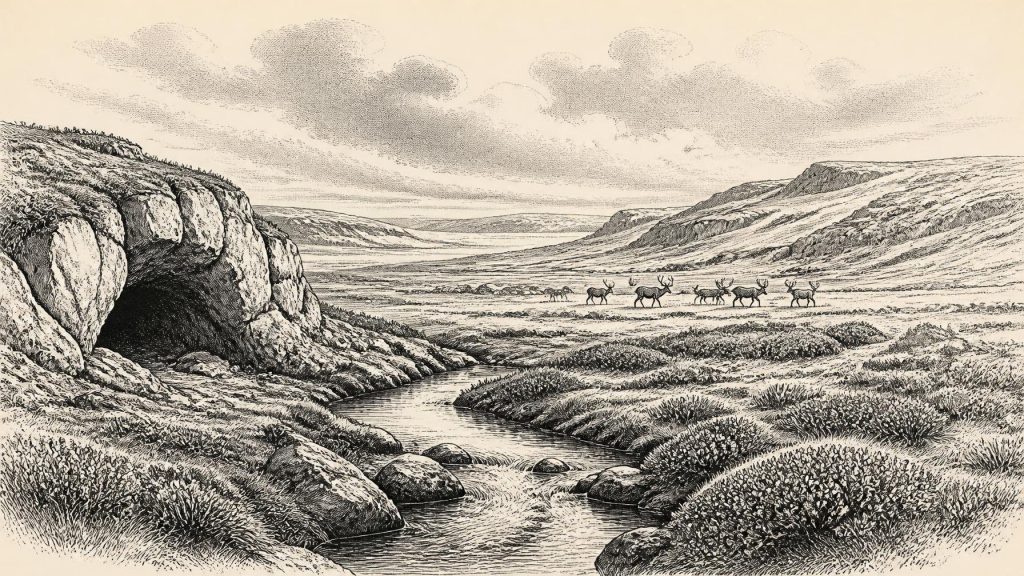
Castlepook Cave in north County Cork preserves Ireland’s richest known Late Pleistocene vertebrate archive, spanning roughly 45,700 to 19,950 years before present. During fluctuating Marine Isotope Stage 3, open, cold-adapted habitats supported reindeer, mammoth, giant deer, bears, hyaenas, wolves and lemmings, amid changing seas and growing ice. Cave deposits are disturbed and accumulate over long periods, preventing a precise reconstruction for 31,713 BCE. A reindeer femur bearing a possible stone-tool cut mark may indicate human butchery around 31,000 BC. However, no associated tools, hearths, occupation layers or settlement evidence exist. Castlepook therefore suggests possible brief human presence, not proven habitation.
Dateline
Modern calendar precision cannot responsibly be projected into this part of prehistory. “31,713 BCE” is a useful point on a modern timeline, roughly 33,660 years before AD 1950, but no event in Ireland can be assigned to that single year. Radiocarbon ages have margins of error; their conversion into calendar ages requires calibration; and cave deposits often represent material accumulated over long intervals. The appropriate setting is therefore the later part of Marine Isotope Stage 3, a fluctuating cold phase of the Late Pleistocene, before the fullest expansion of the last British–Irish Ice Sheet.
For Ireland, the most illuminating evidence comes not from a settlement, a grave or a monument, but from animal bones, cave sediments, glacial landforms and the scientific re-examination of old museum collections. These sources reveal a country that was very unlike later, wooded Ireland: a northern Atlantic landscape affected by severe climatic swings, with open ground capable at times of supporting large mammals. They do not, however, yield a year-by-year narrative, a named people, or proof of a permanent human population.
A Date Within a Long Cold Phase
The date falls well before the Last Glacial Maximum, conventionally placed at about 26,000–19,000 years ago, when ice covered almost all of Ireland. Yet it was not simply a calm prelude to an inevitable freeze. Research on the British–Irish Ice Sheet shows that its growth was geographically uneven and rapid. Scottish ice had advanced through the North Minch by roughly 32,000–31,000 years before present, while separate ice masses and ice caps affected parts of Ireland. Models and geological evidence remain less secure for the earlier growth phase than for subsequent retreat. Accordingly, it is unsafe to draw a single, hard ice margin across Ireland for 31,713 BCE.
The wider Late Pleistocene climate was abrupt and variable rather than uniformly cold. Greenland ice-core chronologies record alternating stadials and interstadials, intervals of relative warming and deterioration which could transform vegetation, snow cover and animal ranges over centuries or less. Conditions in the Irish west, south and north would also have varied with altitude, exposure, distance from the sea and proximity to ice. A particular valley might have offered sheltered grazing while high ground, frozen soils or advancing glaciers made adjacent country hostile.
Lower global sea levels exposed much more of the surrounding continental shelf than exists today, although changing sea level, local ice loading and crustal movement make simple claims about a reliable “land bridge” misleading. Ireland’s coast was not its modern coastline. The Irish Sea and Atlantic approaches were reshaped by ice and shallower waters; any movement of animals or people depended on a changing and hazardous regional geography rather than on the later familiar island map.
The Cave Beneath North Cork
Castlepook Cave, also called Mammoth Cave or Doneraile Cave, near the Awbeg Valley in north County Cork, is central to understanding this period. The limestone cave system was extensively excavated between 1904 and 1918 under Richard J. Ussher. Its galleries acquired memorable names, including Hyaena Hall and Elephant Hall, reflecting the remarkable fossil finds. Although early excavation removed much sediment without the recording standards expected today, surviving bones in the National Museum of Ireland and later investigations have made Castlepook the richest known Irish site for vertebrate life leading towards the Last Glacial Maximum.
Radiocarbon results from individual bones show that the cave’s Ice Age fauna spans a long period, approximately 45,700 to 19,950 years before present. That is the first essential caution: Castlepook is an archive, not a snapshot. A bone discovered in one gallery cannot automatically be treated as contemporary with every other bone there, still less as evidence for a single moment in 31,713 BCE. Water movement, roof collapse, scavenging, redeposition and twentieth-century digging have all affected the assemblage.
Nonetheless, its fauna demonstrates that Ireland was reached by an impressive range of cold-stage mammals. Woolly mammoth, giant deer (Megaloceros giganteus), reindeer, brown bear and spotted hyaena are recorded from the cave; later Ice Age deposits include Arctic fox, wolf and two kinds of lemming. Other Irish cave and fossil localities add further, sometimes uncertain, records. The traditional name “Irish elk” is misleading: giant deer were neither elk nor uniquely Irish. Their huge antlers make them famous, but they belonged to a European species whose Irish fossils happen to be especially abundant.
Open Country and Mobile Herds
The animal record supports an interpretation of broadly open, cold-adapted habitats, often described as steppe-tundra, herb-rich grassland or shrub tundra. Reindeer and lemmings particularly point towards conditions very different from later Atlantic woodland; mammoth and giant deer indicate that enough plant biomass was available, at least seasonally, to sustain large herbivores. This was not necessarily a featureless white wilderness. In favourable intervals it may have included grasses, sedges, herbs, dwarf shrubs, patches of willow or birch, wet ground and river corridors, set among stony slopes and areas of permafrost.
Predators and scavengers gave this landscape a demanding ecological structure. Spotted hyaenas could carry or consume carcass material in caves, while wolves and bears were also present in the wider faunal picture. A cave bone may therefore record an animal killed nearby, a carcass scavenged elsewhere and dragged underground, or remains washed in from outside. Castlepook provides powerful evidence for an Ice Age food web in southern Ireland; it does not demonstrate that mammoths, hyaenas, reindeer and giant deer all stood together outside the cave on one day.
Everyday life can be reconstructed more confidently for these animals than for humans. Reindeer likely moved in response to grazing, season and snow conditions. Carnivores followed prey and exploited carrion. The cave itself was probably used repeatedly as a repository by non-human agents rather than as a domestic dwelling. There is no evidence at this date for Irish farming, pottery, metalworking, built villages, field systems, seafaring trade, writing or any of the institutions familiar from later prehistory.
The Marked Reindeer Femur
A single reindeer femur fragment from Castlepook gives this date exceptional importance. Re-examined by zooarchaeologist Ruth Carden, it bears a deep linear mark interpreted as consistent with cutting or chopping by a sharp stone implement while the bone was fresh. A County Cork heritage publication places the object broadly at about 31,000 BC. If that interpretation is confirmed, it would suggest that a person or small group processed a reindeer in Ireland during this earlier Ice Age phase—far earlier than the traditionally accepted post-glacial settlement evidence.
The claim must be expressed carefully. The femur is a direct object, but it derives from an old and disturbed cave collection, not a newly excavated camp floor. No securely associated stone tool, hearth, dwelling, human bone, butchered assemblage or occupation layer of comparable age has yet been recovered at Castlepook. A radiocarbon determination establishes the age of the animal bone within a statistical range; identifying a surface modification as a human toolmark is a separate taphonomic judgement. Carnivore damage, sediment abrasion, breakage and handling can complicate such assessments.
Thus the evidence supports a measured conclusion: reindeer occupied, or at least reached, southern Ireland during the relevant broad period, and one bone has been interpreted as possible evidence of human butchery. It does not yet establish a permanent population, a settlement at Doneraile, or continuous occupation of Ireland. Recent fieldwork has sought intact deposits in the cave system, but the survival of undisturbed Pleistocene archaeology is limited. The question remains open precisely because the clue is promising enough to deserve further testing.
People Beyond the Western Sea
Elsewhere in north-west Europe, Homo sapiens communities had long made sophisticated stone tools, worked animal materials, used fire and occupied landscapes that could be climatically severe. Upper Palaeolithic groups were mobile hunter-gatherers, linked across extensive territories by movement, marriage, information and the circulation of materials. Such continental evidence makes a short Irish incursion plausible in principle, especially during a favourable phase and where animal movements created opportunities. It cannot substitute for Irish finds.
If people did reach Ireland around this time, the most defensible model is not an established nation or a sizeable colony, but a small, highly mobile party operating within a wider western European world. They may have followed herds or explored new ground; they may equally have left no durable material record beyond the contested bone mark. A brief visit could leave very little archaeology, especially when later ice and erosion repeatedly reworked the landscape.
Political affairs, diplomacy and organised conflict are therefore beyond the evidence. There are no chiefs, territories, alliances or wars that can be responsibly described for Ireland in 31,713 BCE. Nor is there direct Irish evidence for ritual practice, art, language or formal learning. It would be wrong to fill that silence with continental cave art or later Irish folklore. The cultural significance lies instead in the possibility that the island formed, however briefly, part of the humanly explored edge of Upper Palaeolithic Europe.
An Archive, Not an Origin Story
Castlepook’s importance is methodological as well as historical. Its bones were first collected in an era when the priority was retrieval rather than fine-grained context. Later accelerator radiocarbon dating and improved sample pretreatment showed that some earlier dates from Irish caves were unreliable or too young. Modern study combines dating, zooarchaeology, sediment analysis, cave survey and, increasingly, biomolecular approaches. Each advance can revise a seemingly settled story.
For this reason, 31,713 BCE should be remembered not as the birthday of Ireland’s first inhabitants but as a point within a wide, uncertain interval. The strongest picture is of an open and changing Ice Age environment, inhabited by reindeer and other large mammals, while glaciers were growing elsewhere in the archipelago. The Castlepook femur may preserve a rare human trace within that world. Until securely dated tools or an undisturbed occupation deposit are found, possibility must remain distinct from proof.
Primary Sources
- The Irish Quaternary Fauna Project
- Castlepook Cave: County Geological Site Report
- Spotted Hyena Skull
- Heritage Artefacts of County Cork
- 32564: Castlepook Cave, Castlepook, Cork
- Archaeology Research Excavation Grant 2022: Final Report
- Growth and Retreat of the Last British–Irish Ice Sheet, 31,000 to 15,000 Years Ago: the BRITICE-CHRONO Reconstruction
- The Timing and Magnitude of the British–Irish Ice Sheet Between Marine Isotope Stages 5d and 2: Implications for Glacio-Isostatic Adjustment, High Relative Sea Levels and ‘Giant Erratic’ Emplacement
- Maximum Extent and Dynamic Behaviour of the Last British–Irish Ice Sheet West of Ireland
- Dimensions and Chronology of the Last Ice Sheet in Western Ireland
- Last Glacial Maximum Cirque Glaciation in Ireland and Implications for Reconstructions of the Irish Ice Sheet
- Pattern, Style and Timing of British–Irish Ice Sheet Advance and Retreat Over the Last 45,000 Years: Evidence from NW Scotland and the Adjacent Continental Shelf
- Pattern, Style and Timing of British–Irish Ice Sheet Retreat: Shetland and Northern North Sea Sector
- The Deglaciation of the Western Sector of the Irish Ice Sheet From the Inner Continental Shelf to its Terrestrial Margin
- New Insights on the Fauna of Ireland’s Younger Dryas and Early Holocene From Alice & Gwendoline Cave
- Archaeological Excavations at Killuragh Cave, Co. Limerick: A Persistent Place in the Landscape From the Early Mesolithic to the Late Bronze Age
- Occurrence of Mammalia Relicts at Site Castlepook Cave
- Pleistocene Vertebrates in the British Isles
- The IntCal20 Northern Hemisphere Radiocarbon Age Calibration Curve (0–55 cal kBP)
- IntCal Data
- Cork Archaeological Heritage
- Proceedings of the Royal Irish Academy: Castlepook Cave Exploration