Castlepook’s Singular Femur30492 BCE
Although 30,492 BCE is not a precise Irish archaeological date, it lies within a fluctuating late Pleistocene interval represented by evidence from Derryvree and Castlepook Cave. Derryvree’s organic deposits, later sealed by ice, indicate treeless periglacial tundra with freshwater habitats, grasses, sedges and arctic-alpine plants. Castlepook’s mixed cave fauna includes reindeer, mammoth, giant deer and predators, demonstrating ecologically viable cold environments. A cut-like mark on a reindeer femur may record Upper Palaeolithic butchery around 31,000 BCE, but proves neither hunting nor settlement. No Irish evidence establishes communities, material culture, trade, politics or continuous occupation before later ice expansion obscured evidence.
Dateline
The label 30,492 BCE gives a useful point of reference, but it must not be mistaken for a date that can be observed in Ireland’s archaeological record. No calendar existed on the island, and neither people nor events can be assigned responsibly to this particular year. In modern chronological terms, it falls roughly 32,440 years before AD 1950, within the later part of the Pleistocene and Marine Isotope Stage 3, a climatically unstable interval before the Last Glacial Maximum. The evidence for Ireland comes instead from broad calibrated ranges, cave-bone collections, buried wetland deposits and the later geological traces of ice.
Two places offer especially important, though very different, windows: Castlepook Cave, also known as Mammoth Cave, near Doneraile in north County Cork; and Derryvree near Maguiresbridge in County Fermanagh. Neither supplies a diary entry for 30,492 BCE. Together, however, they show that parts of Ireland were capable of sustaining cold-adapted plants and large mammals during this long, changing phase of the Ice Age, and that the island’s earliest possible human trace belongs somewhere close to this deep timescale.
Evidence, Not Annals
The closest relevant environmental chronology is the organic deposit exposed beneath later glacial sediments at Derryvree. Its radiocarbon determination, BIRM-166, was reported as 30,500 ± 1,100 radiocarbon years BP. Calibration produces a much broader and differently expressed calendar range, approximately 36,900–31,700 calibrated years BP in a frequently cited assessment. The conventional year 30,492 BCE falls within that wide window, but it cannot be narrowed further. The deposit demonstrates an interval between episodes of glaciation: ice had laid down a lower till, freshwater and organic sediments accumulated above it, and a subsequent advance buried the whole sequence beneath another till.
That stratigraphy is valuable precisely because later ice sheets removed or disturbed so much older ground. Yet it also imposes limits. The material provides a sequence of changing conditions at one locality, not a simultaneous description of every Irish region. It cannot establish the weather on one day, the coastline visible from Cork, or the extent of ice in every valley. Scientists continue to refine the chronology of the British–Irish Ice Sheet as new dating, marine cores and landscape evidence become available.
Cold Ground and Fresh Water
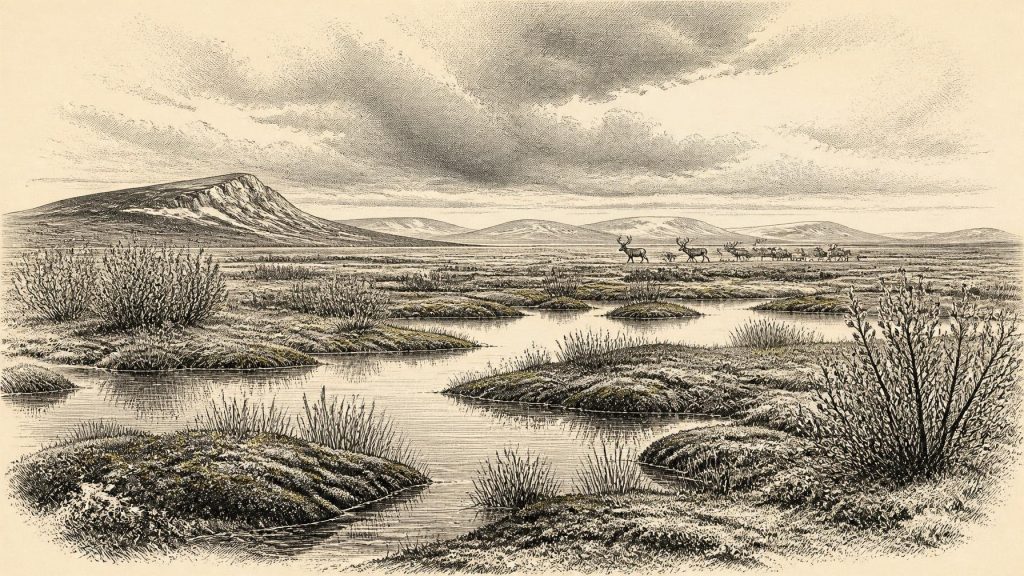
Derryvree preserves an unexpected combination: cold, open ground alongside freshwater life. Fossil pollen, plant macrofossils, mosses and invertebrate remains point to a treeless, periglacial landscape rather than a forested Ireland. Grasses, sedges and northern or arctic-alpine plants occupied wet margins and exposed soils. Finds attributed to the deposit include bogbean, mountain avens and dwarf willow, while freshwater plants indicate pools or slow water. This was not a uniformly frozen wasteland. Short growing seasons could support patches of vegetation, shallow water, mossy ground and marshy habitat, even as the climate remained severe by modern standards.
The most responsible picture is therefore a mosaic: open tundra-like terrain, wet hollows and freshwater basins set within a landscape vulnerable to frost, snow, shifting drainage and renewed ice expansion. There is no basis for imagining the later Irish pattern of wooded fields, blanket bogs, lakeshores settled by farmers or familiar coastlines. Much of the modern landscape’s surface form was still to be transformed by the glaciation that followed. Drumlins, eskers and widespread tills are products of the longer Quaternary story, not features that can simply be projected unchanged onto this moment.
Castlepook’s Animal World
In north Cork, Castlepook Cave has yielded one of Ireland’s most significant Pleistocene faunal collections. Its old excavations produced bones of animals associated with cold-stage environments, including reindeer, woolly mammoth, giant deer, horse, wolf, Arctic fox, brown bear and spotted hyaena. Such a list should not be turned into a single imagined herd gathered outside the cave in 30,492 BCE. The assemblage accumulated over a long period, and cave deposits can mix material brought in by predators, water, collapsing sediment and people. Individual animals need not have lived there at the same time.
Nevertheless, the collection establishes an essential point: Ireland was not ecologically empty throughout the later Pleistocene. Large herbivores could move through suitable habitats, while carnivores scavenged or hunted them. Reindeer are especially relevant to the date in question because their remains fit the open, cold environments suggested by Derryvree. Mammoth and hyaena bones show that Ireland’s fauna was once much richer and less familiar than that of the historic island. Caves were not necessarily homes for these animals; they could be traps, dens, shelters, repositories for scavenged carcass parts or places where bones were redeposited.
A Possible Human Act
A reindeer femur from Castlepook has transformed discussion of Ireland’s earliest human past. Palaeozoologist Ruth Carden identified a deep linear mark on the bone as damage consistent with cutting by a sharp stone tool during butchery. Public heritage accounts have placed the specimen broadly around 31,000 BCE, close enough to the present article’s conventional date to make it highly relevant. If that interpretation is upheld, it indicates that a person, or people, handled a reindeer carcass in Ireland during the Upper Palaeolithic.
Its importance should be matched by caution. The femur is a single object from an antiquarian cave collection, rather than a recently excavated, sealed occupation floor. No securely associated hearth, stone-tool assemblage, dwelling, human burial, human skeletal remains or enduring camp has been identified at Castlepook for this period. The radiocarbon date concerns the death of the animal; identifying the surface incision as a human cut mark is a separate judgement. The find may record butchery, but it does not prove that the animal was hunted, that a group lived beside the cave, or that Ireland had a continuous human population.
Society Beyond Recovery
If people did reach Ireland in this phase, they were likely mobile hunter-gatherers operating at the far north-western edge of Upper Palaeolithic Europe. That is an inference from the possible butchery mark, the available animal resources and comparison with better-preserved continental evidence; it is not a recovered Irish community. Reindeer could have offered meat, fat, marrow, hide, sinew, antler and bone, but the Castlepook femur alone cannot tell which of these were taken, how food was shared, or whether the carcass was acquired by hunting, scavenging or encounter with an animal already dead.
There is no evidence from Ireland around this date for farms, domesticated animals, pottery, metalworking, permanent villages, monuments or burial rites. Nor can archaeology identify a language, personal names, kin groups, artistic tradition or system of teaching. The rich cave art and elaborate tool industries known elsewhere in Upper Palaeolithic Europe provide useful context for the wider human world, but must not be imported into Ireland without Irish finds. A possible act of carcass processing is not evidence for painted caves, ritual practice or a local lithic industry.
No Polities, No Proven Diplomacy
Political affairs, warfare and diplomacy lie beyond the evidence. There were no states, kingdoms or documented peoples whose frontiers can be mapped in Ireland at this time. There is likewise no Irish evidence for organised conflict. Mobility between Britain, continental Europe and Ireland remains difficult to reconstruct because sea levels, ice margins and marine routes were changing, and Ireland’s separation from Britain cannot be reduced to a simple, universal land-bridge story. Any human arrival would have required movement through a demanding and changing northern landscape, but the route, season and means remain unknown.
Trade, in the normal archaeological sense of exchange networks visible through distinctive imported materials, is also unattested. No securely dated toolstone, ornament or manufactured object demonstrates a trading relationship. The only cautious economic conclusion is much narrower: the Pleistocene environment could support animal and plant resources, and the Castlepook femur may preserve a fleeting instance of human use of one such resource.
Approaching the Great Ice
The significance of 30,492 BCE lies less in a named event than in its position before major change. Later in the last glacial cycle, the British–Irish Ice Sheet expanded dramatically, reaching extensive limits around Ireland and across the continental shelf. The deposits at Derryvree, sealed by later till, are a reminder that habitable-looking local environments could be overwhelmed or erased. This helps explain why the earliest evidence is so sparse: the geological processes that shaped modern Ireland also destroyed, buried or redistributed much of its older archaeological potential.
Ireland at this point was therefore neither an empty stage nor a knowable human society. It was a cold and ecologically varied island landscape, intermittently suitable for plants and animals and perhaps visited by people. Derryvree supplies the most tangible environmental setting; Castlepook supplies the provocative possibility of human action. Both are precious precisely because they require restraint: the deeper Ireland’s past becomes, the more history must distinguish what the evidence shows from what it only allows us to imagine.
Primary Sources
- A reconsideration of the radiocarbon dating of the Marine Isotope Stage 3 fauna from southern Ireland
- The Irish Quaternary Fauna Project
- Growth and retreat of the last British–Irish Ice Sheet, 31,000 to 15,000 years ago: the BRITICE-CHRONO reconstruction
- The timing and magnitude of the British–Irish Ice Sheet between Marine Isotope Stages 5d and 2: implications for glacio-isostatic adjustment, high relative sea levels and ‘giant erratic’ emplacement
- The deglaciation of the western sector of the Irish Ice Sheet from the inner continental shelf to its terrestrial margin
- Timing and pace of ice-sheet withdrawal across the marine–terrestrial transition west of Ireland during the last glaciation
- Trimlines, blockfields and the vertical extent of the last ice sheet in southern Ireland
- Exploring the British–Irish Ice Sheet’s sensitivities to climate forcing through data–model comparison
- Pleistocene glaciations in Ireland
- Figure 6.— The subdivision of the Quaternary Period in Ireland
- Quaternary
- Ireland through geological time
- Geology of Ireland
- Fossils
- The Archaeological Heritage of County Cork
- Our Ancient Landscapes: Hunter-Gatherers in Ireland
- CV17040 Irish Sea Palaeolandscape Investigation Survey
- Archaeological excavations at Killuragh Cave, Co. Limerick
- New insights on the fauna of Ireland's Younger Dryas and Early Holocene from Alice & Gwendoline Cave
- Menyanthes trifoliata
- Dryas octopetala
- Early deglaciation of the British-Irish Ice Sheet on the Atlantic shelf northwest of Ireland driven by glacioisostatic depression and high relative sea level