Derryvree’s Mossy Waters31784 BCE
Around 31,784 BCE, Ireland lacked recorded history and is best understood through Late Pleistocene environmental evidence rather than precise annual events. At Derryvree, County Fermanagh, freshwater silts between glacial tills preserve tundra vegetation, mosses and Arctic-affinity insects, showing an ice-free interval amid shifting advances. Castlepook Cave, County Cork, yielded remains of reindeer and other cold-stage animals, although deposits combine different periods and revised dating complicates interpretation. A possibly cut-marked reindeer bone suggests a brief early human presence, but cannot prove settlement. Ireland was a changing, cold edge-land, ecologically connected to Europe, later reshaped by expanding ice sheets during subsequent glaciation.
Dateline
“31,784 BCE” is a modern chronological label, not a year that anyone in Ireland could have named, counted or recorded. It corresponds approximately to 33,700 calendar years before AD 1950, the conventional “present” used in radiocarbon science. At that depth of time, however, modern calendar-year precision is not available. A radiocarbon determination dates organic material within a statistical range, and must be calibrated because atmospheric carbon-14 has varied through time. Nor does a date from a bone or sediment establish what occurred everywhere in Ireland at once. The responsible frame is therefore a broad one: the later part of Marine Isotope Stage 3, a fluctuating cold phase of the Late Pleistocene, before the maximum expansion of the last British–Irish Ice Sheet.
Ireland has no securely established year-by-year human history at this point. There are no written records, named rulers, settlements, graves, monuments or artefact assemblages that can be tied to this nominal year. What can illuminate the island is more indirect but still remarkably vivid: freshwater deposits buried beneath later glacial sediment in County Fermanagh; cave accumulations and animal bones in north County Cork; improved radiocarbon measurements; and reconstructions of changing ice, sea and land. These archives describe episodes and environments over centuries or millennia. They do not provide a single frozen scene for 31,784 BCE.
A Landscape Between Ice Advances
The key northern archive lies at Derryvree, near Maguiresbridge in County Fermanagh. Roadworks there exposed a remarkable sequence within a drumlin: one thick glacial till below, organic silts and fine sands in the middle, and another till above. The middle deposits were laid down beside freshwater during an ice-free interval between episodes of glaciation, then buried and protected when ice later returned. Their radiocarbon result of 30,500 radiocarbon years before present, with a substantial error range, is not identical to the modern label 31,784 BCE. Once calibrated, it nevertheless places the deposit within the cold Late Pleistocene world relevant to this article.
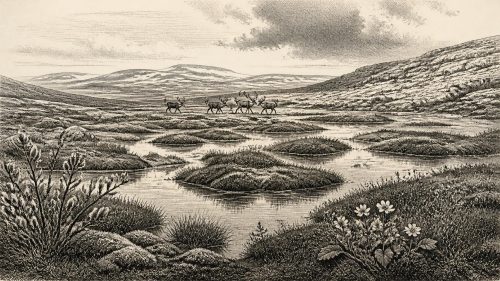
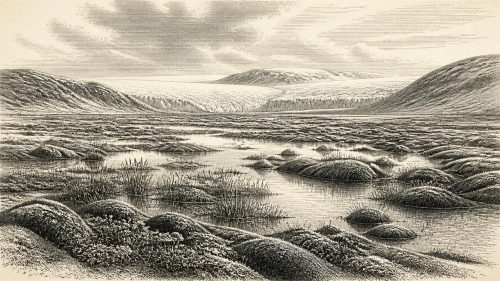
The Derryvree silts contain pollen, plant remains, mosses and insect evidence. Together they indicate open tundra-like ground, periglacial conditions and freshwater habitats rather than woodland or a settled agricultural landscape. Sedges and aquatic or wet-ground plants grew around pools and marshy margins. The insect fauna included species with northern or Arctic affinities. This was not an empty wasteland: even severe climates sustain intricate food webs. But it was a landscape shaped by short growing seasons, frost action, exposed soils, standing water and powerful seasonal contrasts. Trees, if present anywhere locally, were not the defining feature of the Derryvree environment.
Derryvree also demonstrates why simple maps of an “ice-covered Ireland” can mislead. Ice-sheet margins were not permanently fixed. The lower till proves an earlier advance; the organic interval proves that non-glacial freshwater conditions subsequently existed at that site; the upper till records later renewed ice occupation or expansion. Whether other districts were ice-free, thinly glaciated, glacier-front terrain or beyond the reach of ice at precisely the same moment depended on local topography and shifting climate. The later Last Glacial Maximum would transform much of Ireland far more comprehensively, eroding or burying older surfaces and helping to explain the extraordinary scarcity of surviving early archaeological evidence.
Caves and Cold-Stage Animals
In southern Ireland, Castlepook Cave near Doneraile, County Cork, supplies a different kind of record. Excavated principally in the early twentieth century, its chambers yielded a notable collection of Pleistocene animal remains. Reindeer are particularly important, but the wider collection has also included red deer, giant deer, brown bear, wolf, fox, hare, lemmings, woolly mammoth and spotted hyaena. The cave shows that Ireland participated in a wider north-west European cold-stage animal world. Herbivores, carnivores and scavengers did not belong to a mythical isolated fauna: their presence depended on ecological corridors and changing geography beyond the modern shoreline.
Yet Castlepook must not be treated as a census taken in one season. Cave deposits can combine material accumulated at different times through animal deaths, carnivore denning, scavenging, water movement, sediment disturbance and antiquarian excavation. Recent redating of southern Irish cave fauna has shown that several older determinations were too young because methods for extracting and cleaning bone collagen have improved. The revised results indicate that parts of the Castlepook fauna are considerably older than once supposed, and suggest that giant deer and spotted hyaena may have disappeared locally before about 40,000 calibrated years ago. Thus, their bones illuminate the broader Marine Isotope Stage 3 setting, but should not be placed automatically beside a reindeer at Derryvree in 31,784 BCE.
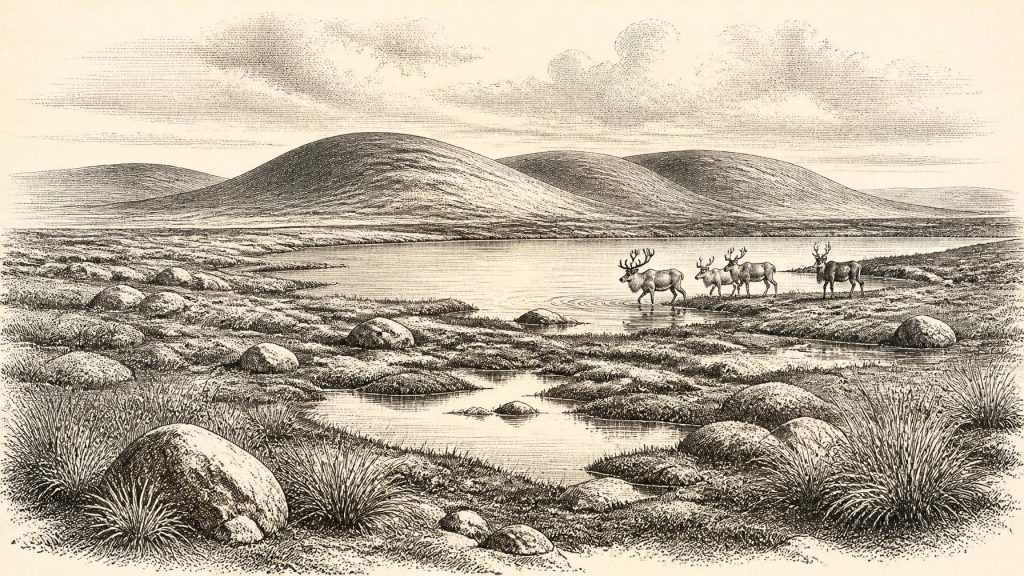
The animal evidence nevertheless permits careful interpretation. Reindeer are well suited to cold, open country and could have grazed grasses, sedges, herbs and dwarf shrubs across tundra and steppe-tundra mosaics. Hares, foxes and lemmings evoke smaller-scale habitats among wet ground, vegetation cover and stony soils. Wolves and hyaenas, when present in Ireland, indicate that large prey animals could support predators and scavengers. Mammoth remains point to connections with a continental Pleistocene fauna, though a find in a cave does not reveal the precise route, season or ecological circumstances by which an animal reached the island. Fossils establish former presence; they do not by themselves recreate behaviour.
The Unsettled Question of People
The possibility of people in Ireland during this broad interval rests largely on a reindeer femur from Castlepook. A mark on the bone has been interpreted as an incision or chop made with a sharp stone implement, and the specimen has been associated with an age of roughly 33,000 years. If that interpretation and dating remain sound, it would be potentially transformative: it would indicate that people processed animal tissue in Ireland many millennia before the island’s formerly accepted post-glacial human record.
But the conclusion must remain deliberately narrow. The bone came from an old cave collection, not from a newly excavated, sealed occupation floor with a hearth, stone-tool scatter, dwelling, repeated butchered assemblage or human burial. One modified bone could record a brief visit or hunting episode; it cannot demonstrate a permanent population, continuous occupation, a village or a distinct cultural tradition. Neither can a cut mark reveal language, kinship, political authority or belief. The claim is important precisely because it is so rare, and rarity makes context and independent confirmation essential. Continued work in undisturbed cave sediment is more likely to clarify the question than confident storytelling around a single object.
Elsewhere in north-west Europe, Homo sapiens groups of this era made sophisticated stone and organic tools, used fire, maintained far-reaching social contacts and, in some regions, created personal ornaments and cave art. That wider evidence makes a human visit to Ireland conceivable. It does not prove that every such practice occurred here. There is presently no securely identified Irish artwork, hearth, camp structure, tool assemblage or burial that can responsibly be assigned to around 31,784 BCE. The appropriate distinction is between European context and Irish evidence.
No Kingdoms, No Trade Network
Political affairs, diplomacy and organised warfare cannot be reconstructed for Ireland at this date. There is no evidence for polities, chiefs, territorial boundaries, alliances or conflict between human communities. Nor can religion, learning or formal cultural institutions be described from Irish material. If people visited, their everyday life may have involved mobile foraging, hunting and the management of fire, clothing and food in a cold climate, but that is an inference from better-documented contemporary societies elsewhere, not a demonstrated Irish household.
For the same reason, there is no evidence for an Irish economy or trade system. The meaningful economic history is ecological: plants converting a brief growing season into forage; herbivores moving through open ground; predators and scavengers exploiting animal populations; freshwater pools sustaining insects and wetland vegetation. Any people present would have depended upon this living landscape rather than farms, livestock, fields, metal or markets. Sea level was lower than today, but the precise existence, timing and usability of land connections between Ireland and Britain remain complex questions shaped by sea level, crustal movement, coastal topography and ice margins. A simple permanent land bridge should not be assumed.
An Evidence-Led Ireland
The most important history around this notional year is therefore the history of environments in motion. Derryvree preserves cold freshwater life between glacial advances. Castlepook preserves fragments of a changing mammal world and a possible, still limited, human trace. Together they show that Late Pleistocene Ireland was neither timeless nor uniformly buried beneath ice. It was a changing edge-land, sometimes capable of supporting tundra wetlands and large animals, then altered again by the advancing British–Irish Ice Sheet. That is not a lesser history because it lacks kings and battles. It is the deep environmental precondition for every later human history of Ireland.
Primary Sources
- A reconsideration of the radiocarbon dating of the Marine Isotope Stage 3 fauna from southern Ireland
- Middle Midlandian Freshwater Series at Derryvree, Maguiresbridge, County Fermanagh, Northern Ireland
- Early Midlandian–Middle Midlandian, Pleistocene, Northern Ireland
- The Exploration of Castlepook Cave, County Cork
- The Exploration of Castlepook Cave, Co. Cork. With 3 plates.
- Occurrence of mammalia relicts at site Castlepook Cave
- Pleistocene Vertebrates in the British Isles
- Extent and timing of the Last Glacial Maximum (LGM) in Britain and Ireland: a review
- Pattern and timing of retreat of the last British-Irish Ice Sheet
- Pattern, style and timing of British–Irish Ice Sheet advance and retreat over the last 45,000 years: evidence from NW Scotland and the adjacent continental shelf
- Maximum extent and dynamic behaviour of the last British–Irish Ice Sheet west of Ireland
- Sedimentology and chronology of the advance and retreat of the last British-Irish ice sheet on the continental shelf west of Ireland
- Dating constraints on the last British-Irish Ice Sheet: a map and database
- Deglaciation, Earth crustal behaviour and sea-level changes in the determination of insularity: A perspective from Ireland
- The problem of a late quaternary landbridge between Britain and Ireland
- Sea-level change and inner shelf stratigraphy off Northern Ireland
- The IntCal20 Northern Hemisphere Radiocarbon Age Calibration Curve (0–55 cal kBP)
- IntCal Publications
- First evidence of a Late Upper Palaeolithic human presence in Ireland
- New insights on the fauna of Ireland's Younger Dryas and Early Holocene from Alice & Gwendoline Cave
- Revisiting Alice and Gwendoline Cave, Co. Clare: New light on the 1902 excavations
- Heritage Artefacts of County Cork