Fermanagh’s Moss-and-Sedge Archive31801 BCE
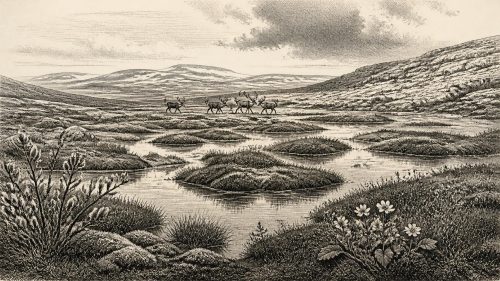
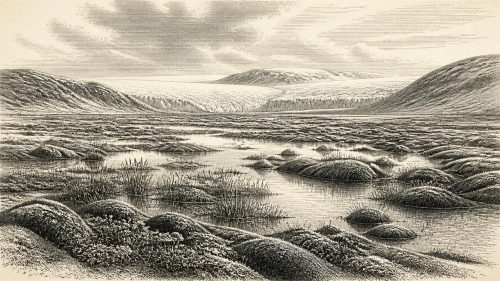
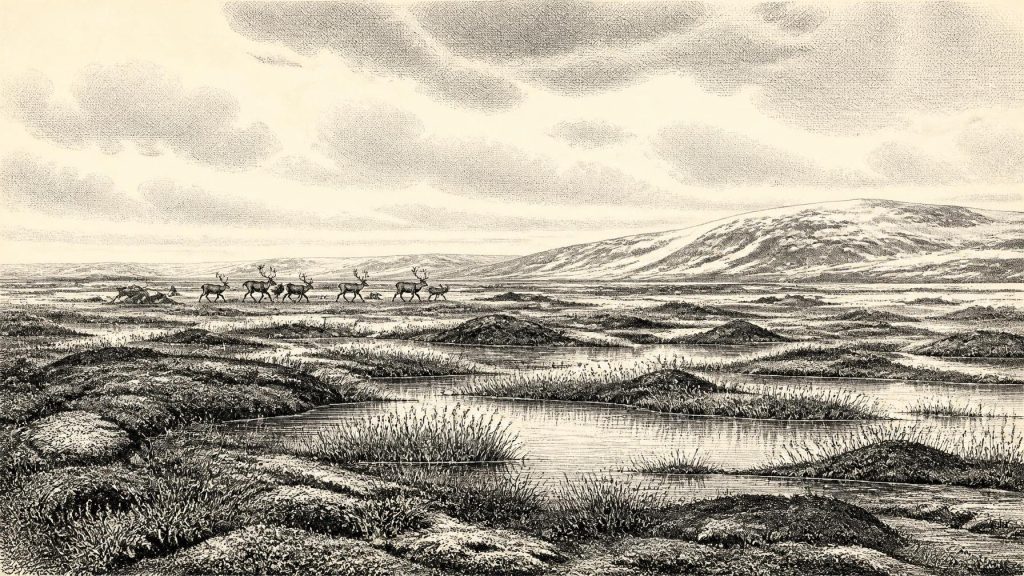
Around 31,801 BCE, a retrospective and imprecise calendar conversion, Ireland lay in the unstable later Marine Isotope Stage 3. At Derryvree, County Fermanagh, organic sediments between tills preserve mosses, sedges and cold-climate insects, indicating open tundra, freshwater hollows and periglacial conditions between ice advances. Related deposits confirm intermittent non-glacial environments, not island-wide conditions. Castlepook Cave, County Cork, contains mixed MIS 3 fauna including mammoth, reindeer, hyaena and bear. A cut-marked reindeer femur may indicate human carcass processing, but cannot prove settlement. Approaching major ice expansion, Ireland’s record remains environmental, fragmentary and cautiously interpreted, with chronology expressed through broad calibrated ranges.
Dateline
Modern calendar-year precision is not available for Ireland in 31,801 BCE. The number is a retrospective conversion, not a date that anyone living then could have recognised or recorded. It corresponds approximately to 33,750 years before AD 1950, the reference point conventionally used for “before present” (BP) dating. At this depth of time, archaeologists and Quaternary scientists work with broad calibrated ranges, sediment sequences and changing environmental phases rather than events fixed to a single year. The most responsible setting is the later part of Marine Isotope Stage 3 (MIS 3), a long and climatically unstable interval of the Late Pleistocene.
Ireland at this point was not a country of kingdoms, parishes, farms or written memories. There is no evidence for political institutions, diplomacy, trade routes, religious monuments, named communities, or a resident human population. Yet it was not an empty abstraction. Fossil plants, insects, animal bones, cave deposits and glacial sediments show that parts of the island supported life during intervals between advances of ice. They allow a limited but vivid reconstruction of an Irish landscape undergoing profound environmental change.
A Date Within Ranges
The distinction between radiocarbon and calendar time matters especially here. A radiocarbon measurement is not itself a calendar date: variations in atmospheric carbon-14 must be corrected through calibration, and uncertainty expands markedly at great antiquity. IntCal20, the current internationally compiled Northern Hemisphere calibration curve, reaches back to 55,000 calibrated years BP, but its authors stress that older determinations may produce wide or more than one possible calendar range. A numbered BCE year can therefore only be used as a convenient point within a much broader archaeological timescale.
The closest securely dated environmental sequence relevant to this date comes from Derryvree, near Maguiresbridge in County Fermanagh. Road works in 1969 exposed a drumlin in section. Beneath a later till, or glacial deposit, investigators found freshwater silts and fine sands rich in organic material; below them lay another till. The position of the deposit is crucial. It records a period when local conditions allowed freshwater sediment, vegetation and insects to persist between two episodes of ice advance, rather than a single unbroken “Ice Age” landscape. The original radiocarbon result was 30,500 radiocarbon years BP, with a substantial uncertainty; published calibrations place it broadly around 36,900–31,700 cal BP. Thus 31,801 BCE lies near the younger end of the wide period that the deposit may illuminate, rather than being a precisely dated moment within it.
Fresh Water Under Later Ice
Derryvree’s evidence is modest in scale but unusually valuable. The organic beds contained freshwater mosses and sedges, poorly preserved pollen dominated by herbs, and insects indicative of cold northern conditions. Taken together, these remains support the conclusion that the locality held open tundra vegetation and a periglacial climate: cold, seasonal ground affected by freezing and thawing, rather than temperate woodland. The vegetation was likely sparse in drier places, while wetter hollows supported mosses, sedges and standing or slow-moving water. This was an ecological patchwork, not a featureless snowfield.
The same Fermanagh region preserves other inter-till deposits at Hollymount and Greenagho. They demonstrate that cold but non-glacial conditions occurred in parts of the north-west during the Midlandian, the regional name often used for the last glacial cycle in Ireland. Their chronologies remain imperfect. Greenagho’s radiocarbon determination of 32,460 BP is treated cautiously as a minimum age, while the deposits cannot simply be assumed to be exactly contemporary with Derryvree. This qualification is important: a locality may offer a window onto a broad climatic phase without recording conditions across all Ireland at the same instant.
The environmental evidence nevertheless rules out familiar modern images of the island. There were no Atlantic oakwoods, enclosed fields, peat-cuttings or settled shores. The rivers and wetlands of places such as Fermanagh lay within a colder world, and the coast was radically altered by lower global sea level. Exposed shelves and changing ice margins reshaped the distances and possible routes between Ireland, Britain and continental Europe. Precisely how accessible every part of Ireland was at any particular millennial phase remains debated; the evidence does not justify imagining a permanent land bridge or an easy migration corridor at this specific date.
Castlepook’s Animal Record
Far to the south, Castlepook Cave near Doneraile in north County Cork offers the most substantial animal archive for Ireland before the Last Glacial Maximum. Excavations undertaken mainly between 1904 and 1918 recovered more than 2,000 bones from a complex limestone cave system. Later re-dating has shown that its fauna spans a long and mixed interval, with individual specimens dating between roughly 45,700 and 19,950 BP. The cave was a repository, not a neatly preserved camp floor: water disturbance, carnivore activity and antiquarian excavation have all complicated the original relationships between bones and sediments.
Even so, the assemblage establishes that a striking range of mammals entered or used Irish landscapes during MIS 3. Castlepook has yielded woolly mammoth, giant deer, reindeer, brown bear and spotted hyaena, alongside later cold-adapted animals including Arctic fox, wolf, Norwegian lemming and collared lemming. These remains should not be treated as a single herd encountered on one day. They were accumulated across many thousands of years and by more than one process. But they show that Ireland contained, at different times and in different combinations, grazers and browsers, predators, scavengers and small mammals adapted to severe northern environments.
For everyday life in the strictly ecological sense, this meant movement, risk and seasonality. Reindeer and mammoth required extensive feeding grounds; hyaenas could drag carcass parts into caves; wolves, bears and foxes occupied different predatory or scavenging niches. The preservation of bones in a cave is therefore evidence both of living animal communities and of death, transport and disturbance after death. Predation and scavenging are real forms of conflict visible in the record, but they are not evidence for warfare, territorial states or human hunting parties.
The Reindeer Bone Question
A single Castlepook reindeer femur has given this period exceptional archaeological importance. It has been reported as approximately 33,000 years old and bears a deep mark which zooarchaeologist Ruth Carden has interpreted as having been made by a sharp stone tool during carcass processing. County Cork heritage material presents the specimen as potential evidence for Palaeolithic hunters handling reindeer in the Doneraile area. If that interpretation is confirmed, it would indicate a human visit to Ireland vastly earlier than the long-established post-glacial record.
The qualification is as important as the possibility. The radiocarbon date establishes when the reindeer died, not independently when the mark was made, where the animal was killed, or how long people may have stayed. The bone comes from an old cave collection, not a modern excavation of an intact occupation surface. No securely associated hearth, stone-tool assemblage, dwelling floor, burial, art object or human bone has yet established a 32nd-millennium BCE settlement in Ireland. Castlepook’s hyaenas and water-disturbed deposits are reminders that caves mix histories. The mark may be highly significant, but it cannot by itself reveal the number, identity, language, beliefs or descendants of any people involved.
Accordingly, society can be discussed only conditionally. If humans processed the reindeer, they probably possessed a sharp lithic edge and knowledge of animal carcass handling. That would be evidence for a brief Upper Palaeolithic incursion or activity episode, perhaps linked to mobile hunting across the wider north-west European zone. It would not prove a permanent Irish population, a village, social hierarchy, regular seasonal return, or continuity with Ireland’s much later inhabitants. Such possibilities remain questions for future excavation, especially if undisturbed deposits or associated artefacts can be recovered and published.
Before the Great Expansion of Ice
The wider glacial chronology explains why this evidence is so fragmentary. The final British–Irish Ice Sheet did not grow and retreat everywhere at once. Large-scale reconstruction places the greatest ice volume at about 23,000 BP, while the timing of maximum extent varied between sectors from about 30,000 to 22,000 BP. Around the broad timespan represented by 31,801 BCE, Ireland was therefore approaching major late-glacial ice expansion, but local landscapes could differ sharply according to altitude, latitude, ice flow and climate. Later ice also eroded or buried much of the older terrestrial record.
The chief historical development appropriate to this date is consequently environmental, not political. Ireland contained pockets of cold open ground and freshwater habitat during a volatile phase of the Pleistocene. Fermanagh’s mosses, sedges and insects record one such landscape; Castlepook’s bones record a wider animal world in which mammoth, reindeer and hyaena could occur. The marked reindeer femur poses the tantalising possibility of human action, but not yet a settled human history. For 31,801 BCE, the honest account is one of calibrated ranges, surviving traces and carefully bounded interpretation.
Primary Sources
- Middle Midlandian Freshwater Series at Derryvree, Maguiresbridge, County Fermanagh, Northern Ireland
- A Reconsideration of the Radiocarbon Dating of the Marine Isotope Stage 3 Fauna from Southern Ireland
- The Irish Quaternary Fauna Project
- Castlepook Cave: Cork County Geological Site Report
- Early Midlandian–Middle Midlandian, Pleistocene, Northern Ireland
- Middle Midlandian Interstadial Deposits at Greenagho, Near Belcoo, County Fermanagh, Northern Ireland
- Growth and Retreat of the Last British–Irish Ice Sheet, 31,000 to 15,000 Years Ago: the BRITICE-CHRONO Reconstruction
- Growth and Retreat of the Last British–Irish Ice Sheet, 31 000 to 15 000 Years Ago: the BRITICE-CHRONO Reconstruction
- Pattern and Timing of Retreat of the Last British-Irish Ice Sheet
- Maximum Extent and Dynamic Behaviour of the Last British–Irish Ice Sheet West of Ireland
- The IntCal20 Northern Hemisphere Radiocarbon Age Calibration Curve (0–55 cal kBP)
- The IntCal20 Northern Hemisphere Radiocarbon Age Calibration Curve (0-55 kcal BP)
- New Insights on the Fauna of Ireland's Younger Dryas and Early Holocene from Alice & Gwendoline Cave
- Heritage Artefacts of County Cork
- Castlepook Cave Excavation, County Cork
- The Antiquity of Man in Ireland
- Mammoth Cave, County Cork
- Palaeoecology: Irish Quaternary Association Field Guide
- Middle Midlandian Freshwater Series at Derryvree, Maguiresbridge, County Fermanagh, Northern Ireland
- Reindeer Bone Found in Cork Cave Shows Human Activity in Ireland 33,000 Years Ago