The Maguiresbridge Silts31802 BCE
Around 31,802 BCE, Ireland lay within the climatically unstable Marine Isotope Stage 3, not a date capable of supporting annual history. At Derryvree near Maguiresbridge, freshwater silts, mosses, sedges and Arctic insects between till layers record a cold, treeless, locally ice-free interval. Comparable northern deposits show repeated glacial advances and retreats. Castlepook Cave preserves remains of cold-adapted fauna, including reindeer, giant deer, mammoth and predators, accumulated over varied periods. A possibly tool-marked reindeer bone suggests, but cannot prove, brief human presence. Evidence supports environmental change and animal occupation, while rejecting claims about contemporary Irish society, settlement or continuous human ancestry.
Dateline
31,802 BCE is a modern label imposed on a time far beyond written memory. No community in Ireland recorded a year, a ruler, a battle or a ceremony at this point, and no Irish deposit can responsibly be dated to that single calendar year. In conventional arithmetic it lies about 33,751 years before AD 1950, the reference point used for “before present” dates. The appropriate historical frame is therefore not an annual chronicle but a broad interval in Marine Isotope Stage 3, a climatically unstable stretch of the last Ice Age.
The best evidence comes from sediments, fossils and landforms rather than from settlements or documents. Radiocarbon measurements of this age are not direct calendar dates: they need calibration against long-term changes in atmospheric carbon-14, and their calendar ranges can be wide. Around the horizon represented by 31,802 BCE, Ireland was a cold, changing place in which open ground, freshwater basins and cave shelters supported animals adapted to severe conditions. Whether people entered this landscape remains an important but unresolved archaeological question.
A Date Measured in Ranges
The numbered year falls within the calibrated range associated with organic sediments at Derryvree, near Maguiresbridge in County Fermanagh. Roadworks exposed a remarkable sequence through a drumlin: one body of glacial till lay below freshwater sands and silts, while another till sealed them above. The deposit consequently preserves an interval when ice was absent locally between two major phases of glaciation. Organic material from the freshwater beds produced a radiocarbon age of about 30,500 years before present; calibration has placed it broadly at approximately 36,900–31,700 calibrated years before present.
That range includes the modern label 31,802 BCE, but it does not identify a particular season, generation or event. Nor does it mean that every layer at Derryvree formed at once. The silts accumulated over time in and around freshwater, then were overridden or buried by later ice. Their importance lies in their stratigraphic order: beneath the later till was a living, non-glacial environment. This is much firmer evidence than any attempt to describe a particular day in prehistoric Ireland.
A Freshwater World Beneath the Till
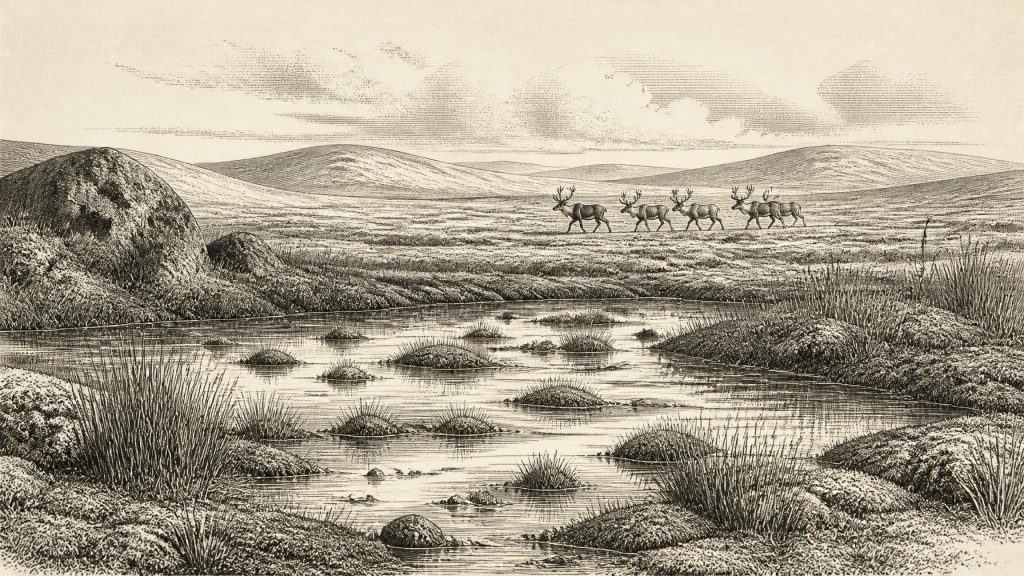
Derryvree’s plant remains and insect fauna point to a cold, largely treeless environment. Freshwater mosses and sedges grew in wet ground; the insect evidence has a northern or Arctic character. Older descriptions used the word “muskeg” for this kind of wet, peaty, tundra-like terrain. It should not be imagined as a uniform white wilderness. The locality included water, fine sediment, wet vegetation and changing margins, all responsive to season, drainage and temperature. Yet it was very different from the densely wooded, agriculturally altered Ireland familiar today.
Other northern deposits help establish the wider pattern while also showing why simple island-wide reconstructions are hazardous. At Greenagho near Belcoo, County Fermanagh, organic material beneath till has been dated to roughly 32,460 radiocarbon years before present, with a calibrated range commonly given as about 37,200–35,700 years before present. Hollymount, also near Maguiresbridge, and Aghnadarragh beside Lough Neagh preserve further inter-till freshwater deposits. These sites demonstrate repeated alternations between ice advance and periods in which water, plants and animals occupied exposed land. They do not prove identical weather or vegetation across every Irish region at the same moment.
Open Country and Animal Life
The animal record is especially vivid in the limestone caves of southern Ireland. Castlepook Cave, near Doneraile in north Cork, has yielded remains of reindeer, giant deer, brown bear, wolf, Arctic fox, lemmings, spotted hyaena and woolly mammoth from deposits of differing ages. Radiocarbon dating shows that its assemblage was not a single contemporaneous community: bones entered the cave over a long period and were later disturbed and re-sorted by water and other processes. Still, specimens dating broadly to the earlier and middle part of the last glacial cycle establish that such animals could use Irish landscapes before the Last Glacial Maximum.
Reindeer and giant deer suggest extensive grazing ground, while lemmings and Arctic foxes suit a cold, open setting. Wolves, bears and hyaenas were predators, scavengers or occasional cave users, rather than signs of a stable “Ice Age zoo” gathered at one place. Mammoth remains are striking but similarly require caution: a mammoth bone in a cave says that the animal or part of it reached the cave system, not necessarily that mammoths were regularly present in every district. The responsible conclusion is that parts of Ireland supported a varied cold-climate fauna, not that any precise animal population can be calculated for 31,802 BCE.
Before the Greatest Ice Advance
This was before the fullest known expansion of the last British–Irish Ice Sheet, generally placed much later, around 26,000–21,000 years ago, with regional advances and retreats varying considerably. Research on southern Ireland, the Irish Sea and the Atlantic shelf has transformed older assumptions that large southern areas escaped the last glaciation. Much of the island was eventually affected by ice, although the timing, thickness and behaviour of that ice differed from place to place and remain subjects of active study.
At the horizon considered here, the Derryvree and Greenagho evidence indicates ice-free conditions in parts of north-central Ireland during at least part of the interval. Cave faunas in Cork likewise show that southern landscapes were accessible to large mammals. It would be unsafe, however, to turn those local records into a definitive map of an entirely ice-free Ireland. The growing ice sheet, its margins and the exposed land beyond them changed through time. Sea level was lower than today, but the exact character of routes between Ireland, Britain and continental Europe cannot be reduced to a single assertion of a permanent land bridge or an uncomplicated crossing.
The Castlepook Human Question
The possibility of people in Ireland gives this period unusual significance. A reindeer femur from Castlepook Cave has been identified by zooarchaeologist Ruth Carden as bearing a deep mark consistent with cutting or chopping by a sharp stone tool during carcass processing. County Cork heritage material presents the bone as approximately 31,000 BCE and as potential evidence of very early human activity. If that reading is confirmed, it would push evidence for people in Ireland far earlier than the securely documented terminal Palaeolithic occupation of the island.
It is nevertheless a possibility, not a licence to invent a population. The bone comes from an old cave collection, not a modern excavation with a fully recorded activity surface. Castlepook’s deposits have experienced disturbance, and the cave accumulated animal remains through several mechanisms. Surface modifications must be distinguished from carnivore damage, sediment abrasion, weathering, excavation damage and later handling. Nor is there a securely associated hearth, stone-tool assemblage, dwelling, burial or series of occupation layers from the cave that would demonstrate a settled group.
Even should the mark prove anthropogenic, the most that can safely be inferred is a brief human encounter with a reindeer carcass in Ireland during a broad part of the Ice Age. Hunters might have travelled through a low-sea-level landscape from Britain or the European mainland; they might have butchered an animal locally, or a bone could have moved after processing. The evidence cannot identify their language, social organisation, beliefs, place of origin or the duration of any visit. It is equally unable to establish a continuous ancestral community.
Society Without a Chronicle
Accordingly, there are no evidenced political affairs, diplomatic relations, chiefs, territories or wars to narrate for Ireland in 31,802 BCE. If people did reach the island, their economy would have depended on knowledge of animals, weather, shelter and movement through a dangerous cold-country environment. That is an inference from the ecological setting and the wider Upper Palaeolithic world, rather than a fact demonstrated by an Irish camp. There is no direct Irish evidence here for houses, clothing, boats, exchange networks, ritual practice, art, formal learning or organised conflict.
The caves themselves should not be casually called human homes. For the animals represented at Castlepook, they could be dens, traps, refuges or places into which bones were washed. For people, if present at all, caves may have been landmarks or temporary shelters, but no archaeological floor permits that conclusion. The distinction matters. Absence of evidence does not prove that no person ever crossed the landscape; it does mean that claims about an Irish society at this date exceed what the record can bear.
An Archive of Change
The most meaningful history of Ireland around 31,802 BCE is therefore environmental. Derryvree’s silts preserve sedges, mosses, insects and freshwater conditions between glacial advances. Greenagho, Hollymount and Aghnadarragh extend the record of unstable cold-stage landscapes in the north. Castlepook’s bones provide a separate southern archive of animals moving through open country and using cave systems across a long span. Together they reveal a land in transition, inhabited certainly by cold-adapted fauna and perhaps visited briefly by people, before later ice profoundly remade its surface.
That restraint is not a deficiency. It is the achievement of prehistoric research to recover a credible Irish past from minute organic traces, fractured bones and layers beneath the till—while keeping clear the boundary between what the evidence establishes and what remains an enticing, unanswered question.
Primary Sources
- A Middle Midlandian Freshwater Series at Derryvree, Maguiresbridge, County Fermanagh, Northern Ireland
- The Irish Quaternary Fauna Project
- Archaeological Heritage of County Cork
- Figure 6.— The Subdivision of the Quaternary Period in Ireland
- Early Midlandian–Middle Midlandian, Pleistocene, Northern Ireland
- Quaternary Deposits and Glacial Stratigraphy in Ireland
- The Geological Heritage of County Leitrim
- Soils of Co. Waterford
- Freshwater Organic Deposits and Stratified Sediments Between Early and Late Midlandian (Devensian) Till Sheets, at Aghnadarragh, County Antrim, Northern Ireland
- References and Recommended Reading
- The IntCal20 Northern Hemisphere Radiocarbon Age Calibration Curve (0–55 cal kBP)
- IntCal20
- Trimlines, Blockfields and the Vertical Extent of the Last Ice Sheet in Southern Ireland
- Late Pleistocene Chronostratigraphy and Ice Sheet Limits, Southern Ireland
- Advance and Retreat of the Marine-Terminating Irish Sea Ice Stream into the Celtic Sea During the Last Glacial: Timing and Maximum Extent
- Ice Sheet Extension to the Celtic Sea Shelf Edge at the Last Glacial Maximum
- Maximum Extent and Dynamic Behaviour of the Last British–Irish Ice Sheet West of Ireland
- Oscillating Retreat of the Last British-Irish Ice Sheet on the Continental Shelf Offshore Galway Bay, Western Ireland
- Last Glacial Maximum Cirque Glaciation in Ireland and Implications for Reconstructions of the Irish Ice Sheet
- Dimensions and Chronology of the Last Ice Sheet in Western Ireland
- Stratigraphic and Palaeo-Geomorphological Evidence for the Glacial-Deglacial History of the Last British-Irish Ice Sheet in the North-Western Irish Sea