
Castlepook’s Open Hinterland31619 BCE
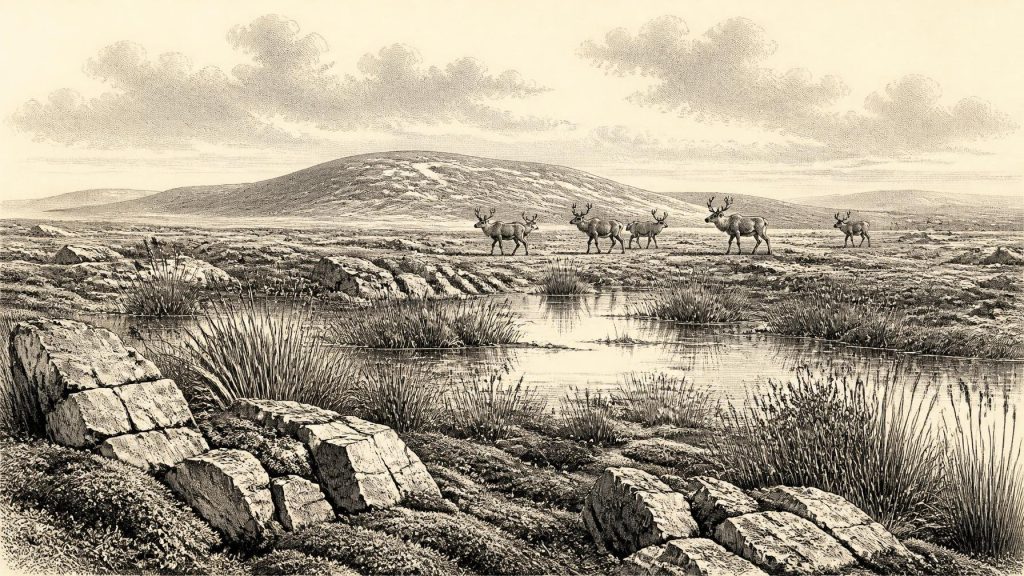
At the modern reference point 31,619 BCE, Ireland lay within the climatically volatile Late Pleistocene, before final glacial expansion. Parts remained ice-free, though ice, frozen ground and altered coastlines created shifting environments and uncertain access. Derryvree’s deposits record cold, open tundra wetland with grasses, sedges, herbs and freshwater plants. Castlepook Cave preserves diverse fauna, including mammoth, reindeer, giant deer, bear and hyena, accumulated over complex periods. A possibly cut-marked reindeer femur suggests but does not prove human presence. No settlements, tools, institutions or continuous population are evidenced. The period is defined by ecological possibility and glacial transformation, rather than history.
Dateline
31,619 BCE is not a date to which Irish prehistory can be pinned with calendar-year accuracy. No people then living could have used such a year-number, and neither archaeological deposits nor radiocarbon results isolate an event to it. It is best treated as a modern reference point, roughly 33.6 thousand calendar years before the 1950 baseline used for radiocarbon chronology. It falls within the Late Pleistocene, during Marine Isotope Stage 3: a cold, climatically volatile part of the last Ice Age, long before Ireland’s final glacial maximum. What can responsibly be said concerns ranges, deposits and changing environments rather than a named person, battle, settlement or political act.
A Landscape in Transition
At this broad point in time, Ireland was not yet the thoroughly ice-covered landscape of the Last Glacial Maximum, conventionally placed at about 26.5–19 thousand years ago. Evidence from beneath later glacial deposits indicates that parts of the island remained ice-free during earlier phases of the last glaciation. A study of the Irish ice sheet’s development concludes that the bulk of the final ice expansion began from largely ice-free conditions around 34,000 years ago and only reached the south coast much later. That is an important qualification: around the notional year 31,619 BCE, advancing and locally persistent ice, snowfields, frozen ground, waterways and exposed terrain may all have mattered, but their precise arrangement cannot be mapped year by year.
The island’s modern outline is also misleading. Global sea level was substantially lower during the Ice Age, and the coasts lay far beyond many present shorelines. Yet lower sea level does not automatically prove a simple dry-land route into every part of Ireland. The Irish Sea basin, changing ice margins, rivers, estuaries and seasonal sea ice created a shifting geographical threshold. For animals, and perhaps for occasional human visitors, access could have varied greatly by route and by century. The evidence does not warrant a confident picture of a permanent land bridge, still less a regular migration corridor used by settled communities.
The strongest environmental window comes not from a single place in 31,619 BCE but from deposits whose calibrated ranges overlap this broad period. At Derryvree near Maguiresbridge in County Fermanagh, roadworks exposed organic silts and fine sands trapped between two substantial sheets of till. The original radiocarbon result, Birm-166, was 30,500 radiocarbon years BP, with a sizeable uncertainty; later calibration places it broadly around 36.9–31.7 thousand calendar years BP. That range encompasses the modern reference year in this article, but it must not be mistaken for proof that its plants and animals lived in one particular calendar year.
Derryvree’s Tundra Wetland
Derryvree nevertheless preserves unusually vivid evidence for the kind of environment that could exist in northern Ireland before the last major ice advance. Its plant and animal remains indicate open tundra and a periglacial regime: ground shaped by severe frost, seasonal thaw and short summers rather than woodland. Grasses and sedges were important, with juniper and herbs, mosses and wetland plants. Fossil remains of bogbean and mountain avens are especially revealing. Bogbean suggests standing or slow-moving freshwater in a cold marshy setting; mountain avens points towards open, cold-adapted vegetation. These are direct environmental observations from the deposit, not names for a vanished ‘Derryvree people’.
Such a landscape was not an empty white wilderness. It probably combined frost-shattered slopes, thinly vegetated ground, sedge-rich hollows, pools, rivulets and sheltered patches where plants could grow during a brief season. Insect evidence from another Irish Middle Midlandian locality, Aghnadarragh, has been interpreted as indicating sparse open vegetation and markedly cold winters; estimates published for that assemblage give mean July temperatures of approximately 11–13°C and mean January temperatures from about –18 to –7°C. Those figures are a regional palaeoclimatic reconstruction, not a thermometer reading for Derryvree or for 31,619 BCE itself. They do, however, convey the scale of climatic hardship under which Irish ecosystems functioned.
Regional variation matters. Fermanagh’s freshwater silts record a lowland wetland caught between ice advances; cave deposits in north Cork preserve animals accumulated over long and complicated periods; mountain evidence records still different conditions. No single pollen list or bone assemblage can stand for the whole island. The responsible general picture is therefore an open, cold and heterogeneous Ireland, with potentially habitable refuges and corridors in some areas but with conditions liable to alter rapidly as climate fluctuated and the Irish Ice Sheet gathered strength.
Castlepook’s Faunal Record
For the animal world of this period, Castlepook Cave near Doneraile in north County Cork is indispensable. Often called Mammoth Cave, it has yielded Ireland’s richest known pre-Last Glacial Maximum cave fauna. Woolly mammoth, reindeer, giant deer, brown bear and spotted hyena are represented there; later cold-stage remains include Arctic fox, wolf and lemmings. This range demonstrates that Ireland was reached, at different times, by a far more diverse Pleistocene fauna than the island supported after post-glacial separation. It does not demonstrate that every species shared the Awbeg Valley at the same moment, or that a visitor in 31,619 BCE could have seen them all together.
The cave itself was a repository, not a straightforward prehistoric camp. Carnivores could drag in parts of carcasses; scavengers gnawed bones; water shifted material; and early twentieth-century excavations did not meet modern standards of stratigraphic recording. Thousands of bones reportedly came from the cave system, but only a portion entered museum collections. The surviving material is consequently precious but difficult. Modern re-dating has shown that some older radiocarbon determinations from Irish cave collections require reassessment because improved pretreatment methods can remove contaminants that make specimens appear too young. Castlepook’s chronology has therefore become more informative, but also more clearly complex.
Reindeer are central to any reconstruction of this open country. They could exploit sparse tundra vegetation and were part of wider north-west European animal movements during cold phases. Mammoth remains imply the availability, at least episodically, of productive open habitats on a large scale; spotted hyenas indicate a predator and scavenger ecology capable of transporting bones to caves. Giant deer, wolves, bears, hares and small mammals each add to the impression of an interconnected food web. But an assemblage of bones is evidence first for species presence and depositional processes. It only cautiously supports broader interpretations of herd movement, seasonal use of valleys or changing predator territories.
The Human Question
Castlepook is also associated with the most debated possibility for a very early human presence in Ireland. A reindeer femur from the old collection has been described by zooarchaeologist Ruth Carden and by County Cork heritage authorities as bearing a deep mark consistent with cutting fresh tissue using a sharp stone edge. The specimen has been presented as dating to about 31,000 BCE, close enough to the period considered here to be historically striking. If that interpretation is upheld, it would indicate that people butchered a reindeer somewhere in the north Cork landscape during the Late Pleistocene. It would not establish that the cave was a home, that hunting occurred inside it, or that Ireland contained a continuous resident population.
The distinction is fundamental. The bone’s age dates the animal, while identifying an incision as a stone-tool cut is a separate zooarchaeological judgement; the cave’s disturbed collection history adds another layer of caution. A carcass may have been processed elsewhere and a discarded limb bone later taken into the cave by hyenas or wolves. Nor have securely associated Palaeolithic stone tools, hearths, shelters, burials or repeated occupation surfaces been recovered from Castlepook. Current work has identified surviving Pleistocene-bearing deposits and offers the prospect of better-controlled evidence, but the famous reindeer femur remains a small and exceptional trace, not a complete settlement archive.
Accordingly, no political history can be written for Ireland at this date. There is no evidence for rulers, tribes with recoverable names, territories, warfare, diplomacy, law or institutions. There is equally no direct Irish evidence for ritual practice, art, formal learning, trade networks or language. If people did reach the island, the most restrained inference is that they were probably members of small, mobile Upper Palaeolithic hunting groups familiar with stone cutting tools and able to operate in cold, open environments. That inference derives from the marked-bone claim and from comparison with continental Europe; it is not evidence for a distinct Irish society.
Economy Without Settlements
In this setting, ‘economy’ means subsistence rather than markets. Reindeer offered meat, fat, hide, sinew, bone and antler; large herbivores and smaller game could have supplied other resources. Yet there is no Irish assemblage from around this date that permits a confident account of hunting strategy, seasonality, food sharing or tool manufacture. The idea of groups following herds is plausible, particularly in a continent where mobile hunter-gatherers were well established, but it remains interpretation in Ireland. There is no sound evidence for farming, domesticated animals, pottery, metalworking, exchange goods or permanent villages.
What survives instead is a fragile conjunction of scientific records: silts beneath a Fermanagh drumlin, plant macrofossils and pollen, cave bones from north Cork, tooth and gnaw marks, modern radiocarbon recalibration, and the geomorphological scars of later ice. These sources illuminate environmental possibility far better than human biography. They show that portions of Ireland, shortly before final glacial expansion, could support freshwater wetlands, tundra vegetation and substantial mammals. They also show why the archaeological record is so sparse: subsequent ice, erosion, sea-level change and antiquarian excavation have removed, buried or mixed much evidence.
For 31,619 BCE, then, the defining Irish development was neither a recorded event nor a political turning point. It was the existence of a cold but living landscape on the threshold of profound glacial change. Derryvree gives that world a wetland texture; Castlepook gives it animal life and a tantalising, unconfirmed human dimension. The historical value of the period lies precisely in that restraint. Ireland’s earliest possible visitors, if they came, left no story in words. They may have left only a cut on a reindeer bone amid the far larger record of ice, water, plants and animals.
Primary Sources
- A Middle Midlandian Freshwater Series at Derryvree, Maguiresbridge, County Fermanagh, Northern Ireland
- A Reconsideration of the Radiocarbon Dating of the Marine Isotope Stage 3 Fauna from Southern Ireland
- The Irish Quaternary Fauna Project
- Trimlines, Blockfields and the Vertical Extent of the Last Ice Sheet in Southern Ireland
- Dimensions and Chronology of the Last Ice Sheet in Western Ireland
- Radiocarbon Constraints on the Age of the Maximum Advance of the British-Irish Ice Sheet in the Celtic Sea
- Maximum Extent and Dynamic Behaviour of the Last British-Irish Ice Sheet West of Ireland
- The Deglaciation of the Western Sector of the Irish Ice Sheet from the Inner Continental Shelf to its Terrestrial Margin
- Early Deglaciation of the British-Irish Ice Sheet on the Atlantic Shelf Northwest of Ireland Driven by Glacioisostatic Depression and High Relative Sea Level
- Timing and Pace of Ice-Sheet Withdrawal Across the Marine–Terrestrial Transition West of Ireland During the Last Glaciation
- Last Glacial Maximum Cirque Glaciation in Ireland and Implications for Reconstructions of the Irish Ice Sheet
- New Insights on the Fauna of Ireland’s Younger Dryas and Early Holocene from Alice & Gwendoline Cave
- Quaternary Site Descriptions
- Figure 6.— The Subdivision of the Quaternary Period in Ireland
- Castlepook Cave, County Geological Site Report
- Spotted Hyena Skull
- Heritage Artefacts of County Cork
- Castlepook Cave Excavation, 2022
- BSBI: Menyanthes trifoliata
- BSBI: Dryas octopetala