
Derryvree’s Alpine Clubmoss31618 BCE
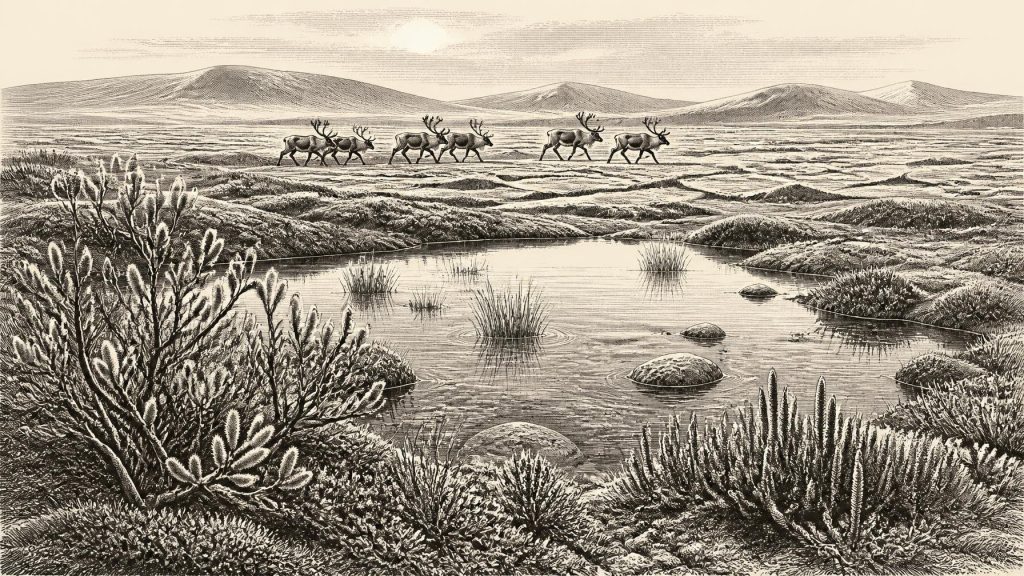
Around 31,618 BCE, Ireland had no recorded history; the date denotes a broad Late Pleistocene interval rather than a specific year. At Derryvree, County Fermanagh, freshwater sediments between glacial tills preserve tundra flora, including dwarf willow, alpine clubmoss and water-milfoil, indicating cold, wet, locally ice-free conditions. Castlepook Cave, County Cork, holds remains of mammoth, giant deer, reindeer and predators, demonstrating periodically suitable habitats, though its bones span many millennia. A marked reindeer femur may indicate human butchery around 33,000 years ago, yet remains disputed. Subsequent ice-sheet expansion destroyed, displaced or buried much evidence, leaving only fragmentary environmental and archaeological traces.
Dateline
31,618 BCE is a modern chronological label, not a date that can be matched to a recorded Irish event. No calendar, writing system, named community or political institution existed in Ireland at this depth of time, and archaeology cannot responsibly isolate a single year. In radiocarbon convention, the date lies about 33,567 years before AD 1950, within the later part of the Late Pleistocene and Marine Isotope Stage 3 (MIS 3). The evidence instead provides overlapping time-ranges: a cold, unstable environment; animal remains from caves; and a small, disputed indication that people may briefly have reached the island.
Intervals Rather Than Annals
The most directly relevant Irish environmental sequence is at Derryvree, near Maguiresbridge in County Fermanagh. Roadworks in 1969 cut through a drumlin and exposed freshwater silts and fine sands trapped between two distinct sheets of glacial till. The order of these layers is important. Ice had deposited the lower till; later, in an interval without local glacier cover, water and organic sediment accumulated; renewed glaciation then laid down the upper till and sealed the deposit. This is not a historical episode in the usual sense, but it is a remarkably clear record of regional environmental change.
Organic material from the Derryvree deposit produced a conventional radiocarbon determination of 30,500 years BP, with a substantial error range. Later calibration places the relevant horizon broadly at about 36,900–31,700 calibrated years BP. The nominal year 31,618 BCE falls within that broad bracket, but cannot be identified as a particular layer, season or generation within it. The same caution applies to every date used here: a scientific age estimate allows an archaeological interval to be discussed; it does not create an Ice Age diary.
The plant and animal evidence from Derryvree indicates open tundra vegetation and a periglacial climate. Fossils include dwarf willow, lesser clubmoss and alternate water-milfoil. Together they point to a landscape with low-growing plants, wet ground and shallow freshwater, rather than the dense woodland now associated with Ireland. Sedges, grasses, herbs, mosses and small shrubs could thrive in sheltered or damp places, while frozen or seasonally frozen ground constrained drainage and soil development. This was not necessarily an unbroken, snow-covered waste. Even in a severe climate, ponds, springs, stream margins and sun-facing slopes created local contrasts in shelter, moisture and food.
An Island Before the Maximum Ice
Ireland at this time stood within the long Midlandian cold stage, but before the later maximum expansion of the British–Irish Ice Sheet. The precise history of the ice sheet remains an active subject of research. Some evidence indicates substantial earlier ice growth and fluctuating margins during MIS 3; other sequences demonstrate that areas of north-central Ireland were ice-free during part of this interval. The Derryvree and Greenagho deposits in Fermanagh are particularly significant because their freshwater sediments survived beneath later glacial deposits.
The responsible picture is therefore regional and changing, rather than one of an island uniformly buried under ice. Around the broad horizon represented by 31,618 BCE, portions of Ireland could support terrestrial and freshwater ecosystems, while glaciers, ice fields and meltwater systems influenced other districts or advanced and retreated through time. The familiar pattern of drumlins, scoured rock and glacial sediment visible across the modern country was still being made and remade. Later ice would alter valleys, strip soils, transport boulders and bury evidence of earlier landscapes.
Climate also changed rapidly on the scale of millennia and centuries during MIS 3. A warmer interstadial could encourage vegetation, animals and perhaps human movement into exposed northern lands; renewed cold could reduce plant cover, freeze ground and enlarge ice masses. It is not possible to assign an annual temperature or a single coast-line to 31,618 BCE. Sea levels were lower than today because much water was held in continental ice, but Irish approaches remained a complicated mixture of land, sea, shallow shelf and glaciated terrain. No evidence from this date demonstrates a permanent land connection, regular seafaring or a dependable route between Ireland and Britain or continental Europe.
Castlepook’s Animal Archive
The richest evidence for the broader Irish animal world comes from Castlepook Cave near Doneraile, County Cork, in the Awbeg valley. Excavations beginning in the early twentieth century recovered more than 2,000 bones from its galleries. Direct dates from individual specimens span a long period, roughly 45,700 to 19,950 years BP. That range is far too wide to make the cave a single deposit or a direct portrait of one moment, but it establishes Castlepook as Ireland’s foremost archive of fauna leading towards the Last Glacial Maximum.
Its Ice Age assemblage includes woolly mammoth, giant deer, reindeer, brown bear and spotted hyaena, as well as wolf, Arctic fox, mountain hare, stoat and lemmings in later cold-stage material. These animals did not necessarily all occupy the same valley at the same time, nor does their presence mean that every species was widespread across Ireland. Cave assemblages are selective records: carnivores drag in carcass parts, animals die in or near entrances, water moves bones, and early excavation can disturb their original relationship. Nevertheless, the collection demonstrates that Ireland was periodically accessible to a far richer large-mammal fauna than the modern island supports.
For living animals, the open country suggested by the Fermanagh flora would have offered different opportunities. Reindeer could exploit tundra plants and seasonal grazing; predators and scavengers could follow herbivore movements; caves and rocky ground provided shelter or dens for some species. Mammoths and giant deer belong to the wider ecological setting, but their remains should not be turned into a neat food-chain tableau. Each specimen has its own age, depositional history and uncertainty. The safe conclusion is that suitable habitats existed in Ireland during parts of MIS 3, allowing cold-adapted and open-ground mammals to move through the region.
A Reindeer Bone and a Cautious Claim
Castlepook also matters because a reindeer femur fragment in the National Museum of Ireland’s Natural History collections has been reported as approximately 33,000 years old and as bearing a deep mark interpreted as having been made by a sharp stone tool while fresh tissue was being removed. If that interpretation is confirmed, it would be evidence that a person or very small group processed a reindeer in Ireland during the Upper Palaeolithic, vastly earlier than the formerly accepted evidence for human presence.
The qualification matters. A directly dated bone gives the age of the animal, not necessarily the instant at which a mark was made. Determining whether a groove came from a lithic edge, carnivore damage, trampling, sediment abrasion, breakage or old excavation requires careful taphonomic and microscopic study. Moreover, Castlepook’s historical collections derive from complex cave contexts affected by water, carnivores and earlier digging. Recent excavation has located surviving sediments, but has not yet supplied an undisturbed Upper Palaeolithic occupation surface that securely associates people, tools and fauna.
Thus the reindeer bone is best treated as a significant and testable clue, not as proof of a village, a permanent population or a named culture. It cannot establish whether people hunted the animal locally, scavenged a carcass, arrived in a single short visit, or returned repeatedly. No human skeletal remains, hearth, stone-tool assemblage, dwelling, burial, art or securely dated camp is known from Ireland for this precise broad period. The stronger claim is also the narrower one: there may be evidence of human handling of a reindeer, but the scale and duration of human presence remain unknown.
Society Beyond the Evidence
For that reason, political affairs, diplomacy and organised warfare cannot be described for Ireland around this date. There were no documented polities, borders, leaders or negotiations, and archaeological evidence does not reveal conflict between human groups. Predation was real in the animal world, and survival in a cold environment would have been demanding, but it would be misleading to convert this into a human political history.
Equally, there is no Irish evidence for religion, formal learning, language, ceremonial practice or artistic traditions at 31,618 BCE. Upper Palaeolithic people elsewhere in Europe made sophisticated tools, ornaments and images, but those continental achievements cannot simply be transferred across the Irish Sea. They provide context for what was possible among contemporary Homo sapiens, not proof of what happened in Ireland. The same restraint applies to clothing, shelters and food: mobile hunter-gatherers would have needed practical knowledge of animals, weather, stone and seasonal landscapes, yet no Irish camp of this age allows its everyday routines to be reconstructed.
Economy, Movement and Loss
If people did reach Ireland, their economy was not farming, herding, metalworking or trade in the later historical sense. The plausible activity indicated by the Castlepook specimen is the immediate use of animal resources: meat, fat, hide, sinew, bone and antler were valuable materials to Upper Palaeolithic hunter-gatherers elsewhere. But there is no evidence in Ireland at this horizon for managed herds, cultivated crops, exchange networks, boats, imported materials or a settled population. Mobility, rather than permanent settlement, is the only interpretation compatible with the slender trace, and even that remains an inference rather than a demonstrated route or pattern.
The overriding historical development was environmental instability. Landscapes capable of supporting wet tundra plants and roaming mammals were vulnerable to the growing power of ice. In subsequent millennia the British–Irish Ice Sheet expanded dramatically, covering much of Ireland and eroding, transporting or sealing earlier deposits. That process helps explain why evidence is so rare: the archaeological record was not merely never created; much of it was probably destroyed, displaced or concealed by glaciation and later rising seas.
Ireland around 31,618 BCE is therefore known not through kings, monuments or communities, but through a buried Fermanagh wetland and the bones of Cork caves. Derryvree’s alpine clubmoss preserves the signature of cold freshwater tundra. Castlepook preserves the remains of animals that moved through a changing western edge of Europe, and perhaps one trace of people among them. Together they offer a rigorous, if fragmentary, beginning: not an annual chronicle, but a landscape in which Irish prehistory was briefly possible before ice transformed it again.
Primary Sources
- A Middle Midlandian Freshwater Series at Derryvree, Maguiresbridge, County Fermanagh, Northern Ireland
- Middle Midlandian Interstadial Deposits at Greenagho, Near Belcoo, County Fermanagh, Northern Ireland
- A Reconsideration of the Radiocarbon Dating of the Marine Isotope Stage 3 Fauna from Southern Ireland
- The Irish Quaternary Fauna Project
- Castlepook Cave
- Heritage Artefacts of County Cork
- Archaeology Research Excavation Grant 2022: Castlepook Cave Project Final Report
- 32564: Castlepook Cave, Co. Cork
- Trimlines, Blockfields and the Vertical Extent of the Last Ice Sheet in Southern Ireland
- Late Pleistocene Chronostratigraphy and Ice Sheet Limits, Southern Ireland
- The Timing and Magnitude of the British–Irish Ice Sheet Between Marine Isotope Stages 5d and 2
- Exploring Controls of the Early and Stepped Deglaciation on the Western Margin of the British Irish Ice Sheet
- Timing and Pace of Ice-Sheet Withdrawal Across the Marine–Terrestrial Transition West of Ireland During the Last Glaciation
- Early Midlandian–Middle Midlandian, Pleistocene, Northern Ireland
- Selaginella selaginoides
- Salix herbacea
- Myriophyllum alterniflorum
- New Insights on the Fauna of Ireland's Younger Dryas and Early Holocene from Alice & Gwendoline Cave
- BRITICE Glacial Map, Version 2: A Map and GIS Database of Glacial Landforms of the Last British–Irish Ice Sheet
- Extent and Timing of the Last Glacial Maximum in Britain and Ireland: A Review