Derryvree’s Freshwater Beds31700 BCE
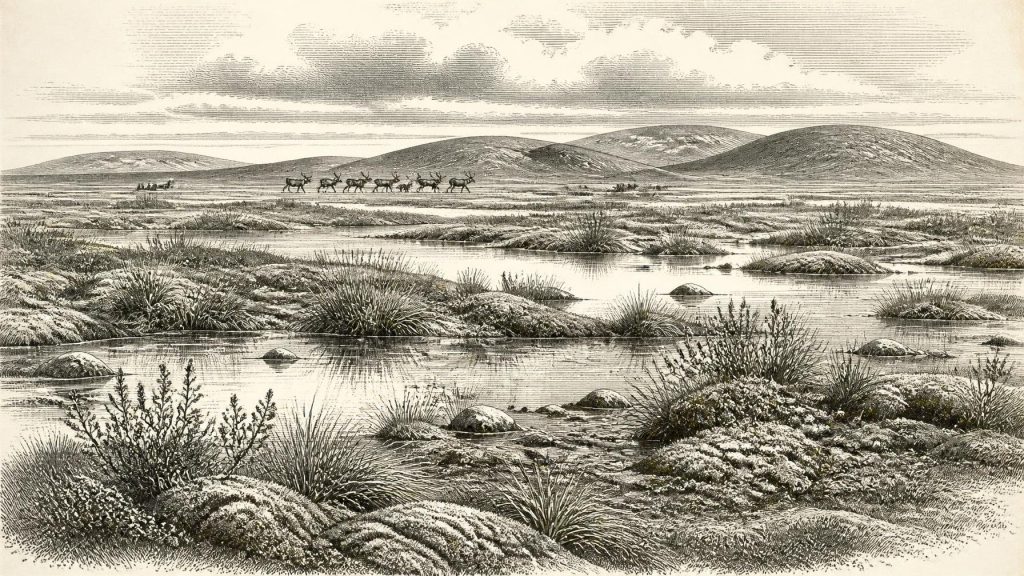
Derryvree’s freshwater sediments near Maguiresbridge provide a cautiously dated glimpse of Ireland during Marine Isotope Stage 3, within a calibrated range encompassing 31,700 BCE. Sandwiched between glacial tills, they indicate ice-free tundra wetland, with mossy vegetation, pools and animal life, rather than continuous ice cover. Greenagho offers comparable pre-maximum evidence. Castlepook Cave preserves mixed remains of mammoth, reindeer, giant deer, bears, hyaenas and other cold-climate fauna. A cut-marked reindeer bone may indicate Palaeolithic butchery, but cannot establish permanent settlement. Later ice destroyed much evidence. Ireland was environmentally variable, increasingly glacial, and possibly visited by mobile hunter-gatherers, though settlement remains unproven.
Dateline
“31,700 BCE” is a modern chronological label, not a year that can be recovered from Irish evidence at annual precision. It corresponds roughly to 33,650 years before AD 1950, but neither archaeology nor palaeoclimate science can isolate an Irish event to that single year. The responsible setting is the later part of the Pleistocene, within Marine Isotope Stage 3 (MIS 3), a long and unstable phase of the last Ice Age. Evidence is dated by radiocarbon determinations, calibrated ranges, sediment sequences and changing animal distributions. It can illuminate an Ireland of cold landscapes and mobile wildlife; it cannot supply a dated ruler, battle, settlement foundation or diplomatic act.
The most closely relevant Irish chronological marker is not a monument but a layer of organic freshwater sediment exposed at Derryvree, near Maguiresbridge in County Fermanagh. This material lay between two deposits of glacial till in a road-cut through a drumlin. Its conventional radiocarbon determination of 30,500 ± 1,100 radiocarbon years BP calibrates broadly to about 36.9–31.7 thousand calendar years BP. That calibrated interval spans approximately 34,950–29,750 BCE and therefore includes 31,700 BCE. It does not prove that the Derryvree pool existed in this precise named year; rather, it provides unusually close evidence for the kind of environment found in north-central Ireland during this part of MIS 3.
A Date Range, Not an Annal
This distinction matters. Radiocarbon years are not the same as calendar years, because atmospheric carbon-14 has varied through time. Calibration curves such as IntCal20 convert measurements into probability ranges, and uncertainty increases at this depth of time. Further complications arise because a sample dates the death of an organism or the formation of a deposit, not necessarily the human or animal activity with which it may later be associated. A calendar-year article can therefore offer a carefully bounded portrait of conditions around the date, but it must not pretend that 31,700 BCE has the documentary clarity of a medieval annal.
Ireland at this horizon was not yet at the maximum of the last glaciation. The Last Glacial Maximum is generally placed at about 26,500–19,000 calendar years BP, substantially later than this article’s notional date. There were already cold conditions, local and regional ice advances, and severe environmental fluctuations; yet the Derryvree evidence, alongside other pre-maximum deposits, shows that at least parts of the island could be ice-free during intervals of the preceding millennia. The advance that later reshaped much of Ireland’s surface was approaching in geological terms, but it had not erased every terrestrial habitat.
Water Among the Drumlins
Derryvree is valuable precisely because it preserves a fleeting non-glacial episode between two episodes of ice deposition. Its fine sands and organic silts record freshwater conditions rather than an uninterrupted frozen wasteland. Plant and insect evidence has been interpreted as indicating an open tundra landscape and a muskeg-like wetland: mossy, plant-rich ground with shallow pools. The setting was harsh, with long cold winters, but it was not biologically empty. Low vegetation, wet hollows and open water offered resources for insects, birds and mammals, while the surrounding ground supported the sparse plant communities characteristic of cold Late Pleistocene environments.
Such evidence corrects an easy but misleading image of Ice Age Ireland as uniformly entombed beneath ice. Conditions changed repeatedly, sometimes on timescales shorter than the broad archaeological periods used in popular history. A freshwater basin in Fermanagh does not describe all regions at once. Upland ground, western coasts, river valleys and limestone districts responded differently to snowfall, permafrost, drainage and ice movement. Nevertheless, Derryvree establishes the essential point: during part of the broad interval embracing 31,700 BCE, northern Ireland included ice-free ground capable of sustaining wetland vegetation and animal life.
Before the Great Ice Advance
The later Irish Ice Sheet would cover much, perhaps nearly all, of the island during the Last Glacial Maximum and would abrade or bury vast quantities of earlier evidence. That destructive legacy is one reason Ireland’s deep Palaeolithic record is so thin. Surface camps, hearths, tools, butchered carcasses and tracks may have been removed, redeposited or now lie beneath later sediments and seas. Caves and protected sub-till deposits have consequently assumed exceptional importance. They are not comprehensive archives, but they preserve fragments that open-air landscapes usually lost.
At Greenagho, also in County Fermanagh, organic material from a lacustrine deposit beneath till produced a calibrated range of roughly 37.2–35.7 thousand calendar years BP. Together with Derryvree, it indicates that north-central Ireland retained ice-free environments before the major late-glacial build-up. Glacial reconstructions differ in detail, especially for the earlier part of the cycle, but they agree that the ice sheet’s fullest expansion belongs later. Around 31,700 BCE, Ireland should therefore be understood as a changing cold-region landscape, not as the familiar wooded island and not simply as a map of fixed ice margins.
Animals at Castlepook
County Cork provides the principal faunal counterpart to Fermanagh’s wetland evidence. Castlepook Cave, near Doneraile in the Blackwater catchment, is Ireland’s richest known cave archive for vertebrate life before the Last Glacial Maximum. Excavations in the early twentieth century recovered a large and chronologically mixed collection from chambers later given memorable names such as Elephant Hall and Hyenahall. Revised radiocarbon work has demonstrated that several older measurements underestimated the true ages of the bones. The cave’s dated remains now document a long span of Pleistocene animal presence rather than a single occupation episode.
Its fauna includes woolly mammoth, reindeer, giant deer, brown bear and spotted hyaena; later material includes wolf, Arctic fox and lemmings. These animals were not all necessarily present in the same season, century or landscape patch. Nor does a bone in a cave automatically mean that people hunted it there. Carnivores could carry remains into dens, animals could die naturally, water could move material, and early excavators did not record deposits to modern standards. Still, the assemblage establishes that Ireland supported a richer cold-climate mammal community than survives in its later historic fauna. Large herbivores and predators formed part of the ecological world against which any human visitor would have moved.
The Human Question
One Castlepook object has made 31,700 BCE especially significant in public discussion: a reindeer femur bearing a deep incision interpreted by zooarchaeologist Ruth Carden as a cut or chopping mark made with a sharp stone implement during carcass processing. The bone has been reported as dating to about 33,000 years ago. If the mark is genuinely anthropogenic and broadly contemporary with the animal’s death, it may be evidence that people handled reindeer in Ireland far earlier than the formerly accepted terminal-Pleistocene traces. It would place a human episode within the wider Late Upper Palaeolithic world of north-west Europe.
The proper conclusion remains cautious. The femur came from an old cave collection, not a securely excavated camp-floor associated with a stone-tool assemblage, hearth, shelter, repeated activity surfaces or human remains of comparable age. Its date is not a date for the incision itself, and the cave was affected by carnivores, water and antiquarian excavation. The find is consequently best treated as important possible evidence of Palaeolithic butchery, not proof of permanent settlement, a named population, or continuous human occupation of Ireland. Ongoing investigation at Castlepook seeks surviving deposits that may test such claims with modern excavation methods.
Life Without a Recorded Society
If people did enter Ireland during this broad period, the available evidence suggests short, mobile forays rather than established villages. Reindeer and other large herbivores could have provided meat, fat, hide, sinew, antler and bone; wetlands could have supplied seasonal birds, plant foods and fresh water. These are reasonable ecological possibilities, not demonstrated facts about a particular Irish group. No securely dated Irish dwelling, hearth, lithic workshop, burial, ornament, art object or food store is known from around 31,700 BCE. There is likewise no evidence for farming, herding, pottery, metalworking, writing or a settled economy.
For the same reason, political affairs, warfare, diplomacy, formal religion and named cultural institutions cannot responsibly be reconstructed. A lone modified bone cannot disclose leadership, kinship, language, territory, ritual or relations between groups. Continental Europe did contain Upper Palaeolithic hunter-gatherer populations, and the Gravettian was emerging across parts of western and central Europe around this broad timescale. Ireland, however, has yielded no diagnostic artefact assemblage allowing its inhabitants or visitors to be assigned to that tradition. Continental comparison supplies context, never an Irish identity.
Connections and Separation
Lower sea levels during the Ice Age altered the outlines of the Irish Sea basin and could expose land now submerged, but the exact routes available at any moment depended on sea level, ice extent, rivers and local topography. Later Last Glacial Maximum reconstructions show broad exposed shelves and possible land connections, yet it is unsafe to project a simple, permanent “land bridge” backwards onto 31,700 BCE. The presence of cold-adapted mammals nevertheless demonstrates that Ireland was connected, directly or indirectly over time, to wider British and European animal populations. Faunal arrival is evidence of biogeographical connection, not of a mapped human road.
The greatest development around 31,700 BCE was therefore environmental rather than political: an island region still capable, in some districts, of supporting tundra wetlands and Pleistocene mammals, while the climatic trajectory was moving towards more extensive ice. Derryvree’s freshwater beds and Castlepook’s bones are small survivals from that vulnerable world. They show why Ireland’s earliest human story must be written with restraint: the landscape and fauna are real, a human presence is possible and perhaps momentarily visible, but the people themselves remain almost entirely beyond recovery.
Primary Sources
- A Middle Midlandian Freshwater Series at Derryvree, Maguiresbridge, County Fermanagh, Northern Ireland
- A Reconsideration of the Radiocarbon Dating of the Marine Isotope Stage 3 Fauna from Southern Ireland
- The Irish Quaternary Fauna Project
- Trimlines, Blockfields and the Vertical Extent of the Last Ice Sheet in Southern Ireland
- Late Pleistocene Chronostratigraphy and Ice Sheet Limits, Southern Ireland
- Exploring Controls of the Early and Stepped Deglaciation on the Western Margin of the British Irish Ice Sheet
- Maximum Extent and Dynamic Behaviour of the Last British–Irish Ice Sheet West of Ireland
- Radiocarbon Constraints on the Age of the Maximum Advance of the British-Irish Ice Sheet in the Celtic Sea
- The Island of Ireland: Drowning the Myth of an Irish Land-Bridge?
- Deglaciation, Earth Crustal Behaviour and Sea-Level Changes in the Determination of Insularity: A Perspective from Ireland
- Ireland: Submerged Prehistoric Sites and Landscapes
- The IntCal20 Northern Hemisphere Radiocarbon Age Calibration Curve (0–55 cal kBP)
- IntCal Publications
- Castlepook Cave: Cork County Geological Site Report
- Spotted Hyena Skull
- 2022:564 – Castlepook Cave, Castlepook South, Cork
- Archaeology Research Excavation Grant 2022
- New Insights on the Fauna of Ireland’s Younger Dryas and Early Holocene from Alice & Gwendoline Cave
- Archaeological Heritage of County Cork
- Guide to the National Museum of Ireland