Castlepook’s Lemming Bones30145 BCE
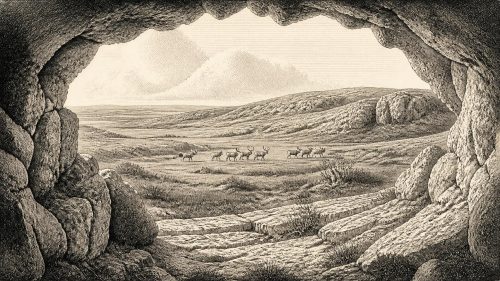
Around 30,145 BCE, Ireland was a cold, unstable Late Pleistocene landscape approaching maximum glaciation, not a dated historical moment. Marine Isotope Stage 3 evidence, especially from Castlepook Cave, records reindeer, giant deer, mammoth, predators, lemmings and fauna, although bones accumulated across millennia and cannot represent one community. Revised radiocarbon dating confirms southern Irish animals before the Last Glacial Maximum. A marked reindeer femur may show Upper Palaeolithic butchery, suggesting brief human visits. It does not prove settlement, society or continuity of occupation. Changing coasts, ice and erosion obscure access routes and camps. Evidence supports uncertainty rather than a prehistoric chronicle.
Dateline
“30,145 BCE” is a modern label imposed on a time far beyond any Irish calendar, annal or year-by-year record. It corresponds broadly to about 32,100 years before 1950, but archaeology cannot identify an event, a season, a ruler or a community in Ireland at that precise point. Radiocarbon measurements from this depth of time must be calibrated against changing atmospheric carbon levels, producing probability ranges rather than a single calendar date. The responsible history of Ireland around this notional year is therefore a history of landscapes, animal remains and a small number of deeply uncertain traces of human action.
The period belongs to the later part of the Pleistocene, within Marine Isotope Stage 3, and to the Irish Midlandian glaciation. It preceded the Last Glacial Maximum, when the Irish Ice Sheet reached its fullest documented late-glacial extent, broadly c. 27,000–23,000 calibrated years BP. Around 30,145 BCE, climate was already cold, highly variable and moving towards more extensive glaciation. Ireland was not yet the familiar island of a temperate, wooded Atlantic world. Its shorelines, ice margins, rivers and exposed lowlands were changing over long timescales, while conditions could alter sharply within a human lifetime.
A Date Without a Chronicle
The precision of the requested year should not be mistaken for precision in the evidence. A calendar date such as 30,145 BCE is useful for ordering a modern archive, but it is not a date that Ice Age Ireland’s archaeological record can independently confirm. The nearest evidence is conventionally reported either in radiocarbon years BP, where “present” means AD 1950, or in calibrated calendar ranges. In both cases, uncertainties are measured in centuries or millennia. Recent work has also shown that earlier radiocarbon determinations on southern Irish cave bones can shift substantially when samples are re-dated using improved pretreatment methods. Dates are evidence to be tested, not immutable labels.
That caution matters especially at Castlepook Cave, near Doneraile in north County Cork, the key Irish site for this period. Its limestone passages preserve remains accumulated over a very long span, but many were excavated in the late nineteenth and early twentieth centuries, before modern recording standards. Water movement, animal activity, earlier excavation and later disturbance have mixed material from different moments. A bone from Castlepook can demonstrate that a species occurred in Ireland at some point in the Late Pleistocene; it cannot automatically reconstruct a single living landscape, still less an event in one numbered year.
Cold Country Before Maximum Ice
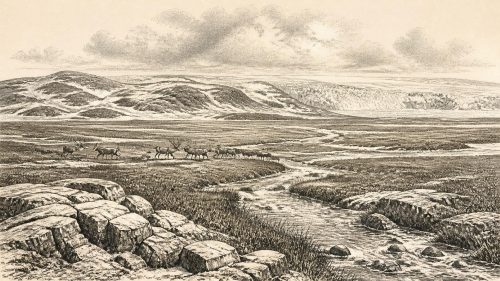
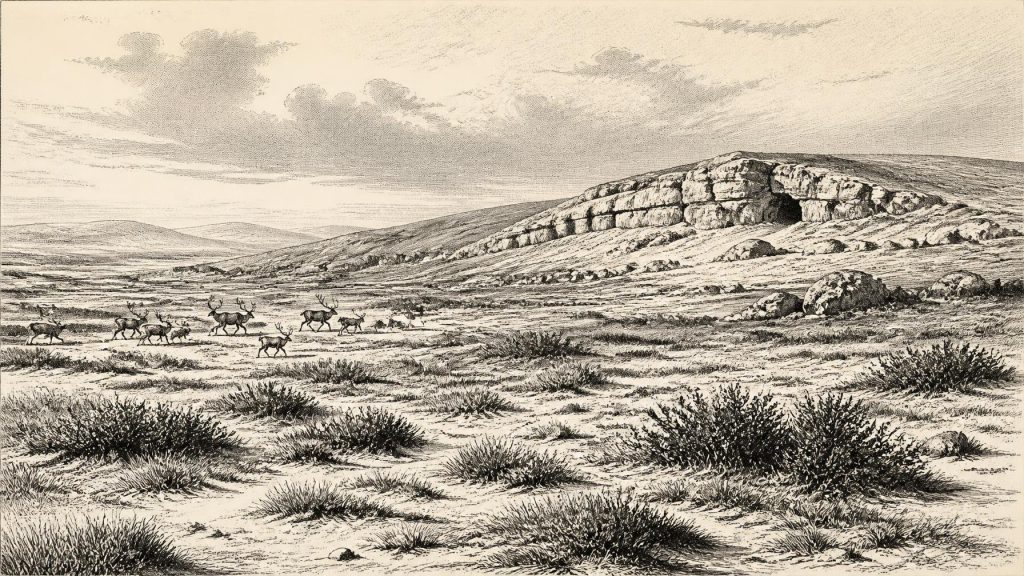
At this stage, Ireland lay on the north-western fringe of Europe, exposed to the full severity of Ice Age climate. Open ground was far more important than woodland. The precise local mix of grasses, herbs, dwarf shrubs, bare sediment, wet hollows and snow patches varied with altitude, drainage and the advance or retreat of ice. This was not necessarily an unbroken white cap across every district at every moment. The maximum Irish ice cover belongs later in the sequence, while evidence from Marine Isotope Stage 3 demonstrates that animals could occupy at least parts of the country before it.
The physical map was also unlike today’s. Sea level was lower globally because enormous quantities of water were held in ice sheets, yet the question of access between Ireland and Britain cannot be reduced to a simple, permanent “land bridge”. Relative sea level around Ireland depended both on global ocean volume and on the loading and flexing of the Earth’s crust beneath nearby ice. At different times, exposed shelf, shallow water, sea ice and glacial connections may have shaped movement. For this date, it is safest to say that Ireland was part of a changing north-west European frontier, not to claim a known road, crossing or migration route.
Glacial erosion and later inundation have erased or buried many potential sites. That preservation problem helps explain why caves dominate the record. A cave can catch bone, sediment and carnivore debris; an open-air camp on exposed ground may leave little that survives repeated frost action, moving water, ice advance and the remodelling of coasts. Absence of a discovered camp is therefore not proof that no person ever entered Ireland, but it does prevent confident claims of settlement.
The Castlepook Faunal Record
Castlepook is one of Ireland’s richest Ice Age faunal archives. The wider collection includes reindeer, giant deer, woolly mammoth, brown bear, spotted hyaena, wolf, Arctic fox, mountain hare and lemmings. Such a list is powerful evidence that Ireland had, at intervals, supported a varied cold-stage animal community. Reindeer and lemmings point to severe, open environments; mammoth and giant deer evoke extensive grazing country; predators and scavengers indicate food webs with substantial herbivores. Yet these animals were not all necessarily present together. The dated bones span many thousands of years, and the cave deposits do not constitute a neatly sealed snapshot.
The re-dating of southern Irish material has sharpened this warning while enhancing the importance of the site. Work led by Ruth Carden, Thomas Higham and Peter Woodman found that several Castlepook determinations were markedly older than earlier results had suggested. Their findings place important elements of the southern Irish fauna securely within Marine Isotope Stage 3 and suggest that some species, including giant deer and spotted hyaena, may have disappeared locally before the Last Glacial Maximum. The result is not a detailed census for 30,145 BCE. It is, however, firm reason to treat pre-maximum Ireland as an inhabited animal landscape rather than an empty prelude to later deglaciation.
Animals reached and used Ireland by processes that remain only partly visible: dispersal through changing coastal and glacial terrain, repeated incursions as habitats shifted, and perhaps local persistence through favourable phases. Their presence does not demonstrate trade, deliberate transport or a stable human population. In this world, mobility belonged first of all to herds, predators, scavengers and the seasonal ecology that bound them together.
A Marked Reindeer Bone
The most provocative human-related object is a reindeer femur from Castlepook, held in the National Museum of Ireland’s natural-history collections. Re-examination identified a deep linear mark interpreted by zooarchaeologist Ruth Carden as having been made on fresh bone by a sharp stone implement. Public reporting and Cork heritage material have associated the bone with roughly 31,000 BCE, close to the modern archival date used here. If that interpretation and broad chronology withstand further scrutiny, the femur indicates that a person processed part of a reindeer carcass in Ireland during the Upper Palaeolithic.
Its importance lies precisely in what it may establish: human handling of an animal. Its limits are equally important. The bone is not a house floor, hearth, burial, tool kit, art panel, human skeleton or securely excavated camp. Nor does it identify the number, origin, language or social organisation of the people responsible. There is no basis for naming a people, assigning a tribe, or treating this evidence as the beginning of continuous Irish occupation. Any visitors may have been a small and temporary party following animals, exploiting a carcass, or making a short reconnaissance in a harsh landscape. That is an interpretation by analogy with wider European Upper Palaeolithic lifeways, not a directly observed Irish biography.
The cautious conclusion is nevertheless consequential. Ireland may no longer be discussed simply as a land first touched by people in the Mesolithic after c. 8000 BCE. The Castlepook bone opens the possibility of a much earlier human presence, more than twenty millennia before the island’s first substantial settlement record. It changes the question from “were people here?” to “how occasional, how early and how archaeologically visible were their visits?”
Society Beyond the Evidence
Political affairs, diplomacy and warfare cannot responsibly be recovered for Ireland around this date. No chiefdom, territory, treaty, fortification or conflict has been identified. The sparse record offers no evidence for permanent villages, hereditary offices or an island-wide society. Likewise, there is no Irish evidence for religion in the form of shrines, graves, images, ceremonial deposits or mythic tradition. It would be misleading to import cave art, ritual practices or elaborate social identities known elsewhere in Ice Age Europe and present them as facts about Cork.
Everyday life can be discussed only conditionally. If people were present, they needed dependable knowledge of shelter, weather, animal behaviour, stone-working and the use of carcasses for meat, hide, fat, sinew and bone. A reindeer encounter could have offered valuable materials, but the marked femur alone cannot tell whether the animal was hunted, scavenged, trapped by terrain, or found after a predator’s kill. There is no demonstrated Irish evidence for farming, stock-keeping, pottery, metalworking, writing or long-distance exchange. The relevant economy was ecological rather than commercial: movement through a demanding landscape, access to animal resources and adaptation to cold.
What the Threshold Means
For Ireland, around 30,145 BCE is best understood as a threshold in both environment and evidence. The island was entering the long approach to maximum glaciation, while southern caves preserve signs of a cold-stage fauna far richer than modern Ireland’s. Castlepook’s deposits show that reindeer, giant deer, mammoth and predators belonged to that wider Pleistocene history, though not all at the same instant. The marked reindeer femur offers a possible human foothold in that world, but not a foundation for invented settlements or narratives of conquest.
The central historical fact is therefore uncertainty carefully bounded by evidence. Ireland was a changing Ice Age landscape used by animals and perhaps, briefly, by people. Its human story at this depth is not yet a chronicle. It is a question preserved in limestone, bone and calibrated ranges.
Primary Sources
- A Reconsideration of the Radiocarbon Dating of the Marine Isotope Stage 3 Fauna from Southern Ireland
- The Irish Quaternary Fauna Project
- New Insights on the Fauna of Ireland's Younger Dryas and Early Holocene from Alice & Gwendoline Cave
- The Exploration of Castlepook Cave, County Cork
- Castlepook Cave: County Geological Site Report
- Occurrence of Mammalia Relicts at Site Castlepook Cave
- Pleistocene Vertebrates in the British Isles
- Pleistocene Glaciations in Ireland
- Last Glacial Maximum Cirque Glaciation in Ireland and Implications for Reconstructions of the Irish Ice Sheet
- Maximum Extent and Dynamic Behaviour of the Last British–Irish Ice Sheet West of Ireland
- Early Deglaciation of the British-Irish Ice Sheet on the Atlantic Shelf Northwest of Ireland Driven by Glacioisostatic Depression and High Relative Sea Level
- Timing and Pace of Ice-Sheet Withdrawal Across the Marine–Terrestrial Transition West of Ireland During the Last Glaciation
- The Deglaciation of the Western Sector of the Irish Ice Sheet From the Inner Continental Shelf to Its Terrestrial Margin
- Deglaciation Chronology of the Donegal Ice Centre, North-West Ireland
- Trimlines, Blockfields and the Vertical Extent of the Last Ice Sheet in Southern Ireland
- The Problem of a Late Quaternary Landbridge Between Britain and Ireland
- The Island of Ireland: Drowning the Myth of an Irish Land-Bridge?
- Ireland: Submerged Prehistoric Sites and Landscapes
- Relative Sea-Level Change Around the Irish Coast
- Resolving Discrepancies Between Field and Modelled Relative Sea-Level Data: Lessons from Western Ireland
- The IntCal20 Northern Hemisphere Radiocarbon Age Calibration Curve (0–55 cal kBP)
- The IntCal20 Approach to Radiocarbon Calibration Curve Construction: A New Methodology Using Bayesian Splines and Errors-in-Variables
- Could Brown Bears Have Survived in Ireland During the Last Glacial Maximum?
- Our Ancient Landscapes: Hunter-Gatherers in Ireland
- Castlepook Cave Geophysical Survey: Archaeology Research Excavation Grant Report