Derryvree’s Intertill Horizon30402 BCE
Around 30,402 BCE, Ireland’s history is reconstructed from environmental rather than written evidence. At Derryvree, County Fermanagh, freshwater organic sediments between two glacial tills indicate a temporary ice-free wetland, with treeless tundra, sedges, mosses and cold-adapted life, during Marine Isotope Stage 3. The deposit’s broad radiocarbon range encompasses the nominal date but cannot identify a single event. Cave faunas, especially at Castlepook, show that large mammals inhabited Ireland in the wider period. A possibly cut-marked reindeer bone suggests fleeting human visitation, not settlement. No social, political or cultural structures are demonstrable. Subsequent glaciation obscured much earlier evidence from this interval.
Dateline
30,402 BCE is not a date to which Irish prehistory can assign an event, a ruler, a settlement or even a season. At this depth in time, modern calendar-year precision is unavailable. The label is best treated as a point within the Late Pleistocene, roughly 32,350 years before AD 1950, during Marine Isotope Stage 3. The evidence closest to it consists not of chronicles or houses but of buried sediments, fossil plants, animal bones and the traces left by moving ice. These record long environmental intervals, generally measured in centuries or millennia, rather than happenings in a particular numbered year.
The most useful Irish evidence comes from Derryvree, near Maguiresbridge in County Fermanagh. There, roadworks exposed an extraordinary sequence within a drumlin: a lower glacial till, freshwater silts and fine sands containing organic material, and a second till above. The order matters. Ice had occupied the site; later, an interval of open ground and freshwater conditions allowed plants and small animals to leave remains; then renewed glaciation buried the basin. The organic horizon produced a conventional radiocarbon age of 30,500 years BP, with a substantial uncertainty. Its published calibrated range is approximately 36,900–31,700 calendar years BP, or about 34,950–29,750 BCE. The nominal year considered here falls within that broad interval, but cannot be identified with a particular layer, action or human lifetime.
A Local Window Between Ice Advances
Derryvree is therefore a window, not a complete map of Ireland. Its freshwater deposits demonstrate that the Fermanagh locality was not under glacier ice for part of this period. They do not prove that every coast, upland, valley and limestone cave across the island was similarly ice-free at the same moment. The survival of a wetland between two tills is itself a warning against simple descriptions of an all-white or all-green Ireland. Ice margins could advance, stagnate, retreat and re-form; lowland basins could collect water while nearby high ground or distant regions experienced very different conditions.
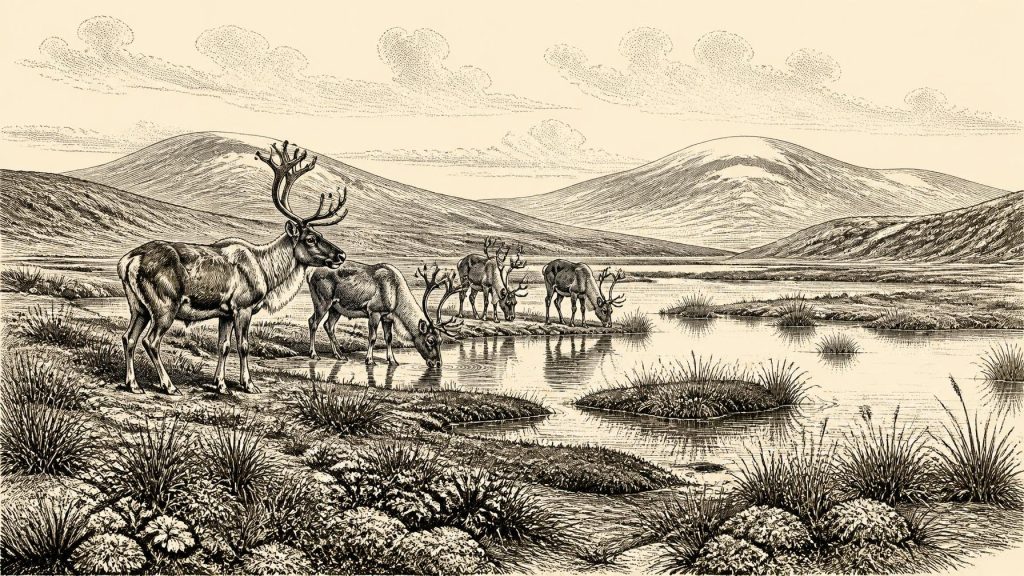
The plants and invertebrate evidence in the Derryvree sediments indicate an open, treeless tundra or muskeg environment under a periglacial climate. This was not forested Ireland. The landscape supported wet ground, shallow freshwater, sedges, mosses and cold-adapted herbaceous vegetation, with a short productive growing season and long cold winters. The word “muskeg” conveys a waterlogged, peaty terrain rather than a modern Irish bog identical in every respect to its ancient counterpart. It is an environmental reconstruction drawn from sediments and fossils: firm evidence for local conditions, but not a licence to paint every square mile of Ireland with the same vegetation.
At the larger scale, Ireland stood within a changeable north-west European ice-age world. Recent syntheses argue that the British–Irish Ice Sheet had a longer and more dynamic history before the later Last Glacial Maximum than older models allowed, including advance–retreat activity during Marine Isotope Stage 3. Yet the chronology and extent of this earlier ice remain less certain than the well-dated maximum and retreat after about 31,000 years ago. It is safer to say that Derryvree lay in a climate system capable of rapid regional transformation than to declare that the whole island was either continuously glaciated or securely habitable.
Animals in a Cold Landscape
Irish cave collections provide a second, imperfect kind of evidence. They show that, before the Last Glacial Maximum, Ireland supported a changing array of large mammals and their predators or scavengers. Reindeer, woolly mammoth, giant deer, brown bear, wolf, fox, hare, lemmings and spotted hyaena are represented among the wider Pleistocene record. Such a list must not be treated as a census for 30,402 BCE. Cave deposits accumulated over long spans, animals did not necessarily live together, and older excavations often disturbed or inadequately recorded their contexts. Nonetheless, the fauna establishes that cold, open habitats could sustain substantial herbivores and carnivores in parts of Ireland during the broad pre-maximum period.
Castlepook Cave, also called Mammoth Cave, near Doneraile in north County Cork, is especially important. Its old collections preserve one of the island’s richest pre-Last-Glacial-Maximum faunal archives. The assemblage includes remains accumulated by several processes: animals dying in or near caves, carnivore activity, water movement and excavation methods that pre-date modern recording. Radiocarbon work has shown that the cave fauna spans different phases rather than one single “Ice Age community”. This is why a mammoth bone or hyaena bone found in the same cave system is not automatically evidence that either belonged to the exact environmental moment represented at Derryvree.
One Castlepook reindeer femur has particular historical importance. Zooarchaeologist Ruth Carden identified a deep surface mark interpreted as a possible cut made by a sharp stone tool on fresh bone. County Cork heritage material presents the specimen as evidence with the potential to push human activity in Ireland back to about 33,000 years ago. If the interpretation and chronological association are sustained, it would suggest that people processed a reindeer in Ireland during the Upper Palaeolithic. It would be a remarkable indication of a brief human encounter with this landscape, not proof of a settled population.
The limits of that inference are essential. The femur was not recovered from a newly excavated, sealed camp floor together with a hearth, a stone-tool assemblage, dwellings, food waste, burials or art. A radiocarbon result dates the animal’s death, not necessarily the precise moment when a surface mark was made. Moreover, reassessment of Irish cave collections has shown how vulnerable older radiocarbon results and antiquarian contexts can be to revision. Current excavations at Castlepook seek undisturbed deposits and clearer evidence for chronology, fauna and any human presence. For 30,402 BCE, the responsible conclusion is that human visitation is a serious possibility in the wider period, but permanent occupation, population size, language, identity and continuity are unknown.
No Polities, No Diplomacy
There is no evidence from Ireland at this date for political institutions, chiefs, territories, warfare, diplomacy or organised religion. Nor can archaeology identify villages, households, kin groups or named cultural communities. The usual headings of political history simply do not apply. If people entered Ireland during this broad period, they would have done so in small mobile groups, probably in relation to seasonal resources and changing routes, but that is an inference from the ecology of Upper Palaeolithic Europe rather than a demonstrated Irish social structure.
Equally, there is no basis for describing trade. Ireland’s position in the north-eastern Atlantic world was affected by lowered global sea levels, altered coastlines and the changing geography of Britain and the Irish Sea basin. But a lower sea level did not necessarily mean a simple land bridge to Ireland. The routes available to animals and people depended on local sea passages, ice, coastlines and weather, all of which changed through time. No imported tool, ornament, raw-material trail or exchange network has been securely tied to this point in Irish prehistory.
Everyday Life: Evidence and Analogy
Should the Castlepook mark eventually be accepted as human workmanship, the most that can be said directly is that a reindeer carcass was cut with a sharp implement. It does not reveal who held the tool, whether the animal was hunted or scavenged, whether the work happened in the cave, how many people were present, or whether they stayed overnight. Comparable Upper Palaeolithic groups elsewhere in Europe used stone, bone, hide, wood and fire in adaptable ways, but those broader comparisons cannot substitute for Irish finds. There is currently no securely demonstrated Irish house, hearth, workshop, burial or artistic object of this age.
Religion, learning and culture are similarly beyond direct recovery. A wetland’s plant remains can illuminate climate; a bone incision may illuminate carcass processing; neither can reveal stories, beliefs, songs, ritual practice or teaching. Silence here is not evidence that such things did not exist among any visitors. It is evidence that Ireland has not preserved them in an identifiable form from this interval.
Approaching Maximum Glaciation
The long-term significance of this period lies in transition. Derryvree preserves conditions before the more severe glaciation that later reshaped much of the island. During the Last Glacial Maximum, conventionally placed broadly between about 26,500 and 19,000 calendar years BP, ice covered most or all of Ireland, though the precise pattern and timing varied by region and have been repeatedly revised as new evidence emerges. Glacial erosion and deposition removed or buried much of the older archaeological record. The scarcity of evidence for people around 30,402 BCE may therefore reflect both genuinely intermittent human presence and the destructive power of later ice.
For that reason, Derryvree’s intertill horizon is more than a local curiosity. It records a living northern Irish environment in the interval between glacial episodes: shallow waters and wet ground, treeless tundra vegetation, cold-adapted creatures, and a landscape vulnerable to the return of ice. Castlepook’s fauna adds evidence that animals ranged across southern Ireland during the wider pre-maximum world, while the marked reindeer femur keeps open the possibility of a fleeting human presence. Together they offer no year-by-year narrative, but they do supply the most responsible history available: an unstable, cold Ireland whose environmental record is richer than its human record.
Primary Sources
- A Middle Midlandian Freshwater Series at Derryvree, Maguiresbridge, County Fermanagh, Northern Ireland
- The Irish Quaternary Fauna Project
- Phylogeographic, ancient DNA, fossil and morphometric analyses reveal ancient and modern introductions of a large mammal: the complex case of red deer in Ireland
- The IntCal20 Northern Hemisphere Radiocarbon Age Calibration Curve (0–55 cal kBP)
- Growth and Retreat of the Last British–Irish Ice Sheet, 31,000 to 15,000 Years Ago: the BRITICE-CHRONO Reconstruction
- The Timing and Magnitude of the British–Irish Ice Sheet Between Marine Isotope Stages 5d and 2
- Pleistocene Glaciations in Ireland
- Late Pleistocene Chronostratigraphy and Ice Sheet Limits, Southern Ireland
- Deglaciation Chronology of the Donegal Ice Centre, North-West Ireland
- Heritage Artefacts of County Cork
- Archaeology Research Excavation Grant 2022: Castlepook Cave Project
- Archaeology Research Excavation Grant Report 2023: Castlepook Cave Project
- The Mesolithic in Ireland: When Was It?
- New Insights on the Fauna of Ireland’s Younger Dryas
- Figure 6: The Subdivision of the Quaternary Period in Ireland
- Ardfinnan County Geological Site Report
- Quaternary Sediments 1:50,000 Ireland Dataset
- Quaternary Geomorphology 1:50,000 Ireland Dataset
- The Geological Heritage of Wicklow
- South Donegal Geological Heritage Audit
- 2022:564 Castlepook Cave, Castlepook South, Cork
- Deglaciation, Earth Crustal Behaviour and Sea-Level Changes in the Determination of Insularity: A Perspective from Ireland