Derryvree’s Overridden Wetland30335 BCE
Around 30,335 BCE, Ireland cannot be described through precise annual history, but through fragmentary Ice Age evidence. At Derryvree, County Fermanagh, organic sediments between glacial tills indicate an ice-free, cold, treeless wetland with pools, sedges, mosses and hardy plants, later overridden by advancing ice. Castlepook Cave, County Cork, preserves remains of mammoths, reindeer, giant deer, predators and other cold-climate fauna, showing varied, productive habitats. A modified reindeer bone may indicate human activity, but cannot prove settlement. No social institutions or material culture are securely documented. Together, these sites reveal regionally diverse environments increasingly transformed and obscured by glaciation over time.

Dateline
The label 30,335 BCE gives a useful point on a modern timeline, but it cannot describe a recoverable Irish calendar year. No written record, settlement sequence or archaeological layer can be dated to that degree of precision. In scientific terms, the date sits roughly 32,284 years before AD 1950, within the later part of Marine Isotope Stage 3, a highly variable interval of the last Ice Age. The responsible history of Ireland at this point is therefore not a chronicle of named people or events, but an account built from buried sediments, cave bones, radiocarbon measurements, landforms and the limits of what those remains can say.
A Date Within Wide Ranges
Radiocarbon ages are not identical to calendar ages. They must be calibrated against changing atmospheric carbon levels, and the uncertainties become substantial this far back in time. The most relevant Irish environmental deposit is at Derryvree near Maguiresbridge, County Fermanagh. There, organic silts and fine sands lay between two deposits of glacial till: material left by ice. The organic horizon produced the radiocarbon determination BIRM-166, 30,500 radiocarbon years before present, with a wide error range. In published calibration, it corresponds broadly to about 36,900–31,700 calendar years before present.
That range matters more than the apparent neatness of 30,335 BCE. It makes Derryvree a valuable witness to a period broadly overlapping this modern date label, but not proof of conditions on a particular day, season or even century. The sediment was deposited during an interval when this part of Fermanagh was not beneath glacier ice, then was sealed below later till. It preserves an environmental episode; it does not supply a year-by-year diary.
Other evidence complicates rather than simplifies the picture. Ice-sheet reconstruction indicates that Ireland was moving towards the major expansion of the last British–Irish Ice Sheet, while ice cover and ice margins varied greatly by region. The full glacial maximum still lay ahead. It would be misleading to picture the whole island either as an unbroken ice cap or as a uniformly habitable plain. Instead, conditions changed across space and time: upland ice, advancing lobes, open ground, wetlands, lakes, river margins and coastal waters could all have mattered in different places.
Derryvree’s Cold Wetland
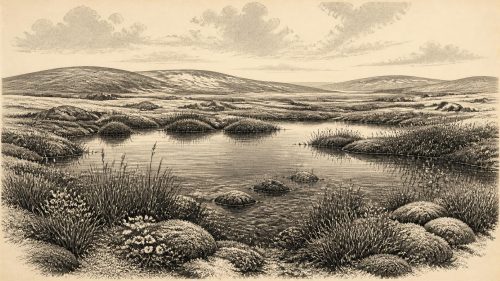
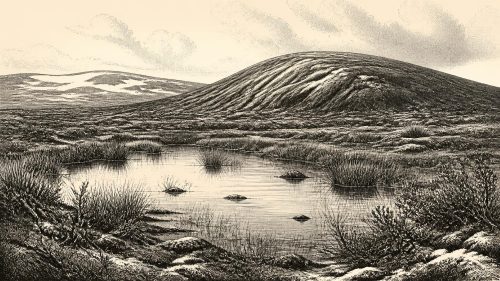
The Derryvree fossils provide the clearest local picture. Plant macrofossils from the inter-till deposits include mosses, sedges, dwarf willow, mountain avens, bogbean and water-milfoil. Together they point to a cold, treeless landscape with freshwater pools or slow water, wet ground and low vegetation. This was not a forested Ireland, nor a scene of permanent deep snow without life. It was a periglacial or tundra-like mosaic in which short growing seasons could nevertheless sustain aquatic plants, marsh vegetation and hardy herbs.
Such an environment was shaped by frost, seasonal meltwater and unstable drainage. Open water is especially important evidence: it tells us that the Derryvree locality was ice-free while the organic mud accumulated. The later till above it records a different phase, when advancing ice overrode the wetland and protected its remains beneath glacial sediment. This sequence is one reason Derryvree is so significant. Later ice action destroyed or disturbed much of Ireland’s older ground surface, leaving only scattered surviving windows onto the pre-maximum landscape.
The evidence does not license exact reconstructions of temperature, precipitation or the duration of summer. Nor can the plant list be converted into a simple modern habitat. Species now associated with cool bogs, alpine ground or northern climates had different distributions in the Ice Age. Yet the combined signals are strong enough to reject two extremes: Ireland was not biologically empty, but its vegetation was sparse, low and cold-adapted by comparison with the wooded island of later millennia.
Animals in a Changing Island
Caves in the south, especially Castlepook Cave near Doneraile in County Cork, preserve a complementary record of Late Pleistocene animals. The cave system has yielded bones of woolly mammoth, reindeer, giant deer, brown bear, wolf, foxes, mountain hare, lemmings and spotted hyaena. These animals were not necessarily contemporaries in one moment, and a cave assemblage is not a census of the surrounding countryside. Carnivores could carry prey remains into caves; animals could die there; water and excavation history could mix material from different deposits. Direct dating has also shown that some earlier cave chronologies required revision.
Nevertheless, the fauna demonstrates that parts of Ireland supported, at different times before the Last Glacial Maximum, communities familiar from the wider north-west European cold steppe and tundra. Reindeer and mountain hare suit open, cold terrain. Lemmings suggest strongly northern conditions. Mammoths required productive grazing patches, while hyaenas and wolves indicate predator and scavenger guilds able to exploit large herbivores. The landscape was demanding but not lifeless: its food webs depended on seasonal vegetation and the movements of grazing animals across an exposed, changing terrain.
There is no basis for describing a stable Irish ‘mammoth-steppe society’. Animal ranges shifted with climate, vegetation, snow cover and access routes. Ireland’s connections to Britain and the continent also differed from those of today because sea level was lower, although lower seas did not automatically create a simple, dry and permanent route for people. Ice, rivers, marshes, marine channels and changing coastlines were all barriers or corridors at different times. The important point is mobility, not a fixed map.
The Human Question at Castlepook
Human history at this date is possible, but exceptionally difficult to establish. A reindeer femur from Castlepook, found in early twentieth-century cave excavations and later re-examined, bears a deep linear modification interpreted as consistent with a stone-tool cut or chopping mark. Public accounts have associated the bone with an age of roughly 33,000 years ago. If the modification was made by a person on fresh bone and belongs with the animal’s death, it would indicate that humans processed a reindeer in Ireland long before the well-attested post-glacial settlement record.
That conditional language is essential. One modified bone cannot demonstrate permanent occupation, a camp, a hunting territory, a population, a migration route or a named culture. It cannot tell us whether people killed the animal, encountered a carcass, removed meat or hide, or processed the limb elsewhere before it entered the cave. Nor should an approximate age for that find be treated as an exact match for 30,335 BCE. The date under consideration belongs to the broad setting in which the claim must be assessed, not to a securely documented human episode.
Recent archaeological work at Castlepook has reinforced the need for caution. Excavation in 2022 confirmed that deposits and animal remains survive in parts of the cave, but reported no cultural artefacts. Some recovered charcoal was modern or medieval in date. This does not disprove a much older human visit; it shows instead how easily caves acquire later material and why robust stratigraphy, direct dating and microscopic study are indispensable. Castlepook remains a site of major potential rather than a finished answer.
No Polities, Yet a Human Horizon
There were no Irish kingdoms, chiefs, treaties, markets, towns or religious institutions that can responsibly be described for this date. There is no evidence for agriculture, stock-keeping, pottery, metalworking, monuments, literacy or formal trade on the island. Terms such as diplomacy, political affairs and warfare therefore have no archaeological content here. Even if people briefly reached Ireland, they would have belonged to small, mobile Upper Palaeolithic hunter-gatherer groups whose social relationships, languages, kinship systems and beliefs are beyond recovery from the present Irish evidence.
It is equally impossible to infer ritual from caves merely because caves later became culturally important places. Castlepook’s principal value is palaeontological and archaeological: it preserves bones, traces of carnivore activity and the possibility of human modification. No cave art, burial, dwelling floor, hearth securely of this age, or assemblage of stone tools presently provides a basis for reconstructing religious practice or learning in Ireland around this point.
Everyday life, if humans were present, would have been structured by cold, mobility and risk. Clothing, fire, stone tools, shelters and knowledge of animal behaviour were widespread capacities among Upper Palaeolithic people elsewhere in Europe, but importing that general knowledge into Ireland must remain interpretation, not evidence. The Irish record has not yet identified a settlement where such activities can be demonstrated. What can be said is narrower and more compelling: a changing Ice Age island had places with fresh water, hardy vegetation and large mammals, and at least one cave bone raises the serious possibility of a human encounter with that world.
Landscape Before Erasure
The strongest development relevant to 30,335 BCE was environmental, not political. Ireland was entering the long build-up to more extensive glaciation. Subsequent ice would scour bedrock, remodel valleys, deposit tills and conceal older landscapes, helping to explain the fragmentary evidence now available. The drumlins, tills, erratics and glacial landforms visible across much of Ireland are reminders of later ice action, but the organic seam at Derryvree and the bones at Castlepook preserve rare earlier fragments.
For that reason, this period should be understood as a threshold. Derryvree shows an ice-free northern wetland in a cold, treeless world; Castlepook shows that large mammals had occupied southern Ireland and preserves a disputed but important possible sign of human action. Neither site authorises a precise annual narrative. Together, however, they reveal an Ireland that was environmentally active, regionally varied and increasingly vulnerable to the advance of ice: a landscape whose histories survived only in silts below a drumlin and bones within limestone darkness.
Primary Sources
- The Irish Quaternary Fauna Project
- A reconsideration of the radiocarbon dating of the Marine Isotope Stage 3 fauna from southern Ireland
- Trimlines, blockfields and the vertical extent of the last ice sheet in southern Ireland
- Growth and retreat of the last British–Irish Ice Sheet, 31,000 to 15,000 years ago: the BRITICE-CHRONO reconstruction
- Deglaciation chronology of the Donegal Ice Centre, north-west Ireland
- The deglaciation of the western sector of the Irish Ice Sheet from the inner continental shelf to its terrestrial margin
- New data for the Last Glacial Maximum in Great Britain and Ireland
- The IntCal20 Northern Hemisphere Radiocarbon Age Calibration Curve (0–55 cal kBP)
- A stratigraphic framework for abrupt climatic changes during the Last Glacial period based on three synchronized Greenland ice-core records: refining and extending the INTIMATE event stratigraphy
- Phylogeographic, ancient DNA, fossil and morphometric analyses reveal ancient and modern introductions of a large mammal: the complex case of red deer (Cervus elaphus) in Ireland
- New insights on the fauna of Ireland's Younger Dryas and Early Holocene from Alice & Gwendoline Cave
- Occurrence of mammalia relicts at site Castlepook Cave
- Castlepook Cave, County Cork: Excavation report 2022
- Heritage Artefacts of County Cork
- Archaeological Heritage of County Cork
- Ice Age Ireland: Cool Fossils! Did Woolly Mammoths Walk in Wicklow?
- Geology of Ireland
- Quaternary
- Ireland Through Geological Time
- The Subdivision of the Quaternary Period in Ireland