
A Cutmark in North Cork31531 BCE
Thirty-one-thousand five-hundred-and-thirty-one BCE is a modern label within MIS 3, not a date for a recorded Irish event. Derryvree sediments in Fermanagh indicate a treeless, cold, wetland environment during a broad ice-free interval before later glaciation, while other deposits demonstrate regional climatic variation. Cave fauna, especially at Castlepook, shows that reindeer, mammoth, giant deer, hyaena and other mammals occupied Ireland before the Last Glacial Maximum. A reindeer femur possibly bearing a stone-tool cut mark may indicate human contact around 31,000 BC, but lacks context. No evidence supports settlement, institutions or continuous population; future research may clarify this Ice Age landscape.
Dateline
31,531 BCE is a modern chronological label, not a date that can be matched to an Irish event, season, ruler or generation. No community in Ireland then counted years in this way, and neither radiocarbon dating nor glacial stratigraphy can isolate activity to a single calendar year more than 33,000 years ago. The appropriate setting is the later Middle Palaeolithic climatic world of Marine Isotope Stage 3 (MIS 3), within the Late Pleistocene. What can responsibly be recovered is a broad, changing picture: cold landscapes, intermittently advancing ice, wetlands and open ground, animals moving through them, and a tantalising but still limited possible trace of people.
Dating a Moving Landscape
In radiocarbon terms, 31,531 BCE falls about 33,481 years before AD 1950, the conventional reference point for “before present” (BP). At this depth of time, dates must be calibrated and expressed as ranges. At Derryvree, near Maguiresbridge in County Fermanagh, organic-rich freshwater silts and sands were preserved between two tills, sediments deposited by glacial ice. The organic material returned a radiocarbon age of 30,500 ± 1,200 radiocarbon years BP, calibrated by later scholarship to roughly 36,900–31,700 calendar years BP. The numbered year used here lies within that broad span, but it cannot be assigned to one layer, one pool, or one episode in the deposit.
This distinction matters because the Irish Ice Sheet did not simply switch from absence to total cover on a single date. Research on the British–Irish Ice Sheet shows a long history of growth, retreat and renewed advance during MIS 3, followed by the major Last Glacial Maximum expansion. Different sectors behaved differently, and evidence for ice-free ground in one region should not be treated as a map of the entire island. Derryvree demonstrates that north-central Ireland had a non-glacial interval before later ice overran the locality; it does not prove that every Irish valley, upland or coast was habitable at precisely the same time.
Derryvree’s Cold Wetland
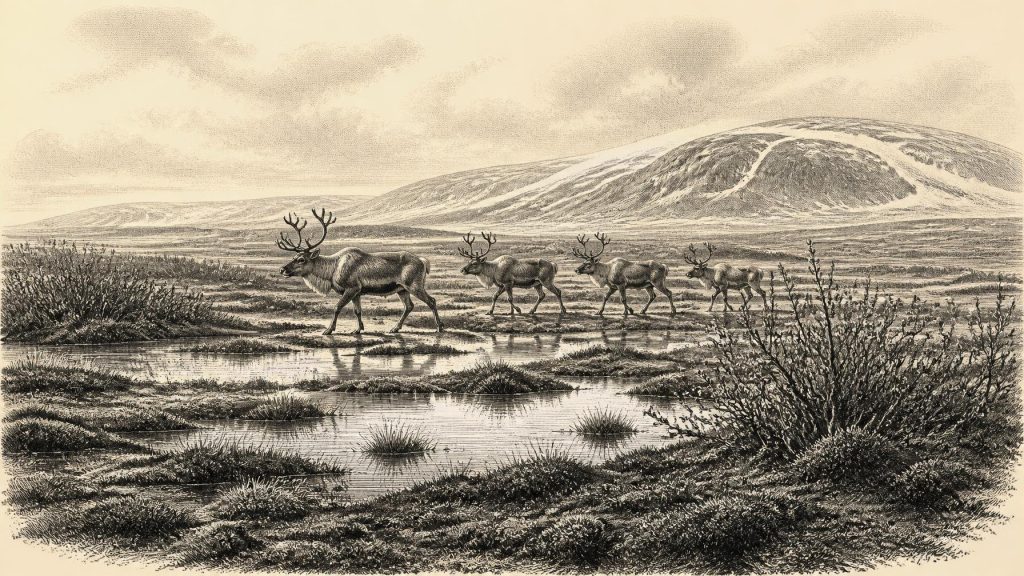
The Derryvree sediments are the clearest Irish environmental witness for a date in this vicinity. Their pollen, plant macrofossils, mosses and insect remains point to a treeless, periglacial landscape rather than the familiar wooded island of later millennia. Sedges, mosses and other cold-tolerant plants grew around shallow freshwater and wet, peaty ground. Such evidence suggests tundra or muskeg-like terrain: open, waterlogged in places, vulnerable to frost and wind, and capable of supporting specialised vegetation in sheltered basins.
This was not necessarily a featureless snow desert. A cold-stage landscape could contain pools, wet margins, bare mineral ground and patches of low vegetation, all changing with season and climate oscillation. The sequence records life in a basin that later became sealed beneath ice-derived sediment. It is precisely because the deposits were buried that fragile organic evidence survived. They offer an environmental archive, not a photograph of a single day in 31,531 BCE.
Elsewhere, the evidence reinforces the regional variability. Organic detritus beneath till at Greenagho, also in County Fermanagh, has been dated to an earlier broad interval of about 37,200–35,700 calendar years BP. Reworked marine shells from Glenulra in the west indicate open water in or near Donegal Bay during parts of the longer pre-maximum interval. Together these records show that Ice Age Ireland included episodes and places where freshwater, coastal waters and terrestrial ecosystems persisted, even as the ice-sheet system was building towards a much more extensive phase.
Animals Before the Maximum
The animal record supplies another important route into this period. Ireland’s Late Pleistocene cave assemblages are sparse and difficult, but they show that large mammals reached the island during the long interval before the Last Glacial Maximum. The Irish Quaternary Fauna Project concluded that a wide range of mammals was present between at least about 45,000 and 20,000 years ago, although the bones often came from nineteenth- and early twentieth-century excavations where deposits had been disturbed.
Castlepook Cave, near Doneraile in north County Cork, is central to this evidence. Re-dating has shown that some of its fauna is substantially older than had once been thought, placing mammals including giant deer and spotted hyaena in Ireland during MIS 3. The cave’s wider assemblage includes reindeer, woolly mammoth, brown bear, wolf, Arctic fox, lemmings and mountain hare. These species were not necessarily neighbours at one instant, nor proof of a single unchanging ecosystem. Cave deposits can combine remains accumulated across long periods through carnivore activity, natural deaths, water movement and excavation disturbance.
Nevertheless, the fauna makes the broader setting vivid. Reindeer and cold-adapted small mammals are consistent with open, cold habitats; hyaenas reveal the role of predators and scavengers in dragging prey and bone into caves. Mammoth and giant deer attest to the potential scale of animals moving through suitable landscapes, but their bones cannot tell us where a herd stood in 31,531 BCE. The responsible conclusion is that Ireland formed part of a shifting north-west European ecological zone, repeatedly connected to, and separated from, neighbouring lands by changing ice, sea and terrain.
The Castlepook Human Question
The most arresting claim connected with this horizon concerns a reindeer femur from Castlepook Cave. County Cork heritage material reports that the specimen dates to around 31,000 BC and bears a mark identified by the palaeozoologist Ruth Carden as a cut made by a sharp stone tool during carcass processing. If that interpretation is sustained by further specialist study, it would be evidence that one or more Upper Palaeolithic people handled a reindeer in Ireland far earlier than the previously accepted human record.
Yet this is a possibility, not a licence to invent a settled hunting society. A radiocarbon result dates the animal’s death within a range; it does not date an expedition, identify its participants or establish an occupation surface. Identifying a cut mark is a separate taphonomic judgement, requiring comparison with damage caused by teeth, trampling, breakage, sediment abrasion and excavation. Moreover, the bone derives from an old cave collection rather than from a newly excavated hearth with associated tools, charcoal, shelter remains or repeated butchery debris. The recent Castlepook project has found stratified Pleistocene bone-bearing deposits, but its purpose is partly to obtain the secure contexts that older discoveries lack.
It is therefore sound to say that a brief human visit around this broad period is possible, perhaps involving carcass processing. It is not sound to claim a village, a continuous population, a named people, or descent from such visitors to later inhabitants of Ireland. The National Museum of Ireland still presents clear Palaeolithic human presence as unproven in the conventional archaeological record. Its famous Mell flint flake near Drogheda was made elsewhere and transported by ice, so it cannot demonstrate an Irish Palaeolithic camp.
Society Beyond the Evidence
There is no Irish evidence at this date for rulers, states, chiefdoms, diplomacy, law, organised warfare or territorial boundaries. Nor are there securely dated Irish houses, hearths, burials, monuments, art panels, farms, crops, domestic animals, markets or trade goods belonging to 31,531 BCE. Political history cannot begin where the evidence does not support political institutions.
If people did reach Ireland, the most cautious inference is that they were mobile foragers operating in very small groups, as Upper Palaeolithic communities elsewhere in north-west Europe did. They may have had sophisticated social knowledge, tool-making traditions, kin relationships and ritual lives; none of that can be demonstrated for Ireland from a single possible modified bone. Continental comparison supplies context, not proof. There is likewise no basis for assigning a language, ethnic identity or religious practice to hypothetical visitors. Calling them “Irish” in a national or cultural sense would be anachronistic.
Routes, Coasts and Risk
At this early point in the last glacial cycle, Ireland’s geography differed profoundly from the modern island, but exact routes remain uncertain. Lower global sea levels enlarged coastal plains and altered the Irish Sea basin, while ice margins and marine waters could still form formidable barriers. Any human arrival would have depended on conditions that changed over centuries and millennia, not upon a permanent land bridge that can simply be assumed for this precise date. Later Pleistocene and Holocene research also stresses that now-submerged landscapes may hold evidence lost from the modern coastline.
For animals, ecological connections were evidently sufficient at intervals to permit colonisation or re-colonisation. For people, the issue is more demanding: a viable population requires repeated movement, social links and resources reliable enough to sustain it. The current Irish record cannot show that such a population existed during MIS 3. The first securely published direct evidence of a human presence remains much later, at Alice and Gwendoline Cave in County Clare, where a butchered brown-bear patella produced two compatible calibrated ranges of 12,810–12,590 and 12,810–12,685 BP.
An Archive, Not an Annal
The significance of 31,531 BCE lies not in a recorded event but in the questions preserved by Irish deposits. Derryvree reveals cold freshwater and tundra-like conditions during a wide pre-maximum interval. Castlepook preserves the remains of animals moving through a harsher, open world, and a reindeer femur that may yet revise the chronology of human contact with Ireland. Neither source supports a conventional national narrative of leaders and battles. Both reveal something more fundamental: Ireland’s deep past was shaped by climatic instability, glacial transformation and fleeting biological opportunity.
That uncertainty is not a defect in the history. It is the history. Around this modernly numbered year, Ireland was a changing Ice Age landscape whose clearest witnesses are silts beneath tills, bones from caves and scientific methods able to date broad intervals rather than individual lives. Future excavation, improved dating and microscopic re-examination may sharpen the picture. For now, the evidence demands both attention and restraint.
Primary Sources
- Prehistoric Details
- A Reconsideration of the Radiocarbon Dating of the Marine Isotope Stage 3 Fauna from Southern Ireland
- Trimlines, Blockfields and the Vertical Extent of the Last Ice Sheet in Southern Ireland
- The Timing and Magnitude of the British–Irish Ice Sheet Between Marine Isotope Stages 5d and 2: Implications for Glacio-Isostatic Adjustment, High Relative Sea Levels and ‘Giant Erratic’ Emplacement
- Maximum Extent and Dynamic Behaviour of the Last British–Irish Ice Sheet West of Ireland
- Growth and Retreat of the Last British–Irish Ice Sheet, 31,000 to 15,000 Years Ago: The BRITICE-CHRONO Reconstruction
- The Irish Quaternary Fauna Project
- First Evidence of a Late Upper Palaeolithic Human Presence in Ireland
- New Insights on the Fauna of Ireland’s Younger Dryas and Early Holocene from Alice & Gwendoline Cave
- The Colonization of Ireland: A Human Ecology Perspective
- Phylogeographic, Ancient DNA, Fossil and Morphometric Analyses Reveal Ancient and Modern Introductions of a Large Mammal: The Complex Case of Red Deer (Cervus elaphus) in Ireland
- Ireland: Submerged Prehistoric Sites and Landscapes
- Heritage Artefacts of County Cork
- Archaeology Research Excavation Grant Report: Castlepook Cave Project
- 2022:564 – Castlepook Cave, Castlepook South, Cork
- Figure 6—The Subdivision of the Quaternary Period in Ireland
- Response of the Irish Ice Sheet to Abrupt Climate Change During the Last Deglaciation
- Pattern and Timing of Retreat of the Last British–Irish Ice Sheet
- Dimensions and Chronology of the Last Ice Sheet in Western Ireland
- The IntCal20 Northern Hemisphere Radiocarbon Age Calibration Curve (0–55 cal kBP)