

A Femur Beneath Castlepook31479 BCE
Around 31,479 BCE, Ireland lay in the unstable, cold Late Pleistocene, before maximum glaciation. Much terrain was probably ice-free, supporting tundra, steppe-tundra, wetlands and sparse shrubs, while later ice destroyed much evidence. Deposits at Derryvree and Maguiresbridge show wetland habitats with cold-adapted plants. Castlepook Cave in County Cork yielded fauna including reindeer, mammoth, giant deer, hyaena and Arctic fox. An incised reindeer femur, dated broadly to about 31,000 BC, may indicate human butchery, but lacks a secure archaeological context. It cannot prove settlement. Ireland’s evidence instead suggests a changeable landscape, rich Ice Age fauna, and only possible brief human visits.
Dateline
31,479 BCE is not a date at which Ireland’s past can be observed with calendar-year precision. It is a modern numerical label, roughly equivalent to 33,429 calibrated years before present, where “present” conventionally means 1950. At this depth in time, radiocarbon measurements have margins of uncertainty, calibration curves are revised as science improves, and cave deposits often represent accumulations over long intervals rather than a single season. The responsible question is therefore not what happened in Ireland in this exact year, but what evidence can illuminate the island during the broad period around it.
That evidence places Ireland in the Late Pleistocene, within Marine Isotope Stage 3, before the Last Glacial Maximum. It is a period of severe climatic instability rather than an unbroken, uniformly frozen age. Greenland ice-core records show abrupt swings between colder stadials and relatively milder interstadials across the North Atlantic world. Ireland lay at the far north-western edge of the European landmass, repeatedly exposed to these changes. Its archaeological record is exceptionally thin, and its environmental record is fragmentary; yet cave bones, buried wetland sediments, pollen, plant remains, insects, geomorphology and modern re-dating programmes together supply a cautious outline.
A Landscape Before Maximum Ice
Around this broad date, the great British-Irish Ice Sheet had not yet reached the maximum extent achieved later in the glacial cycle. Research on upland trimlines, blockfields and exposure dating indicates that parts of Ireland, including north-central areas, were ice-free until at least about 34,000 years ago, though conditions and ice limits varied considerably by region. More recent modelling likewise places an ice-free phase in Ireland before the major build-up that culminated much later, around the Last Glacial Maximum. These are regional and probabilistic reconstructions, not a map of conditions on one particular day in 31,479 BCE.
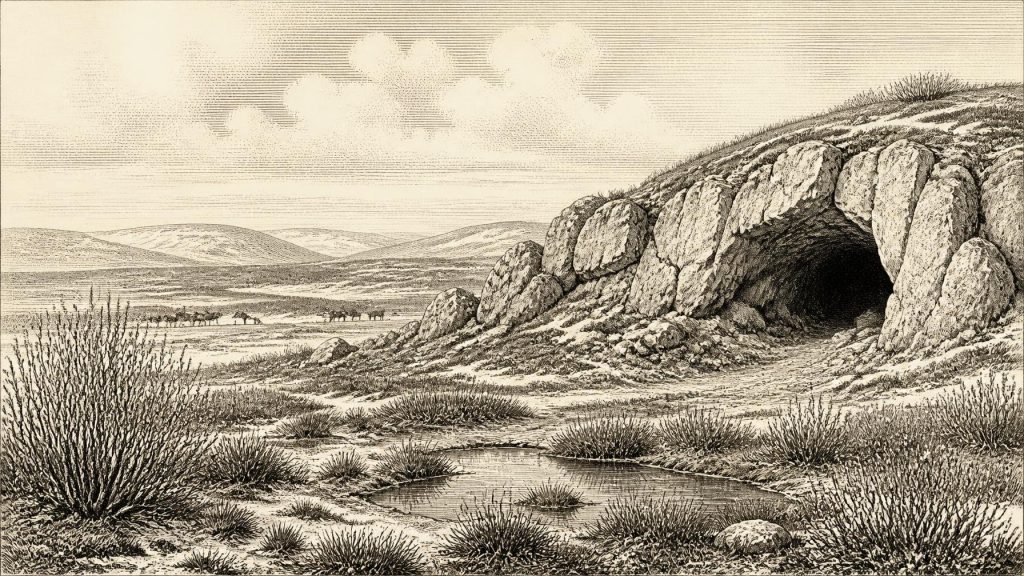
The safest picture is of a cold, open and changeable country. Forest was absent or very restricted. Instead, much of the available terrain supported tundra, steppe-tundra, sparse grassland, sedge-rich wet ground and patches of low shrubs. Frost action, seasonal thaw, wind-blown sediment and unstable drainage shaped many surfaces. In south Fermanagh, organic silts sealed between glacial tills at Derryvree and Maguiresbridge preserve evidence for freshwater or wetland episodes during an earlier part of the last cold stage. Mosses, sedges, dwarf shrubs and cold-adapted plants indicate that even a treeless landscape could contain pools, marshes and productive local habitats.
Those deposits are important because they correct the old caricature of an entirely sterile Ice Age Ireland. Cold did not mean lifeless. Wet hollows could hold water, aquatic plants and insects; open ground could sustain grazing animals; limestone caves could shelter carnivores, trap sediment and preserve bones. Equally, the later ice advances destroyed or buried much evidence. What survives is not a balanced sample of the ancient landscape, but a small and heavily filtered archive.
Castlepook and the Reindeer Bone
The most striking Irish object relevant to this period is a fragment of reindeer femur from Castlepook Cave near Doneraile in north County Cork. Castlepook, also known as Mammoth Cave, has long been known for its rich Ice Age animal assemblage. Its collections include remains attributed to mammoth, giant deer, reindeer, brown bear, wolf, Arctic fox, mountain hare, lemmings and spotted hyaena. The species list demonstrates that Ireland, at least intermittently, formed part of the wider north-west European world of cold-open habitats.
County Cork heritage material presents one reindeer femur as dating to about 31,000 BC and carrying a deep incision identified by zooarchaeologist Ruth Carden as consistent with cutting by a sharp stone tool while a carcass was being processed. If that interpretation is confirmed, the bone would be extraordinarily important: it may preserve evidence that Upper Palaeolithic people handled a reindeer in Ireland tens of millennia before the island’s better documented terminal-Pleistocene and Mesolithic inhabitants.
But it cannot bear more historical weight than the evidence allows. The femur emerged from early twentieth-century cave excavations, not a modern excavation of a sealed occupation floor. No associated hearth, dwelling, stone-tool assemblage, human burial, campsite or concentration of butchered bones has yet been securely demonstrated for the same moment. A radiocarbon measurement dates organic material in the bone, principally the animal’s death; it does not separately date an incision, identify its maker, establish where the animal was killed, or prove the duration of any visit. Caves also gather material through carnivore scavenging, natural deaths, water movement, collapse and later disturbance.
The strongest formulation is therefore deliberately modest. Around the broad span represented by 31,479 BCE, a Castlepook reindeer bone may record human carcass processing. It is possible evidence of a fleeting encounter, not proof of a settled Irish population. The National Museum of Ireland accordingly remains cautious about claims for a demonstrated Palaeolithic human presence on the island. That caution is not a dismissal of the bone; it is the proper distinction between a promising individual trace and a securely excavated archaeological settlement.
Animals, Predators and Food Webs
The Castlepook fauna nevertheless makes the period vividly intelligible. Reindeer suggest open terrain with substantial seasonal grazing; Arctic foxes, lemmings and mountain hares belong to cold-adapted communities; mammoth and giant deer point to the broader Pleistocene fauna capable of using open, productive landscapes. Spotted hyaena is especially significant. A hyaena den is not simply a record of animals living together: it is a place where prey parts may have been dragged in, gnawed, broken and mixed with material accumulated at different times. A cave-bone assemblage must therefore be read taphonomically, as evidence of processes as well as species.
For any people who may have reached Ireland, reindeer would have been a valuable resource. Meat and fat supplied food; hide, sinew, antler and bone could potentially have supplied practical materials. Yet none of these uses may be inferred confidently from the single marked femur. There is no basis for imagining a named hunting party, a permanent camp in the cave, a particular weapon or a regular seasonal migration route. Comparable Upper Palaeolithic groups elsewhere in Europe were highly mobile hunter-gatherers, but Ireland’s evidence does not establish that their social arrangements, languages, beliefs or technologies were reproduced here.
No Politics, No Known Community
Conventional headings such as political affairs, diplomacy and conflict have almost no direct content at this date. There were no states, kingdoms, written records, borders or institutions known from Ireland around 31,479 BCE. Nor can conflict be deduced from a marked bone. At most, the Castlepook evidence raises the possibility that very small human groups entered an ecologically demanding western territory during a favourable interval. Whether they arrived by a land connection, crossed water, followed exposed coastal plains, or came only once cannot be resolved from the present Irish record.
The same limits apply to religion, culture and learning. No ceremonial site, art, ornament, musical instrument, grave or symbolic object of this age is securely known from Ireland. It would be wrong to fill that silence with generic Ice Age cave art or ritual borrowed from France, Iberia or central Europe. Human beings of the Upper Palaeolithic certainly possessed rich cultural lives elsewhere, but evidence of culture in Ireland must be Irish evidence. Here, the history is chiefly one of potential presence and environmental opportunity.
Economic life, if people were present, was likewise not an economy of farms, markets or trade routes. It would have centred on immediate subsistence, mobility and local knowledge: reading animal movements, choosing shelter, maintaining tools and navigating a difficult landscape. This is informed interpretation from wider hunter-gatherer archaeology, not a directly observed Castlepook household. There is no evidence for farming, stock-keeping, pottery, metalworking, long-distance exchange or permanent village life. Indeed, even the existence of a short-lived human camp in Ireland at this time remains unproven.
What the Date Can Mean
For Ireland, the importance of this remote date lies in a threshold rather than an event. The island was neither the familiar green landscape of later prehistory nor necessarily a continuous ice sheet. It was part of a volatile North Atlantic environment in which open habitats and cold-adapted animals could spread into areas later remade by ice and rising seas. The Derryvree and Maguiresbridge wetland archives show ecological complexity in cold conditions; Castlepook shows a remarkable Ice Age fauna in Munster; and one incised reindeer bone poses a serious, still unresolved question about people.
Future work may transform that question. Re-excavation at Castlepook has sought surviving Pleistocene deposits, while improved collagen pretreatment, radiocarbon calibration, microscopic surface analysis, sediment study and ancient biomolecular methods are refining what old museum collections can reveal. Some earlier Irish cave dates have already proved unreliable when retested, demonstrating why new results must be assessed critically. Around 31,479 BCE, then, Ireland’s year-by-year history is necessarily a history of calibrated ranges, deposits and probabilities. Its most responsible conclusion is also its most compelling: a cold Irish landscape supported Ice Age animals, and a single marked reindeer femur may preserve the faintest sign that people briefly entered it.
Primary Sources
- A reconsideration of the radiocarbon dating of the Marine Isotope Stage 3 fauna from southern Ireland
- Heritage Artefacts of County Cork
- 2022:564 – Castlepook Cave, Castlepook South, Cork
- Prehistoric Details: Mell Flint Flake
- The Irish Quaternary Fauna Project
- Irish Association for Quaternary Research Guide 16: Quaternary History of South Fermanagh
- Figure 6: The Subdivision of the Quaternary Period in Ireland
- Trimlines, Blockfields and the Vertical Extent of the Last Ice Sheet in Southern Ireland
- Dimensions and Chronology of the Last Ice Sheet in Western Ireland
- New Data for the Last Glacial Maximum in Great Britain and Ireland
- Early Deglaciation of the British-Irish Ice Sheet on the Atlantic Shelf Northwest of Ireland Driven by Glacioisostatic Depression and High Relative Sea Level
- Timing and Pace of Ice-Sheet Withdrawal Across the Marine–Terrestrial Transition West of Ireland During the Last Glaciation
- Exploring Controls of the Early and Stepped Deglaciation on the Western Margin of the British-Irish Ice Sheet
- The IntCal20 Northern Hemisphere Radiocarbon Age Calibration Curve (0–55 cal kBP)
- A Stratigraphic Framework for Abrupt Climatic Changes During the Last Glacial Period Based on Four Greenland Ice-Core Records
- New Insights on the Fauna of Ireland’s Younger Dryas and Early Holocene from Alice & Gwendoline Cave
- Radiocarbon Dates IV
- Occurrence of Mammalia Relicts at Site Castlepook Cave
- Ireland’s Palaeolithic Archaeology – Fleeting Footprints in a Frozen Land
- Spotlight on COALESCE
- The Irish Elk: When and Why Did This Giant Deer Go Extinct and What Did It Look Like?