Castlepook’s Butchered Reindeer30737 BCE
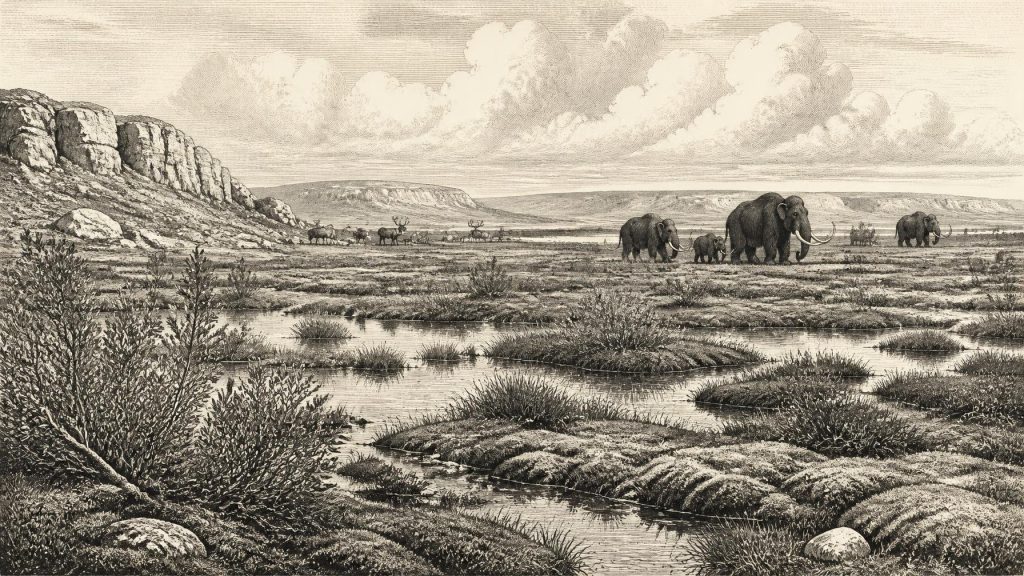
Around 30,737 BCE, Ireland lay within fluctuating cold conditions of Marine Isotope Stage 3, not a precisely datable historical year. Derryvree, County Fermanagh, preserves organic silts indicating treeless freshwater wetlands with sedges, mosses, pools and tundra vegetation. Castlepook Cave, County Cork, contains a mixed Ice Age fauna, including mammoth, reindeer, giant deer, bear and hyaena, demonstrating links to wider mammoth-steppe environments. A reindeer femur, dated about 33,000 years ago, bears possible stone-tool butchery marks, suggesting a brief human visit. However, disturbed deposits and absent settlements, tools or hearths preclude claims for permanent occupation or a distinct Ice Age Irish society.
Dateline
Modern calendar-year precision cannot be carried back to 30,737 BCE. No annal, settlement layer or securely dated event lets us describe a particular year in Ireland at this depth of time. The number is best treated as a point within a broad late Pleistocene interval: Marine Isotope Stage 3 (MIS 3), before the Last Glacial Maximum. The responsible history of Ireland at this point is therefore a history of calibrated ranges, cave deposits, plant remains and animal bones—not of named communities or annual happenings.
The closest material evidence comes from two very different Irish settings. At Derryvree near Maguiresbridge, County Fermanagh, organic silts sealed between glacial deposits preserve a small environmental archive. At Castlepook Cave near Doneraile, County Cork, a complex cave-earth sequence has yielded an exceptional Ice Age fauna and one reindeer femur bearing marks that have been interpreted as possible stone-tool butchery. Neither site supplies a continuous, precisely annual narrative. Together, however, they show that parts of Ireland could support freshwater wetlands, tundra vegetation and large mammals during a changing, severe glacial climate.
A Date Within a Cold World
30,737 BCE is roughly 32,700 years before the conventional 1950 radiocarbon reference year, but this comparison must not be mistaken for an exact correlation. Radiocarbon ages require calibration, and calibration in this period commonly produces ranges rather than a single calendar date. The Derryvree organic deposit has long been associated with a radiocarbon determination of about 30,500 BP. That is an uncalibrated radiocarbon age, not a proof that its plants were growing in the numbered calendar year 30,737 BCE. It nevertheless places the deposit in the same broad middle-to-late MIS 3 world relevant here.
This was not the uniform white emptiness often imagined by later generations. MIS 3 contained pronounced climatic fluctuations: relatively milder interstadial episodes alternated with colder stadials, while the British–Irish Ice Sheet expanded and reorganised over millennia. Ireland’s geography was also unlike that of the present. Global sea level was lower, coastlines lay farther out, and the Irish Sea basin offered a changing, exposed or shallow-water landscape. Yet lower sea level did not automatically mean a simple, permanent dry-land route across every channel. Ice margins, rivers, marshes, seasonal snow and shifting sea passages all shaped movement.
It would be unsafe to say that the whole island was either ice-free or continuously covered at this moment. The evidence instead indicates a patchwork, changing environment. Some areas were affected by glacier advance or periglacial conditions; elsewhere, especially in sheltered sedimentary basins, water and vegetation left fragile records. The important point is regional variation. Ireland was part of the north-west European Ice Age zone, not an isolated, static island landscape.
Derryvree’s Wetland Evidence
Derryvree is especially valuable because its fossil plants make climate visible at ground level. The organic silts have yielded pollen, mosses, seeds and invertebrate evidence. They indicate a treeless, open landscape with freshwater conditions: a muskeg or sedge-and-moss wetland, with shallow pools rather than forest. Finds reported from the deposit include bogbean (Menyanthes trifoliata), alternate water-milfoil (Myriophyllum alterniflorum), dwarf willow and a suite of cold-environment mosses and herbs. Such evidence is local, recording what grew in or beside a particular basin; it cannot simply be enlarged into a complete vegetation map of Ireland.
Nevertheless, its implications are substantial. Plants such as bogbean and water-milfoil imply standing or slow-moving freshwater during at least part of the year. Sedge, moss and low shrub communities point to damp ground, short growing seasons and an open horizon. Insects recovered from comparable interpretations reinforce the picture of cold, wet ground with pools. There is no basis for imagining the dense oak woodland of much later prehistoric Ireland. Nor should tundra be understood as lifeless. Wetland margins could provide forage for herbivores, cover for small animals and seasonal concentrations of birds and fish, even in a climate hostile to trees.
The Derryvree sequence also carries a warning about survival of evidence. It was buried between tills, deposits left by ice. The very processes that later advanced across the landscape could erase campsites, hearths, tracks and bone scatters. Archaeological absence is consequently difficult to interpret. It may indicate that people did not visit a place; it may also reflect the destructive power of ice, erosion and later sediment movement.
Castlepook and the Mammal Landscape
At Castlepook Cave, the evidence is animal rather than botanical. Excavation and later study have documented more than 2,000 bones from a long sequence, although the original early twentieth-century excavations and subsequent disturbance make simple associations hazardous. Direct radiocarbon dating shows that the cave contains remains spanning a substantial part of the last glacial period. Re-dating has also demonstrated that some formerly accepted ages were too young, making careful treatment of individual specimens essential.
The pre-Last Glacial Maximum fauna associated with Castlepook includes woolly mammoth, reindeer, giant deer, brown bear and spotted hyaena; wolf and smaller cold-adapted mammals occur in the broader cave record. These animals did not necessarily occupy the exact same valley in the same season, and a cave is not a census of an open landscape. Carnivores can accumulate prey remains, water can rearrange deposits, and bones from separate episodes may become mixed. Yet the overall assemblage establishes that Ireland formed part of a wider mammoth-steppe and tundra-margin ecological world before the ice sheet reached its later maximum.
For people, that ecology mattered more than any political boundary. Reindeer were mobile herd animals, and their seasonal movements could have created brief opportunities for hunters. Mammoth, giant deer and smaller game offered different resources but also demanded different risks and skills. Spotted hyaenas, wolves and bears were competitors and dangers, not picturesque background fauna. A visitor moving through southern Ireland would have needed knowledge of weather, animal behaviour, fuel, shelter and routes across a landscape whose conditions could change rapidly.
The Reindeer Femur and Human Possibility
The most arresting object is a reindeer femur from Castlepook. It has been dated to around 33,000 years ago and carries a set of marks argued to be consistent with cutting or chopping by a sharp stone tool. If that interpretation is sustained, it is evidence that humans handled and probably butchered a reindeer in Ireland during MIS 3—far earlier than the previously accepted evidence for post-glacial settlement. It would demonstrate a visit or short-lived episode of activity, not a village, a population estimate or an ancestral line leading to later Irish communities.
Its limits are as important as its promise. The bone is not a human skeleton; no associated hearth, tool assemblage, dwelling, burial, art panel or securely defined occupation surface has yet been established for this episode. The cave deposits are complicated, and marks on ancient bone require specialist assessment against damage caused by carnivores, sediment movement, excavation and preservation. The specimen supports a carefully phrased possibility of Upper Palaeolithic human activity. It does not permit confident claims about a permanent settlement, a named culture, language, religion or social hierarchy in Ireland in 30,737 BCE.
Even the identity of any visitors must remain open. By this stage, Homo sapiens were widespread in western Europe, and comparisons with contemporary hunter-gatherer groups beyond Ireland are useful only as context. There is no Irish human DNA, no diagnostic stone toolkit and no living surface from which to reconstruct a group’s origin. Any crossing would have occurred through the wider lands and waters joining Ireland, Britain and continental Europe in altered Ice Age geography, perhaps following animal movements or exploiting a favourable seasonal window.
No Polities, but a Material World
There is no evidence for political affairs, diplomacy, warfare, chiefs, territories, formal trade or institutions in Ireland at this date. Equally, there is no evidence for farming, domestic animals, pottery, metalwork or built monuments. To supply any of these would be invention. If the Castlepook marks are human-made, the most defensible picture is of highly mobile foragers undertaking a limited task: processing an animal carcass. Meat, marrow, hide, sinew, antler and bone could all have been useful, but the femur alone cannot reveal which products were taken or where they were carried.
Religion, ceremony and learning are similarly beyond recovery. A cave can later acquire powerful ritual associations, but there is no reason to project those meanings backwards onto Castlepook. The relevant culture was practical knowledge embedded in action: recognising a herd’s tracks, finding drinkable water, reading snow and ground conditions, choosing stone edges, sharing food and keeping people safe near large predators. These are reasonable human capacities, not recoverable details of a particular Irish group.
The economy, if humans were present, was a subsistence economy of mobility rather than trade in the later sense. Exchange networks may have linked Upper Palaeolithic societies elsewhere in Europe, but no Irish artefacts demonstrate such a network at this time. Nor can the particular cave bone prove hunting rather than opportunistic scavenging. The evidence supports contact with an animal carcass; motives and social arrangements remain interpretation.
A Precarious Irish Presence
Around 30,737 BCE, Ireland’s best-documented history is environmental. Derryvree records freshwater life in an open, cold wetland. Castlepook records a striking assemblage of Ice Age mammals and perhaps the earliest sign that people briefly entered this world. Both sites underscore the instability of the setting: warming and cooling, ice growth, altered drainage, moving animals and eventually the far more extensive glaciation of the Last Glacial Maximum. Any human presence, if confirmed, was precarious and left extraordinarily little behind.
This is not an empty chapter, but it is a chapter with strict evidential boundaries. Ireland was a place of pools, sedges, mosses, reindeer, mammoths and carnivores, shaped by a changing North Atlantic climate. Beyond that, the archive asks for restraint. The reindeer femur may preserve a fleeting human encounter; it cannot yet give us an Ice Age Irish society. Its importance lies precisely in that tension: one marked bone has opened a much deeper past, while reminding us how much has still been lost beneath ice and time.
Primary Sources
- A reconsideration of the radiocarbon dating of the Marine Isotope Stage 3 fauna from southern Ireland
- Castlepook Cave, County Geological Site report
- The Irish Quaternary Fauna Project
- Prehistoric Details
- Figure 6.— The subdivision of the Quaternary Period in Ireland
- ESCR site summary
- Menyanthes trifoliata
- Myriophyllum alterniflorum
- Landscapes and environments of the last glacial-interglacial transition: a time of amazingly rapid change in Ireland
- Could brown bears (Ursus arctos) have survived in Ireland during the Last Glacial Maximum?
- New insights on the fauna of Ireland's Younger Dryas and Early Holocene from Alice & Gwendoline Cave
- New insights on the fauna of Ireland's Younger Dryas and Early Holocene from Alice & Gwendoline Cave
- Archaeological Heritage of County Cork
- Heritage Artefacts of County Cork
- Ireland's Palaeolithic Archaeology – Fleeting Footprints in a Frozen Land
- What was on the menu in prehistoric Ireland?
- Reindeer bone found in Cork cave shows human activity in Ireland 33,000 years ago
- Archaeological excavations at Killuragh Cave, Co. Limerick: a persistent place in the landscape from the Early Mesolithic to the Late Bronze Age
- Pleistocene vertebrates in the British Isles
- The Irish elk: when and why did this giant deer go extinct and what did it look like?