

A Line on Reindeer Bone31528 BCE
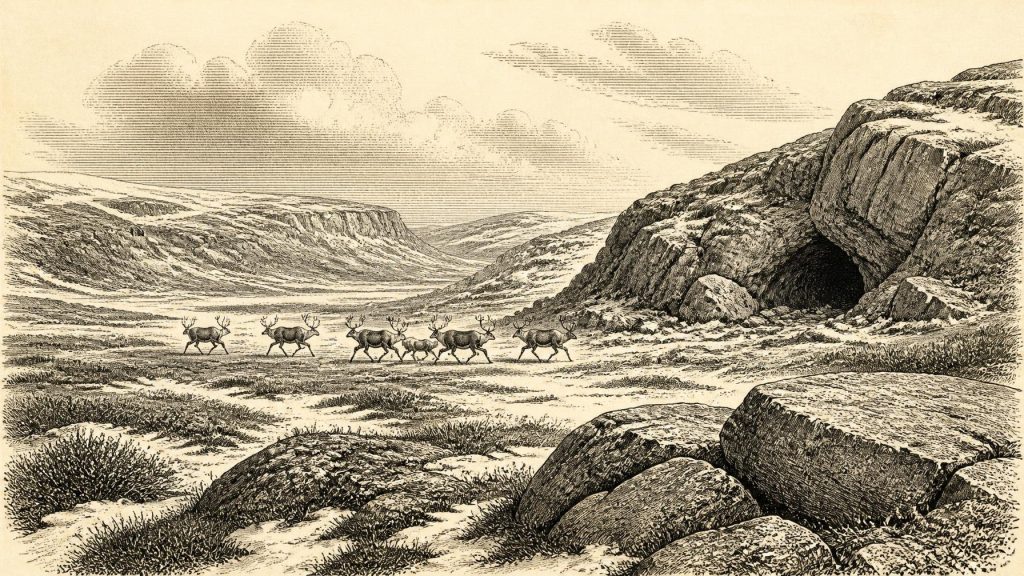
Around 31,528 BCE, Ireland lay within the unstable cold conditions of Marine Isotope Stage 3, not a datable historical year. Castlepook Cave, County Cork, yielded diverse Pleistocene fauna, including reindeer, mammoth, giant deer, hyena and lemmings. A reindeer femur, radiocarbon dated to about 33,000 years ago, bears a mark interpreted as stone-tool butchery, potentially Ireland’s earliest human evidence. This does not establish settlement, as cave deposits are disturbed and the cut’s origin remains debated. Open tundra-steppe, wetlands and changing ice margins supported intermittent animal and possible human movement. Advancing glaciation later obscured evidence, leaving fragile traces of Upper Palaeolithic visits.
Dateline
The label 31,528 BCE gives a useful point of orientation, but it must not be mistaken for a date at which Irish prehistory can be narrated year by year. There are no written records, named communities or calendar-dated events for Ireland at this depth of time. Nor can an arithmetic BCE equivalent be treated as identical to a scientific age: radiocarbon years require calibration, and the resulting ranges may be broad. The responsible subject is therefore Ireland during the later part of Marine Isotope Stage 3, roughly the middle of the Last Glacial Period, rather than an event demonstrably occurring in one numbered year.
One object makes this horizon unusually important. A fragment of reindeer femur from Castlepook Cave, near Doneraile in north County Cork, has been publicised as approximately 33,000 radiocarbon years old and bears a deep linear mark interpreted by zooarchaeologist Ruth Carden as damage made with a sharp stone tool while the bone was fresh. In broad popular conversions this has been associated with the early thirty-second millennium BCE. It is potentially the earliest evidence of human activity in Ireland. Potentially is the essential word: the bone is evidence for a reindeer, a mark and a particular interpretation of that mark; it is not proof of a permanent settlement, a named hunting party or an Irish population enduring through the period.
An Ice-Age Landscape in Motion
At this time Ireland was not the green, wooded Atlantic island of later millennia. It lay in a cold-stage world whose coastlines, vegetation and ice margins changed repeatedly. Global sea level was considerably lower than today because large volumes of water were locked into northern ice sheets. The exposed continental shelf made the landmass geographically larger, and routes between Ireland, Britain and the European mainland may at intervals have been easier than in the modern seascape. Yet the exact character and continuity of any crossing route remain matters for geological reconstruction, not assumptions to be filled with a convenient “land bridge”.
The climate was severe, though not uniformly frozen. Marine Isotope Stage 3, conventionally spanning roughly 57,000 to 29,000 years ago, contained abrupt cold phases and relatively milder interstadials. Around the date represented by this article, the British–Irish Ice Sheet was developing dynamically rather than simply sitting at its later maximum. The full Last Glacial Maximum lay ahead, broadly between about 27,000 and 20,000 years ago, when Ireland was extensively ice-covered. This distinction matters. A period before maximum glaciation could support animals and perhaps brief human visits in some areas, while later advancing ice would destroy, bury or rearrange much of the evidence they left.
Most of what can be said about the Irish environment comes from deposits that are themselves incomplete and local. At Derryvree near Maguiresbridge, County Fermanagh, freshwater sediments preserved between tills contain plant and animal evidence for an ice-free interval in the north-western part of the island during the Middle Midlandian. Mosses, sedges, dwarf shrubs and aquatic plants indicate wet ground and shallow water amid generally open, cold terrain. Such deposits do not provide a weather report for all Ireland or securely describe one single year. They do, however, demonstrate that ice-age Ireland could include ponds, marshes and vegetated ground, not merely an unbroken white wilderness.
The Cave and Its Bone Assemblage
Castlepook Cave is the principal Irish window onto the larger animals of this cold-stage landscape. Excavated intermittently from the early twentieth century, it produced remains attributed to woolly mammoth, reindeer, giant deer, red deer, brown bear, wolf, fox, hare, lemmings and spotted hyena. The National Museum of Ireland holds important material from the cave, including a spotted-hyena skull. Its faunal record confirms that Ireland was at least intermittently reachable by mammals from wider north-west European populations before the last great ice advance.
But a cave bone collection is not a census and is rarely a neatly preserved snapshot. Animals may have died nearby, been dragged into the cave by carnivores, accumulated in dens, been washed or moved by water, disturbed by frost, or recovered long ago without modern stratigraphic controls. Improved radiocarbon pretreatment has also shown that some southern Irish Pleistocene specimens are older than earlier results indicated. Individual Castlepook animals need not have lived simultaneously, and a list of species from the cave should not be turned into a single crowded scene set in 31,528 BCE.
Spotted hyena is especially revealing. Hyenas could transport substantial pieces of carcass and modify bones through gnawing and crushing. Their presence makes Castlepook valuable for understanding food webs, but also complicates any claim about human activity. Marks on fossil bone must be distinguished from tooth damage, trampling, breakage, weathering, root etching, sediment abrasion and excavation damage. The notable incision on the reindeer femur has been assessed as consistent with stone-tool butchery, an interpretation with major consequences if sustained. Yet direct dating establishes the age of the animal bone, not the precise moment of cutting, the identity of the cutter, or the place where the reindeer was killed.
A Possible Human Visit
If the cut-mark interpretation is correct, it indicates an encounter between people and a reindeer carcass in Ireland during the Upper Palaeolithic. It would fit a wider European world in which Homo sapiens used stone tools, moved across large territories and made flexible use of seasonally available animal and plant resources. Reindeer could provide meat, fat, hide, sinew, bone and antler; a hind limb was a valuable portion of any carcass. But none of that broad European knowledge permits a detailed reconstruction of the people at Castlepook. Ireland has produced no securely associated hearth, stone-tool assemblage, dwelling floor, human skeleton, burial, ornament or art from this age.
Accordingly, the safest interpretation is modest but significant: one animal bone may preserve evidence that a person processed a reindeer in Ireland, perhaps during a short visit by highly mobile hunter-gatherers. It cannot yet demonstrate that a group lived permanently in the Doneraile district, how many people were present, whether they travelled by land or water, what language they spoke, or whether they returned. The gap between a possible act of butchery and a settled society is immense. Much later evidence from Alice and Gwendoline Cave in County Clare, where a cut-marked brown-bear bone has terminal-Pleistocene calibrated dates, shows how rare and fragile Ireland’s early human record remains even thousands of years nearer the present.
No Politics, but Real Ecologies
For a conventional historical article, headings such as politics, diplomacy or warfare would be expected. For Ireland at this date they would be misleading. There is no evidence for polities, rulers, territorial boundaries, organised warfare, treaties or institutions. Nor is there evidence for agriculture, livestock, metalworking, built villages, long-distance commodity exchange or formal religion. Absence in this case does not prove that no social life existed among any visitors; it means the Irish record cannot responsibly describe it.
What can be examined is ecology. Large herbivores and their predators occupied an open, cold and often windy landscape in which edible vegetation was dispersed and seasonal conditions mattered intensely. Reindeer and hares point towards tundra or steppe-tundra conditions; lemmings strengthen that picture. Mammoth and giant deer remains evoke a more varied mosaic of grassland, herb-rich ground, river corridors and sheltered patches, rather than a simple modern analogue. Wetland plants from Fermanagh show that water persisted locally despite cold conditions. Caves offered shelter to animals and preservational traps for their remains, but they should not automatically be imagined as habitual human homes.
The economy directly visible in Ireland was therefore an animal economy: grazing, browsing, predation, scavenging, carcass transport and seasonal movement. A human economy is only tentatively glimpsed in the possible modification of one reindeer femur. There is no Irish evidence at this date for trade in the later sense. Any movement of people, animals or stone raw material would have occurred through wider Pleistocene landscapes now altered by rising seas and repeated glaciation. Archaeology may eventually identify such connections, but it has not yet done so securely for Castlepook’s early horizon.
What the Date Can Mean
31,528 BCE should thus stand not as the year Ireland was “settled”, but as a prompt to look carefully at a changing cold-stage frontier. The island supported, at different times, an impressive Pleistocene fauna; wetlands and open vegetation survived in local ice-free windows; and glaciers were moving towards a more extensive phase that would remodel the country. In a Cork cave, a reindeer femur preserves a mark that may record a human hand. That small, contested trace is more historically valuable than a confident invented story. It places Ireland within the possibilities of Upper Palaeolithic north-west Europe while preserving the distinction between what the evidence shows and what future research may yet establish.
Primary Sources
- A reconsideration of the radiocarbon dating of the Marine Isotope Stage 3 fauna from southern Ireland
- The Irish Quaternary Fauna Project
- New insights on the fauna of Ireland's Younger Dryas and Early Holocene from Alice & Gwendoline Cave
- Spotted Hyena Skull
- Heritage Artefacts of County Cork
- 32564: Castlepook Cave, County Cork
- Ireland's Palaeolithic Archaeology – Fleeting Footprints in a Frozen Land
- The Archaeology of Caves in Ireland
- Occurrence of mammalia relicts at site Castlepook Cave
- Pleistocene Vertebrates in the British Isles
- A Middle Midlandian Freshwater Series at Derryvree, Maguiresbridge, County Fermanagh, Northern Ireland
- The Quaternary History of Ireland
- Maximum Extent and Dynamic Behaviour of the Last British–Irish Ice Sheet West of Ireland
- Growth, Dynamics and Deglaciation of the Last British–Irish Ice Sheet: The Deep-Sea Ice-Rafted Detritus Record
- Dynamic Cycles, Ice Streams and Their Impact on the Extent, Chronology and Deglaciation of the British-Irish Ice Sheet
- Late Pleistocene Sediments, Landforms and Events in Scotland: A Review of the Terrestrial Stratigraphic Record
- Rapid Glaciation and a Two-Step Sea-Level Plunge into The Last Glacial Maximum
- The Colonization of Ireland: A Human Ecology Perspective
- The Last Glaciation in Caithness, Scotland: Revised Till Stratigraphy and Ice-Flow Paths Indicate Multiple Ice Flow Phases
- Extent of the Last Ice Sheet in Northern Scotland Tested with Cosmogenic Be-10 Exposure Ages
- The Glacial Stratigraphy of the Sperrin Mountains and Its Relation to the Glacial Stratigraphy of North-West Ireland
- References and Recommended Reading: IQUA Guide 16