Doneraile’s Reindeer Lair31148 BCE
31,148 BCE is a retrospective date within Marine Isotope Stage 3, not a recoverable Irish year. Derryvree, County Fermanagh, preserves freshwater sediments dated broadly to 36,900–31,700 years before present, revealing cold, treeless tundra wetlands between glacial advances. Ireland’s climate, ice extent and coastlines changed regionally, while access routes remained uncertain. Castlepook Cave, County Cork, contains remains of reindeer, mammoth, giant deer and carnivores, demonstrating an Ice Age fauna but not a single contemporaneous community. A possibly tool-marked reindeer femur may indicate early human activity, yet lacks secure context. Later glaciation reshaped landscapes and obscured evidence, leaving a cautious landscape record.
Dateline
31,148 BCE is a modern retrospective label, not a year that can be recovered from an Irish Ice Age calendar. No written record, ruler, settlement sequence or event can be assigned to this point with annual precision. The responsible approach is to place it within the Late Pleistocene, in Marine Isotope Stage 3, and to use dated deposits as broad chronological windows. Most importantly, organic sediments buried beneath a drumlin at Derryvree, near Maguiresbridge in County Fermanagh, have produced a calibrated range of roughly 36,900–31,700 years before present. The numbered year falls within that wide interval, but it does not identify a particular season, occurrence or human generation.
What emerges is not a conventional political history but a landscape history: a cold, treeless or nearly treeless Ireland of wetlands, open ground and changing ice margins; a country inhabited by Ice Age animals; and a tantalising, still unconfirmed possibility that small groups of people may have reached its south-western edge. The evidence is powerful precisely because it is fragmentary. Bones, pollen, seeds, insect remains, cave sediments, landforms and isotope dates can illuminate conditions. They cannot furnish a chronicle.
A Midlandian Interval
Ireland was in the Midlandian phase of the last glacial cycle, although the island was not yet uniformly overwhelmed by the ice sheet that would later reach its greatest extent. The period around this modern date belongs to a long and unstable climatic deterioration before the Last Glacial Maximum. Recent reconstructions of the British–Irish Ice Sheet show that its growth, advance and eventual retreat varied greatly between regions. It is therefore misleading to picture a simple, island-wide white blanket arriving on a single date.
Derryvree provides an unusually direct Irish window on this earlier phase. Roadworks in 1969 cut through a drumlin and exposed organic silts and fine sands lying between two thick layers of glacial till. In plain terms, a freshwater environment developed after one episode of ice deposition and before another. The upper till eventually sealed that fragile environmental archive. Its preservation is exceptional: later ice commonly eroded or rearranged deposits that might otherwise tell us about pre-maximum Ireland.
The original radiocarbon determination from the Derryvree organic bed was about 30,500 radiocarbon years before present, with substantial laboratory uncertainty. Calibration and later correlation place the deposit more usefully within a multi-millennial interval, approximately 31.7–36.9 thousand calibrated years before present. Such ranges matter. Radiocarbon years are not identical to calendar years, and dates approaching the method’s limit need cautious treatment. Derryvree can therefore support a description of an interval around 31,148 BCE, not an assertion that its pond existed in that exact named year.
Pools Beneath Future Ice
The Derryvree fossils indicate a harsh but living freshwater setting. Plant remains and insects point to a mossy, wet ground with open pools, sedges and other cold-tolerant vegetation: a tundra or muskeg-like mosaic rather than a forest. Mountain-avens, dwarf willow, arctic-alpine herbs and aquatic plants are among the kinds of evidence associated with the wider reconstruction. The vegetation was low, patchy and exposed to wind, but it was not a sterile polar desert. In the brief growing season, wet hollows and shallow water could sustain a surprisingly varied community of plants and invertebrates.
This was a landscape of acute seasonality. Frozen or deeply chilled ground in winter, meltwater, standing water and short summers shaped where organisms could live. The conventional image of ‘Ireland before the ice’ as a single tundra plain is too flat. Sheltered basins, river margins, exposed slopes and limestone country would have offered different conditions. Yet woodland was absent or extremely restricted. There were no oak groves, farms, hedged fields or coast-to-coast human tracks: those belong to vastly later Irish worlds.
Regional change was already the central force in life. Ice accumulated in uplands and elsewhere in the British–Irish region, while habitable ground could expand or contract as climate fluctuated. Lower sea levels altered the surrounding shelf, but they did not automatically make Ireland an accessible peninsula. The precise configuration of sea, ice, coast and routes across the Irish Sea at this time remains uncertain. Any claim of a dependable land bridge, or of a particular migration corridor, would go beyond the evidence.
Reindeer and Carnivores
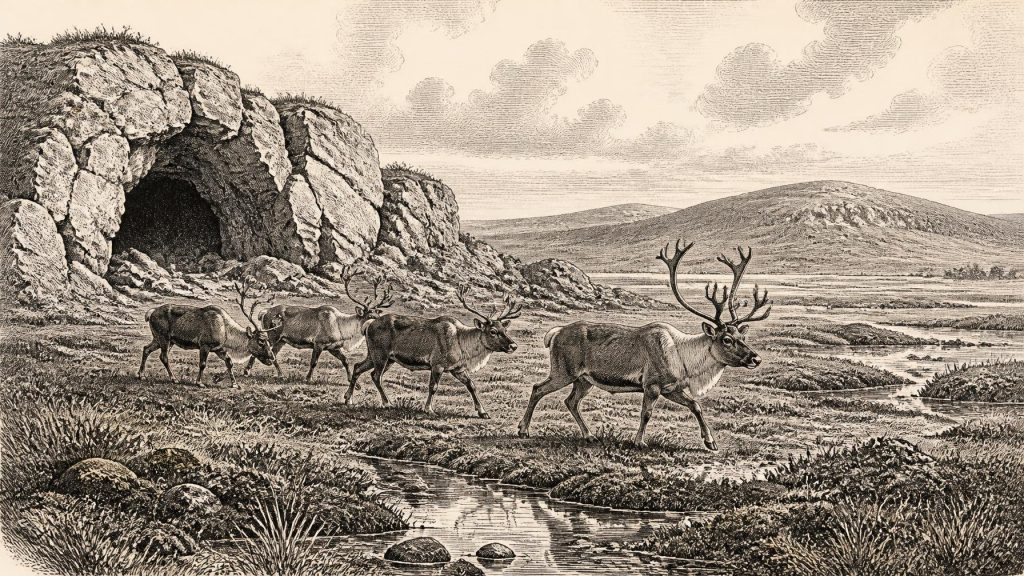
Irish cave collections provide another, less neatly dated record of the broader Ice Age fauna. Castlepook Cave near Doneraile, in north County Cork, is especially important. Excavated in the early twentieth century and later re-examined through the Irish Quaternary Fauna Project, it yielded remains attributed to reindeer, woolly mammoth, giant deer, brown bear, wolf, spotted hyaena, arctic fox, hare and lemming. Not every bone belongs to the same episode. Caves are accumulators: carnivores drag in prey, animals die in or near entrances, water moves sediment, and antiquarian excavation can disturb the original relationships.
For that reason Castlepook cannot be read as a snapshot of one valley on one day. It nonetheless establishes that Ireland was part of a wider north-west European world in which cold-adapted mammals could reach and inhabit available terrain. Reindeer are especially evocative because open, lichen- and herb-rich country would have suited them. Mammoth and giant deer signal that, at different times represented in the deposits, large herbivores occupied the island as well. Hyaenas, wolves and bears indicate that predation and scavenging structured this ecosystem as much as grasses and sedges did.
The cave itself was probably more often a carnivore den or bone trap than a human home. A reindeer carcass could be killed on open ground, partly consumed there, then carried or scattered by scavengers. That is an important corrective to romantic pictures of people sheltering beside a cave fire. Even when animal remains establish that large mammals lived in Ireland, they do not automatically demonstrate the presence of hunters.
The Marked Femur
One Castlepook find makes the question of people impossible to ignore: a reindeer femur fragment, held in the National Museum of Ireland’s natural-history collections, has been reported as bearing a deep mark interpreted by zooarchaeologist Ruth Carden as made by a sharp stone tool during carcass processing. It has also been publicly described as around 33,000 years old in radiocarbon terms, broadly relevant to the period represented by this article. If the mark is genuinely anthropogenic and contemporary with the bone, it may record an Upper Palaeolithic visit to Ireland far earlier than the island’s previously accepted human evidence.
That conditional language is essential. The object is not accompanied by a securely excavated hearth, a stone-tool assemblage, a habitation surface, human remains or a sequence of food waste. The old cave collection contains material accumulated and recovered under conditions that make precise association difficult. The date of an animal bone does not by itself prove the date, agent or purpose of a surface modification. Nor can one marked bone show whether its maker lived locally, arrived on a short hunting foray, travelled with a family group, or visited Ireland repeatedly.
The claim should thus be treated as a significant research lead rather than as proof that Ireland had a settled Palaeolithic population. It does, however, give a concrete historical question to the landscape: might mobile people, already established elsewhere in north-west Europe, have reached this cold island and processed a reindeer? Further microscopic analysis, direct dating, careful excavation and securely stratified finds are needed to move from possibility to a firmer conclusion.
No Polities, No Diplomacy
There is no evidence for political institutions, named communities, warfare, diplomacy, religion, formal learning or trade networks in Ireland at this date. It would be wrong to fill that silence with analogies from later prehistory. There were no known chiefs, kingdoms, monuments, graves, ritual places, domestic structures or exchange goods. If people did make a brief incursion, their social world may have involved co-operation, knowledge of animal movements, skilled use of stone edges and decisions about risk, food and shelter; but these are inferences from the practical demands of northern hunter-gatherer life, not facts demonstrated in Ireland.
Equally, the economy cannot be described as an Irish hunting economy. Reindeer bones and a possible cut mark suggest animal exploitation only in the most limited sense. No Irish site of this age has supplied the evidence required to reconstruct diet, season of occupation, clothing, tools, routes, exchange or household organisation. The material record more securely reveals the economy of non-human life: grazing herbivores, predators, scavengers and wetland organisms adapting to an unstable cold environment.
What This Date Can Mean
The greatest development around 31,148 BCE was environmental rather than political. Ireland lay in a narrowing interval between survivable open habitats and the later expansion of major ice cover. Derryvree’s freshwater deposits show that tundra wetland ecosystems existed during this broad phase; Castlepook’s fauna shows that large mammals and carnivores formed part of the island’s Pleistocene history; and the marked reindeer femur raises, but does not settle, the question of early people.
Later glaciation was both an ancient event and a historian’s obstacle. It reshaped the ground, deposited tills, carved landforms and probably destroyed many archaeological sites. The scarcity of evidence is therefore not proof that no person ever entered Ireland before the Last Glacial Maximum. Neither is it licence to claim a lost population. For this distant point in time, the most defensible Irish history is one of tundra pools beneath future ice, roaming animals around limestone caves, and a single contested incision that may preserve the faintest trace of a human hand.
Primary Sources
- A Middle Midlandian Freshwater Series at Derryvree, Maguiresbridge, County Fermanagh, Northern Ireland
- The Irish Quaternary Fauna Project
- First Evidence of a Late Upper Palaeolithic Human Presence in Ireland
- The Colonization of Ireland: A Human Ecology Perspective
- Ireland: Submerged Prehistoric Sites and Landscapes
- Growth and Retreat of the Last British–Irish Ice Sheet, 31,000 to 15,000 Years Ago: the BRITICE-CHRONO Reconstruction
- Vertical Dimensions and Age of the Wicklow Mountains Ice Dome, Eastern Ireland, and Implications for the Extent of the Last Irish Ice Sheet
- The Timing and Magnitude of the British–Irish Ice Sheet Between Marine Isotope Stages 5d and 2
- Episodic Speleothem Deposition Tracks the Terrestrial Impact of Millennial-Scale Last Glacial Climate Variability in SW Ireland
- New Insights on the Fauna of Ireland’s Younger Dryas and Early Holocene From Alice & Gwendoline Cave
- The Mesolithic in Ireland: When Was It?
- Heritage Artefacts of County Cork
- Looking for the Irish Palaeolithic: New Research Projects on Old Animal Bones and Cave Sediments
- Ireland’s Palaeolithic Archaeology – Fleeting Footprints in a Frozen Land
- The Antiquity of Man in Ireland
- Exposure-Age Constraints on the Extent, Timing and Rate of Retreat of the Last Irish Sea Ice Stream
- BRITICE Glacial Map, Version 2: A Map and GIS Database of Glacial Landforms of the Last British–Irish Ice Sheet
- Radiocarbon Dates from the Oxford AMS System: Archaeometry Datelist 31
- Glacial Geomorphology in the Wicklow Mountains, Ireland
- Reindeer Bone Found in Cork Cave Shows Human Activity in Ireland 33,000 Years Ago
- Advances in Irish Quaternary Studies