Cork’s Reindeer Window31278 BCE
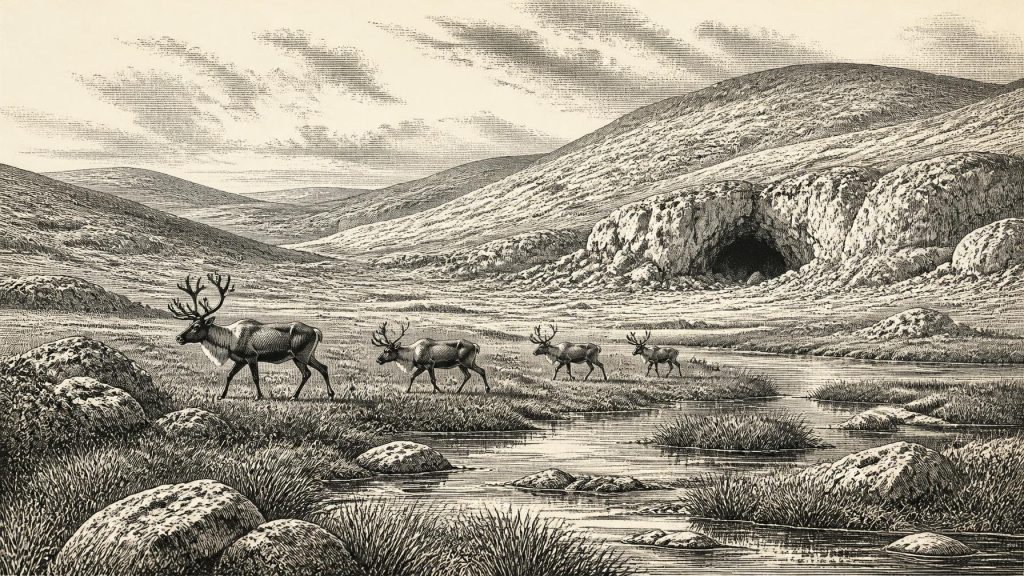
31,278 BCE is a modern label, requiring interpretation through Late Pleistocene ranges rather than a dated Irish event. During climatically unstable Marine Isotope Stage 3, Ireland varied regionally between ice-affected and open environments. Derryvree sediments preserve a cold, treeless freshwater wetland supporting plants and insects between glacial episodes. Castlepook Cave in County Cork contains mixed, disturbed remains of reindeer, mammoth, giant deer and carnivores, demonstrating cold-stage fauna but not a single contemporaneous community. A cut-marked reindeer bone may indicate brief human butchery, although this remains debated. No evidence supports settlement, polity, ritual or trade; glaciation and sea-level change erased evidence.
Dateline
31,278 BCE is a modern chronological label, not a year that can be matched to a recorded Irish event. There were no written calendars, named rulers or dated settlements in Ireland at this depth of time. Even the conversion is only a convenience: in the conventional system that counts calibrated ages back from 1950, this label falls roughly 33,227 years before present. Archaeology cannot distinguish what happened in one particular year. The responsible frame is therefore the later part of the Late Pleistocene, within Marine Isotope Stage 3, and the evidence must be expressed through date ranges, deposits and probabilities rather than a year-by-year narrative.
A Cold, Changing Island
Ireland around this notional date stood in a long glacial age, but not necessarily under a single, unchanging blanket of ice. Marine Isotope Stage 3, conventionally spanning about 57,000 to 29,000 calibrated years before present, was climatically unstable. Cold phases alternated with comparatively milder interludes on scales far longer than a human lifetime but short in geological terms. The large British–Irish Ice Sheet was growing and changing its limits. Its later maximum, broadly around 25,000–23,000 years ago in the Irish Sea sector, still lay in the future; yet evidence from western Ireland also indicates major earlier ice advances and substantial local ice loading before that maximum.
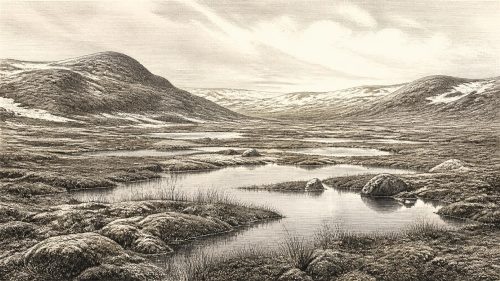
That complexity matters. It is unsafe to picture all of Ireland at c. 33,200 calibrated years ago as either wholly ice-covered or wholly open country. Ice margins differed between regions and advanced or retreated over time. Much of the evidence comes from deposits that have themselves been overridden, eroded, redeposited or exposed only in modern quarrying, roadworks and caves. The most defensible conclusion is a regional one: at some points during this wider interval, ice-free or less severely glaciated landscapes existed sufficiently long for plants, animals and freshwater environments to develop, while other areas were affected by ice or lay close to its margins.
Derryvree’s Buried Wetland
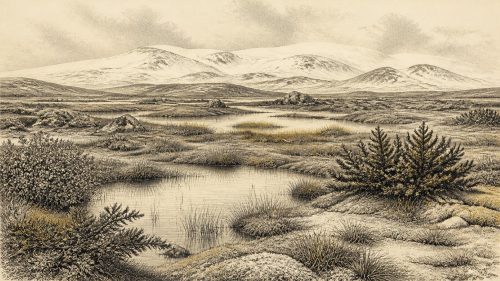
A crucial environmental archive lies at Derryvree near Maguiresbridge in County Fermanagh. Road excavation in 1969 cut through a drumlin and revealed freshwater silts and fine sands between two thick tills. The organic deposit is not a diary of a particular Irish year, nor should it be assumed to represent conditions across the island. Its significance is that it records a cold, largely treeless wetland environment during an earlier Midlandian interstadial sequence, securely demonstrating that freshwater plants, insects and open-ground communities could occupy parts of Ireland between episodes of glaciation.
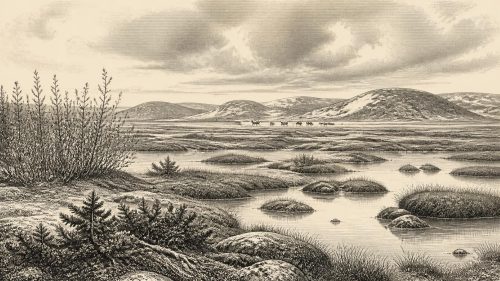
The Derryvree evidence suggests sedge-rich, mossy and shallow-water habitats rather than a familiar modern landscape of enclosed fields and woodland. Fossil plant remains include species suited to cold, open conditions, while insect evidence adds detail about local habitats. Pools, damp ground and vegetation along their margins could sustain a small but functioning food web. This was not a lush temperate refuge. It was a demanding northern environment, exposed to severe winters, short growing seasons and changing moisture conditions. Nevertheless, it contained biological productivity: a fact of importance when considering where grazing animals might have found forage.
Chronological correlation remains cautious. The Derryvree organic layer has been discussed in relation to cold phases around the middle of the last glacial cycle, and its radiocarbon evidence requires calibration and comparison with other records. It provides a close palaeoenvironmental analogue for the kind of Irish landscape relevant to 31,278 BCE, not proof that every Derryvree pond was open in that numbered year. Its principal lesson is methodological as well as environmental: Irish deep-time history survives in fragments, and each fragment has a local setting and its own chronological uncertainty.
Castlepook’s Animal Archive
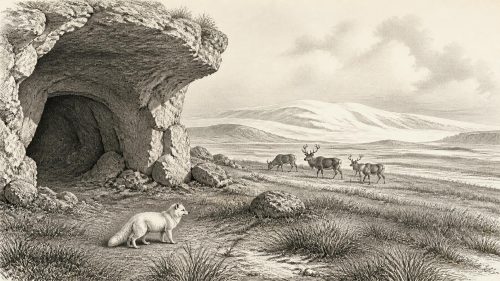
The most important evidence from southern Ireland is Castlepook Cave, also called Mammoth Cave, near Doneraile in north County Cork, in the Awbeg valley below the Ballyhoura Hills. Excavated principally in the early twentieth century, the cave yielded a remarkably rich collection of Pleistocene animal remains. Later research and direct radiocarbon dating have made it central to discussion of Ireland before the Last Glacial Maximum. The cave contains bones from more than one period, however, and its deposits were disturbed by water, earlier excavation and natural processes. It is an archive assembled over time, not a sealed hunting camp.
Its fauna is striking. Reindeer, woolly mammoth, giant deer, brown bear, wolf, Arctic fox, lemmings and spotted hyena are represented in the wider Castlepook record. The association does not mean that every species shared the same valley in the same season. Direct dates on individual bones span a substantial interval, and older excavation methods did not preserve the contextual detail now expected. Still, the assemblage firmly establishes that Ireland was reached by a succession of cold-stage mammals during Marine Isotope Stage 3. The cave was connected, directly or indirectly, to a wider north-west European world of open habitats and mobile animal populations.
Reindeer are especially relevant to the approximate period represented by 31,278 BCE. They are well adapted to open, cold landscapes and could have exploited herbs, grasses, sedges, dwarf shrubs and lichens across broad seasonal ranges. Their presence does not prove an uninterrupted herd moving through every part of Ireland, but it makes a reindeer landscape credible in suitable regions. Mammoth and giant deer point to varied grazing opportunities, while carnivores such as hyena and wolf indicate that carcasses, prey and shelter were contested resources. Caves may have served as dens, traps, temporary refuges or places where bones were washed in; each mechanism has different implications for what survives.
The Human Question
A reindeer femur from Castlepook has been reported as bearing a mark interpreted as a fresh-bone cut made with a sharp stone tool, and it has been widely presented as evidence for human activity in Ireland about 33,000 years ago. If that interpretation is upheld, it would indicate a brief Upper Palaeolithic human incursion, probably involving carcass processing, during the broader period close to this article’s notional date. It would not establish a village, a permanent population or a known community. No securely associated hearth, stone-tool assemblage, dwelling floor, human bone or undisturbed butchery area of comparable age has yet been recovered at the cave.
That distinction is essential. A single modified bone can illuminate an encounter between people and an animal, but it cannot reveal the size, language, kinship system or duration of a group. Nor can a cave fauna be transformed automatically into a story of regular reindeer hunting. The possibility of human visitation is important precisely because Ireland’s earlier Palaeolithic archaeological record is so slight. It should be described as evidence under investigation and interpretation, not as a settled fact from which a detailed social history can be built. Recent excavation at Castlepook located surviving deposits and recovered faunal material, but reported no cultural artefacts.
If people did reach Ireland in this period, they would have belonged to the wider Upper Palaeolithic human world of north-west Europe. Comparisons with Britain and continental Europe make small, mobile hunter-gatherer parties a reasonable model, especially where seasonal animal movements offered opportunities. Yet comparison is not evidence of identity. No Irish site of this age has produced the blades, points, ornaments, portable art, shelters or burials that could tie visitors to a particular archaeological culture. The distance across changing sea, shelf and ice conditions is also unresolved at the needed scale. Lower global sea levels exposed land now submerged, but that alone does not demonstrate a dry, accessible route from Britain to Ireland at this moment.
No Polities, No Diplomacy
There is no evidence for political institutions, territories, chiefs, warfare, diplomacy or collective identities in Ireland around 31,278 BCE. Those are not subjects hidden by a lack of written sources; the material record is far too sparse to support them. Nor can religion be responsibly reconstructed. Ireland has no demonstrable shrine, burial rite, cave art, ceremonial object or structured deposit from this date. It is possible that any visiting people possessed social rules, stories, ritual practices and learned ecological knowledge, as all human groups do, but none can presently be identified as Irish evidence.
The same restraint applies to culture and economy. There was no agriculture, livestock keeping, metalworking, pottery production or built settlement in evidence. If humans were present, their subsistence may have included opportunistic hunting, scavenging or butchery of large mammals, supplemented in ways invisible to the record by smaller game and gathered foods. Such possibilities are interpretations based on the ecological setting and Upper Palaeolithic comparison, not observations from an excavated Irish camp. There is no direct evidence for trade, regular exchange routes or seafaring at this date.
A Landscape Before Erasure
The greatest historical development appropriate to this point is not a named human event but the formation of a fragile environmental and fossil record before the harshest stages of the last glaciation reshaped much of the island. Ice could scour landscapes, rework sediments and destroy or bury open-air sites. Sea-level change later drowned parts of the former coastal plain. Those processes help explain why caves such as Castlepook and sediment pockets such as Derryvree have disproportionate importance: they are rare survivors from a period for which Ireland has no continuous archaeological sequence.
Thus Ireland at 31,278 BCE can be approached, but not narrated with false precision. The evidence supports a cold and variable late-Ice-Age setting, locally capable of sustaining wetland vegetation and cold-adapted mammals. Castlepook offers compelling evidence of a rich fauna and a debated indication that people may have briefly processed reindeer there. It does not support claims of an established Irish population, a named culture or an event assigned to one calendar year. The honest history of this moment is an unfinished one: written in bone, silt, pollen, insects, cave sediments and the careful revision of older collections.
Primary Sources
- The Exploration of Castlepook Cave, County Cork, Being the Third Report from the Committee Appointed to Explore Irish Caves
- The Exploration of Castlepook Cave, Co. Cork. With 3 Plates.
- Castlepook Cave: Cork County Geological Site Report
- A Reconsideration of the Radiocarbon Dating of the Marine Isotope Stage 3 Fauna from Southern Ireland
- The Irish Quaternary Fauna Project
- A Middle Midlandian Freshwater Series at Derryvree, Maguiresbridge, County Fermanagh, Northern Ireland
- Figure 6: The Subdivision of the Quaternary Period in Ireland
- Radiocarbon Constraints on the History of the Western Irish Ice Sheet Prior to the Last Glacial Maximum
- Growth and Retreat of the Last British–Irish Ice Sheet, 31,000 to 15,000 Years Ago: The BRITICE-CHRONO Reconstruction
- Stratigraphic and Palaeo-Geomorphological Evidence for the Glacial-Deglacial History of the Last British-Irish Ice Sheet in the North-Western Irish Sea
- Maximum Extent and Readvance Dynamics of the Irish Sea Ice Stream and Irish Sea Glacier Since the Last Glacial Maximum
- The Colonization of Ireland: A Human Ecology Perspective
- First Evidence of a Late Upper Palaeolithic Human Presence in Ireland
- New Insights on the Fauna of Ireland's Younger Dryas and Early Holocene from Alice & Gwendoline Cave
- 2022:564 – Castlepook Cave, Castlepook South, Cork
- Spotted Hyena Skull
- Mammals
- Archaeological Heritage of County Cork: Volume 1, Part 1
- The Mesolithic in Ireland: When Was It?
- Phylogeographic, Ancient DNA, Fossil and Morphometric Analyses Reveal Ancient and Modern Introductions of a Large Mammal: The Complex Case of Red Deer (Cervus elaphus) in Ireland