Fermanagh Shallows31277 BCE
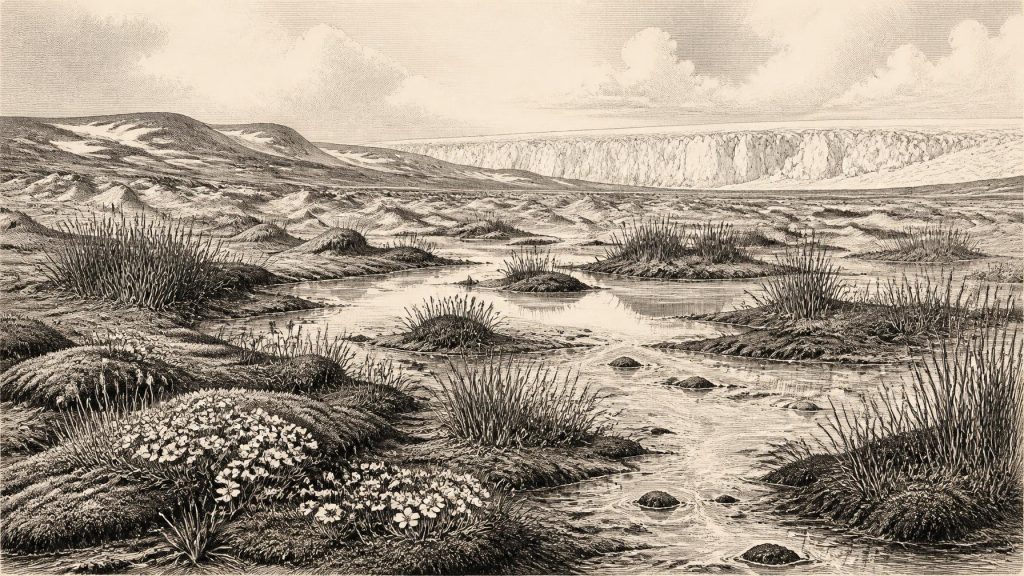
Around 31,277 BCE, Ireland lay in the unstable later Marine Isotope Stage 3, approaching the Last Glacial Maximum, rather than within recoverable written history. Ice expanded unevenly across the region, leaving temporary exposed, wetland or marine environments. At Derryvree, County Fermanagh, freshwater silts between tills preserve pollen, plants and beetles indicating shallow water, tundra-like ground and severe seasonal conditions before later ice advance. Cave remains from Castlepook suggest cold-open-country fauna, including reindeer, mammoth and predators, but accumulated across long periods. A possibly cut-marked reindeer bone offers uncertain evidence of early people; permanent settlement, politics, trade and social life remain unproven.
Dateline
“31,277 BCE” is a modern chronological label, not a date that can be recovered from Irish evidence with calendar-year precision. No community in Ireland kept a written calendar at this depth of time, and neither archaeology nor earth science can identify an event, ruler, battle, settlement or individual belonging to that particular year. In the conventional archaeological count from AD 1950, the label lies roughly 33,226 years before present. That arithmetic conversion must not be mistaken for a scientific date: radiocarbon determinations require calibration, carry statistical uncertainty, and usually illuminate spans of centuries or longer. The responsible subject is therefore Ireland in the later part of Marine Isotope Stage 3, during the long climatic descent towards the Last Glacial Maximum.
For this period Ireland has no historical narrative. Its record consists instead of cave bones, organic silts, pollen, plant remains, beetles, landforms and measurements of radioactive decay or cosmogenic exposure. These traces establish some things securely: climates were severe and unstable; ice masses were growing and shifting around Ireland and the Irish Sea; and cold-adapted animals could occupy at least parts of the region during ice-free intervals. They establish other things poorly or not at all: human population, language, social organisation, religious practice, territorial control and trade. A year-by-year account must begin by recognising that the most important evidence is environmental, not political.
A Cold Stage in Motion
The Irish name for the last major glacial episode is the Midlandian glaciation. Around the requested date, the British–Irish Ice Sheet was not yet necessarily at its single, universally simultaneous maximum. Modern reconstructions instead show a complicated and asynchronous growth of ice between roughly 35,000–32,000 and 27,000–21,000 years ago, with different sectors advancing, stabilising or retreating at different times. In the Irish Sea sector, substantial expansion is placed broadly between about 30,000 and 26,000 years ago. The global Last Glacial Maximum came later, conventionally about 26,500–19,000 years ago.
This means that it would be misleading to picture one uniform Irish landscape in 31,277 BCE. In some places ice may already have overridden the ground; elsewhere, exposed terrain, marine margins, lakes or wetlands could survive temporarily. Ice-sheet reconstructions are continually refined because their evidence is uneven. Moraines, streamlined drumlins, meltwater channels, offshore sediment cores and dated shells preserve different parts of the story, often recording the passage of ice rather than the precise time of its arrival. The later ice sheet also scoured away or buried much of what had existed before it. Ireland’s apparent archaeological silence is therefore partly a product of preservation.
The Fermanagh Freshwater Archive
The closest and most informative Irish environmental evidence comes from Derryvree near Maguiresbridge in County Fermanagh. Road works in 1969 exposed fine sands and freshwater organic silts sealed between two thick tills within a drumlin. The deposit was investigated by Eric Colhoun, James Dickson, A. M. McCabe and F. W. Shotton, who recovered pollen, seeds, mosses and insect remains. A conventional radiocarbon determination of about 30,500 ± 1,100 radiocarbon years before present is not equivalent to a single modern calendar date; later calibration discussions place it broadly in the mid- to later-MIS 3 world, with a range extending over millennia. It is near enough to the requested horizon to be illuminating, but it is not proof of conditions in Ireland in one numbered year.
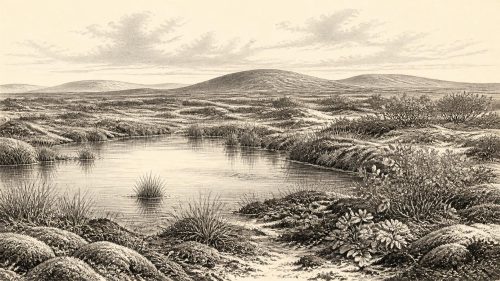
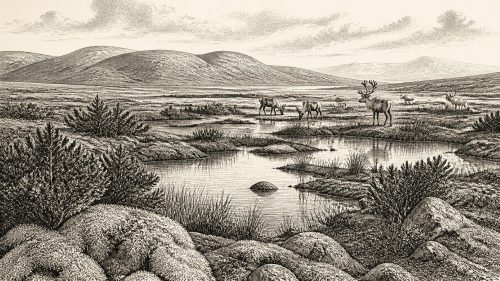
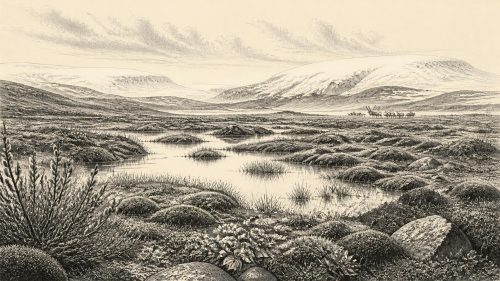
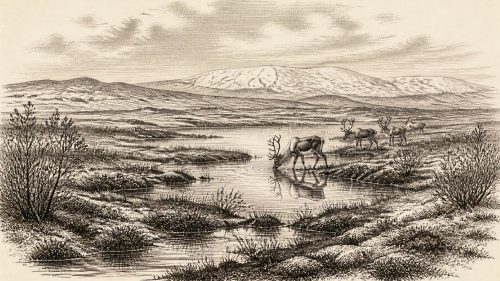
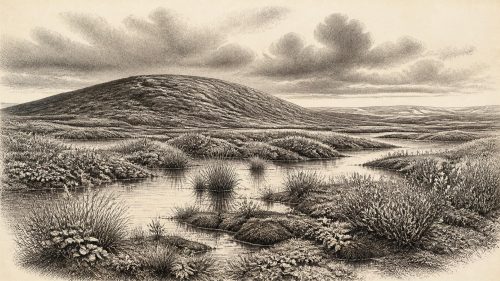
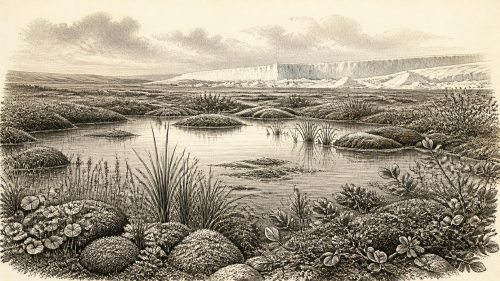
What the Derryvree silts do show is a local freshwater environment in an otherwise cold, open landscape before a later ice advance sealed it beneath till. The recovered flora includes sedges, mosses and aquatic plants such as bogbean; records also include cold-tolerant plants including mountain avens and rosy saxifrage. Beetle evidence complements the botanical material. Together, these proxies support an interpretation of shallow water, wet margins and tundra-like or periglacial ground, rather than forested countryside. Trees were not the defining feature of this northern landscape. Summers may have permitted a brief growing season at favourable wetland edges, while winters were long and severe.
This is a valuable corrective to a familiar image of an Ireland wholly entombed beneath ice. Ice certainly dominated the broader glacial history, and later ice helped create the drumlin landscape now associated with Fermanagh. But the inter-till deposit shows that open water and living communities of plants and invertebrates could exist during a cold interval between episodes of glaciation. It does not allow us to reconstruct a pleasant oasis or a stable ecosystem. Its value lies precisely in revealing an austere, changeable habitat at the edge of expanding ice.
Animals in Open Country
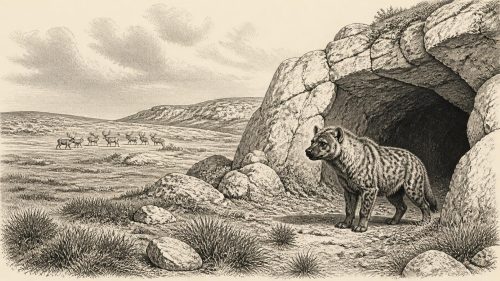
Caves in southern Ireland provide another fragmentary line of evidence. The old collections from Castlepook Cave near Doneraile, County Cork, include remains attributed to woolly mammoth, reindeer, giant deer, brown bear, wolf, Arctic fox, mountain hare, lemmings and spotted hyaena. Some radiocarbon determinations on the assemblage fall in the broad pre-Last-Glacial-Maximum period, though the cave’s deposits accumulated over long spans and were excavated before modern recording standards. Bones found in the same cave need not be contemporary, and animal lists should not be turned into a precise inventory for every Irish valley.
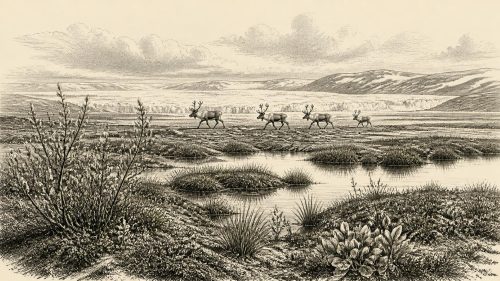
Even with that caution, the fauna is significant. Reindeer, lemmings and Arctic fox indicate cold open habitats; mammoth and giant deer suggest that large herbivores at times reached Irish landscapes capable of sustaining them. Spotted hyaena and wolf point to predator-scavenger networks, while the cave itself may have been used repeatedly by carnivores bringing in prey or by animals dying in its passages. Their presence demonstrates regional ecological connections across a north-west European world whose coastlines and ice margins differed greatly from those of today. It does not demonstrate that these species all lived together at one moment, nor that their range extended continuously across every part of Ireland.
The Human Question
Human activity is the most tempting and the most uncertain subject. A reindeer femur from Castlepook has been reported as carrying a deep linear mark consistent with stone-tool butchery and as dating to approximately 33,000 years ago. If the modification is confirmed as human-made, it would be extraordinarily early evidence that one or more Upper Palaeolithic people processed an animal in Ireland before the great ice advance. It would indicate a visit or a short-lived use of the island, not a settled population, a named people or a durable colony.
The qualification is essential. The specimen derives from an old cave collection rather than a newly excavated occupation floor with associated tools, hearths, dwelling traces and a securely dated series of butchered remains. A radiocarbon measurement dates the animal’s death, not automatically the cut or its maker. Sharp marks may be evaluated against damage caused by carnivores, trampling, sediment movement, breakage, weathering and earlier excavation. Ireland has no securely associated stone-tool assemblage, human bone, camp or burial of comparable antiquity. The National Museum of Ireland consequently still describes clear Palaeolithic human presence on the island as unproven, while the better-supported terminal Pleistocene evidence is far later: a butchered brown-bear patella from Alice and Gwendoline Cave, County Clare, dated to about 12,810–12,590 calibrated years BP.
It is reasonable to say that mobile hunter-gatherers elsewhere in Upper Palaeolithic Europe possessed sophisticated stone technologies, used fire, made clothing and equipment from organic materials, shared food, and maintained social ties over wide areas. It is not reasonable to assign those practices directly to Ireland in 31,277 BCE. The possibility of a brief human encounter with a reindeer belongs to the evidence; an Irish campfire, kin group, language, ritual or hunting territory belongs to inference beyond what the island’s record presently bears.
No Politics, No Trade, No Named Communities
Accordingly, there are no identifiable political affairs, conflicts, diplomatic exchanges, institutions or leaders for Ireland at this time. Nor is there evidence for agriculture, herding, permanent settlement, craft production, formal religious monuments, graves, seaborne commerce or long-distance trade from this horizon. Lower global sea levels exposed portions of the surrounding seabed, but the exact geography of routes between Ireland and Britain remains model-dependent and changed with ice loading, crustal movement and the sea. Physical access alone would not prove human movement.
The major development around 31,277 BCE was therefore environmental: Ireland was entering a harsher phase in which advancing ice and polar-desert or tundra conditions increasingly constrained life. Derryvree’s buried freshwater bed preserves a fleeting counterpoint—plants, insects and water persisting in a cold landscape before later ice covered the site. The cave fauna shows that animals occasionally found a way into this changing world. Whether people did so too remains an important question, not a settled fact. For Ireland, this is not yet history in the conventional sense. It is deep time, reconstructed patiently from the small survivals that ice did not erase.
Source References
Hover over a number to see the source. Select it to open the source.

- [1] Growth and retreat of the last British–Irish Ice Sheet, 31 000 to 15 000 years ago: the BRITICE-CHRONO reconstruction
- [2] Extent and timing of the Last Glacial Maximum (LGM) in Britain and Ireland: a review
- [3] Maximum extent and readvance dynamics of the Irish Sea Ice Stream and Irish Sea Glacier since the Last Glacial Maximum
- [4] Maximum extent and dynamic behaviour of the last British–Irish Ice Sheet west of Ireland
- [5] Radiocarbon constraints on the history of the western Irish ice sheet prior to the Last Glacial Maximum
- [6] Early deglaciation of the British-Irish Ice Sheet on the Atlantic shelf northwest of Ireland driven by glacioisostatic depression and high relative sea level
- [7] Timing and pace of ice-sheet withdrawal across the marine–terrestrial transition west of Ireland during the last glaciation
- [8] Stratigraphic and palaeo-geomorphological evidence for the glacial-deglacial history of the last British-Irish Ice Sheet in the north-western Irish Sea
- [9] Pattern and timing of retreat of the last British-Irish Ice Sheet
- [10] Dimensions and chronology of the last ice sheet in Western Ireland
- [11] Late Pleistocene chronostratigraphy and ice sheet limits, southern Ireland
- [12] Quaternary deposits and glacial stratigraphy in Ireland
- [13] A Middle Midlandian Freshwater Series at Derryvree, Maguiresbridge, County Fermanagh, Northern Ireland
- [14] Figure 6.— The subdivision of the Quaternary Period in Ireland
- [15] The Quaternary of the Irish Midlands
- [16] The Irish Quaternary Fauna Project
- [17] New insights on the fauna of Ireland's Younger Dryas and Early Holocene from Alice & Gwendoline Cave
- [18] Prehistoric Details
- [19] The Mesolithic in Ireland: when was it?
- [20] The Island of Ireland: Drowning the Myth of an Irish Land-Bridge?
- [21] The problem of a late quaternary landbridge between Britain and Ireland
- [22] Ice Age Ireland
Primary Sources
- Growth and retreat of the last British–Irish Ice Sheet, 31 000 to 15 000 years ago: the BRITICE-CHRONO reconstruction
- Extent and timing of the Last Glacial Maximum (LGM) in Britain and Ireland: a review
- Maximum extent and readvance dynamics of the Irish Sea Ice Stream and Irish Sea Glacier since the Last Glacial Maximum
- Maximum extent and dynamic behaviour of the last British–Irish Ice Sheet west of Ireland
- Radiocarbon constraints on the history of the western Irish ice sheet prior to the Last Glacial Maximum
- Early deglaciation of the British-Irish Ice Sheet on the Atlantic shelf northwest of Ireland driven by glacioisostatic depression and high relative sea level
- Timing and pace of ice-sheet withdrawal across the marine–terrestrial transition west of Ireland during the last glaciation
- Stratigraphic and palaeo-geomorphological evidence for the glacial-deglacial history of the last British-Irish Ice Sheet in the north-western Irish Sea
- Pattern and timing of retreat of the last British-Irish Ice Sheet
- Dimensions and chronology of the last ice sheet in Western Ireland
- Late Pleistocene chronostratigraphy and ice sheet limits, southern Ireland
- Quaternary deposits and glacial stratigraphy in Ireland
- A Middle Midlandian Freshwater Series at Derryvree, Maguiresbridge, County Fermanagh, Northern Ireland
- Figure 6.— The subdivision of the Quaternary Period in Ireland
- The Quaternary of the Irish Midlands
- The Irish Quaternary Fauna Project
- New insights on the fauna of Ireland's Younger Dryas and Early Holocene from Alice & Gwendoline Cave
- Prehistoric Details
- The Mesolithic in Ireland: when was it?
- The Island of Ireland: Drowning the Myth of an Irish Land-Bridge?
- The problem of a late quaternary landbridge between Britain and Ireland
- Ice Age Ireland