
Derryvree Before the Till31265 BCE
31,265 BCE is a modern notional date within Ireland’s Late Pleistocene MIS 3, not a recordable year. At Derryvree, County Fermanagh, organic silts between tills document an ice-free interval, dated broadly to 36,900–31,700 calibrated BP, when tundra-like wetland supported grasses, sedges, mosses, juniper, insects and freshwater plants. Cave remains, especially at Castlepook, show mammoth, reindeer and hyaena reached Ireland. A marked reindeer femur may indicate Upper Palaeolithic butchery, but cannot prove permanent settlement. Evidence reveals no institutions or communities. Changing sea levels, ice and uncertain routes shaped access before the expanding British–Irish Ice Sheet transformed habitats and obscured earlier traces.
Dateline
The label 31,265 BCE is useful only as a modern point on a very long prehistoric timescale. It does not denote a year that anyone in Ireland recorded, named or could have recognised. At this depth in time, archaeology cannot isolate a particular winter, hunt, journey or political act to a calendar year. In the conventional system that counts backwards from AD 1950, it corresponds roughly to 33,214 years before present. The responsible setting is therefore a broad interval in the Late Pleistocene, within Marine Isotope Stage 3 (MIS 3), rather than an annual chronicle.
Ireland at this notional date was not yet the familiar island of later prehistory, with farms, monuments, territorial communities and sea routes known from archaeology. It was a changing northern landscape in the last Ice Age. Its evidence survives unevenly: in silts sealed beneath glacial deposits, pollen and plant remains, insects, cave bones, and the shapes left by later ice. These sources illuminate environment and animal life far better than human institutions. They require a distinction throughout between what has been found and what may reasonably be inferred.
A Date Within a Range
The closest important Irish chronological anchor is the Derryvree sequence near Maguiresbridge in County Fermanagh. Roadworks exposed organic-rich freshwater silts and fine sands caught between two tills, the unsorted sediments laid down by glacier ice. The order is decisive evidence: ice had occupied the site; a period without local glacier cover then allowed water, plants and sediment to accumulate; and a later advance sealed the deposit beneath another till. It is a record of profound environmental change, not a layer belonging to one named year.
Organic material from Derryvree produced a radiocarbon age of 30,500 ± 1,200 radiocarbon years BP. When calibrated, this has been placed broadly at about 36,900–31,700 calibrated years BP, or approximately 34,950–29,750 BCE. The date 31,265 BCE lies within that wide span, but it cannot be assigned to a particular part of the deposit. Radiocarbon ages must be converted through calibration curves because atmospheric carbon-14 has changed over time; at more than 30,000 years ago, the resulting calendar ranges are necessarily broad.
That limitation is not a failure of the evidence. It defines what good history can say. Derryvree can responsibly illuminate a cold phase of Ireland’s Late Pleistocene, while it cannot establish that a particular pool, plant, animal or person existed there in 31,265 BCE. Nor should its local history be projected unaltered across the entire landmass now called Ireland.
Wet Ground in Cold Country
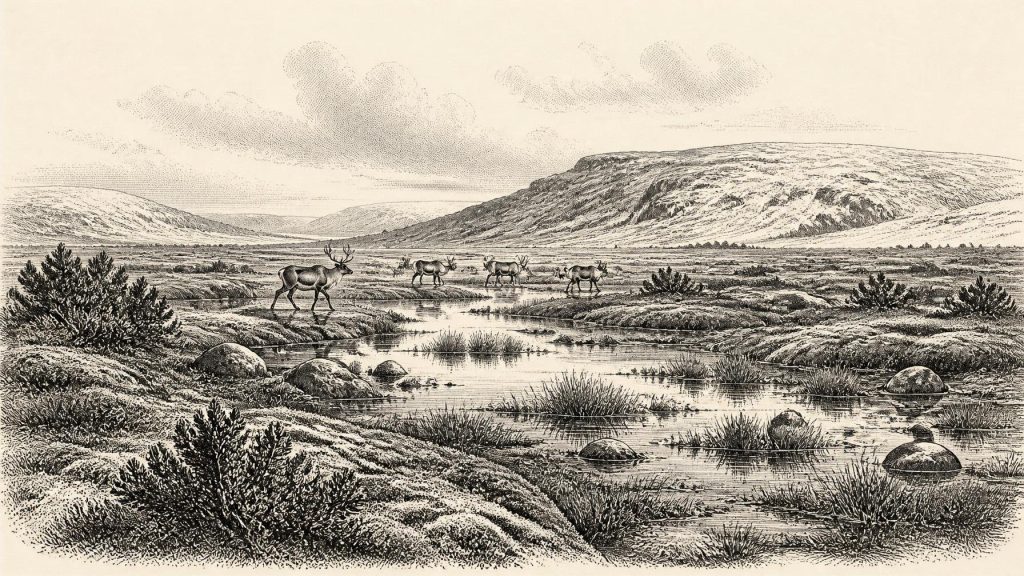
The Derryvree fossils point to open, treeless country rather than forest. Grasses, sedges, herbs, juniper and mosses, together with insect evidence, indicate a tundra or muskeg environment: wet, peaty ground with shallow open pools, plant-rich margins and extensive frost-affected terrain. A fossil seed of bogbean, a plant of wet places, is particularly vivid evidence for freshwater habitats amid the cold. The climate was harsh, with long cold winters, but the deposits show that this locality was not continuously entombed beneath glacier ice while the sediments formed.
This was a periglacial world. Seasonal freezing and thawing would have disturbed soils, moved sediment and limited woody vegetation. In warmer months, however brief, wet hollows and stream margins could support a productive mosaic of grasses, sedges, mosses and flowering herbs. Such ground was neither empty nor uniform. It offered forage to grazing animals, cover to smaller mammals and insects, and freshwater to anything moving through the landscape. Yet its productivity must not be confused with comfort: exposure, wind, frost and rapidly shifting seasonal conditions governed daily survival.
The wider glacial picture remains regionally complex. Geological reconstructions suggest that north-central Ireland had remained ice-free until at least about 34,000 years ago, before the last Irish Ice Sheet expanded. At around the broad horizon represented by this article, ice was beginning to become a more important force in the region, but neither the exact margin nor the timing of advance can be fixed everywhere. Later growth was substantial: reconstructions show the British–Irish Ice Sheet building from 31,000 to 26,000 years ago and reaching maximum volume around 23,000 years ago.
Animals and Cave Archives
Irish cave deposits supply the strongest evidence for the animals able to live in, or reach, this cold landscape. Castlepook Cave near Doneraile in north County Cork, long also known as Mammoth Cave, has produced remains attributed to woolly mammoth, reindeer, spotted hyaena and other Pleistocene fauna. Earlier dating work identified mammoth and hyaena remains of roughly the relevant age range. Such assemblages demonstrate that Ireland was accessible to a changing suite of large mammals before the fullest glaciation, although cave collections are often old, incomplete and disturbed by water, carnivores or later excavation.
Reindeer were especially suited to open ground and, alongside mammoth, evoke an ecosystem in which grazing and browsing animals could range across broad, sparsely wooded terrain. Spotted hyaenas indicate predators and scavengers capable of moving bones into caves; a cave assemblage is therefore not automatically a picture of animals living together at one moment. It may instead be an accumulation made across generations or millennia. The Irish Quaternary Fauna Project stressed both the remarkable range of mammals present before the Last Glacial Maximum and the severe limits imposed by sparse, reworked evidence.
The Castlepook Human Question
One object makes this period exceptionally important for Irish archaeology: a reindeer femur from Castlepook Cave, publicly reported as about 33,000 years old and bearing a deep mark interpreted by palaeozoologist Ruth Carden as a stone-tool cut or chopping mark. If that interpretation is confirmed, it is evidence that a person processed a reindeer in Ireland during the Upper Palaeolithic, much earlier than the long-established record of post-glacial settlement. County Cork’s heritage publication identifies the bone as a Palaeolithic reindeer femur from Castlepook and dates it broadly to c. 31,000 BC.
Its importance should not be inflated into a story the evidence cannot bear. The bone’s date is the age of the animal, not a precisely dated moment of butchery. It came from an antiquarian cave collection, not a modern, fully stratified excavation with a securely associated hearth, tool-kit, dwelling surface or human remains. No contemporaneous settlement has yet been demonstrated at Castlepook. Carnivores may have transported discarded bone into the cave, and neither one cut-marked specimen nor one cave can establish the scale, duration or regularity of human presence.
The most cautious conclusion is also the most consequential: the femur may document a fleeting episode of human activity in Ireland around this wider period. It does not prove a permanent population, a village, a named people or a continuous ancestry leading to later inhabitants. Ongoing work at Castlepook seeks undisturbed deposits and further evidence such as lithics, charcoal, modified bone or cave art precisely because corroboration is essential for so early and unusual a claim.
Life Without Institutions
There is no evidence from 31,265 BCE for Irish political affairs, diplomacy, formal leadership, warfare, law or territorial states. There are no inscriptions, monuments, settlements or graves from which to reconstruct religion, language, kinship rules or social rank. It would be misleading to invent them. If people did reach Ireland, they would most plausibly have travelled in small, highly mobile hunter-gatherer groups, as part of wider north-west European movements following seasonal resources. That is an interpretation drawn from the possible butchery evidence, the reindeer ecology and the known character of Upper Palaeolithic lifeways elsewhere, not a directly observed Irish social system.
Under that interpretation, everyday work would have centred on movement, shelter, fire, clothing and the acquisition of food in a cold landscape. A reindeer carcass could yield meat, fat, hide, sinew, marrow and bone, but the Castlepook femur cannot reveal which of these mattered, whether hunters killed the animal, or whether they encountered an already dead carcass. No evidence supports farming, stock-keeping, pottery, metalworking, permanent houses, trade goods or long-distance exchange networks within Ireland at this date.
Religion and culture are equally beyond direct recovery. People elsewhere in Upper Palaeolithic Europe made sophisticated tools, ornaments and images, but Ireland has no securely dated artistic tradition, ritual site or learning institution from this horizon. The absence is meaningful chiefly as an archaeological fact, not proof that visitors lacked beliefs, stories, skills or social customs. Mobile groups leave light traces; subsequent glaciation and later erosion have removed or buried much of what may once have existed.
Routes, Water and Change
How animals and possible people arrived remains uncertain. Lower sea levels altered the surrounding shelves, but this does not license a simple claim that Ireland was joined to Britain by an easy continuous land bridge. Geological scholarship has challenged that older assumption and emphasises changing coastlines, ice, water and short-lived possible connections. The cave fauna confirms that some animals reached Ireland; it does not identify the route, season or conditions of every crossing.
The principal historical development around this notional year was environmental instability. Derryvree preserves a freshwater tundra landscape between glacial episodes. Castlepook preserves evidence of Ice Age animals and a possible human action. Together they show an Ireland that was habitable in places, but vulnerable to the expanding power of ice. Over the following millennia, the last Irish Ice Sheet grew across much of the island, reshaping ground, disrupting habitats and destroying or concealing older archaeological evidence.
Thus 31,265 BCE is not the date of a battle, ruler or foundation. It is a cautiously placed point within a long Pleistocene interval, where sediments beneath a Fermanagh drumlin and a marked reindeer bone in a Cork cave offer rare, tantalising glimpses of Ireland before the greatest advance of the last ice sheet.
Primary Sources
- The IntCal20 Northern Hemisphere radiocarbon age calibration curve (0-55 cal kBP)
- Growth and retreat of the last British–Irish Ice Sheet, 31,000 to 15,000 years ago: the BRITICE-CHRONO reconstruction
- BRITICE-CHRONO maps and GIS data of the last British-Irish Ice Sheet 31 to 15 ka, including model reconstruction, geochronometric age spreadsheet, palaeotopographies and coastline positions
- Trimlines, blockfields and the vertical extent of the last ice sheet in southern Ireland
- Late Midlandian, Pleistocene, Northern Ireland
- Introduction to the Late Quaternary and Holocene of Northern Ireland
- Figure 6.— The subdivision of the Quaternary Period in Ireland
- Irish Pleistocene biostratigraphy
- The Irish Quaternary Fauna Project
- Heritage Artefacts of County Cork
- Archaeology Research Excavation Grant 2022
- Ireland's Palaeolithic Archaeology – Fleeting Footprints in a Frozen Land
- Reindeer bone found in Cork cave shows human activity in Ireland 33,000 years ago
- New insights on the fauna of Ireland’s Younger Dryas and Early Holocene from Alice & Gwendoline Cave
- The problem of a late quaternary landbridge between Britain and Ireland
- Deglaciation, Earth crustal behaviour and sea-level changes in the determination of insularity: A perspective from Ireland
- On the postglacial isostatic adjustment of the British Isles and the shallow viscoelastic structure of the Earth
- New data for the Last Glacial Maximum in Great Britain and Ireland
- Menyanthes trifoliata
- Timing, pace and controls on ice sheet retreat: an introduction to the BRITICE-CHRONO transect reconstructions of the British-Irish Ice Sheet