Doneraile’s Single Cutmark31270 BCE
Around 31,270 BCE, Ireland had no recoverable historical record or securely dated human settlement. During Marine Isotope Stage 3, before the Last Glacial Maximum, its environments were severe, variable and increasingly affected by ice and periglacial processes. Castlepook Cave, County Cork, preserves mixed late Pleistocene fauna, including mammoth, reindeer, giant deer, predators and lemmings, but its deposits are disturbed and chronologically complex. A reindeer femur bears a possible stone-tool cutmark, suggesting human butchery, yet lacks associated artefacts or secure context. It may indicate a brief Upper Palaeolithic incursion, not permanent occupation. Environmental change, rather than social history, defines this period.
Dateline
“31,270 BCE” is a modern way of placing a point very deep in time, not a year for which Ireland possesses a historical record. Mechanically, it lies about 33,220 years before the conventional radiocarbon reference year of 1950, but neither written evidence nor an archaeological sequence permits calendar-year precision on the island at this depth. The responsible framework is therefore broad: late Pleistocene Ireland during Marine Isotope Stage 3 (MIS 3), before the climatic nadir known as the Last Glacial Maximum. Individual scientific dates carry ranges, methods and uncertainties; some Irish deposits are difficult to correlate securely at all. What can be described is an Ice Age landscape in transition, and the unusually important but problematic evidence from Castlepook Cave near Doneraile, County Cork.
A Date Without a Chronicle
This was not an Irish “year” in any political or cultural sense. There were no kingdoms, named peoples, towns, treaties or institutions that can be recovered from the evidence. No person is known. There is no demonstrable settlement, hearth, tool-kit, grave, artwork or structure in Ireland that can securely be assigned to this precise point in time. It is consequently misleading to imagine a continuous national community extending back to 31,270 BCE. Ireland was part of a changing north-west European physical landscape, and the sparse evidence that survives concerns animal remains, cave sediments, landforms and deposits shaped by ice, water and frost.
The wider climatic record does, however, give the date context. Around 33,000 calendar years before present, the North Atlantic world was marked by abrupt millennial-scale swings between colder stadials and relatively milder interstadials. The Greenland ice-core chronology identifies an interstadial phase, GI-5.2, in this general interval, but that does not supply a weather report for Cork, Fermanagh or Donegal. It is an external chronological framework against which Irish evidence may cautiously be compared. Local conditions depended upon altitude, proximity to ice margins, the sea, prevailing winds and the changing extent of the British–Irish Ice Sheet.
Before Maximum Ice
At this date Ireland was not yet at the Last Glacial Maximum, conventionally placed broadly between about 26,500 and 19,000 years ago. The later maximum brought extensive ice cover across Ireland and the surrounding continental shelf. Yet the growth of that ice mass was not a simple, island-wide advance occurring everywhere at once. The major BRITICE-CHRONO reconstruction finds that advance, maximum extent and retreat differed between sectors of the British–Irish Ice Sheet; maximum positions were reached at different times, roughly between 30,000 and 22,000 years ago. Thus 31,270 BCE belongs to an early and poorly resolved part of a major glacial build-up, rather than to a settled picture of an island wholly buried beneath ice.
That qualification matters. Much of the present Irish landscape has been remodelled by later ice, especially during and after the Last Glacial Maximum. Glaciers eroded bedrock, moved sediment, reshaped valleys and deposited tills, drumlins, moraines and meltwater gravels. They also removed or mixed older archaeological deposits. Absence of campsites is therefore not proof that no humans ever entered Ireland during MIS 3; it is also a consequence of the poor odds of preservation and discovery. Conversely, an isolated bone or surface mark cannot, by itself, establish a settled population.
Regional reconstructions underline the complexity. Donegal later developed an independent ice-dispersal centre within the larger British–Irish Ice Sheet. In the west and offshore, marine geophysical work shows that ice eventually reached far onto the continental shelf. Southern Ireland has its own contested record of ice limits and re-advances. For the period around 31,270 BCE, the most defensible picture is therefore one of severe, changeable environments, with ice and periglacial processes increasingly important, rather than a map with confidently drawn coastlines, vegetation zones or inhabited districts.
Castlepook’s Faunal Archive
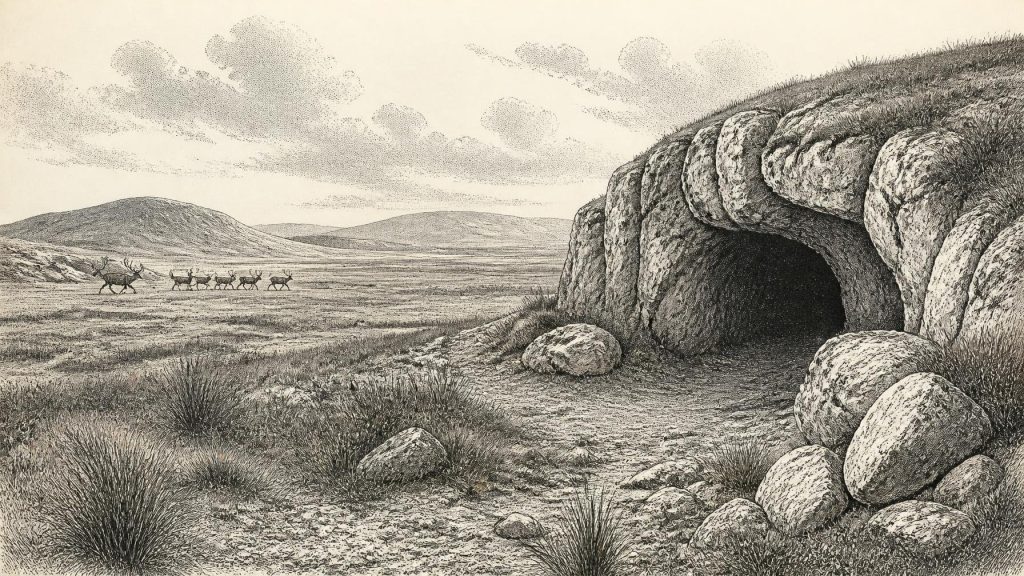
The strongest directly relevant evidence comes from Castlepook Cave, also called Mammoth Cave or Doneraile Cave, in north County Cork. Excavations undertaken between 1904 and 1913 recovered a remarkable concentration of Pleistocene animal remains from passages in Carboniferous limestone. The assemblage has included mammoth, reindeer, giant deer, brown bear, wolf, fox, mountain hare, Arctic and Norway lemmings, and spotted hyaena. Taken together, these finds show that southern Ireland was available to a distinctive cold-stage fauna during parts of the late Pleistocene. They do not show that all these animals lived together at the same moment, in the same numbers, or in the exact landscape represented by 31,270 BCE.
That distinction is especially important because Castlepook is a cave archive, not a sealed hunting camp. Carnivores can carry carcass parts into caves; water, sediment movement and later animals can disturb deposits; nineteenth- and early twentieth-century excavation methods, although valuable, did not meet modern standards. Some younger material was found among older remains. The Irish Quaternary Fauna Project therefore treated cave collections with caution and used accelerator radiocarbon dating to test the ages of selected bones. More recent work has shown that improved preparation and measurement can substantially alter the apparent ages of some Castlepook specimens. The assemblage is immensely informative, but it is neither a single event nor a simple calendar.
A mammoth bone from Castlepook once produced a radiocarbon result of 33,400 ± 1,200 BP, an uncalibrated measurement that helped place part of the fauna in MIS 3. Subsequent reassessment has argued that some faunal components are older than earlier results implied, and that giant deer and spotted hyaena may have disappeared locally before about 40,000 calibrated years BP. This does not erase the importance of the cave. Instead, it demonstrates why the date of an animal, the date of deposition, and the date of human activity must be kept separate.
The Reindeer Femur
The object most closely associated in public interpretation with c. 31,000 BCE is a reindeer femur from Castlepook. County Cork heritage material identifies it as bearing a single mark considered by palaeozoologist Ruth Carden to have been made by a sharp stone tool during butchery. If that diagnosis is sustained, it would be evidence that people handled a reindeer in Ireland during the Upper Palaeolithic, far earlier than the formerly accepted evidence for human presence. It would be a striking discovery: not a settlement or a named hunter, but a moment of contact between people and a carcass in an Ice Age ecosystem.
However, this must remain a carefully framed interpretation rather than a foundation for detailed storytelling. The femur was recovered from an old cave collection rather than a modern excavation of an undisturbed floor. The apparent tool mark is a taphonomic judgement about how a surface was modified; the date of the bone establishes the age of the animal, not automatically the circumstances of the incision. The cave’s carnivore activity supplies a plausible alternative history for how discarded or scavenged remains reached its passages. No securely associated stone blade, spear point, hearth or habitation surface has yet been recovered in Ireland for this proposed episode. A single cutmark may point to a brief human incursion; it cannot demonstrate permanent occupation.
This uncertainty is not a weakness to conceal but the central historical fact. Archaeology advances by asking whether evidence can survive repeated scrutiny. Reanalysis of museum collections, microscopic examination of marks, direct dating of additional bones, sedimentary ancient-DNA work and fresh cave excavation may clarify the question. Until then, the responsible conclusion is modest: a reindeer bone from Castlepook offers a potentially significant indication of human butchery in late Pleistocene Ireland, but it does not permit certainty about population size, ancestry, language, route of arrival or duration of stay.
Life in a Cold Landscape
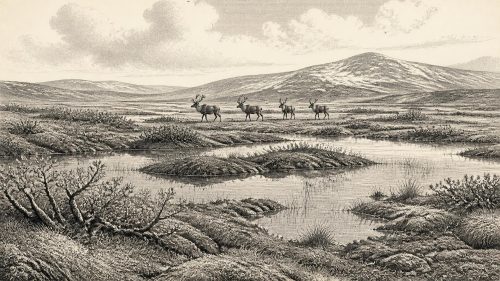
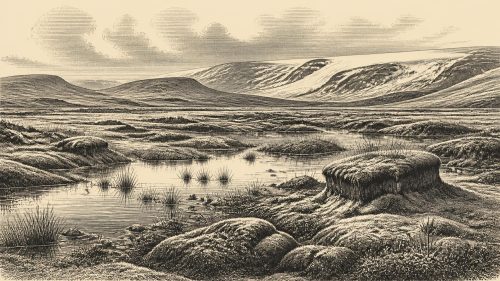
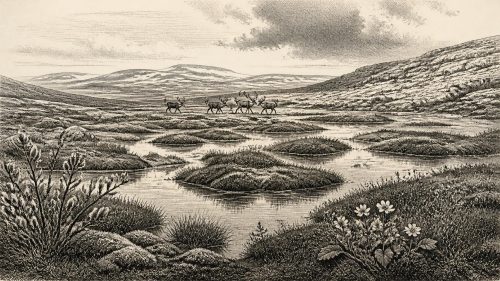
The fauna nevertheless permits a cautious reconstruction of the ecological setting. Reindeer and lemmings are consistent with open, cold environments; mammoth and giant deer indicate large-herbivore opportunities during suitable phases; wolves and spotted hyaenas reveal a food web with major predators and scavengers. Such associations are often described as mammoth-steppe or tundra-steppe, but those labels should not imply a uniform plain across all Ireland. Vegetation and terrain could have varied sharply between exposed uplands, sheltered valleys, river margins, cave districts and land close to glacier fronts.
Evidence from Derryvree and nearby Maguiresbridge in County Fermanagh illustrates why environmental reconstruction needs local archives. Organic sediments preserved between tills have yielded plant macrofossils and insects indicating cold, open wetland conditions during an earlier Middle Midlandian interstadial. Mosses, sedges, bogbean, dwarf willow, mountain-avens and other taxa point to pools, marshy ground and treeless tundra-like vegetation. These deposits are not securely dated to 31,270 BCE, nor should Fermanagh’s wetland be treated as a portrait of north Cork. Their value is comparative: they demonstrate the kinds of detailed evidence that can survive from Irish cold-stage intervals and the environmental mosaics that broad labels can hide.
If people did enter Ireland in the Castlepook period, they would have been highly mobile hunter-gatherers operating within this unstable ecological world. Following animal herds, processing carcasses, exploiting shelter and moving seasonally are reasonable possibilities drawn from Upper Palaeolithic practice elsewhere in north-west Europe. They are not direct observations from Ireland. There is no Irish evidence at this date for farming, herding, pottery, metalworking, weaving, monument building, long-distance trade or permanent village life. Nor is there evidence for political authority, organised warfare, diplomacy, formal religion or learning in the later written sense.
What Cannot Be Recovered
Religion and culture are almost wholly beyond recovery here. A cut bone may record subsistence, but it tells us nothing secure about beliefs, ritual, kinship or language. The absence of evidence for exchange does not prove that people carried nothing between Ireland and Britain or continental Europe; during low sea-level phases the geography of the Irish Sea region differed greatly from today, and movements could have occurred through landscapes now drowned or destroyed. Yet no direct Irish evidence currently supports a trade network at 31,270 BCE. It is better to acknowledge that silence than to populate it with imagined tribes and voyages.
For Ireland around 31,270 BCE, then, the principal development was environmental rather than political: the island lay within a volatile late-glacial world on the approach to more extensive ice-sheet conditions. Castlepook Cave preserves evidence that cold-adapted and large mammals reached southern Ireland, while one marked reindeer bone raises the possibility of a very early human encounter. Its importance lies precisely in its scale: a single, contested trace that asks a large question about Ireland’s human past, while reminding us how little a calendar year can reveal when the archive is ice, bone and stone.
Primary Sources
- A Reconsideration of the Radiocarbon Dating of the Marine Isotope Stage 3 Fauna from Southern Ireland
- The Irish Quaternary Fauna Project
- The Exploration of Castlepook Cave, Co. Cork. With 3 Plates.
- Pleistocene Vertebrates in the British Isles
- Heritage Artefacts of County Cork
- Archaeological Heritage of County Cork
- Irish Caves Database: Mammoth Cave
- Growth and Retreat of the Last British–Irish Ice Sheet, 31,000 to 15,000 Years Ago: the BRITICE-CHRONO Reconstruction
- Pattern and Timing of Retreat of the Last British–Irish Ice Sheet
- Deglaciation Chronology of the Donegal Ice Centre, North-West Ireland
- The Deglaciation of the Western Sector of the Irish Ice Sheet from the Inner Continental Shelf to its Terrestrial Margin
- Last Glacial Maximum Cirque Glaciation in Ireland and Implications for Reconstructions of the Irish Ice Sheet
- Stratigraphic and Palaeo-Geomorphological Evidence for the Glacial-Deglacial History of the Last British-Irish Ice Sheet in the North-Western Irish Sea
- Timing and Pace of Ice-Sheet Withdrawal Across the Marine–Terrestrial Transition West of Ireland During the Last Glaciation
- Spatio-Temporal Dynamics of Speleothem Growth and Glaciation in the British Isles
- McCabe, A.M. (1987), Quaternary Deposits and Glacial Stratigraphy in Ireland
- Palaeoecology: IQUA Field Guide 16
- First Evidence of a Late Upper Palaeolithic Human Presence in Ireland
- New Insights on the Fauna of Ireland's Younger Dryas and Early Holocene from Alice & Gwendoline Cave
- The IntCal20 Northern Hemisphere Radiocarbon Age Calibration Curve (0–55 cal kBP)
- IntCal: International Radiocarbon Calibration
- A Stratigraphic Framework for Abrupt Climatic Changes During the Last Glacial Period Based on Three Synchronized Greenland Ice-Core Records
- The Quaternary Period in Ireland—An Assessment, 1960