
Fermanagh’s Alpine Clubmoss31312 BCE
31,312 BCE is a modern label for a broad MIS 3 interval, not a precisely recoverable Irish year. At Derryvree, County Fermanagh, freshwater organic sediments between glacial tills indicate a local ice-free episode, supporting tundra vegetation including bogbean, mountain-avens and lesser clubmoss. The site records cold, wet, treeless conditions, though regional environments varied. Castlepook Cave, County Cork, preserves remains of mammoth, giant deer, reindeer, hyaena and other Ice Age animals, showing intermittent access from north-west Europe. A possibly cut-marked reindeer bone may indicate brief Upper Palaeolithic human activity, but no settlement is proven. Later advancing ice buried and reshaped landscapes.
Dateline
A Modern Date, Not an Ancient Anniversary
31,312 BCE is a modern chronological label, not a year that can be recovered from the Irish evidence with calendar-like precision. It lies roughly 33,260 calendar years before AD 1950, the reference point conventionally used in radiocarbon dating. No writing, named individuals, political communities, settlements or annual records survive from Ireland at this depth in time. It would therefore be misleading to attach an event, ruler, battle or migration to this particular year. The responsible subject is a broad Late Pleistocene interval within Marine Isotope Stage 3 (MIS 3), a volatile phase of the last Ice Age. Ireland can be glimpsed through sediments, fossil plants, animal bones, cave deposits and reconstructions of moving ice; these sources reveal environments and possibilities, not a year-by-year history.
The nearest especially useful Irish evidence comes from Derryvree, near Maguiresbridge in County Fermanagh. Organic sediment there produced the radiocarbon determination BIRM-166, conventionally 30,500 +1,170/−1,030 radiocarbon years BP. Radiocarbon ages are not identical to calendar ages, because the atmospheric concentration of carbon-14 changed through time. Modern calibration places the determination broadly at about 36,900–31,700 calibrated years BP, approximately 34,950–29,750 BCE. The notional year 31,312 BCE falls inside that broad range, but cannot be located within a particular layer, season or generation. The range is not an inconvenience to be wished away: it is the evidence’s real level of resolution.
Freshwater Beneath a Drumlin
Derryvree was exposed during roadworks in February and March 1969, when a cutting passed through a drumlin about two kilometres north-east of Maguiresbridge. The section revealed fine sands, freshwater silts and organic deposits enclosed between two distinct sheets of till, the unsorted debris laid down by glacier ice. Its sequence offers a clear relative history. Ice crossed the site and deposited the lower till; a subsequent non-glacial interval allowed standing or slow-moving freshwater, silt and organic material to accumulate; later ice returned and sealed the deposit beneath the upper till. This does not prove that all Ireland was ice-free at once. It does prove that this Fermanagh locality was not continuously buried beneath glacier ice during the relevant part of the last glacial cycle.
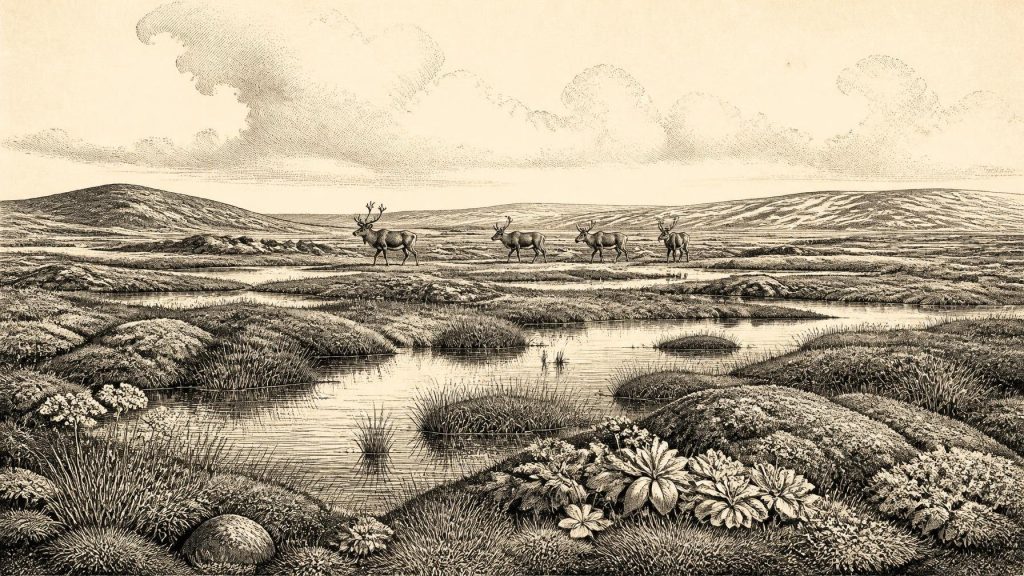
The biological evidence in the freshwater bed makes the site more than a geological curiosity. Poorly preserved pollen was dominated by herbaceous types, while macrofossils included mosses and the remains of plants associated with cold, wet ground. Fossil records from the deposit include bogbean (Menyanthes trifoliata), mountain-avens (Dryas octopetala) and lesser clubmoss (Selaginella selaginoides). These are not merely decorative species lists. Together with the sediments, they support an interpretation of open tundra vegetation and a periglacial climate: a landscape shaped by prolonged cold, frost action, seasonal thaw and waterlogged hollows. A few pollen grains from trees such as pine or hazel cannot securely establish nearby woodland, since pollen may travel far or be redeposited. The stronger signal is of treeless, herb-rich ground.
A Living, Harsh Landscape
“Tundra” should not be imagined as an unchanging blank of snow. Derryvree indicates a functioning freshwater environment. Shallow water and muddy margins could support aquatic plants, mosses, sedges and insects during the short growing season. On drier ground there may have been sparse herbs, grasses and low shrubs. In winter, severe frost, snow cover and deeply frozen or seasonally frozen ground would have imposed sharp constraints. Meltwater may have pooled where frozen subsoil impeded drainage; summer warmth could briefly make these wet places unusually productive. The old term “muskeg” has sometimes been used for this combination of mossy, sedge-rich, waterlogged terrain, but it should be treated as an environmental comparison rather than a detailed map of the Fermanagh countryside.
Regional variation was fundamental. Ireland was on the Atlantic edge of north-west Europe, and its weather, sea conditions and glacier margins responded to shifts in the wider North Atlantic climate system. Greenland ice-core records demonstrate abrupt climatic oscillations across MIS 3, but they cannot provide a daily Fermanagh forecast. Nor can a single buried wetland stand for Cork, Donegal, the central lowlands and the coasts. It is safest to say that parts of the island retained exposed, cold habitats during an interval of shifting ice cover. Later glaciers stripped, mixed and buried much of the older landscape, so the survival of Derryvree’s small archive is itself exceptional.
Animals in the Southern Caves
Caves in County Cork provide a different, less precisely unified window on Ice Age Ireland. Castlepook Cave, near Doneraile, has yielded the island’s richest known assemblage of pre-Last Glacial Maximum vertebrate remains. Its fauna includes woolly mammoth, giant deer, reindeer, brown bear, spotted hyaena, wolf, fox, mountain hare and lemmings. Such bones show that Ireland was connected to, or repeatedly accessible from, the wider north-west European world of cold-adapted mammals. They do not all demonstrate that every species occupied the cave, or even the surrounding district, at the same moment. Cave assemblages are cumulative: carnivores, natural deaths, water movement, collapse, early collecting and later disturbance can combine remains deposited over long periods.
Spotted hyaena is especially instructive. At Castlepook, its bones and coprolites indicate a large predator and scavenger capable of using caves and transporting or modifying animal remains. Mammoth and giant deer evoke open country with substantial forage, while reindeer and lemmings fit colder conditions. Yet a cave is not a census of an entire island. The composition of the Castlepook assemblage is evidence for animals reaching southern Ireland at various points in the Late Pleistocene; it is not proof of a permanent, balanced ecosystem in 31,312 BCE. The absence of securely comparable evidence from many regions may chiefly reflect survival and discovery, rather than true absence from the ancient landscape.
The Human Question
One reindeer femur from Castlepook has made this early period unusually important to Irish archaeology. A deep mark on the bone has been interpreted by the palaeozoologist Ruth Carden as damage from a sharp stone tool during butchery, and the bone has been publicly associated with an age of about 33,000 years ago. If that interpretation and association are upheld, it would be evidence that people handled a reindeer in Ireland during the Upper Palaeolithic, far earlier than the long-established record of post-glacial settlement. It would not, however, establish a village, an enduring population or a named culture. A modified bone is evidence of an encounter with an animal, perhaps during a brief visit, rather than proof of continuous occupation.
This distinction matters because Ireland has not yielded a securely dated lithic assemblage, habitation surface, burial ground or artistic site from this horizon. Across Europe, groups of Homo sapiens used varied stone technologies, made clothing and equipment, maintained far-reaching social connections and, in some areas, created ornaments and cave art. None of those practices can responsibly be projected into Ireland without direct evidence. No language, kin group, religious rite, political authority or diplomatic relationship can be identified here. There were no states or borders in the later historical sense; equally, the evidence is too slight to describe local bands, territories or social rules. The appropriate conclusion is not that humans certainly were absent, but that their presence remains unproven beyond a small and consequential body of possible traces.
Ice on the Horizon
At roughly this stage of MIS 3, Ireland was approaching the major growth of the last British–Irish Ice Sheet, but had not yet reached the climatic and glacial peak usually called the Last Glacial Maximum. Modern reconstructions place major ice-sheet growth after about 31,000 years BP, with different sectors advancing at different times. The ice sheet’s maximum volume occurred much later, around 23,000 years BP, while maximum extent was asynchronous across its many marine and terrestrial margins. This chronology corrects the tempting image of a single island-wide moment when Ireland abruptly vanished beneath ice. Ice build-up was uneven, and Fermanagh’s sediments record one local interval before a later advance overwhelmed the site.
The environmental transformation to come would be immense. Glaciers eroded bedrock, transported sediment, deepened basins and deposited tills that later shaped drumlins, lowlands and drainage patterns. But in 31,312 BCE that later reshaping was still a future development, not a completed fact. The direct evidence instead preserves water between ice advances, low vegetation, mobile animal communities and a climate in which small shifts in temperature or snowfall could alter the extent of habitable ground. Environmental change, rather than human politics, was the main force visible in the surviving Irish record.
No Economy or Religion to Recover
There is no basis for describing agriculture, trade, permanent settlement, formal leadership, warfare, diplomacy, religion or learning in Ireland at this date. Farming lay tens of millennia in the future; there are no Irish monuments, domestic structures, tools or symbolic objects securely attributable to this interval. If people did reach the island, their subsistence may have involved the opportunistic use of animal and plant resources in a harsh seasonal setting, but even that remains interpretation rather than demonstrated local fact. The Castlepook femur, if humanly modified, suggests carcass processing alone. It cannot tell us whether the people involved travelled by sea, crossed a temporary land connection, arrived in a party or stayed beyond a single episode.
What can be said with confidence is both narrower and more remarkable. Around the broad period represented by 31,312 BCE, Ireland was not simply an empty backdrop awaiting later history. At Derryvree, cold freshwater habitats supported distinctive plant communities. At Castlepook, Ice Age mammals and predators left a fragmentary record of a changing southern landscape. Glacial deposits bracketed, buried and preserved these traces. Fermanagh’s fossil clubmoss is therefore an apt emblem for the date: small, specific and durable evidence of life in a severe world, while the larger human story remains necessarily unfinished.
Primary Sources
- A Middle Midlandian Freshwater Series at Derryvree, Maguiresbridge, County Fermanagh, Northern Ireland
- Quaternary Research in Ireland: Field Guide 16
- Selaginella selaginoides
- Menyanthes trifoliata
- Dryas octopetala
- Growth and Retreat of the Last British–Irish Ice Sheet, 31,000 to 15,000 Years Ago: the BRITICE-CHRONO Reconstruction
- Extent and Timing of the Last Glacial Maximum (LGM) in Britain and Ireland: a Review
- Pattern and Timing of Retreat of the Last British-Irish Ice Sheet
- Late Pleistocene Chronostratigraphy and Ice Sheet Limits, Southern Ireland
- Dimensions and Chronology of the Last Ice Sheet in Western Ireland
- The Deglaciation of the Western Sector of the Irish Ice Sheet from the Inner Continental Shelf to its Terrestrial Margin
- Growth, Dynamics and Deglaciation of the Last British–Irish Ice Sheet: the Deep-Sea Ice-Rafted Detritus Record
- The Last Eurasian Ice Sheets – a Chronological Database and Time-Slice Reconstruction, DATED-1
- The IntCal20 Northern Hemisphere Radiocarbon Age Calibration Curve (0–55 cal kBP)
- New Data for the Last Glacial Maximum in Great Britain and Ireland
- New Insights on the Fauna of Ireland’s Younger Dryas and Early Holocene from Alice & Gwendoline Cave
- Castlepook Cave, County Geological Site Report
- Heritage Artefacts of County Cork
- Archaeological Excavations at Castlepook Cave, Co. Cork, 2022
- Ireland: Submerged Prehistoric Sites and Landscapes
- The Colonization of Ireland: A Human Ecology Perspective
- Dating Constraints on the Last British-Irish Ice Sheet: a Map and Database