Derryvree’s 1969 Roadcut31313 BCE
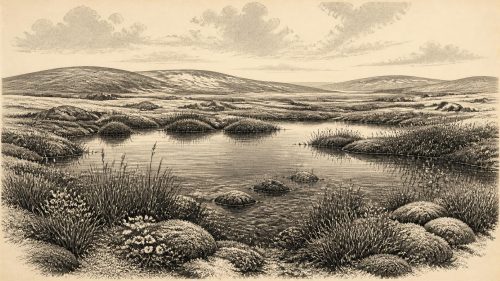
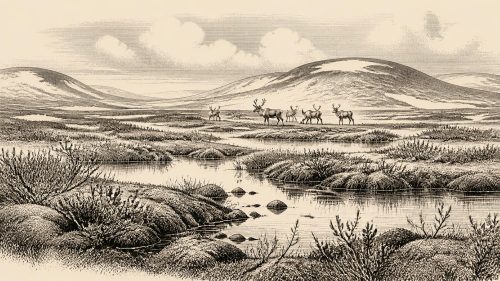
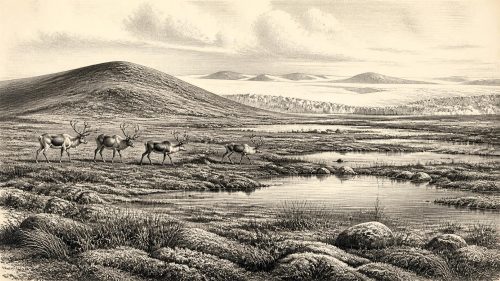
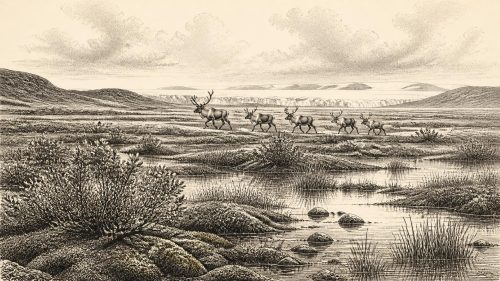
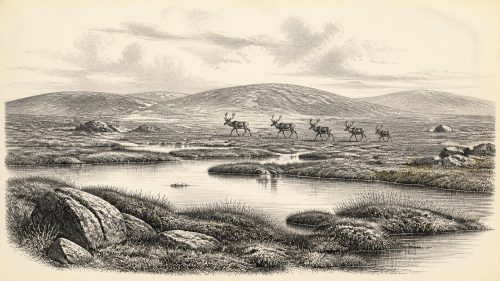
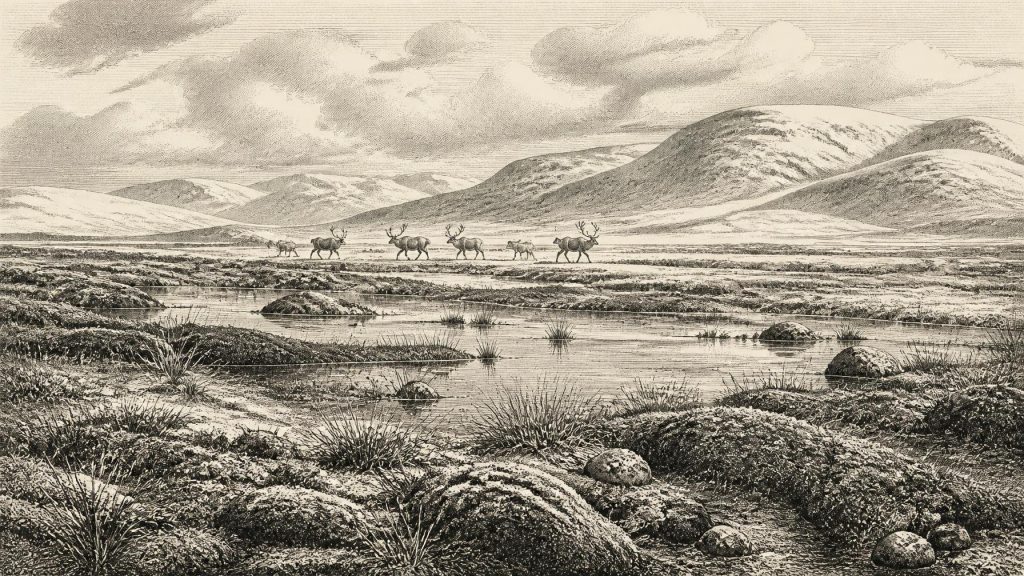
Around 31,313 BCE, Ireland lay within the unstable cold conditions of Marine Isotope Stage 3, not recorded history. Roadworks at Derryvree, County Fermanagh, exposed organic freshwater silts between glacial tills, dated broadly to 36,900–31,700 calibrated years BP. They indicate a treeless, frost-affected tundra wetland during an interval between ice advances. Elsewhere, Crag Cave records intermittent milder conditions, while Castlepook Cave preserves diverse fauna, including mammoth, reindeer, giant deer, hyaena and bear. A marked reindeer femur may indicate human butchery, but remains unconfirmed. No secure evidence supports permanent settlement, society, belief, or political organisation; the period is understood through environmental evidence.
Dateline
31,313 BCE is not a date that can be matched to a recorded Irish event. It is a modern calendar label imposed on a time long before writing, named peoples, borders or any indigenous calendar known to us. Archaeology cannot identify what happened in Ireland in that particular year, nor assign a political decision, battle, migration or religious rite to it. The responsible approach is therefore to place the notional year within a broader, dated horizon of the Late Pleistocene: Marine Isotope Stage 3 (MIS 3), during the Midlandian glaciation. The evidence is sparse, uneven and often difficult to date, but it does illuminate a cold, changing Ireland in which tundra wetlands, large mammals and advancing ice mattered far more than the institutions of later history.
The nearest useful chronological anchor is not a calendar date but a radiocarbon determination from Derryvree, near Maguiresbridge in County Fermanagh. Organic silts there produced the laboratory age Birm-166, 30,500 radiocarbon years BP, with substantial uncertainty. Later calibration places the deposit broadly between about 36.9 and 31.7 thousand calibrated years BP. That range embraces the general horizon represented by 31,313 BCE, but it emphatically does not identify a single season, generation or event. It offers a window onto conditions over millennia.
A Wetland Between Ice Sheets
Derryvree became important because roadworks in 1969 cut through a drumlin: a streamlined hill formed by glacier ice. Beneath one till, and above another, investigators found freshwater silts and fine sands containing organic material. The sequence matters. An earlier ice advance had deposited the lower till; afterwards, water and sediment accumulated in an ice-free or at least non-glacial local setting; a later advance sealed the deposit beneath fresh glacial sediment. Rather than giving us a view of all Ireland, Derryvree gives unusually direct proof that this part of Fermanagh supported a freshwater environment during a phase of the last glacial cycle.
The fossil evidence led the original investigators to reconstruct open tundra vegetation and a periglacial climate: ground affected by persistent frost, but not necessarily covered by glacier ice. Plant remains included mosses and herbaceous taxa associated with cold, exposed ground, while the wetland itself probably combined sedge-rich, mossy surfaces with shallow pools and channels. Comparisons have likened it to muskeg, a waterlogged and frost-influenced mosaic rather than a uniform lake or a forested bog. Sparse pollen must be interpreted cautiously, especially where preservation is poor, yet the combined botanical and sedimentary evidence strongly supports a treeless landscape around the site.
Cold, but Not Permanently Frozen
This was not the Last Glacial Maximum itself. The most extensive phase of the last Irish Ice Sheet came later, with major growth and expansion occurring after this broad period. Research on the chronology of Irish glaciation suggests that parts of north-central Ireland remained ice-free until at least roughly 34,000 years ago, while the ice sheet subsequently expanded over a long and regionally uneven interval. Southern Ireland was not crossed by inland-derived ice until after about 24,000 years ago. Thus, around the horizon represented by this article, Ireland was entering a volatile phase of glacial build-up rather than existing beneath one simple, island-wide sheet of ice.
Climate was also unstable on shorter timescales. At Crag Cave in County Kerry, uranium-thorium dating of broken and reworked speleothems shows that calcite formed episodically during MIS 3. Since such deposition required liquid water and conditions generally above freezing in this shallow cave system, the record indicates repeated ameliorations within an otherwise cold glacial world. It does not mean that Derryvree and Crag Cave experienced identical weather at the same moment. It does, however, reinforce the wider picture: Irish environments could alter markedly as North Atlantic climate shifted, creating temporary opportunities for plants, animals and perhaps people.
The Fauna of Castlepook
County Cork supplies a different kind of evidence. Castlepook Cave, near Doneraile, is Ireland’s richest known archive of vertebrate remains from the period leading towards the Last Glacial Maximum. More than 2,000 bones recovered from its passages have yielded dates extending broadly from about 45,700 to 19,950 years BP. The assemblage includes woolly mammoth, giant deer, reindeer, brown bear and spotted hyaena, with later cold-stage material including Arctic fox, wolf and lemmings. These animals demonstrate that Ireland, at various points in this long span, was neither empty nor environmentally uniform. It contained open-country habitats capable of sustaining large herbivores and the predators or scavengers that followed them.
The cave is not, however, a ready-made scene of daily life. Its bone collection accumulated through several processes over a very long period. Hyaenas and other carnivores could have carried material into chambers; water disturbed deposits; and extensive antiquarian excavation removed much original context. A mammoth bone or reindeer antler dated from the cave tells us that an animal was present in Ireland, or that part of it reached the cave, not that a herd stood outside the entrance in 31,313 BCE. The fauna is powerful evidence for changing ecosystems, but weak evidence for a precisely reconstructed local landscape on any one day.
A Possible Human Trace
One Castlepook object gives this era exceptional archaeological importance: a reindeer femur reported as approximately 33,000 years old and bearing a deep linear mark interpreted by zooarchaeologist Ruth Carden as damage made by a sharp stone tool while the bone was fresh. If that reading is confirmed, it would indicate that people processed reindeer in Ireland during MIS 3, dramatically earlier than the island’s formerly accepted terminal-Pleistocene evidence for human activity. County Cork heritage material has consequently presented the specimen as a possible Palaeolithic butchery trace dating to about 31,000 BC.
Yet the distinction between evidence and interpretation is crucial. Radiocarbon dating establishes the age of the animal bone, not the identity of the agent who made a mark or the precise place where butchery occurred. The femur came from an old cave collection rather than a newly excavated camp floor associated with stone tools, hearths, shelters, repeated occupation surfaces or human remains. Carnivore damage, breakage, sediment movement and earlier excavation can complicate any bone’s history. Nor has a securely associated Palaeolithic lithic assemblage been recovered at Castlepook. Current research is appropriately testing surviving sediments and searching for charcoal, lithics, further modified bone and better stratified evidence. The specimen may record a brief human visit; it cannot presently demonstrate a permanent Irish population or continuous settlement.
Society Without Settlements
There is therefore no evidential basis for political affairs, diplomacy, formal conflict, named communities or territorial rule in Ireland at this date. Neither can archaeologists responsibly describe villages, families, clothing, language, ritual specialists or systems of leadership. No house, hearth, grave, tool kit or settlement of this age is securely known from Ireland. If the Castlepook mark is anthropogenic, the most that may be inferred is an episode of mobile hunter-gatherer activity within a wider north-west European world where people had long used stone technology and exploited animal resources.
That inference should not be inflated into a picture of established society. Reindeer, mammoth and other game would have represented potential food, hide, bone and sinew resources for hunter-gatherers, but potential resources are not proof of an Irish economy. Nor is there evidence for trade, exchange routes or regular crossings into Ireland at this horizon. The island’s position on the Atlantic edge, fluctuating sea levels and the growth of ice all made access and survival environmental questions, but the archaeological record cannot yet say whether people came regularly, intermittently or not at all.
Culture, Belief and Deep Time
Religion and learning leave no identifiable trace in the Irish evidence for this period. There are no art objects, monuments, burials or inscriptions that can support claims about belief or ceremony. The most meaningful cultural lesson is methodological: Ireland’s deep past is recovered from layers of silt, pollen, moss spores, animal collagen, cave deposits and the microscopic study of marks on bone. These are not silent merely because people failed to leave history; they are partial because later ice, water, scavengers and excavation have repeatedly altered what survived.
For the notional year 31,313 BCE, the central Irish development was environmental. In Fermanagh, freshwater silts preserved the signature of a cold, open wetland between episodes of glaciation. In Cork, cave deposits preserve evidence of a diverse Pleistocene fauna and a tantalising, still unconfirmed possibility of human butchery. Together they show an Ireland of tundra, frost, shifting ice margins and mobile animals—not yet the settled, wooded or politically organised island of later prehistory. Calendar precision is unavailable, but the archaeological record gives something more valuable than invented detail: a disciplined view of the limits, as well as the possibilities, of knowledge.
Primary Sources
- A Middle Midlandian Freshwater Series at Derryvree, Maguiresbridge, County Fermanagh, Northern Ireland
- Early Midlandian–Middle Midlandian, Pleistocene, Northern Ireland
- Palaeoecology
- The Irish Quaternary Fauna Project
- A Reconsideration of the Radiocarbon Dating of the Marine Isotope Stage 3 Fauna from Southern Ireland
- Castlepook Cave: County Geological Site Report
- Episodic Speleothem Deposition Tracks the Terrestrial Impact of Millennial-Scale Last Glacial Climate Variability in SW Ireland
- Trimlines, Blockfields and the Vertical Extent of the Last Ice Sheet in Southern Ireland
- The Last Irish Ice Sheet: Extent and Chronology
- Radiocarbon Constraints on the Age of the Maximum Advance of the British-Irish Ice Sheet in the Celtic Sea
- Early Deglaciation of the British-Irish Ice Sheet on the Atlantic Shelf Northwest of Ireland Driven by Glacioisostatic Depression and High Relative Sea Level
- BRITICE Glacial Map, Version 2: A Map and GIS Database of Glacial Landforms of the Last British–Irish Ice Sheet
- The Deglaciation of the Western Sector of the Irish Ice Sheet
- New Insights on the Fauna of Ireland's Younger Dryas and Early Holocene from Alice & Gwendoline Cave
- Archaeology Research Excavation Grant Report: Castlepook Cave Project
- Castlepook Cave, Co. Cork, 2022
- Heritage Artefacts of County Cork
- Figure 6.—The Subdivision of the Quaternary Period in Ireland
- The Quaternary of Western Ireland
- Irish Pleistocene Biostratigraphy
- The Mesolithic in Ireland: When Was It?
- Soils of County Waterford