Mammoth Cave’s Cut Femur31311 BCE
Labelled 31,311 BCE, this period in Ireland belongs to Marine Isotope Stage 3 and cannot be dated as a precise historical year. Castlepook, or Mammoth, Cave in County Cork produced a reindeer femur, broadly dated to about 31,000 BCE, whose possible stone-tool cut mark may indicate early human carcass processing. The disturbed cave deposits instead chiefly document diverse cold-stage fauna, including mammoth, deer, carnivores and small mammals. Derryvree, County Fermanagh, preserves buried freshwater sediments showing intermittent ice-free tundra wetlands. Ireland remained climatically variable, with shifting ice, coastlines and animal ranges. No settlements, tools, polity or sustained human occupation are established.
Dateline
“31,311 BCE” is a modern way of labelling a point deep in the Pleistocene, not a year for which Ireland possesses a chronicle, a ruler, or even a dateable human episode. Calendar-year precision is unavailable at this depth of time. In the archaeological convention that counts backwards from AD 1950, the label lies roughly 33,260 years before present, but the usable evidence consists of radiocarbon ranges, cave deposits and environmental sequences with uncertainties measured in centuries or millennia. The responsible subject is therefore Ireland during the later part of Marine Isotope Stage 3, before the fullest expansion of the Last Glacial Maximum ice sheet.
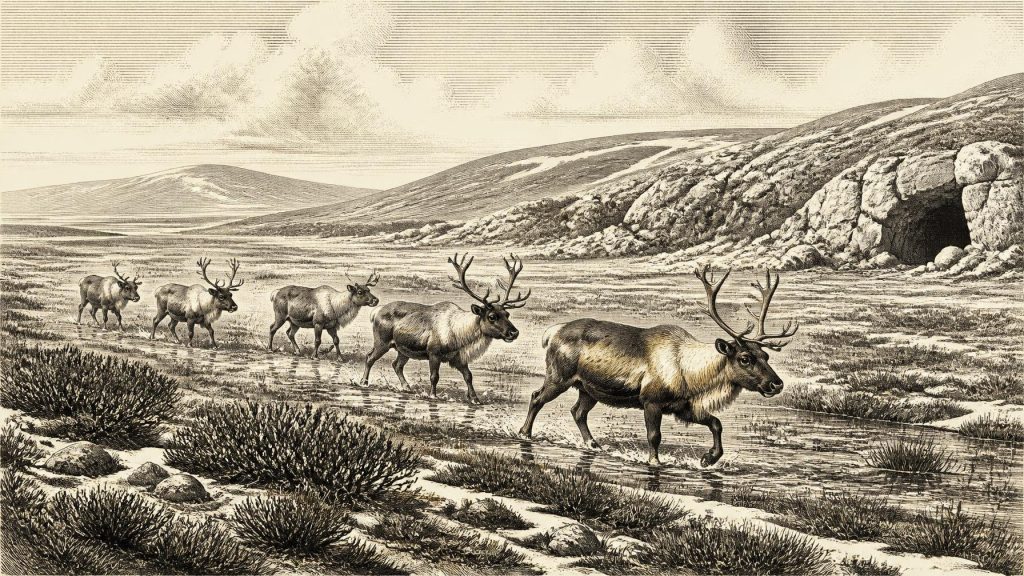
The most evocative evidence is not a settlement but a fragment of reindeer femur from Castlepook Cave, also called Mammoth Cave, near Doneraile in north County Cork. The bone has been assigned broadly to about 31,000 BCE and bears a surface mark interpreted by zoologist Ruth Carden as a cut made by a sharp stone tool during carcass processing. If that interpretation is sustained, it is a remarkable indication that people reached Ireland far earlier than the formerly accepted terminal-Pleistocene evidence. It is not, however, proof of a village, a permanent population or an event occurring in this particular numbered year.
A Date Without Annals
No written language, political institution, named community or recoverable oral tradition can be placed in Ireland at this time. Nor can archaeologists identify a calendar day when a reindeer was killed, butchered or carried towards a cave. Radiocarbon dating measures the remaining radioactive carbon in once-living material and produces a probability range rather than a historical timestamp. Calibration is especially important beyond 30,000 years ago because atmospheric carbon levels varied markedly. A date on a bone establishes when the animal died within a range; it does not by itself date a mark on its surface to a precise instant.
This distinction matters at Castlepook. Much of its rich bone collection was excavated between 1904 and 1913, before modern field recording, sieving, micromorphology and accelerator radiocarbon dating. Water movement, carnivore activity and later disturbance complicate the relationship between individual finds. Castlepook is invaluable precisely because it preserves a large Ice Age fauna, but it is not a sealed, single-occasion hunting camp. The femur is best understood as a potentially important trace within a long and complicated cave archive.
Cold Country Before the Maximum
At around 33,000 years before present, Ireland was in a cold phase of the last glacial cycle, but it should not be imagined as a featureless island buried uniformly beneath ice. The major Last Glacial Maximum, when the British–Irish Ice Sheet reached its greatest known extent, came later, broadly around 26,000–20,000 years ago. New reconstructions show that ice margins were dynamic before and during that maximum. Consequently, it is unsafe to draw a confident island-wide map for 31,311 BCE, or to claim that every Irish region was either ice-free or glaciated at once.
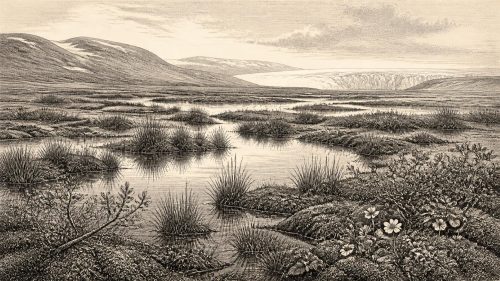
In broad terms, open, treeless landscapes were available in at least some intervals and places. Cold grassland, herb-rich tundra, bare ground, wet hollows and sparse shrubby vegetation would have formed a changing mosaic rather than a single uniform habitat. The climate was highly seasonal and unstable on the scale of human lifetimes. Shorter warmings and deteriorations could alter vegetation, water supply, animal movement and the reach of glaciers. A scene in north Cork may therefore have differed substantially from one in Fermanagh, western Ireland or the highlands.
Sea level was much lower than today because vast quantities of water were locked in northern ice sheets. Yet lower sea level does not automatically establish a walkable land bridge between Ireland and Britain at this date. The exact configuration of channels, coasts, glaciers and exposed shelf changed through time. The presence of large mammals in Ireland demonstrates that colonisation occurred during favourable windows, but it does not by itself reveal the route, season or number of crossings. Any people associated with the Castlepook femur may have arrived by a route still debated by researchers.
The Castlepook Fauna
Castlepook Cave is Ireland’s foremost archive for vertebrate life before the Last Glacial Maximum. Its wider assemblage has produced remains attributed to woolly mammoth, reindeer, giant deer, brown bear, wolf, Arctic fox, mountain hare, lemmings and spotted hyena. Such animals do not all prove a single contemporaneous community: specimens accumulated over a lengthy period and some deposits are disturbed. Nevertheless, the group shows that Ireland could support a far more varied cold-stage fauna than the modern landscape suggests.
Reindeer are especially important to the possible human story. They are mobile herd animals suited to cold open country, and elsewhere in Upper Palaeolithic Europe they were a major resource for hunters. That wider European comparison can explain why a butchered reindeer would be plausible; it cannot fill Ireland’s evidential gaps with imagined camps, weapons, clothing or hunting rituals. No securely associated flint toolkit, hearth, dwelling, human burial or processing floor of this age has been recovered in Ireland. The cut femur points, at most, to an episode of animal handling.
Carnivores were also agents in the formation of the cave record. Spotted hyenas can drag bones into dens, gnaw them heavily and scatter them through repeated use of a shelter. Wolf and fox remains add to the picture of a predator-rich landscape. Mammoth and giant deer indicate substantial herbivore biomass, while small mammals such as lemmings offer sensitive clues to cold environmental conditions. Rather than a peaceful pastoral wilderness, this was an exposed food web shaped by predation, scavenging, winter stress and seasonal movement.
Freshwater Under Fermanagh Till
A second line of evidence comes from Derryvree near Maguiresbridge in County Fermanagh. Roadworks exposed freshwater silts, sands and organic sediments caught between two layers of glacial till in a drumlin. The basic sequence is secure: ice deposited the lower till; an interval without overriding ice allowed water and organic matter to accumulate; later ice buried the deposit beneath another till. The layer is a rare survival of a landscape that was later concealed by glacial sediment.
Plant and insect evidence from such inter-till deposits has been interpreted as indicating cold, open, treeless wetland conditions, including mosses, sedges and aquatic plants. This helps explain how low-lying freshwater habitats could exist within a generally severe glacial climate. But Derryvree must not be treated as a weather report for every part of Ireland or as a precisely dated counterpart to the Castlepook reindeer. Its radiocarbon results, stratigraphic interpretation and calibration all carry substantial uncertainty. Its value lies in demonstrating environmental possibility: parts of Ireland experienced ice-free, waterlogged tundra-like landscapes between glacial advances.
People: A Possible Visit, Not a Polity
The Castlepook mark has consequences for the question of human presence, but not for political history in the usual sense. There is no evidence for chiefs, territories, alliances, warfare, diplomacy, law or social hierarchy in Ireland around this date. If Upper Palaeolithic hunters did visit, their social arrangements remain unknown. They may have been a very small and mobile group operating at the north-western fringe of wider European networks; equally, the Irish evidence is presently too slight to establish whether visits were repeated, seasonal or isolated.
Everyday life can only be approached conditionally. A group processing a reindeer would have needed sharp stone edges, practical knowledge of animal anatomy and ways of using meat, hide, sinew, fat and bone. None of those activities can yet be documented as a complete Irish chaîne opératoire. There is no sound basis for assigning a particular language, ethnicity, artistic tradition or religious belief to the people potentially represented by the bone. Cave use should not be confused with ceremonial cave use: Castlepook’s assemblage chiefly reflects natural processes and carnivore accumulation, not an identified human sanctuary.
There is likewise no evidence of farming, trade in the later prehistoric sense, metalworking, pottery, monuments or permanent settlement. The relevant economy, if people were present, was foraging and opportunistic use of animal resources in an exacting environment. Movement itself was probably central: following herds, locating sheltered ground, finding fuel and water, and negotiating a coast altered by cold, low sea level and ice. These are interpretations drawn from the landscape and from Upper Palaeolithic comparisons, not facts directly observed in an Irish camp.
What Can Be Said Reliably
The greatest development around this notional date is therefore not a recorded Irish event but the possibility of a much deeper human past. Castlepook’s reindeer femur challenges the older assumption that people first reached Ireland only near the end of the Ice Age. It joins the cave’s mammal remains and Fermanagh’s buried freshwater deposits in showing an Ireland that was environmentally active, regionally varied and intermittently habitable long before the familiar Mesolithic record.
Future work may refine this picture through fresh excavation, direct dating of individual bones, microscopic reassessment of surface modifications, ancient biomolecular methods and better models of ice and sea-level change. Until then, 31,311 BCE should be treated with disciplined restraint. Ireland had no recoverable state, no known town and no dated public event. It had cold landscapes, mobile animals, changing ice margins and, perhaps, a fleeting human encounter with a reindeer whose marked bone survived in a Cork cave for more than thirty-three millennia.
Primary Sources
- A Reconsideration of the Radiocarbon Dating of the Marine Isotope Stage 3 Fauna from Southern Ireland
- The Irish Quaternary Fauna Project
- Castlepook Cave, County Geological Site Report CK032
- Spotted Hyena Skull
- Heritage Artefacts of County Cork
- Archaeological Heritage of County Cork
- The Quaternary Period in Ireland: An Overview
- The Stratigraphic Position and Age of the Gortian
- Pleistocene Vertebrates in the British Isles
- The Exploration of Castlepook Cave, Co. Cork
- Post-Glacial Colonisation of Ireland
- Spatio-Temporal Dynamics of Speleothem Growth and Glaciation in the British Isles
- Growth and Retreat of the Last British–Irish Ice Sheet, 31,000 to 15,000 Years Ago: the BRITICE-CHRONO Reconstruction
- The Deglaciation of the Western Sector of the Irish Ice Sheet from the Inner Continental Shelf to its Terrestrial Margin
- Last Glacial Maximum Cirque Glaciation in Ireland and Implications for Reconstructions of the Irish Ice Sheet
- The IntCal20 Northern Hemisphere Radiocarbon Age Calibration Curve (0–55 cal kBP)
- The IntCal20 Approach to Radiocarbon Calibration Curve Construction: a New Methodology Using Bayesian Splines and Errors-in-Variables
- First Evidence of a Late Upper Palaeolithic Human Presence in Ireland
- New Insights on the Fauna of Ireland's Younger Dryas and Early Holocene from Alice and Gwendoline Cave
- Quaternary