Derryvree’s Tundra Threshold31150 BCE
At 31,150 BCE, Ireland lay within the unstable cold conditions of Marine Isotope Stage 3, before the last British–Irish Ice Sheet’s maximum. Derryvree, County Fermanagh, preserves freshwater sediments between glacial tills, demonstrating a locally ice-free periglacial interval with open tundra vegetation, pools and sparse herbaceous cover. Cave faunas show that mammals including reindeer, giant deer, mammoth, wolves and hyaenas occurred during the wider period, although dates and contexts vary. A cut-marked reindeer bone from Castlepook Cave may indicate human butchery, but cannot prove settlement. Evidence portrays fluctuating tundra, freshwater habitats, animal movement and uncertain human opportunities, later obscured by glaciation.
Dateline
“31,150 BCE” is a modern chronological label, not a date that can be matched to a recorded Irish event, ruler, journey or settlement. At this depth of time, calendar-year precision is unavailable. The label sits about 33,100 years before AD 1950, the conventional radiocarbon reference point, but radiocarbon ages and calendar ages are not interchangeable by simple arithmetic. Ireland can instead be discussed through broad calibrated ranges, stratified deposits and changing ecological evidence. The relevant setting is the later part of Marine Isotope Stage 3, within the Midlandian cold stage of the Irish Pleistocene: a long, unstable interval before the maximum extent of the last British–Irish Ice Sheet.
A Date Within a Wider Interval
The closest securely dated Irish environmental archive is at Derryvree, near Maguiresbridge in County Fermanagh. Roadworks in 1969 exposed a drumlin cut through by a remarkable sequence: older glacial till below, freshwater silts, fine sands and organic material in the middle, and later till above. Till is debris laid down directly by ice. The sequence therefore establishes an important order of events: ice affected the locality; an interval followed in which standing or slow-moving freshwater and vegetation existed; and glacier ice later advanced across and sealed the deposits.
Organic material from the Derryvree freshwater bed produced a conventional radiocarbon determination of 30,500 +1,170/−1,030 BP. Its uncertainty is substantial, and calibration turns it into a broad calendar range rather than a single year. The numbered year used here falls within the wider late-MIS-3 world to which the deposit is relevant, but it cannot responsibly be claimed that a particular Derryvree pool, plant or animal lived in the exact year 31,150 BCE. That distinction matters. The bed is powerful evidence for a cold, locally ice-free phase in south Fermanagh; it is not an annual diary and does not describe all Ireland at once.
Freshwater Beneath a Future Glacier
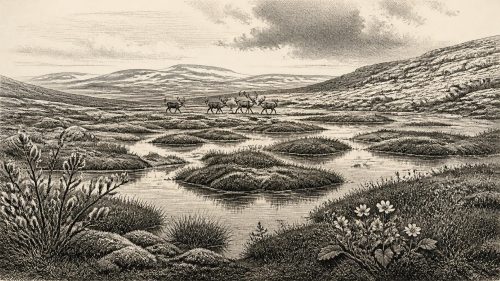
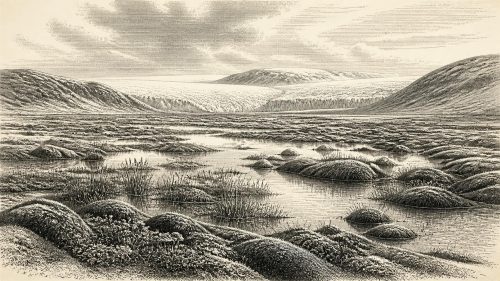
Derryvree preserves an unexpectedly detailed glimpse of conditions in a landscape now hidden beneath a drumlin. Pollen, plant macrofossils, mosses and small animal remains point to open, largely treeless tundra or tundra-like vegetation under a periglacial climate. Periglacial does not mean buried beneath glacier ice: it means a severe cold-climate environment shaped by frost, seasonal freezing and sparse plant cover at or near an ice margin.
The plants identified or reported from this deposit include grasses and sedges, dwarf willow, mountain-avens, alpine clubmoss, bogbean and water-milfoil, alongside a notable moss flora. Together they suggest a patchwork rather than a uniform white wilderness: damp hollows, shallow pools, sedge-rich margins and low vegetation on better-drained ground. Bogbean and water-milfoil are especially useful reminders that even a severe cold landscape could include freshwater habitats. Yet the evidence does not permit a picturesque reconstruction of dense woodland, settled farmland or a richly stocked lake. Tree pollen was scant and may have been redeposited from older sediments; the dominant signal is of exposed ground and sparse herbaceous cover.
Such a setting would have been seasonal and vulnerable. Short summers could allow plants to flower, insects to breed and wet places to support aquatic life. Long winters, frost disturbance and thin soils would have restricted growth. The important historical development was environmental opportunity on a narrow margin: enough ice-free ground for vegetation and animals to occupy, yet a landscape that later glacier movement would partly erase, bury or rearrange.
Before the Ice Sheet’s Maximum
Ireland at this time should not be imagined as either entirely ice-covered or wholly open. The Derryvree sequence proves that at least one Fermanagh locality experienced an ice-free freshwater interval between glacial episodes. Regional conditions could differ sharply according to elevation, latitude, proximity to ice and changing climate. The later maximum of the British–Irish Ice Sheet was reached much later, broadly around 26,000–24,000 calibrated years BP in the western and Irish Sea records. Thus 31,150 BCE belongs to a phase of fluctuating cold and ice growth before that better-defined maximum, not to a moment when a single ice margin can be drawn confidently around the whole island.
Lower global sea levels exposed areas now submerged around north-west Europe, but the exact routes available between Ireland, Britain and continental Europe changed with sea level, ice and local topography. It is unwise to write of an assured Irish “land bridge” for this particular date. What can be said is that the geography of movement was unlike that of the modern island, while passage through cold, glaciated or waterlogged terrain would still have been difficult. The sea, ice and exposed shelves were active parts of the landscape, not blank spaces between modern coastlines.
Animals in a Cold Mosaic
Irish caves, especially Castlepook Cave near Doneraile in County Cork, provide a second kind of evidence: animal bone assemblages. Redating has shown that some older measurements from cave collections require revision, but it has also demonstrated that a range of mammals occurred in Ireland during MIS 3. Reindeer, giant deer, brown bear, wolf, Arctic fox, lemmings, woolly mammoth and spotted hyaena are represented in the wider Irish cave record. Not every specimen is contemporary with every other specimen, and disturbed nineteenth- and early twentieth-century cave excavations demand caution. Still, the fauna demonstrates that Ireland was not biologically empty during the broader period.
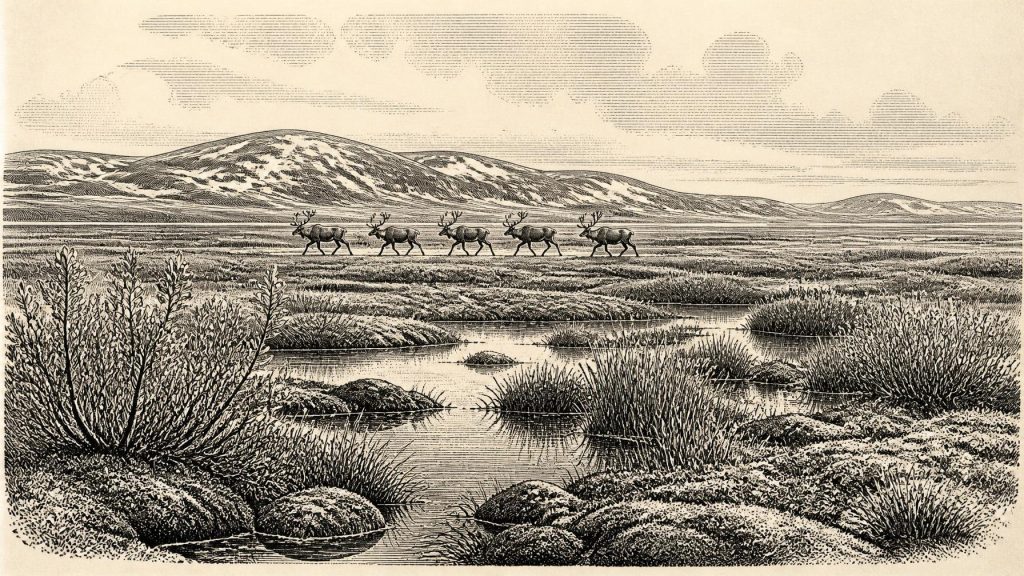
Reindeer are particularly appropriate to the Derryvree-type environment: mobile grazers suited to open country, though their presence does not tell us the size or route of a herd in any one season. Giant deer evoke productive open habitats but should not be projected automatically into every part of the island. Hyaenas and wolves demonstrate that carcasses and caves had complex histories. A cave bone may record an animal’s death elsewhere, scavenging, transport by carnivores and later sediment movement before excavation. For that reason, cave fauna supplies a regional ecological range, not a census of a single living community.
The Human Question at Castlepook
The most debated possible connection with people is a reindeer femur from Castlepook Cave. County Cork heritage material identifies a cut mark on it as consistent with a sharp stone tool and dates the object broadly to c. 31,000 BCE. If that reading is sustained, it would indicate that people handled and butchered a reindeer in Ireland during the Palaeolithic, far earlier than the island’s well-established post-glacial hunter-gatherer record. It is an important proposition precisely because the object is so slight: a marked bone, rather than a camp.
The limits must be kept in view. No securely associated stone-tool assemblage, hearth, dwelling, burial, occupation surface, named group or human remains of this age have been recovered at Castlepook. Nor does one bone establish permanent residence, population continuity, language, ancestry or a migration route. Cave deposits have complicated formation histories, while improved pretreatment and redating have altered the chronology of several Irish Pleistocene faunal specimens. The responsible conclusion for 31,150 BCE is therefore not that Ireland possessed a settled human society, but that a possible episode of human butchery belongs to the archaeological question now being tested.
What Cannot Yet Be Written
There is no evidence from Ireland around this point for political institutions, chiefs, territories, diplomacy, warfare, formal religion, monuments, writing, schools, markets or long-distance trade. There are no known houses, villages, boats, fields or graves that can be securely assigned to this date. It would be misleading to fill those silences with assumptions drawn from later Mesolithic Ireland or from Upper Palaeolithic societies elsewhere in Europe.
If people did enter the island during a favourable interval, they may have travelled in very small, mobile groups and relied heavily on knowledge of animal movements, weather, stone sources and safe routes. That is an interpretation from comparable European hunter-gatherer contexts, not a fact demonstrated in Ireland. The direct Irish evidence remains environmental and faunal: cold freshwater sediments at Derryvree; a sparse tundra flora; and cave bones that indicate animal life in an unstable Pleistocene landscape.
An Archive of Possibility
The history of Ireland at 31,150 BCE is consequently a history of thresholds. Derryvree shows life persisting in a cold, open wetland between advances of ice. Castlepook and other caves show that large mammals moved through southern Irish landscapes during the wider MIS-3 interval. A single marked reindeer bone raises, but does not settle, the question of human presence. Later glaciation destroyed or buried much of the evidence that might have answered it more fully. What survives is enough to replace the old image of an empty, uniformly frozen Ireland with a more careful one: a changing country of tundra, freshwater, animals and uncertain human opportunity.
Primary Sources
- Palaeoecology
- Quaternary Site Descriptions
- A reconsideration of the radiocarbon dating of the Marine Isotope Stage 3 fauna from southern Ireland
- The Irish quaternary fauna project
- New insights on the fauna of Ireland's Younger Dryas and Early Holocene from Alice & Gwendoline Cave
- Heritage Artefacts of County Cork
- Archaeological Heritage of County Cork
- Archaeology Research Excavation Grant 2022
- Growth and retreat of the last British–Irish Ice Sheet, 31,000 to 15,000 years ago: the BRITICE-CHRONO reconstruction
- Pattern and timing of retreat of the last British-Irish Ice Sheet
- Maximum extent and dynamic behaviour of the last British–Irish Ice Sheet west of Ireland
- Oscillating retreat of the last British-Irish Ice Sheet on the continental shelf offshore Galway Bay, western Ireland
- The deglaciation of the western sector of the Irish Ice Sheet from the inner continental shelf to its terrestrial margin
- Stratigraphic and palaeo-geomorphological evidence for the glacial-deglacial history of the last British-Irish Ice Sheet in the north-western Irish Sea
- The Island of Ireland: Drowning the Myth of an Irish Land-Bridge?
- The problem of a late quaternary landbridge between Britain and Ireland
- New data for the Last Glacial Maximum in Great Britain and Ireland
- Landscapes and environments of the last glacial-interglacial transition: a time of amazingly rapid change in Ireland
- Menyanthes trifoliata
- Dryas octopetala