Menyanthes Under the Drumlin31149 BCE
Approximately 31,149 BCE is a notional date within Marine Isotope Stage 3, not a recordable Irish year. Derryvree, County Fermanagh, preserves organic sediments between glacial tills, indicating a locally ice-free, treeless freshwater wetland with sedges, mosses, bogbean and other cold-adapted plants. Castlepook Cave, County Cork, contains a diverse pre-Last Glacial Maximum fauna, including mammoth, reindeer, giant deer, bears, wolves, lemmings and spotted hyaena. These deposits represent extended, disturbed periods rather than a single ecosystem. No secure evidence establishes human settlement; a possibly cut reindeer bone suggests only unresolved, early human activity. Ireland was environmentally dynamic, variable and vulnerable to ice.

Dateline
The label 31,149 BCE is a modern chronological convenience, not a date anyone living in Ireland could have recorded. In archaeological terms it falls roughly 33,100 calibrated years before present, where “present” is conventionally AD 1950. At that depth of time, neither radiocarbon dating nor stratigraphy can identify a particular Irish year, season, community or event. The responsible subject is therefore not an annual chronicle but a carefully bounded view of Ireland during the later Pleistocene: a cold, unstable phase of the last Ice Age known as Marine Isotope Stage 3.
The strongest evidence relevant to this notional date comes from sediments, animal bones, cave deposits and glacial landforms. It is unevenly preserved and often difficult to date. These sources can show that environments existed, that particular animals reached Ireland, and that ice advanced and retreated. They say far less about people. There were no states, rulers, borders, written languages, farms, villages or monuments that can be recovered for Ireland at this time. Political affairs, diplomacy and organised warfare therefore lie beyond the evidence rather than merely being unknown details awaiting discovery.
A Wide Date, Not a Recorded Year
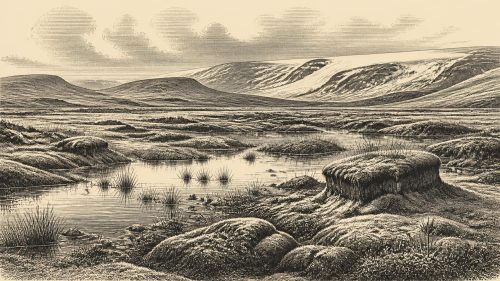
The closest Irish environmental archive is Derryvree, near Maguiresbridge in County Fermanagh. Roadworks in 1969 cut through a drumlin, a streamlined hill later shaped by glacier ice, and exposed a remarkable sequence. Freshwater silts and fine sands rich in organic material lay between two deposits of till: stony, unsorted sediment left by moving ice. The basic order is secure. A glacier had deposited the lower till; afterwards, ice was absent locally long enough for water, sediment and organic remains to accumulate; a later glacial advance buried the deposit beneath upper till.
The Derryvree organic series produced a conventional radiocarbon age of about 30,500 years before present, with a large laboratory uncertainty. When calibrated, published estimates place the deposit broadly around 36,900–31,700 calibrated years before present, approximately 34,950–29,750 BCE. The nominal date 31,149 BCE lies within this broad span, but cannot be attached to a single layer, seed, insect or episode at the site. Calibration is essential because atmospheric carbon-14 has varied through time; moreover, uncertainty necessarily expands far beyond the range of written history.
This distinction matters. Derryvree is not proof that all of Ireland shared one climate at once, nor does it demonstrate that the whole island was free of ice. It is a local archive, sealed and preserved in exceptional circumstances. Its importance is precisely that it demonstrates environmental change in northern Ireland during a period often obscured by later glacial erosion.
A Cold Freshwater Landscape
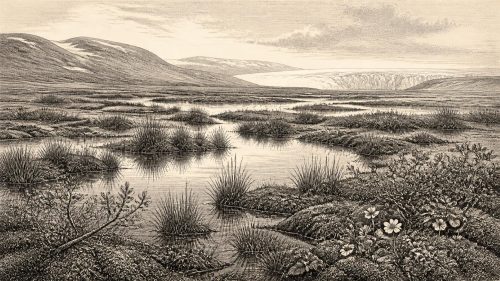
The organic remains at Derryvree point to a treeless or nearly treeless periglacial wetland, sometimes described as a muskeg-like environment. Mosses, sedges and cold-adapted flowering plants occurred around shallow water and saturated ground. Particularly evocative is bogbean, Menyanthes trifoliata, a three-leaved wetland plant still familiar in suitable Irish habitats today. Its presence in a Pleistocene deposit does not make the ancient landscape modern; rather, it shows that some plants capable of surviving in cold, waterlogged ground occupied this particular basin.
Other botanical and insect evidence indicates open terrain with short growing seasons. Dwarf willow, mountain-avens, arctic clubmoss and water-milfoil belong to the wider picture reconstructed from the Derryvree material. Such evidence supports an interpretation of sedgy margins, mossy ground, shallow pools and sparse low vegetation rather than forest. Frost processes would have been important in shaping soils and drainage. The land was productive only seasonally, but it was not a sterile wasteland. Small freshwater habitats could sustain plant and invertebrate communities even under severe climatic conditions.
The climatic background was unstable. Marine Isotope Stage 3 contained abrupt shifts in North Atlantic climate, and Ireland stood at the Atlantic edge of a changing north-west European world. The Derryvree sequence records one interval between ice advances, while the wider geological record shows that the British–Irish Ice Sheet was building towards its later maximum. Reviews of that ice sheet commonly place its major build-up after roughly 35,000–32,000 years ago, with its maximum extent substantially later, around 27,000–21,000 years ago. Around 31,149 BCE, then, Ireland was not simply “before the ice” or “under the ice”: conditions varied through time and from region to region.
Castlepook and the Animal World
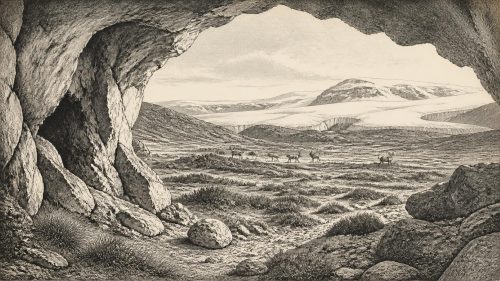
In north County Cork, Castlepook Cave near Doneraile provides the principal Irish faunal record for this broad pre-Last Glacial Maximum interval. Excavated mainly in the early twentieth century, its deposits and collections have yielded remains attributed to woolly mammoth, reindeer, giant deer, brown bear, wolf, fox, Arctic fox, mountain hare, Norwegian and collared lemmings, and spotted hyaena. Geological Survey Ireland describes Castlepook as Ireland’s richest known site for vertebrate fauna before the Last Glacial Maximum.
Those animals should not be imagined as a single herd or one perfectly simultaneous food chain. Cave deposits often combine material introduced over long periods by carnivores, water, sediment movement and earlier excavators. Some of Castlepook’s bones derive from disturbed contexts, and radiocarbon reassessment has shown that older determinations require caution. Yet the assemblage securely establishes a striking fact: during portions of the middle and later Ice Age, Ireland supported or was reached by a varied cold-stage mammal fauna.
Reindeer and lemmings suit the evidence for open, cold country; mammoth and giant deer imply extensive foraging landscapes; wolves and spotted hyaenas indicate large carnivores able to exploit such prey, carrion or both. The hyaena is especially notable because Castlepook remains Ireland’s only recognised site for the species. Its bones, teeth and coprolites demonstrate that caves were not neutral shelters: they could be predator refuges and bone accumulators. A cave collection is therefore evidence for ecological relationships, but not a straightforward census of creatures living outside its entrance in a single year.
The Human Question
No securely excavated settlement, hearth, stone-tool assemblage, dwelling, burial or occupation surface has been demonstrated in Ireland for this period. That absence is important. It means that there is no basis for describing an Irish population’s language, kinship, religious practice, artistic tradition, leadership or territorial organisation around 31,149 BCE. Nor is there evidence for agriculture, domesticated animals, pottery, metalworking, long-distance trade networks or permanent settlement. Economy, if people were present at all, cannot responsibly be reconstructed beyond the possibility of short-term hunting, scavenging or movement through a changing landscape.
A reindeer femur from the old Castlepook collection has nevertheless made this period archaeologically consequential. It has been publicly reported as approximately 33,000 years old and as carrying a deep mark interpreted as a possible stone-tool incision associated with butchery. If the identification of the mark and its contemporaneity with the animal’s death are confirmed, it would be evidence that people handled a reindeer in Ireland far earlier than the securely evidenced terminal-Pleistocene human activity at Alice and Gwendoline Cave, County Clare.
At present, however, the inference must remain limited. The bone’s date measures when the animal died, not automatically when the mark was made; the cave collection comes from early excavations and lacks the secure associated context expected of a modern excavation. One modified bone would not prove a resident community, a seasonal camp, a migration route or continuous occupation. It certainly cannot demonstrate political communities or a developed Irish Palaeolithic culture. The most careful wording is that Castlepook presents a significant, unresolved indication of possible human activity within an animal-rich Ice Age landscape.
Connections Without Trade or Diplomacy
Ireland’s fauna nevertheless reveals wider regional connections. Reindeer, mammoth, hyaena and other cold-stage mammals could only have arrived through changing routes across the then-exposed or narrowed landscapes and seaways of north-west Europe. Lower global sea levels altered coastlines profoundly, although the exact accessibility of Ireland varied with time, ice cover and local geography. Animals did not cross modern political frontiers; their presence records ecological movement, not “trade” or diplomacy.
If people did reach Ireland in this interval, they too would have moved through that broader north-west European setting. But no material from Ireland identifies where they came from, how many travelled, whether they returned, or whether they encountered others. It would be misleading to import the rich evidence for Upper Palaeolithic art, ritual and tool traditions elsewhere in Europe and label it Irish. Ireland’s own evidence has not yet yielded comparable objects for this age.
What This Moment Can Mean
Around the notional year 31,149 BCE, Ireland was a place of environmental opportunity and extreme vulnerability. At Derryvree, a cold freshwater basin supported wetland plants and small animal life between episodes of glaciation. At Castlepook, the accumulated remains of large herbivores and predators show that cold-adapted mammals entered or persisted in parts of the island during the broader period. Later expansion of ice would destroy, bury or transform many traces of these landscapes.
The history of this date is therefore not one of named leaders, battles or settlements. It is the history of a drumlin’s sealed wetland, cave-bone assemblages, moving ice and animals adapted to open northern ground. These are fragmentary witnesses, but they are substantial ones. They show that prehistoric Ireland was neither timeless nor empty: it was a dynamic Ice Age environment whose surviving evidence sets firm limits on imagination while still revealing a surprisingly complex natural world.
Primary Sources
- A Middle Midlandian Freshwater Series at Derryvree, Maguiresbridge, County Fermanagh, Northern Ireland
- The Irish Quaternary Fauna Project
- A Reconsideration of the Radiocarbon Dating of the Marine Isotope Stage 3 Fauna from Southern Ireland
- Castlepook Cave: County Geological Site Report
- Pleistocene Vertebrates in the British Isles
- Introduction to the Late Quaternary and Holocene of Northern Ireland
- Exploring the Last British-Irish Ice Sheet: A Review of Recent Research
- Extent and Timing of the Last Glacial Maximum in Britain and Ireland: A Review
- The IntCal20 Northern Hemisphere Radiocarbon Age Calibration Curve (0–55 cal kBP)
- The IntCal20 Approach to Radiocarbon Calibration Curve Construction: A New Methodology Using Bayesian Splines and Errors-in-Variables
- New Insights on the Fauna of Ireland's Younger Dryas and Early Holocene from Alice & Gwendoline Cave
- First Evidence of a Late Upper Palaeolithic Human Presence in Ireland
- 2022:564 – Castlepook Cave, Castlepook South, Cork
- Archaeological Heritage of County Cork
- An Assessment of the Geological Heritage of County Cork
- Soils of County Waterford
- The Geology of Ireland: Cenozoic, Tertiary and Quaternary
- Field Guides
- Irish Quaternary Association Publications
- The Stratigraphic Position and Age of the Gortian
- New Data for the Last Glacial Maximum in Great Britain and Ireland
- Early Deglaciation of the British-Irish Ice Sheet on the Atlantic Margin