The Doneraile Butchery Question31203 BCE
31,203 BCE is a modern chronological marker rather than a recoverable Irish year. During this unstable Late Pleistocene period, Ireland experienced variable ice cover, lower sea levels and cold, open wetlands, evidenced by Derryvree sediments in Fermanagh. Castlepook Cave near Doneraile preserves a mixed late-Ice-Age fauna including mammoth, reindeer, giant deer, hyaena and wolf, though deposits were disturbed and span millennia. A dated reindeer femur bearing a possible stone-tool cut mark may indicate Upper Palaeolithic human processing around 33,000 years ago. It cannot prove settlement or continuity. It stresses uncertainty, distinguishing environmental evidence, animal remains, and an unresolved human trace.
Dateline
The label 31,203 BCE is a useful modern waypoint, not a recoverable Irish calendar year. No written record, annual sequence of events or excavated settlement can be fixed to it. In archaeological terms it lies about 33,150 calendar years before the conventional “present” of AD 1950, within the Late Pleistocene and Marine Isotope Stage 3, a climatically unstable part of the last Ice Age. Radiocarbon measurements from this depth of time require calibration and normally produce ranges rather than a single date; a date on an animal bone tells us when that animal died, not automatically when people arrived or acted. The responsible history of Ireland at this point is therefore a history of changing habitats, animal movements, ice growth and one unusually provocative fragment of bone.
A Landscape Before Full Glaciation
Ireland was not the green, wooded island familiar today. The last British–Irish Ice Sheet was developing, but the island was not yet uniformly covered by ice. Modern reconstructions indicate considerable regional variation around the opening of the final glacial maximum: ice caps and mountain glaciers existed in parts of Ireland, especially in northern and upland areas, while other ground could remain open, seasonally frozen or intermittently ice-free. The later maximum, when ice spread across Ireland and its continental shelf on a far greater scale, belongs chiefly to roughly 27,000–23,000 calibrated years before present. The precise shape of ice margins earlier in the cycle remains debated, which is important: it rules out any simple map showing either an entirely frozen or entirely open Ireland in 31,203 BCE.
Lower global sea level altered the geography as well as the climate. The shores stood farther from their modern positions in many places, and the Irish Sea region was a changing combination of sea, exposed shelf and glacially influenced corridors. That did not create a permanently simple overland route from continental Europe to Ireland. Water crossings, shifting coastlines, ice and harsh terrain all mattered. Yet mammals evidently reached Ireland during favourable intervals, whether by moving through connected or near-connected landscapes, across narrow marine barriers, or along routes that changed as ice and sea level did. For humans, if they were present, access would have been equally contingent and probably episodic.
Cold Ground, Living Water
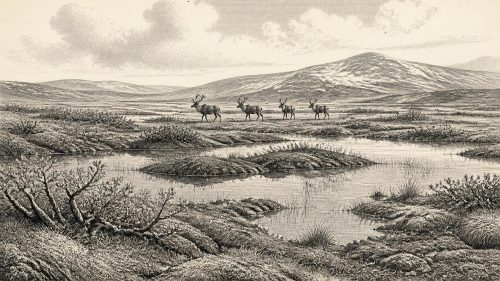
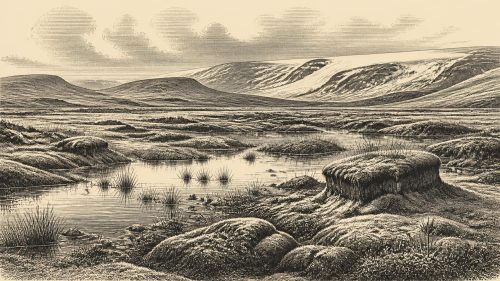
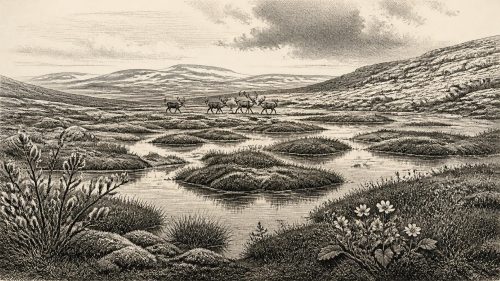
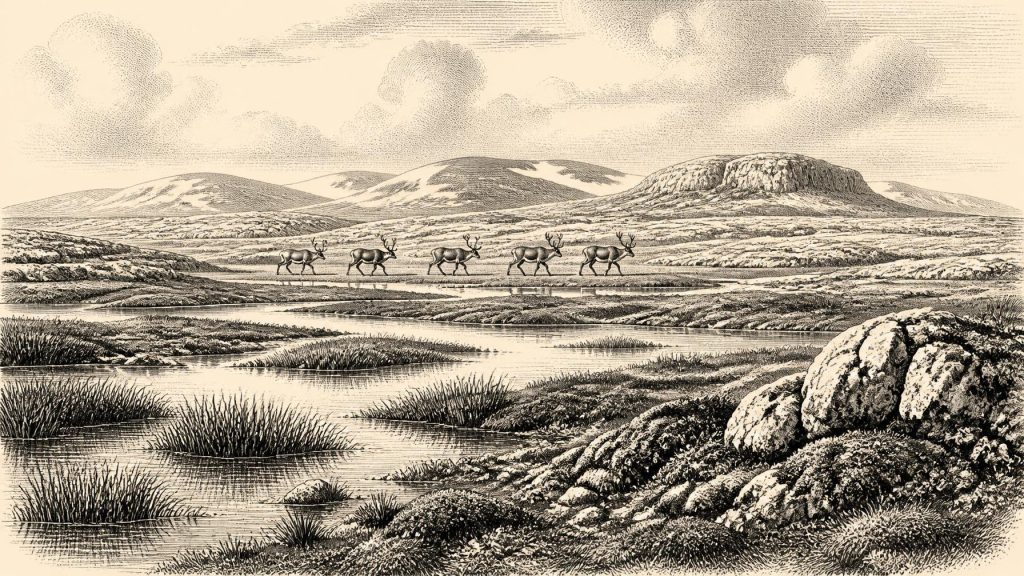
The clearest environmental evidence for the broader period comes not from a village but from sediments. At Derryvree near Maguiresbridge in County Fermanagh, organic-rich freshwater deposits were preserved between two tills, sheets of glacial sediment laid down at different times. Their pollen, plant macrofossils and insects describe a treeless, cold-climate wetland: sedges and grasses, mosses, dwarf shrubs and herbs around shallow pools and waterlogged ground. This was not a forest landscape, nor an unbroken white desert. It was a patchwork of open tundra-like terrain, wet muskeg, freshwater margins and mineral ground, shaped by severe winters and short growing seasons.
Its chronology is necessarily broad. A radiocarbon determination from the Derryvree organic beds, once calibrated, has been placed approximately within 36,900–31,700 calendar years before present. That range overlaps the general timescale represented by 31,203 BCE, but it does not prove that Derryvree’s pools and every other Irish district looked identical in that particular year. Sediments accumulate over time, pollen can travel, and conditions varied from Fermanagh’s lowlands to the limestone country of Cork. Nevertheless, Derryvree establishes an essential point: before later ice overran or buried parts of the island, some Irish landscapes supported persistent freshwater habitats and cold-adapted vegetation.
The evidence also demonstrates why Ireland’s deep prehistory is so uneven. Advancing glaciers eroded older surfaces; meltwater shifted sediment; rising seas later drowned extensive coastal landscapes. Caves, buried wetland lenses and protected sedimentary basins are therefore disproportionately important. They are not complete samples of the country. Rather, they are rare archives that survived processes which removed much of the evidence that might otherwise record camps, tracks, hunting places or short-lived visits.
Castlepook’s Animal Archive
The most important Irish site for this period is Castlepook Cave, also called Mammoth Cave, near Doneraile in north County Cork, in the Awbeg Valley beneath the Ballyhoura Hills. Excavations undertaken in the early twentieth century recovered more than two thousand bones. Subsequent work has shown that the cave contains faunal material from a long span of the late Ice Age, not one neatly sealed moment. Its assemblage includes woolly mammoth, giant deer, reindeer, brown bear, wolf, Arctic fox, hare, lemmings and spotted hyaena. Castlepook is consequently evidence for repeated animal presence in and around southern Ireland, but it cannot be treated as a census of one local herd, one season or one human occupation.
Spotted hyaena are especially revealing. Their presence shows that Ireland could support, or at least receive, a large scavenging predator within a wider community of grazing and browsing mammals. Hyaenas also complicate the archaeology. They could drag carcass parts into caves, gnaw bones, disturb deposits and create accumulations that later excavators might mistake for a straightforward record of human hunting. Water movement and old excavation practices added further disturbance. A bone found in Castlepook may retain powerful evidence of an animal’s life and death, but its final position in the cave need not be the place where it was killed or consumed.
The animals imply open feeding grounds beyond the cave: enough vegetation for reindeer and giant deer, terrain traversable by mammoth, and prey or carrion for carnivores. They do not justify a picture of a stable ‘mammoth steppe’ covering every Irish county. Species have different ecological tolerances, and bones from several millennia can occur in the same cave system. The safest interpretation is of a cold, dynamic landscape containing open habitats, wetlands and sheltered limestone terrain, visited by animals as climate, vegetation and access routes changed.
The Reindeer Femur
One object gives 31,203 BCE its particular historical interest: a reindeer femur fragment from Castlepook. Re-examination and improved accelerator radiocarbon methods have placed it broadly around 33,000 years ago in public accounts, while a deep linear modification has been interpreted as a cut mark made by a sharp stone tool. If that interpretation is sustained, the bone would be evidence that a person butchered or otherwise processed reindeer in Ireland during the Upper Palaeolithic, vastly earlier than the formerly accepted post-glacial human record.
That claim must be stated carefully. The radiocarbon result dates the animal bone, not a person. The surface mark requires separate microscopic and taphonomic assessment: cuts made with stone tools need to be distinguished from carnivore damage, trampling, sediment abrasion, excavation damage and other natural alterations. Nor does one potentially modified bone establish a settlement, a resident population, a named culture or a continuous ancestral line to later Irish communities. It cannot tell us whether people killed the reindeer, scavenged it, transported a portion of carcass, or visited the cave itself.
The claim is valuable precisely because it is limited and testable. It encourages renewed excavation in undisturbed parts of Castlepook, direct dating of securely excavated material, study of bone-surface damage and searches for associated stone artefacts, hearths or occupation surfaces. Work at the cave in 2022 was undertaken to determine whether Pleistocene deposits survive beyond the areas disturbed by earlier digging. Such research may strengthen, refine or overturn parts of the current interpretation. At present, the marked femur is a possible trace of human action, not the foundation for an invented Ice Age society.
People Without Polities
There is no evidence from Ireland around this date for political institutions, rulers, territorial states, diplomacy, organised warfare, formal religion, trade networks or literacy. Nor are there securely dated houses, burials, art panels, tool assemblages or camp floors from which to reconstruct everyday social life. It would be misleading to supply chiefs, clans, rituals or battles simply because the period is remote. If people did reach Ireland, they would have been small, mobile Upper Palaeolithic groups accustomed to cold-season risk, animal behaviour and movement across large landscapes; that is an inference from the wider north-west European context, not an Irish settlement record.
Even this cautious possibility changes the questions historians ask. Ireland was once often presented as wholly beyond the human world until after the final retreat of the ice. Castlepook instead suggests that the island may have been visited during an earlier, more hospitable interval of the Ice Age. Such visits could have been brief and leave almost no durable trace, especially where later glaciers scoured the terrain. Human absence from the present archaeological record is therefore not the same thing as proof that no person ever stood on the island.
What This Date Can Mean
Around the modernly expressed year 31,203 BCE, Ireland was defined less by human history than by environmental opportunity and constraint. Ice was growing but had not yet imposed the later island-wide maximum; cold wetlands and open ground supported a distinctive fauna; caves preserved fragmentary records of animals, predators and perhaps people. Derryvree’s buried freshwater sediments provide the best local picture of a tundra wetland, while Castlepook supplies the richest animal archive and the unresolved human question.
The principal development is therefore not a dated event but a revision in perspective. Ireland’s deep past cannot yet yield an annual chronicle for this year. It can, however, show a landscape of reindeer and hyaenas, sedge-fringed pools and unstable ice margins, in which a single marked reindeer bone may preserve the faintest known sign of an Upper Palaeolithic encounter. The distinction between what the bone proves, what the cave suggests and what future research may establish is the key to understanding Ireland at this immense distance in time.
Primary Sources
- A reconsideration of the radiocarbon dating of the Marine Isotope Stage 3 fauna from southern Ireland
- The Irish Quaternary Fauna Project
- Castlepook Cave, County Geological Site Report
- Spotted Hyena Skull
- 2022:564 – Castlepook Cave, Castlepook South, Cork
- Growth and retreat of the last British–Irish Ice Sheet, 31,000 to 15,000 years ago: the BRITICE-CHRONO reconstruction
- BRITICE-CHRONO Maps and GIS Data of the Last British-Irish Ice Sheet 31 to 15 ka
- The timing and magnitude of the British–Irish Ice Sheet between Marine Isotope Stages 5d and 2
- Trimlines, blockfields and the vertical extent of the last ice sheet in southern Ireland
- A Middle Midlandian Freshwater Series at Derryvree, Maguiresbridge, County Fermanagh, Northern Ireland
- Irish Pleistocene Biostratigraphy
- The Quaternary of Ireland: Field Guide 17
- The IntCal20 Northern Hemisphere Radiocarbon Age Calibration Curve (0–55 cal kBP)
- New insights on the fauna of Ireland's Younger Dryas and Early Holocene from Alice & Gwendoline Cave
- Stratigraphic and palaeo-geomorphological evidence for the glacial-deglacial history of the last British-Irish Ice Sheet in the north-western Irish Sea
- Ireland: Submerged Prehistoric Sites and Landscapes
- Maximum extent and dynamic behaviour of the last British–Irish Ice Sheet west of Ireland
- Early deglaciation of the British-Irish Ice Sheet on the Atlantic shelf northwest of Ireland driven by glacioisostatic depression and high relative sea level
- 18) Castlepook Caves
- Guide to the National Museum of Ireland – Natural History
- Mammoth Cave / Castlepook Cave