Ireland’s Iceward Interval31202 BCE
Around 31,202 BCE, Ireland lay within the climatically unstable Late Pleistocene, approaching major expansion of the British–Irish Ice Sheet. Evidence cannot reconstruct a single year: ice extent varied regionally, and later glaciers erased or disturbed earlier landscapes and deposits. Cold, seasonal open habitats probably persisted where ice did not cover land, while fossil caves attest to a wider earlier fauna including mammoth, reindeer and predators, though revised dates prohibit assigning species confidently to this moment. No secure evidence shows human residence, society, trade or conflict. Ireland’s first demonstrated human activity dates about 12,800 cal BP. Glaciation reshaped terrain, obscuring evidence.
Dateline
31,202 BCE is not a year for which Ireland can be described through an event, ruler, battle or settlement. No written calendar existed on the island, and archaeology cannot resolve evidence at anything like modern year-by-year precision this far back. In conventional terms, the label falls at about 33.1 thousand calibrated years before present (cal BP, where “present” is AD 1950), near the close of Marine Isotope Stage 3, a long and climatically unstable phase of the Late Pleistocene. The responsible historical question is therefore not “what happened in Ireland that year?”, but what the surviving geological, fossil and archaeological record can say about Ireland within a broad interval around c. 34,000–32,000 cal BP.
A Date on the Edge of Glaciation
This was an ice-age Ireland, but not necessarily an island already buried beneath the maximum ice cover familiar from later glacial maps. The most recent large reconstruction of the British–Irish Ice Sheet traces its changing margins in thousand-year steps rather than annual ones. It indicates major growth over the period after c. 31,000 years ago, while evidence from the western shelf and from Ireland itself shows that the timing, thickness and extent of early ice were not uniform in every region. By c. 28,000–26,500 cal BP, ice had expanded to the continental-shelf edge in several western sectors; the full ice-sheet maximum came later still, with different margins reaching their greatest positions at different times.
For the interval represented by 31,202 BCE, the best picture is one of transition. Some reconstructions allow comparatively limited or discontinuous Irish ice cover before about 32,000 cal BP, especially away from mountain and marine margins. Other evidence, particularly raised marine deposits and dated shells on the west coast, has been interpreted as requiring substantial ice loading in western Ireland at points between roughly 40,000 and 19,000 cal BP. These are not simply mutually exclusive stories: an ice sheet can grow, thin, advance and reorganise, while local records preserve different portions of that history. They do mean, however, that a neat map of the island for one notional calendar year would pretend to a certainty the science does not possess.
Cold was the defining political force of this world, if the word “political” can be used at all. It governed where water pooled or froze, where animals could feed, which valleys carried ice, and whether any temporary human party could enter, remain or leave. The landscape was being drawn into the formation of the British–Irish Ice Sheet: a connected but changing complex of Irish, Scottish and marine-based ice masses. Later flow left the drumlins, streamlined bedrock, tills, meltwater channels and moraines that make much of Ireland’s glacial landscape so recognisable today. Yet those visible landforms chiefly record later, stronger phases of glaciation and retreat, not a snapshot of 31,202 BCE.
Reading a Landscape Largely Erased
The record is unusually difficult because later ice was an active geological agent. Glaciers eroded older soils, reworked sediments, transported stones and bones, and covered possible occupation surfaces beneath till or offshore deposits. A lack of evidence for camps, hearths or tools from this interval cannot prove that no person ever crossed part of Ireland; it does show that no secure evidence currently demonstrates a resident human population. This distinction is essential. Absence is not proof of absence, but neither is it a licence to create a prehistoric society from possibility alone.
Ireland’s first securely demonstrated human presence belongs much later, at the end of the last glacial period. Cut marks on a brown-bear kneecap from Alice and Gwendoline Cave, County Clare, have been independently dated to roughly 12,810–12,590 and 12,810–12,685 cal BP. That remarkable find establishes Upper Palaeolithic butchery in Ireland, not occupation twenty millennia earlier. Claims for older Irish Palaeolithic artefacts have generally failed because the objects were naturally fractured, displaced by ice, or lacked reliable archaeological context.
Accordingly, there were no demonstrable Irish chiefs, tribes, territorial kingdoms or diplomatic relationships in 31,202 BCE. There is no evidence from which to infer local languages, kinship systems, dwellings, ritual places, art, teaching or exchange customs. Nor can modern ideas of an Irish nation be projected backwards into a time before any documented human community on the island. The appropriate history here is environmental and evidential: a history of changing habitats, animal movements and the preservation—or destruction—of traces.
The Closing Faunal Window
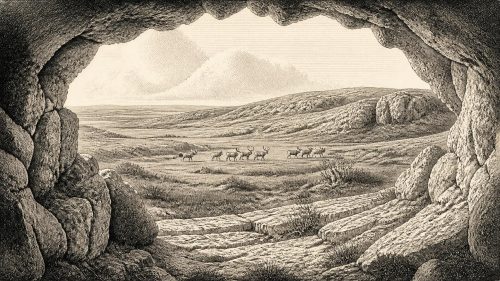
Caves in southern Ireland, especially Castlepook Cave near Doneraile in County Cork, preserve the most evocative evidence for the preceding and overlapping Pleistocene world. Fossils from Irish caves include woolly mammoth, giant deer, reindeer, brown bear, wolf, Arctic fox, lemmings and spotted hyena. They demonstrate that, during portions of the Late Pleistocene, Ireland supported or was reached by a varied cold-stage fauna rather than being perpetually a lifeless sheet of ice. The National Museum of Ireland’s collections make the point vividly, but the fossils must be used carefully: an animal bone dates an individual animal or deposit, not an entire landscape, and need not prove that the species lived everywhere on the island at the same time.
The caution matters acutely at this date. A reassessment of radiocarbon evidence from southern Irish cave fauna concluded that some apparently late Marine Isotope Stage 3 ages were misleadingly young, and suggested that giant deer and spotted hyena may have vanished locally before about 40,000 cal BP. Thus, hyenas or giant deer should not be placed confidently in an Irish scene for 31,202 BCE merely because their bones occur in an Irish cave. Mammoth and other animals are likewise evidence for a broader pre-maximum faunal window, not a roll call for a single year.
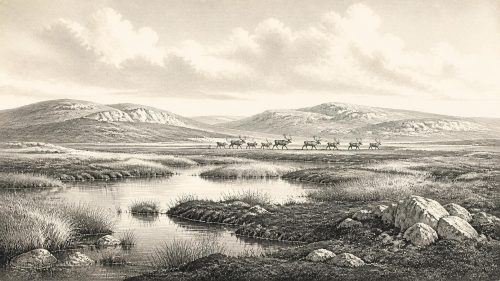
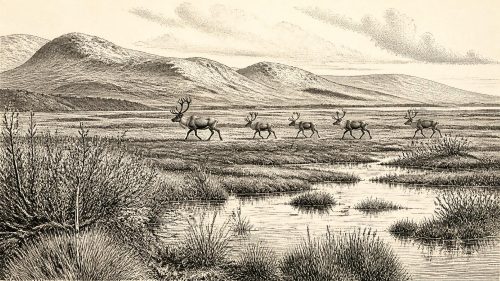
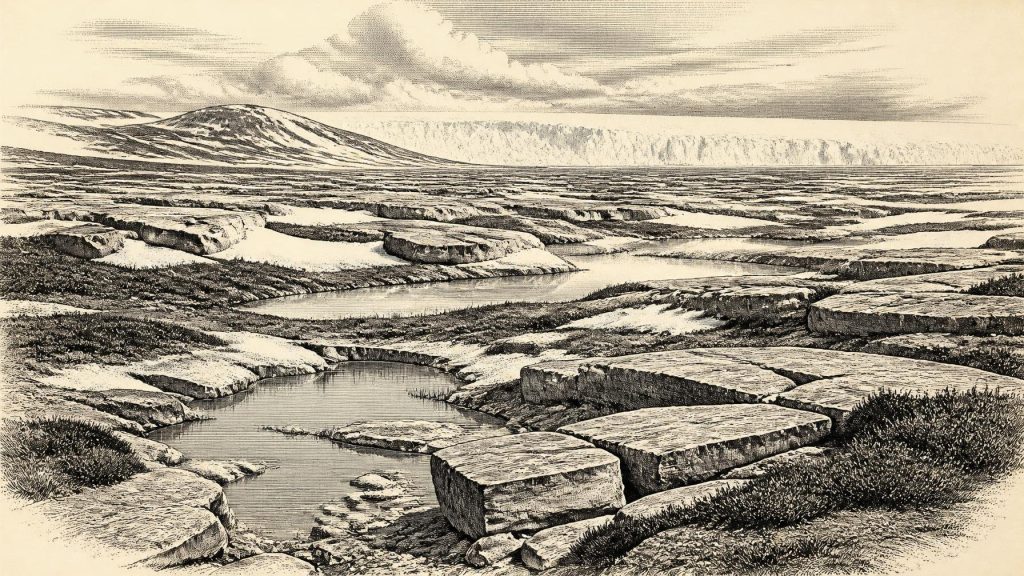
The environment was probably open, cold and highly seasonal wherever land was not ice-covered: a mosaic of sparse grassland, herb-rich tundra, wet hollows, exposed mineral ground and, locally, snowbeds or glacier margins. Extensive closed woodland is unlikely in such conditions. But even this description is a regional inference assembled from fossils, sediments, pollen and comparison with north-west European climatic records; direct Irish plant archives of this age are rare and unevenly preserved. It is more responsible to envisage shifting habitats than a uniform “mammoth-steppe Ireland”.
Sea, Land and Movement
Sea level was much lower than today during the wider glacial period because enormous volumes of water were stored in land ice. The coastline was therefore not the familiar modern outline: broad shelves now beneath the Atlantic, Celtic Sea and Irish Sea may have been exposed or shallower at different times. Yet lower sea level does not automatically establish a simple land bridge between Ireland, Britain and continental Europe. Deep basins, changing ice margins, local uplift and depression under the weight of ice, and poorly preserved offshore terrain complicate the matter. A route usable by animals or people at one time may have been blocked by water, ice or severe terrain at another.
That uncertainty limits what can be said about migration and trade. Animals clearly reached Ireland in earlier Pleistocene intervals, but their routes may have involved exposed ground, seasonal ice, short water crossings or combinations of these. There is no evidence for commerce, imported objects or organised long-distance exchange at 31,202 BCE. “Connection” in this context means ecological connectivity: the intermittent possibility that plants and animals moved across a changing north-west European geography.
Conflict Without Armies
Conflict, too, must be understood in ecological rather than military terms. Predators, scavengers and herbivores competed for food and shelter; freezing temperatures, snow cover, unstable ground and advancing ice reduced the places in which life could persist. Carnivore-modified bone, cave deposits and fossil associations can illuminate such food webs, but they do not record human hunting parties or battles. Even apparent cut marks demand specialist scrutiny, since trampling, excavation damage, geological abrasion and carnivore teeth can imitate purposeful incision.
The larger development was the narrowing of habitable opportunities. As the British–Irish Ice Sheet gathered strength, its advance did more than cool Ireland. It repeatedly removed soils, altered drainage, shifted coastlines and destroyed many of the contexts in which delicate human and animal traces might have survived. The scarcity of the record is therefore part of the history: later glaciation made earlier Ireland difficult to recover.
What Can Be Said Responsibly
Around the broad interval indicated by 31,202 BCE, Ireland stood near a threshold. It was part of a cold north-west European world undergoing rapid environmental change, with expanding ice and increasingly restricted refuges. Fossils show that substantial mammals had used Ireland during the wider pre-Last Glacial Maximum period, but revised dating warns against assigning particular species to this exact moment. The archaeological record provides no secure basis for describing inhabitants, government, religion, learning or economy.
This is not an empty chapter. It is the precondition for every later chapter of Irish history. The ice advance that followed reshaped the ground on which Mesolithic camps, Neolithic tombs, medieval lordships and modern towns would later stand. Its erosion also explains why the island’s deep human past is more elusive than that of many neighbouring regions. For 31,202 BCE, the honest conclusion is not a story of named people and dated deeds, but a scientifically bounded one: Ireland was entering a decisive glacial transformation, and the evidence survives in fragments measured in millennia, not years.
Primary Sources
- Growth and retreat of the last British–Irish Ice Sheet, 31,000 to 15,000 years ago: the BRITICE-CHRONO reconstruction
- Exploring controls of the early and stepped deglaciation on the western margin of the British Irish Ice Sheet
- Maximum extent and readvance dynamics of the Irish Sea Ice Stream and Irish Sea Glacier since the Last Glacial Maximum
- Stratigraphic and palaeo-geomorphological evidence for the glacial-deglacial history of the last British-Irish Ice Sheet in the north-western Irish Sea
- Radiocarbon constraints on the history of the western Irish ice sheet prior to the Last Glacial Maximum
- Extent and timing of the Last Glacial Maximum (LGM) in Britain and Ireland: a review
- Radiocarbon constraints on the age of the maximum advance of the British-Irish Ice Sheet in the Celtic Sea
- Dimensions and chronology of the last ice sheet in Western Ireland
- Vertical dimensions and age of the Wicklow Mountains ice dome, Eastern Ireland, and implications for the extent of the last Irish Ice Sheet
- The last Eurasian ice sheets – a chronological database and time-slice reconstruction, DATED-1
- First evidence of a Late Upper Palaeolithic human presence in Ireland
- A reconsideration of the radiocarbon dating of the Marine Isotope Stage 3 fauna from southern Ireland
- The Irish Quaternary Fauna Project
- Ireland: Submerged Prehistoric Sites and Landscapes
- The colonization of Ireland: A human ecology perspective
- The Antiquity of Man in Ireland
- The Mesolithic in Ireland: when was it?
- Ice Age Ireland: Cool Fossils!
- Spotted Hyena Skull
- Guide to the National Museum of Ireland – Natural History
- Anthropogenic changes to the Holocene nitrogen cycle in Ireland
- New insights on the fauna of Ireland's Younger Dryas and Early Holocene from Alice & Gwendoline Cave