
BIRM-166’s Reindeer Question31080 BCE
Labelled 31,080 BCE only retrospectively, this period in Ireland is reconstructed from uncertain environmental evidence rather than dated events. At Derryvree, County Fermanagh, organic deposits between glacial tills indicate an ice-free freshwater wetland during part of Marine Isotope Stage 3, supporting treeless tundra vegetation in severe conditions. Castlepook Cave, County Cork, contains Late Pleistocene fauna including reindeer, mammoth and predators, accumulated across long intervals. A cut-like mark on a reindeer femur may indicate human butchery, but cannot establish settlement, culture or continuity. As ice expanded towards the Last Glacial Maximum, shifting landscapes and uncertain routes constrained animal and human movement.
Dateline
The label 31,080 BCE is a modern chronological convenience, not a year that any person in prehistoric Ireland could have named, recorded or experienced as a calendar date. It falls roughly 33,030 years before the conventional radiocarbon reference year of AD 1950, within the Late Pleistocene and Marine Isotope Stage 3, a particularly unstable part of the last Ice Age. Evidence from Ireland cannot resolve events to this single year. What it can provide are radiocarbon ranges, geological sequences, plant fossils and animal remains that illuminate a changing Irish environment around this broad period.
A Date Within a Range
The closest major Irish environmental record is Derryvree, near Maguiresbridge in County Fermanagh. Road construction in 1969 exposed an unusual sequence inside a drumlin, the streamlined hill-form created by glacier ice. An older till lay below freshwater sands, silts and organic material; another till sealed the deposit above. The order is clear evidence of change: ice had crossed the locality, a later interval allowed freshwater sediment and living things to accumulate, and renewed glaciation buried the wetland.
Organic material from this deposit, known by the laboratory number BIRM-166, returned a conventional radiocarbon age of about 30,500 BP, with a substantial error range. Radiocarbon years are not calendar years. Changes in atmospheric carbon mean that measurements must be calibrated, and beyond 30,000 years ago the resulting ranges become broad. The Derryvree material has commonly been placed at approximately 36,900–31,700 calibrated years BP, or about 34,950–29,750 BCE. The requested year lies inside that long span, but it cannot be assigned to a particular layer, pool, animal, season or human visit.
This distinction is fundamental. Derryvree is not a diary of 31,080 BCE; it is a surviving environmental archive accumulated over an interval. Nor can one Fermanagh cutting stand for the whole island. Yet it decisively challenges any simple picture of Ireland as continuously ice-covered throughout the Ice Age. For part of the Middle Midlandian, there was an ice-free freshwater landscape at this northern site, though one exposed to severe cold and eventually overwhelmed by later ice.
Wetland on a Cold Margin
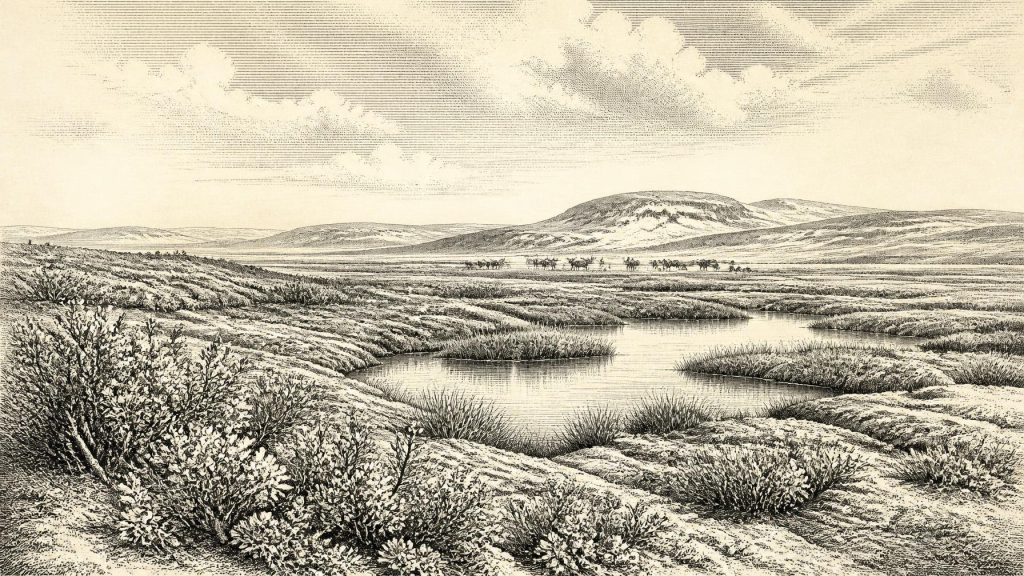
The Derryvree fossils indicate open, treeless tundra or tundra-like vegetation. Plant remains include bogbean (Menyanthes trifoliata), dwarf willow (Salix herbacea), mountain avens (Dryas octopetala) and alternate water-milfoil (Myriophyllum alterniflorum). These are not a list of plants that necessarily flourished together in every corner of Ireland in the named year. They do, however, establish a cold freshwater setting in which shallow water, sedges, mossy ground, low-growing shrubs and herb-rich patches could persist.
Such country should not be imagined as either a green modern Ireland or an unbroken desert of snow. In the short growing season, wet margins could support aquatic plants and insects, while exposed ground supported sparse but resilient vegetation. Frost, wind, seasonal freezing and thin soils would have placed hard limits on plant cover. The landscape was shaped not only by climate but by the legacy of earlier ice: hollows, poorly drained ground, gravel, silt and newly rearranged sediments affected where water collected and where plants could take hold.
There is no evidence here for farms, fields, livestock, houses, cleared woodland or permanent village life. Agriculture lay many millennia in the future. The economic reality demonstrated by the deposit is ecological rather than social: primary productivity in a demanding northern environment, available to animals adapted to cold and open ground.
Animals of the Cave Country
Southern Irish caves provide a complementary, though complicated, record. Castlepook Cave, also called Mammoth Cave, near Doneraile in north County Cork, yielded an important collection of Pleistocene bones. The broader cave fauna includes remains attributed to reindeer, woolly mammoth, giant deer, brown bear, wolf, Arctic fox, lemmings and spotted hyaena. These remains show that Ireland was reached by elements of the wider north-west European cold-stage fauna during the Late Pleistocene.
They must not be turned into a single illustrated scene. Cave deposits may accumulate over many thousands of years; old excavations did not always preserve the stratigraphic information expected today; and some remains have been shown by improved dating to be older than formerly thought. A mammoth, a hyaena and a reindeer found in one cave system do not prove that they met at one place or time. The responsible conclusion is narrower: the island supported, at different points within this long glacial interval, a richer large-mammal community than later historical Ireland.
Predation and scavenging formed part of that ecology. Spotted hyaenas could carry and modify bones, while caves might serve as dens, traps, shelters or places where water and sediment concentrated remains. The evidence records animal lives and deaths far more securely than it reveals an orderly food chain. It nevertheless makes clear that Ireland was not ecologically empty.
The Reindeer Mark
Castlepook matters especially because a reindeer femur from the old collection has been reported to bear a deep incision interpreted by zooarchaeologist Ruth Carden as a cut or chop made on fresh bone with a sharp stone tool. County Cork heritage material associates the specimen with about 31,000 BCE. If that interpretation and chronological association are sustained, the bone may preserve an exceptionally early indication that people handled and processed an animal in Ireland.
Its importance requires caution rather than embellishment. A radiocarbon determination dates the animal bone, not the exact instant at which a surface mark was made. Identifying a mark as a stone-tool cut is a separate taphonomic judgement: carnivore damage, breakage, abrasion and later disturbance must be excluded. Above all, the bone was not recovered from a modern, closely recorded occupation floor accompanied by a hearth, tools, butchered assemblage, dwelling, human burial or preserved food store.
Consequently, Castlepook cannot yet demonstrate a permanent population, a named archaeological culture, a route of arrival, language, ancestry or continuity with later Irish communities. It does not prove that a camp stood at the cave in 31,080 BCE, nor even that the carcass was killed at the cave. At most, it offers a potentially momentous but currently limited trace of human activity: one animal may have been butchered by one or more people during a much wider Late Pleistocene interval.
Society Beyond Recovery
There can be no evidence-based account of political affairs, diplomacy or organised conflict in Ireland for this date. No communities are named; no territory is defined; no settlement is securely known. It would be misleading to turn the possible reindeer processors into a tribe, nation or lineage. If people were present, they may have been highly mobile foragers making a brief use of a landscape shared with dangerous predators and large herbivores. That is an inference from the possible bone modification and the wider Upper Palaeolithic world, not a fact demonstrated by an Irish settlement.
The same restraint applies to religion, culture and learning. No Irish artwork, ornament, burial rite, musical object, ceremonial place or symbolic practice can presently be dated to this horizon. Silence in the archaeological record is not proof that people lacked beliefs or knowledge; it is simply the limit of what has survived, been found and securely dated. A single cut-marked femur cannot reveal speech, kinship, ritual or story.
Approaching the Great Ice
The date also belongs to a phase before the fullest development of the Last Glacial Maximum, generally placed later, around 26,000–19,000 years ago. Reconstructions of the British–Irish Ice Sheet show that ice expansion was dynamic, regionally uneven and still under revision. By around 31,000 years ago, ice was growing strongly in parts of the wider British–Irish region; later it would profoundly scour Ireland, reshape drainage and destroy or bury many earlier deposits. The survival of Derryvree between two tills is therefore remarkable.
Lower sea levels altered coastlines and exposed continental shelves, but the practical routes by which animals or any people reached Ireland at this time remain uncertain. The evidence does not permit a simple claim of a permanent land bridge, regular migration corridor or established trade network. There is no proof of exchange in objects or raw materials. Movement, if it occurred, was ecological and opportunistic: animals and perhaps small human groups negotiating a cold, changing Atlantic-edge landscape.
Around 31,080 BCE, Ireland’s history is thus written in silt, pollen, seeds, bone and ice-borne debris rather than in chronicles. Derryvree provides the strongest local picture: a cold open wetland that existed between glacial episodes. Castlepook provides the sharper human question: a reindeer bone whose mark may signal butchery, but not yet settlement. Together they show an Ireland capable of supporting life in brief and shifting windows, while reminding us how much of that deep past remains beyond recovery.
Primary Sources
- A Middle Midlandian Freshwater Series at Derryvree, Maguiresbridge, County Fermanagh, Northern Ireland
- The Irish Quaternary Fauna Project
- A Reconsideration of the Radiocarbon Dating of the Marine Isotope Stage 3 Fauna from Southern Ireland
- Growth and Retreat of the Last British–Irish Ice Sheet, 31,000 to 15,000 Years Ago: the BRITICE-CHRONO Reconstruction
- The Deglaciation of the Western Sector of the Irish Ice Sheet from the Inner Continental Shelf to its Terrestrial Margin
- A Stratigraphic Investigation of the Celtic Sea Megaridges Based on Seismic and Core Data from the Irish-UK Sectors
- Last Glacial Maximum Cirque Glaciation in Ireland and Implications for Reconstructions of the Irish Ice Sheet
- Trimlines, Blockfields and the Vertical Extent of the Last Ice Sheet in Southern Ireland
- The IntCal20 Northern Hemisphere Radiocarbon Age Calibration Curve (0–55 cal kBP)
- New Insights on the Fauna of Ireland's Younger Dryas and Early Holocene from Alice & Gwendoline Cave
- A Genetic Assessment of the Introduced Irish Red Deer and their Origins
- Heritage Artefacts of County Cork
- BSBI: Menyanthes trifoliata
- BSBI: Salix herbacea
- BSBI: Dryas octopetala
- BSBI: Myriophyllum alterniflorum
- The Geological Heritage of County Leitrim
- Pleistocene Vertebrates in the British Isles
- Occurrence of Mammalia Relicts at Site Castlepook Cave
- Mammoth Cave, County Cork
- Geological Heritage Audit Report: County Cork
- The IntCal20 Northern Hemisphere Radiocarbon Age Calibration Curve PDF