Norwegian Lemmings at Castlepook30133 BCE
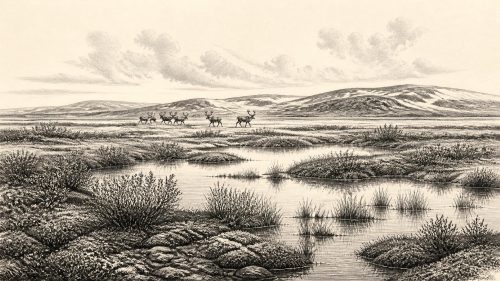
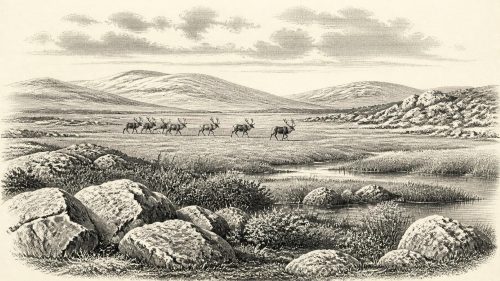
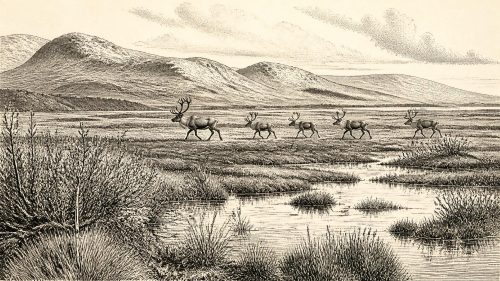
About 30,133 BCE, Ireland cannot be described through annual history, but Late Pleistocene evidence indicates a cold, changing MIS 3 environment. Derryvree, County Fermanagh, preserves freshwater deposits dated broadly to this period, showing treeless tundra-like wetlands with sedges, mosses and cold-adapted plants between glacial episodes. Castlepook Cave, County Cork, contains a mixed, complex fauna including mammoth, reindeer, giant deer, lemmings, Arctic fox, wolf and hyaena, demonstrating open cold habitats but not contemporaneity. A possibly tool-marked reindeer bone suggests human activity around 33,000 years ago, although no settlement is proven. Later ice and sea-level change destroyed or obscured much surviving evidence.
Dateline
“30,133 BCE” is a useful label for a point far beyond the reach of ordinary historical chronology, not a date to which an Irish event can responsibly be attached. No written record, ruler, settlement sequence or securely dated human occupation allows us to describe a particular year in Ireland at this depth of time. In calendar arithmetic the label lies about 32,080 years before the radiocarbon convention of AD 1950, but modern calendar-year precision is unavailable. The appropriate setting is the Late Pleistocene, within the climatically volatile later part of Marine Isotope Stage 3 (MIS 3), before the Last Glacial Maximum transformed much of the island.
The strongest evidence comes from a small number of environmental deposits and caves, each with its own limitations. Most important for a landscape close to this broad period is Derryvree, near Maguiresbridge in County Fermanagh. Roadworks in 1969 exposed freshwater silts and fine sands trapped between two distinct glacial tills in a drumlin. Organic material from the deposit produced radiocarbon determination BIRM-166, 30,500 radiocarbon years BP, with a substantial uncertainty of +1,170/-1,030 years. That is a laboratory age, not a calendar date: calibration produces a broad Late-Pleistocene probability range rather than a single year. The deposit represents an interval of deposition, too, rather than a snapshot of one season. It can illuminate conditions around the nominated date only in this deliberately broad sense.
A Treeless Fermanagh
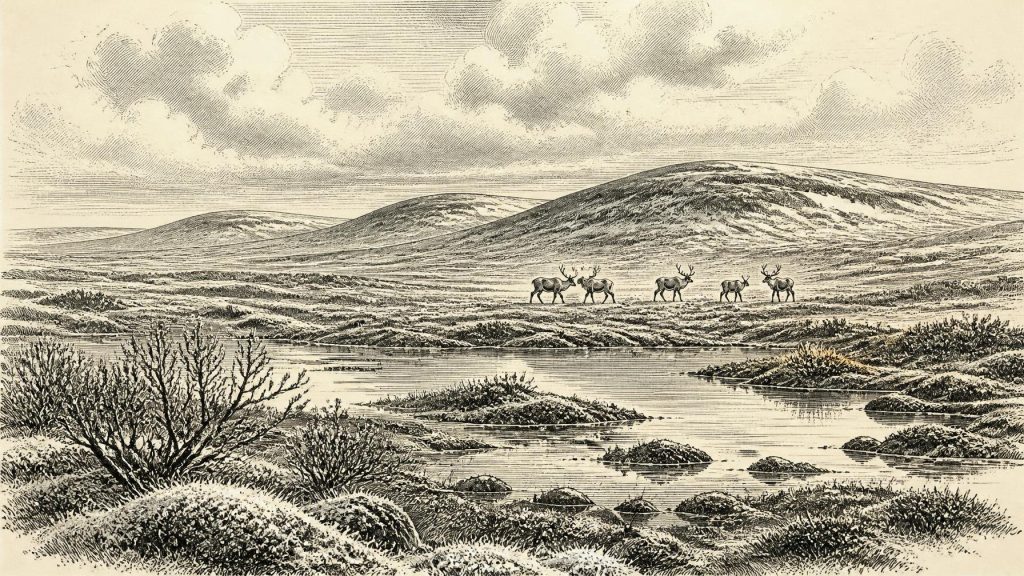
Derryvree gives the clearest Irish evidence for a cold, open environment during the Middle Midlandian, the Irish term commonly used for part of the last glacial cycle. Its pollen, plant macrofossils, mosses and insect remains point to a treeless tundra or tundra-like wetland landscape. Grasses and sedges were important, with herbs, dwarf shrubs and cold-tolerant plants. Recorded remains include buckbean (Menyanthes trifoliata), alternate water-milfoil (Myriophyllum alterniflorum), dwarf willow and lesser clubmoss, alongside a varied moss flora. These were not signs of a lush forested Ireland. They indicate shallow fresh water, sedgy margins, wet ground and sparse vegetation on nearby drier surfaces, all shaped by frost, short growing seasons and periglacial processes.
The setting was nevertheless more varied than the word “tundra” can imply. A freshwater basin could support aquatic plants and sheltered wet ground even where the wider terrain was exposed and cold. Snowmelt, seasonal freezing and thawing, unstable slopes and waterlogged hollows would have made travel difficult in places. The lower till beneath the organic layer and the upper till above it show that this local wetland existed between phases of glaciation. Derryvree is therefore evidence both of an ice-free or locally ice-free episode and of vulnerability: a living freshwater landscape was eventually overridden or sealed by renewed ice.
It would be wrong, however, to extend one Fermanagh exposure unchanged across the entire island. Ireland’s relief, distance from ice centres, proximity to the Atlantic and shifting ice margins created regional variation. Geological evidence shows repeated advances and retreats of ice during the wider Midlandian cold stage, while the better-known Last Glacial Maximum lay ahead. Around this broad time, parts of Ireland may have offered open ground and freshwater refuges, whereas other districts were affected by ice, cold-based conditions or the reorganising drainage of an evolving glacial landscape. The familiar eskers, drumlins and many glacially moulded valleys visible in Ireland today are enduring reminders of these later and repeated processes, but they do not preserve a map of one particular year.
Animals and Cave Archives
County Cork’s Castlepook Cave, near Doneraile and sometimes called Mammoth Cave, supplies a complementary record. It is Ireland’s most important cave archive for Late Pleistocene vertebrates before the Last Glacial Maximum. Fossils recovered there include woolly mammoth, reindeer, giant deer, brown bear, wolf, Arctic fox, mountain hare, collared lemming, Norwegian lemming and spotted hyaena. Such a combination evokes an open, cold environment with grazing animals, scavengers and predators, rather than a closed woodland ecosystem.
Yet Castlepook must not be treated as a perfectly sealed time capsule. Its bones were recovered during early twentieth-century excavations from a complex cave system; water movement, carnivore activity, disturbance and deposits of different ages complicate the assemblage. Some earlier radiocarbon measurements on Irish cave bones have also been reassessed as laboratory methods improved. Recent re-dating has pushed several Castlepook faunal specimens further back into MIS 3 and suggests that species such as spotted hyaena and giant deer may have disappeared locally before the Last Glacial Maximum. The fauna firmly establishes that large mammals and carnivores used, or were deposited in, Irish landscapes during this broad period. It does not prove that every listed animal stood together outside the cave in 30,133 BCE.
The cave’s very complexity is historically valuable. Reindeer point to seasonally mobile herbivores capable of using open country; lemmings and Arctic fox are especially strong indicators of cold conditions. Mammoths and giant deer suggest that some terrain could sustain very large grazers or mixed feeders. Hyaenas may have carried carcass parts into the cave or scavenged there, reminding us that a bone assemblage records animal behaviour as well as death. Ireland was not an empty sheet of ice or a timeless wilderness. It was a changing habitat in which water, vegetation, herbivores, predators and glacial processes interacted.
The Human Question
A reindeer femur from Castlepook has made this period especially significant for Irish archaeology. It has been reported as bearing a deep linear mark interpreted as damage made on fresh bone by a sharp stone tool, possibly during butchery. If that interpretation is confirmed and the modification is contemporary with the animal’s death, it would be evidence that Upper Palaeolithic people handled a reindeer in Ireland roughly 33,000 years ago. That would extend the island’s possible human story far beyond the securely attested post-glacial settlement record.
For now, the evidence should be described as important but limited. One modified bone is not a camp, a house, a burial, a tool kit or proof of a resident population. Castlepook has not yielded a securely associated hearth, stratified stone-tool assemblage, art, repeated occupation surface or human remains of this age. Nor can archaeologists reconstruct a named group, language, kinship system or migration route from the specimen. The mark is evidence for a particular action only if the butchery interpretation survives continued microscopic and taphonomic scrutiny; it cannot by itself establish a settled community.
The wider geography makes brief visitation plausible without making it certain. During glacial periods, lower sea levels and changing ice configurations altered the Irish Sea region and could at times have facilitated movement between Ireland, Britain and mainland Europe. Faunal links show that animals reached the island. But animal dispersal does not demonstrate a human crossing, and no reliable evidence permits a precise route, season or direction of travel. The cautious conclusion is that Ireland may have been visited by people exploiting animal resources during MIS 3, while the scale, duration and frequency of any presence remain unknown.
No Polities, but Real Livelihoods
There were no demonstrable Irish polities, chiefs, diplomatic relations or organised wars in the evidence for this period. There is likewise no evidence for farming, herding, metalworking, permanent villages, long-distance trade in finished goods, formal religion or institutional learning. These are not gaps to be filled with imaginative reconstructions. If people were present, their material world would have depended on portable knowledge: reading terrain, weather and animal tracks; finding water and fuel; maintaining clothing and stone tools; and sharing food within very small, mobile groups. Those are reasonable comparative possibilities for Upper Palaeolithic hunter-gatherers elsewhere in north-west Europe, not direct observations of a community in Ireland.
Economy, in the narrow sense supportable here, was ecological. Plants fixed brief summer growth; herbivores converted it into meat, hide, bone and antler; carnivores and scavengers followed them; and humans, if the Castlepook mark proves anthropogenic, may have entered that food web as occasional hunters or carcass processors. There is no evidence for trade networks based in Ireland at this date. Nor is there proof that cave sites were homes: a cave can be a carnivore den, a trap for washed-in sediment, a temporary shelter, a bone repository or several of these over millennia.
A Landscape Mostly Lost
The central historical fact of this remote period is loss. Later ice advances eroded older surfaces, redistributed sediment and buried rare organic deposits beneath till. Rising seas after the glacial period then reshaped the coasts and separated Ireland more decisively from Britain. What survives is fragmentary: a freshwater seam beneath a Fermanagh drumlin, a cave collection in Cork, scattered animal bones, landforms and laboratory measurements. Their value lies precisely in their specificity.
For Ireland around 30,133 BCE, then, the responsible picture is neither a year-by-year narrative nor an empty prelude to later history. It is a cold, largely treeless and regionally variable island landscape, approaching more extensive glaciation; a world of freshwater hollows, sedges, mosses, reindeer and other cold-stage animals; and a tantalising, unresolved indication that people may have processed an animal there. Derryvree and Castlepook do not tell us what happened in one calendar year. They tell us why Ireland’s deepest human and environmental past remains both extraordinarily sparse and profoundly important.
Primary Sources
- A Middle Midlandian Freshwater Series at Derryvree, Maguiresbridge, County Fermanagh, Northern Ireland
- A Reconsideration of the Radiocarbon Dating of the Marine Isotope Stage 3 Fauna from Southern Ireland
- Castlepook Cave, County Cork: County Geological Site Report
- The Exploration of Castlepook Cave, County Cork
- Occurrence of Mammalia Relicts at Site Castlepook Cave
- Pleistocene Glaciations in Ireland
- Dimensions and Chronology of the Last Ice Sheet in Western Ireland
- Radiocarbon Constraints on the Age of the Maximum Advance of the British-Irish Ice Sheet in the Celtic Sea
- Trimlines, Blockfields and the Vertical Extent of the Last Ice Sheet in Southern Ireland
- Deglaciation Chronology of the Donegal Ice Centre, North-West Ireland
- BRITICE Glacial Map, Version 2: A Map and GIS Database of Glacial Landforms of the Last British-Irish Ice Sheet
- New Insights on the Fauna of Ireland's Younger Dryas and Early Holocene from Alice & Gwendoline Cave
- The Irish Quaternary Fauna Project
- Pleistocene Vertebrates in the British Isles
- Palaeoecology
- The Subdivision of the Quaternary Period in Ireland
- Quaternary
- Ireland Through Geological Time
- Geology of Ireland
- Irish Caves Database: Mammoth Cave
- IntCal20 Northern Hemisphere Radiocarbon Age Calibration Curve (0–55 cal kBP)
- Sedimentary Ancient DNA Reveals Late Pleistocene Faunal Connectivity Between Ireland and Eurasia