Reindeer Passage at Castlepook30228 BCE
At 30,228 BCE, Ireland has no recoverable annual history; evidence instead derives from uncertain Late Pleistocene deposits and fauna. Derryvree, County Fermanagh, records a freshwater wetland between glacial advances, with cold, treeless vegetation including sedges, mosses and aquatic plants, indicating a tundra-like environment. Castlepook Cave, County Cork, preserves remains of reindeer, mammoth, giant deer and other cold-adapted animals, although its poorly recorded deposits cannot date a single moment. A potentially cut-marked reindeer bone suggests brief Upper Palaeolithic human activity, but proves neither settlement nor continuity. Environmental instability preceded the Last Glacial Maximum, which destroyed or buried much earlier surviving evidence.
Dateline
The label 30,228 BCE is useful for organising a modern chronology, but it cannot describe a recoverable Irish “year”. Nobody in Ireland recorded dates, names or events at this depth in time, and archaeological science cannot assign a particular political decision, migration or season to that calendar number. In radiocarbon convention it lies roughly 32,178 years before AD 1950, within the Late Pleistocene and Marine Isotope Stage 3 (MIS 3), an unstable middle phase of the last glacial cycle. The responsible history of Ireland at this point is therefore a history of deposits, bones, plants, ice and uncertainty.
Calibrated ranges, not exact years, are essential. The principal Irish environmental record close to this notional date is the Derryvree freshwater deposit near Maguiresbridge, County Fermanagh. Its organic sediments produced the conventional radiocarbon determination BIRM-166, reported as 30,500 radiocarbon years BP, with a large uncertainty. Under modern calibration this relates broadly to about 36,900–31,700 calibrated years BP, or approximately 34,950–29,750 BCE. Thus 30,228 BCE falls within a relevant chronological span, but it cannot be made the date of one particular pond, animal, human visit or episode of weather.
A Wetland Between Ice Advances
Derryvree was exposed by roadworks in 1969, when a cut through a Fermanagh drumlin revealed a remarkable sequence. A lower till, the unsorted debris left directly by glacier ice, was overlain by freshwater silts, sands and organic deposits. These were in turn sealed beneath another till. The sequence is direct evidence: ice had occupied the locality; later, in an interval when the site was not under glacier ice, a freshwater basin and wet ground developed; subsequently, ice crossed or expanded over the area again. The upper till preserved the earlier landscape while also destroying any open surface from which a conventional archaeological site might otherwise have survived.
This does not demonstrate that the whole island was ice-free in 30,228 BCE. Ireland was not a single climatic unit. Coastal margins, uplands, lowland basins and areas close to ice fronts could differ sharply, and their conditions could alter on millennial or shorter scales. Recent research on the British–Irish Ice Sheet has reinforced the broader point that the last glacial cycle involved repeated growth, retreat and reorganisation before the later maximum. Derryvree is unusually valuable precisely because it records an ice-free or ice-marginal interval in one locality rather than offering an island-wide map.
An Open, Cold Landscape
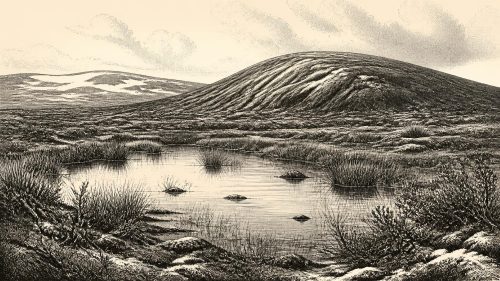
The organisms preserved at Derryvree give the closest view of everyday natural conditions. Plant and insect evidence points to a cold, treeless, periglacial wetland: a mosaic of mossy ground, sedges, shallow pools and open vegetation rather than a forest or a settled agricultural landscape. Macrofossils and pollen include aquatic and northern plants such as bogbean, alternate water-milfoil, dwarf willow, mountain avens and lesser clubmoss. These are not a picturesque list of modern species transported intact from the present; they are fossil evidence that particular wet-ground and cold-adapted plants grew locally or nearby while the sediments accumulated.
The environmental interpretation is necessarily broader than each individual fossil. Mosses and sedges imply persistently damp surfaces and organic-rich margins. Water-milfoil and bogbean support the presence of freshwater. Dwarf willow and mountain avens fit open, cold conditions with little or no tree cover. Fossil insects also suggest a severe climate, with cold winters and a short productive season. Taken together, the evidence supports a tundra-like landscape in Fermanagh, not a uniform white wilderness. In summer, shallow water, plants and invertebrates could make sheltered ground biologically active; in winter, frost, wind and snow would have imposed formidable constraints.
The landforms familiar in Fermanagh today were also being shaped within this larger glacial history. Drumlins are streamlined hills of glacial sediment, formed beneath moving ice or substantially remodelled by it. The Derryvree wetland was buried within one such landscape. Its preservation is an accident of geology: organic material lay in a basin and was sealed by later deposits. Most traces of exposed ground, animal movement and any short human presence were likely eroded, reworked or concealed by later ice.
Castlepook and the Animal World
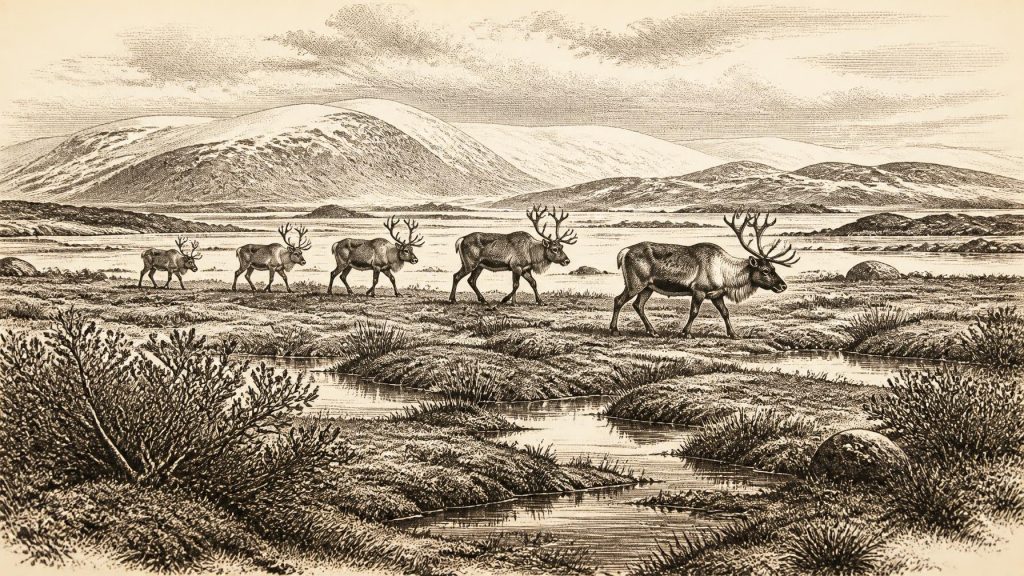
At the opposite end of the island, Castlepook Cave near Doneraile in north County Cork provides a different, though more complicated, archive. Antiquarian excavations recovered a rich collection of Ice Age animal remains. The fauna associated with the cave includes reindeer, woolly mammoth, giant deer, brown bear, wolf, foxes, spotted hyaena, mountain hare and lemmings. It demonstrates that, during portions of the Late Pleistocene, Ireland could sustain a far more varied cold-climate mammal community than the later historic island.
Such a list must not be turned into a claim that every species stood together outside the cave in 30,228 BCE. Cave deposits can combine material accumulated over long periods, and the early excavations did not meet modern standards of stratigraphic recording. Some old radiocarbon dates from Irish fauna have also been reassessed as laboratory methods improved. Castlepook is consequently strongest as evidence for the presence of species during broad late-Pleistocene intervals and for the research potential of surviving cave deposits, rather than as a census of one year.
Reindeer are especially significant because they connect Ireland to the wider north-west European world. Their seasonal movements and grazing ecology suit open cold landscapes, and their arrival implies traversable routes through a changing geography of land, sea and ice. Lower global sea levels exposed continental shelves, but the exact connections between Ireland, Britain and mainland Europe changed repeatedly and should not be imagined as a permanent, simple land bridge. Animal populations may have reached the island during windows when terrain, climate and sea level permitted passage, then vanished as conditions shifted.
The Human Question
Castlepook also bears on the most tantalising issue: whether people reached Ireland in this era. A reindeer femur from the cave collection, said to be about 33,000 years old, carries a deep linear mark interpreted by zooarchaeologist Ruth Carden as damage from a sharp stone tool on fresh bone. If that interpretation and association are sustained by further work, it is evidence that Upper Palaeolithic hunters processed reindeer in Ireland roughly around 31,000 BCE, much earlier than the formerly accepted post-glacial settlement record.
Yet this is not a licence to invent a resident population for 30,228 BCE. The bone comes from an old cave collection with limited original context; it is not accompanied by a securely stratified living floor, hearth, tool assemblage, dwelling or cemetery. The National Museum of Ireland still rightly emphasises the absence of clear, secure Palaeolithic evidence for human presence in Ireland. The most careful conclusion is narrower: Castlepook raises a serious possibility of brief human activity during the Late Pleistocene, but it does not establish a continuous community, population size, language, kinship system or route of arrival.
Nor can European analogies fill the gap. Elsewhere in north-west Europe, Homo sapiens made sophisticated stone tools, hunted large animals, used ornaments and created powerful graphic art. None of that is direct evidence for Ireland at this date. It is reasonable to infer that any people who reached the island would have depended on mobile hunting, gathering and detailed knowledge of seasonal terrain. It is not reasonable to assign them Irish settlements, named territories, religious monuments or an artistic tradition without local evidence.
No Polities, No Diplomacy
There were no identifiable Irish political affairs in 30,228 BCE: no kingdoms, borders, alliances, diplomacy or warfare that can be responsibly reconstructed. Even a confirmed hunter visit would not reveal institutions. Likewise, there is no evidence for farming, livestock, metalworking, market exchange or maritime trade networks. The economy visible in the record is ecological rather than commercial: wetland plants growing, herbivores feeding, predators scavenging or hunting, and perhaps transient people seeking animal resources.
Religion, culture and learning are equally beyond direct recovery. Caves can acquire symbolic importance in many human societies, but Castlepook’s Pleistocene bones do not prove ritual use. A cut-marked bone, if accepted as such, documents an act of carcass processing; it cannot by itself disclose belief. This restraint matters. The archaeological silence is not evidence that people lacked culture; it is evidence that Ireland has not yet yielded material with which to describe it.
A Precarious Irish World
The major development around this date was environmental volatility. Derryvree records living freshwater conditions between glacial episodes, while the wider Irish and British record shows ice sheets capable of rapid expansion and major landscape transformation. The more extensive Last Glacial Maximum lay ahead, broadly after about 27,000 years ago and especially between roughly 26,500 and 19,000 years ago. Its ice would scour, bury and rearrange much of the evidence that might have recorded earlier landscapes and people.
For Ireland, then, 30,228 BCE is best understood as part of a long, uneven interval: locally ice-free ground in Fermanagh supported cold wetland vegetation; Ice Age mammals ranged through suitable habitats; and Castlepook preserves a provocative but still limited clue to human activity. There is no annual narrative to recover. There is, however, a vivid and scientifically defensible picture of an island on the edge of changing ice, inhabited certainly by hardy plants and animals, and possibly visited by people whose traces are almost entirely lost.
Primary Sources
- A Middle Midlandian Freshwater Series at Derryvree, Maguiresbridge, County Fermanagh, Northern Ireland
- Irish Pleistocene Biostratigraphy
- The Irish Quaternary Fauna Project
- The Timing and Magnitude of the British–Irish Ice Sheet Between Marine Isotope Stages 5d and 2: Implications for Glacio-Isostatic Adjustment, High Relative Sea Levels and ‘Giant Erratic’ Emplacement
- Pattern and Timing of Retreat of the Last British-Irish Ice Sheet
- Stratigraphic and Palaeo-Geomorphological Evidence for the Glacial-Deglacial History of the Last British-Irish Ice Sheet in the North-Western Irish Sea
- Timing and Pace of Ice-Sheet Withdrawal Across the Marine–Terrestrial Transition West of Ireland During the Last Glaciation
- Late Pleistocene Chronostratigraphy and Ice Sheet Limits, Southern Ireland
- Trimlines, Blockfields and the Vertical Extent of the Last Ice Sheet in Southern Ireland
- The IntCal20 Northern Hemisphere Radiocarbon Age Calibration Curve (0–55 cal kBP)
- IntCal Publications
- Figure 6.—The Subdivision of the Quaternary Period in Ireland
- References and Recommended Reading: Irish Association for Quaternary Studies Field Guide
- Prehistoric Details
- Heritage Artefacts of County Cork
- Archaeology Research Excavation Grant 2022: Castlepook Cave Project Final Report
- 2022:564 – Castlepook Cave, Castlepook South, Cork
- Ireland’s Palaeolithic Archaeology – Fleeting Footprints in a Frozen Land
- Mammoth Cave / Castlepook Cave
- New Insights on the Fauna of Ireland’s Younger Dryas and Early Holocene from Alice & Gwendoline Cave
- Selaginella selaginoides in Fermanagh: Fossil Record
- Salix herbacea in Fermanagh: Fossil History
- Menyanthes trifoliata in Fermanagh: Fossil Record
- Dryas octopetala in Fermanagh: Fossil Occurrence
- Myriophyllum alterniflorum in Fermanagh: Fossil Occurrence