
Castlepook’s Carnivore Passage31007 BCE
Around 31,007 BCE, Ireland lay in the unstable later phase of the last Ice Age, not necessarily beneath maximum ice cover. Fragmentary geological and cave evidence indicates cold, open environments and changing connections with north-west European fauna. Castlepook Cave in County Cork preserves remains of hyenas, reindeer, mammoths and other mammals, accumulated largely through carnivore activity. A marked reindeer femur may indicate human butchery, but its old excavation context and uncertain taphonomy prevent firm conclusions. No settlements or society can be reconstructed. Later glaciation destroyed evidence, leaving Castlepook as a crucial yet provisional record of ecological change and possible visitation.
Dateline
31,007 BCE is not a year that can be recovered from Ireland’s evidence in the way that a later historical year can. No written calendar, settlement sequence or securely dated event allows archaeology to distinguish this one modern calendar label from the centuries on either side of it. Expressed in archaeological convention, it lies about 32,956 years before AD 1950, within the later part of Marine Isotope Stage 3, an unstable phase of the last Ice Age. The responsible history of Ireland at this point is therefore not an annual chronicle, but a carefully bounded account of landscapes, animal remains and a possible human trace.
That distinction matters. A date given as “about 33,000 years ago” may be a radiocarbon age, a calibrated calendar estimate, or a rounded public description; these are not interchangeable. Ireland’s Pleistocene record is fragmentary, and many important cave discoveries were made before modern excavation and sampling methods. Around this notional date, the island’s evidence can illuminate a cold-world ecology and the possibility of brief human activity. It cannot demonstrate a kingdom, a named people, permanent villages, trade routes or a political frontier.
A Changing Ice-Age Island
Ireland was then in the Midlandian cold stage, the Irish expression of the last glacial cycle. This was not one unbroken deep freeze. Climate shifted abruptly over millennia and centuries; glaciers advanced and retreated; sea level stood substantially lower than today; and the extent of ice varied greatly by region and time. The maximum expansion of the last British–Irish Ice Sheet belongs later, broadly after about 26,000 years ago, with evidence for major ice advance west of Ireland after 24,720 ± 260 calibrated years BP. Thus 31,007 BCE should not be pictured automatically as an island buried beneath its final, fullest ice cover. It was instead part of the long, climatically deteriorating approach to that maximum.
What the terrain looked like locally is harder to establish. Ice, frost, running water and later erosion removed or disturbed much of the evidence. Geological Survey Ireland’s mapping records tills, glaciofluvial and glaciolacustrine sediments, landforms and striae across the island, reminders that the landscape has repeatedly been remodelled by ice. Modern eskers, drumlins and valleys are not a direct view of 31,007 BCE, but they are part of the long Quaternary inheritance of those transformations.
There are important signs that, at least in some intervals and some districts, Ireland supported open cold-climate environments rather than a uniform ice sheet. Older stratigraphic work in Ulster identified a middle Midlandian phase described as cold but non-glacial, represented by organic deposits beneath later tills and conventionally dated to around 30,500 radiocarbon years BP. Such figures are broad chronological anchors, not dates for a particular season or a single island-wide landscape. They nevertheless show why a simple narrative of uninterrupted ice cover is misleading.
The Castlepook Archive
The strongest directly relevant Irish evidence comes from Castlepook Cave, also called Mammoth Cave, near Doneraile in north County Cork. The limestone cave system lies in the Awbeg Valley, below the Ballyhoura Hills. Excavations from the early twentieth century produced a remarkable collection of Ice Age animal bones, much of it now associated with the National Museum of Ireland. Recent work has returned to the site because the early excavators lacked today’s methods of sediment recording, microscopic analysis, sieving, accelerator dating and ancient-DNA research. A 2022 project specifically sought intact deposits and a better understanding of the old collection.
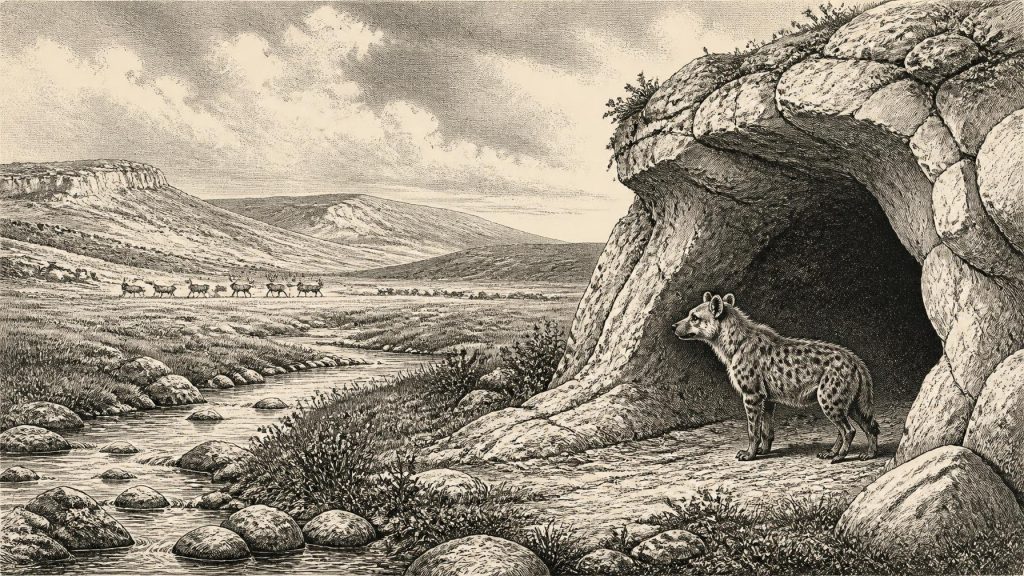
Castlepook is particularly valuable because it preserves evidence of an animal community that has no modern Irish equivalent. Spotted hyena remains make it Ireland’s most important last-cold-stage mammal site. Museum research places hyenas and associated mammals at Castlepook within a broad migration and occupation window of roughly 45,000 to 30,000 years ago, interpreted against climate and changing sea levels. Other remains from the cave assemblage include reindeer, woolly mammoth, giant deer, brown bear, wolf, Arctic fox, stoat, mountain hare and lemmings. Not every species necessarily lived there at the same moment, and a cave bone collection is not a census of the surrounding countryside. Yet together they establish that southern Ireland was connected to a wider north-west European cold-stage fauna.
Hyenas are especially important for interpreting the cave. They could drag carcass parts underground, break bones, leave droppings and accumulate a mixed assemblage over a long period. Water, collapse, frost and scavenging could further alter deposits. Castlepook should therefore not be imagined as a human hunting camp simply because bones occur there. It was above all a carnivore landscape: a place where large herbivores, predators and scavengers moved through seasonally difficult country, and where caves could become dens, traps or repositories of transported remains.
A Reindeer Bone and a Human Question
The most arresting possibility is a reindeer femur from Castlepook that has been publicised as bearing a deep mark made by a sharp stone implement during carcass processing. County Cork heritage material associates the object broadly with “31,000 BC”, while recent research and public discussion have treated it as potential evidence of Upper Palaeolithic human activity far earlier than the securely documented post-glacial occupation of Ireland. If the mark is confirmed as anthropogenic, it would show that a person handled a reindeer carcass on the island during the Ice Age. It would be a major discovery.
But the limits of that claim must be stated just as plainly. The bone came from an old cave collection, not a freshly excavated occupation floor containing hearths, stone tools, structures and food debris in secure association. A radiocarbon determination dates the animal’s death, not necessarily the exact moment at which a surface mark was made. Distinguishing a cut made by a stone tool from damage caused by carnivores, excavation, breakage or other processes requires specialist taphonomic assessment. Ongoing research has found further Pleistocene-bearing deposits, but the evidence presently available does not establish a settled population at Castlepook or elsewhere in Ireland.
This is where calibrated ranges are essential. Recent reassessment of Irish cave fauna has demonstrated that some older bone dates can be seriously misleading: at Castlepook, ultrafiltration redating showed one reindeer antler to be more than 7,500 years older than a 1990s result. By contrast, directly dated reindeer remains from Alice and Gwendoline Cave in County Clare belong much later, to calibrated ranges of 12,620–11,885 and 12,745–12,487 cal BP. Those later ranges cannot be projected backwards to the Castlepook femur. They underline why “about 33,000 years ago” is a research problem, not calendar-year precision.
Life Without a Recorded Society
If people did reach Ireland in this broad period, the most defensible interpretation is of brief, small-scale movement through a demanding northern Atlantic environment. A single modified bone could reflect butchery of a carcass, whether hunted, found dead or taken from another predator. It does not reveal the size of a group, its language, kinship, beliefs, territory or route of arrival. Nor does it prove repeated seasonal visits. Reindeer would have offered meat, hide, sinew, marrow and bone, but no Irish assemblage of this age allows us to reconstruct an economy from those possibilities.
Accordingly, political affairs, diplomacy and organised conflict are absent from the record—not because Ice-Age people elsewhere lacked social lives, but because Ireland supplies no evidence from which they can responsibly be described here. There are no known houses, graves, monuments, art objects, toolkits or ritual deposits securely attributable to this point around 31,007 BCE. There is no basis for speaking of tribes, chiefs, alliances, trade or religious institutions. Silence is not proof that none existed; it is the boundary of the surviving evidence.
The same caution applies to culture and learning. Continental Europe preserves rich Upper Palaeolithic traditions, including sophisticated stone technology, portable art and cave art. It would be unsound to transfer any named archaeological culture wholesale across the sea to Ireland on the strength of one disputed or provisional trace. Ireland may have been visited by people who knew such wider traditions, but that is an inference about regional possibility, not a demonstrated Irish cultural identity.
Regional Change and Deep Time
The broader environmental story is more secure than the human one. Open herb-rich ground, tundra-like vegetation, patches of wetland and sheltered valleys could support grazing animals, while carnivores followed prey or scavenged carcasses. At the same time, worsening cold and the growing ice sheet would have made habitats unstable. Faunal movements and any human visits depended on changing coastlines, weather, vegetation and access through or around glaciated terrain. The familiar wooded and farmed Ireland of later millennia was still unimaginably distant.
The subsequent advance of ice helps explain the scarcity of traces. Glacial erosion could strip deposits; later sediment could bury them; acidic soils often destroy bone outside favourable limestone caves. The archaeological record is therefore biased towards unusual survival places such as Castlepook and towards museum collections whose original contexts are imperfect. Geological and archaeological research continues to refine the island’s Quaternary map and cave chronology, so conclusions remain provisional.
For Ireland around 31,007 BCE, then, the key development is neither a recorded battle nor the foundation of a settlement. It is the existence of a cold-stage ecological corridor in which reindeer, hyenas, mammoths and other animals reached the island, and in which a reindeer femur may preserve evidence of human action. Castlepook offers an extraordinary opening onto that world, but not a licence to invent one. Its lesson is methodological as much as historical: deep Irish history begins with fragments, date ranges and contested marks, and gains clarity only when evidence and interpretation are kept distinct.
Primary Sources
- Quaternary Deposits and Glacial Stratigraphy in Ireland
- Dimensions and Chronology of the Last Ice Sheet in Western Ireland
- Maximum Extent and Dynamic Behaviour of the Last British–Irish Ice Sheet West of Ireland
- Trimlines, Blockfields and the Vertical Extent of the Last Ice Sheet in Southern Ireland
- Oscillating Retreat of the Last British-Irish Ice Sheet on the Continental Shelf Offshore Galway Bay, Western Ireland
- The Colonization of Ireland: A Human Ecology Perspective
- Spotted Hyena Skull
- Quaternary
- Ireland Through Geological Time
- An All-Ireland Quaternary Map
- Release of 3 New Quaternary Maps
- Heritage Artefacts of County Cork
- Archaeological Heritage of County Cork
- 2022:564 – Castlepook Cave, Castlepook South, Cork
- New Insights on the Fauna of Ireland’s Younger Dryas
- The Brown Bear (Ursus arctos L.) in Ireland
- The Irish Quaternary Fauna Project
- Landscapes and Environments of the Last Glacial-Interglacial Transition: A Time of Amazingly Rapid Change in Ireland
- The Stratigraphic Position and Age of the Gortian
- Ireland’s Palaeolithic Archaeology – Fleeting Footprints in a Frozen Land
- Autumn 2023 Newsletter
- New Insights into Ireland's Ice Age Past From Castlepook Cave