Castlepook’s Uncertain Horizon30175 BCE
Around 30,175 BCE, Ireland lay within the unstable later Pleistocene, before maximum expansion of the last British–Irish Ice Sheet. Precise dating is impossible, and evidence survives chiefly in disturbed cave deposits. Castlepook Cave, County Cork, preserves remains of mammoth, reindeer, giant deer, hyaena, bear and other cold-adapted animals, accumulated across millennia rather than in one episode. Open tundra-like habitats and lower sea levels shaped a landscape. A marked reindeer femur may indicate Upper Palaeolithic butchery, but lacks secure context and cannot prove settlement. No wider reconstruction is justified. Castlepook instead records intermittent animal life and a possible fleeting human encounter.
Dateline
30,175 BCE is a modern chronological label, not a date that can be recovered from an Irish diary, settlement layer or historical calendar. At this depth of time, precision measured in individual years is impossible. The responsible frame is the later Pleistocene, broadly within Marine Isotope Stage 3, a long and climatically unstable part of the last Ice Age. Evidence from Ireland is sparse, discontinuous and often recovered from caves disturbed by natural processes and early excavation. Yet it still permits a meaningful account: not of kingdoms or named communities, but of a cold, changing island landscape in which large mammals travelled, carnivores used caves, ice was beginning to expand in the wider region, and a possible human trace remains under investigation.
A Date Within Ranges
The numerical year corresponds approximately to 32,100 years before AD 1950, the conventional reference point for “BP” dating. That conversion should not be mistaken for archaeological certainty. Radiocarbon determinations must be calibrated against changing atmospheric carbon-14 levels, and beyond 30,000 years ago their calendar ranges can be broad or even irregular. Modern calibration curves extend this far back, but they do not turn a single laboratory result into a precise historical anniversary.
For this reason, the evidence relevant to Ireland around 30,175 BCE is best expressed in ranges. The Irish Quaternary Fauna Project concluded that a varied mammal fauna reached Ireland sometime between at least about 45,000 and 20,000 years ago. Castlepook Cave, near Doneraile in north County Cork, is central to that conclusion, but its bones accumulated over a very long interval. A mammoth tooth, hyaena remains, bear bones, reindeer, giant deer and smaller cold-adapted animals do not describe one simultaneous scene. They record repeated episodes in an ancient cave system and its surrounding landscape.
Before the Maximum Ice Advance
Ireland was not yet simply the white, fully ice-covered island often imagined for the Ice Age. The most extensive phase of the last British–Irish Ice Sheet came later, broadly during the Last Glacial Maximum. Reconstructions of the ice sheet begin at around 31,000 years ago because evidence for earlier margins is limited; at that stage they indicate centres of ice accumulation in parts of the region, including northern Ireland, rather than demonstrating uniform ice cover across the whole island. Around the date considered here, therefore, glaciation was a growing regional force, but its precise limits in Ireland remain debated.
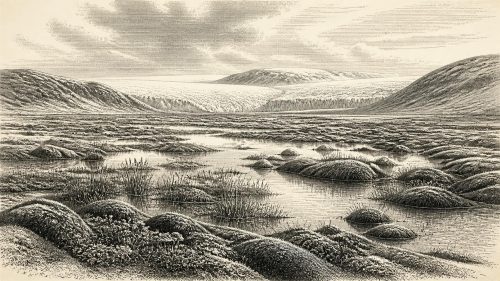
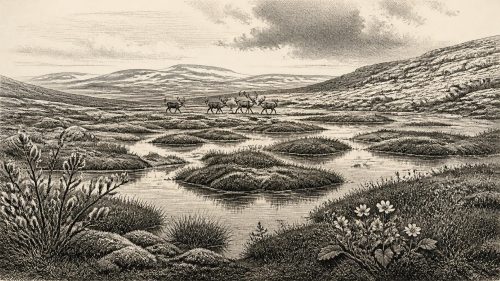
The climate was cold and changeable on a scale beyond human experience. Greenland ice-core sequences show abrupt alternations between colder stadials and relatively milder interstadials across this era. Those northern records provide a vital climatic framework, but they are not a weather station in Cork or Fermanagh. Ireland’s response depended on altitude, exposure to Atlantic systems, proximity to ice and local terrain. Open ground, patches of grassland and herb-rich tundra, wet hollows, bare mineral soils and areas of seasonal snow may all have existed at different places and times. Dense woodland was not the dominant landscape.
Sea level was considerably lower than today because vast quantities of water were locked in continental ice sheets. The outlines of Ireland and its continental shelf were consequently different, and the Irish Sea was a transformed glacial-world basin. Lower sea level alone, however, does not prove a simple walkable land bridge between Ireland and Britain at this particular time. Geological work has long questioned such straightforward reconstructions. Routes available to animals or people must remain an open problem, not an assumed fact.
The Castlepook Animal World
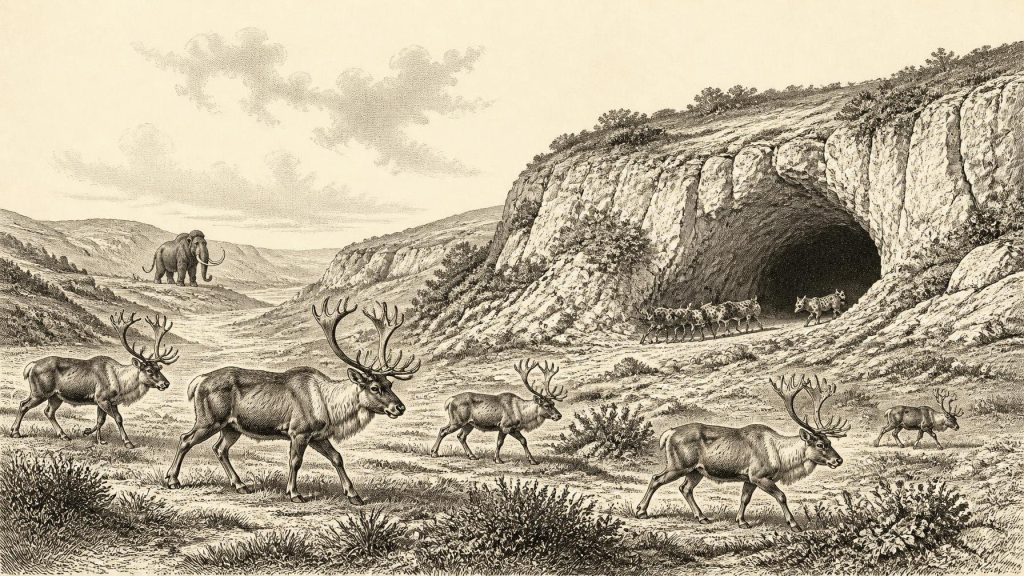
Castlepook Cave offers Ireland’s strongest glimpse of the wider ecological setting. The cave lies in limestone country above the Awbeg valley, beneath the Ballyhoura Hills. Its fossil assemblage includes woolly mammoth, giant deer, reindeer, brown bear, wolf, Arctic fox, mountain hare, lemmings and spotted hyaena. This is impressive evidence that, during suitable intervals in the wider late-Pleistocene span, Ireland supported a richer and more continental-looking mammal community than the island has known in recent millennia.
Each animal hints at ecological relationships without allowing a painted certainty. Reindeer and lemmings are consistent with open, cold environments. Mountain hare and Arctic fox likewise indicate conditions far removed from modern temperate Ireland. Mammoth and giant deer needed substantial forage, while hyaenas, wolves and bears occupied different places in a predator-and-scavenger web. The presence of hyaena is especially important: caves can be dens, scavenging locations or traps into which bones arrived by several routes. A cave bone is not necessarily proof that the animal lived or died exactly at the entrance.
Nor should all these species be placed together in one dramatic herd. Direct dates from the broader Castlepook collection range across many thousands of years, and older radiocarbon results have required reassessment as laboratory methods improved. What can be said securely is more modest and more valuable: north Cork formed part of an intermittently habitable late-Pleistocene landscape, and its cave deposits preserve rare biological evidence from periods otherwise stripped, buried or altered by later ice movement.
A Reindeer Bone and a Human Question
The most arresting object for this period is a reindeer femur from Castlepook. County Cork heritage interpretation presents it as dating to about 31,000 BC, while public reporting has described its radiocarbon age as about 33,000 years. Zooarchaeologist Ruth Carden identified a deep linear mark on the bone as consistent with cutting by a sharp stone tool on fresh bone. If that assessment is confirmed, the bone would be evidence that a person processed a reindeer in Ireland during the Upper Palaeolithic, far earlier than Ireland’s well-established post-glacial settlement record.
“If” matters. The dated bone provides an age range for the animal’s death; it does not independently date the incision to a particular day, nor identify its maker. The femur was recovered from an old cave collection rather than a modern, sealed excavation context. Natural damage, carnivore activity, sediment movement and curatorial history all have to be considered. The mark is a serious and promising clue, not a licence to invent a camp, a migration, a language or a continuous population.
Even if human modification is ultimately accepted, it would establish only a brief encounter. The people involved may have hunted the reindeer, found a carcass, scavenged an animal killed by predators, or carried part of it to or near the cave. There is no securely associated hearth, stone-tool assemblage, dwelling surface, burial or repeated concentration of butchered bones from which to reconstruct a settlement. The distinction is crucial: a trace of human action is not the same as evidence for permanent occupation.
No Polities, No Recorded Conflict
Political affairs, diplomacy and organised warfare cannot responsibly be described for Ireland at this date. There are no states, tribal names, rulers, monuments of authority or written traditions that reach back to this horizon. Nor does the known evidence demonstrate a human population large enough to support any political reconstruction. The only conflicts securely visible are ecological ones: predators, scavengers and herbivores competing within a difficult landscape, and the far larger contest between life and a deteriorating climate.
It is equally unsafe to call the Castlepook evidence “trade”. A reindeer limb altered by a possible tool reveals neither exchange networks nor long-distance commerce. The movement that can be discussed is animal mobility: herds and predators shifting through favourable seasonal habitats, perhaps aided by a lower-sea-level geography whose exact routes are still uncertain.
Lives Beyond Recovery
If people were present, their everyday life would have depended on knowledge of animals, weather, stone and shelter. Across contemporary north-west Europe, hunter-gatherers used stone tools, maintained mobile social ties and drew food, hides, sinew and fuel from landscapes that could change rapidly. These are comparisons, not direct observations of an Irish community. Ireland has not yielded the material record needed to transfer such details wholesale to Castlepook.
There is no demonstrated religion, art, language, teaching tradition or ritual site in Ireland from around 30,175 BCE. Caves invite imaginative stories, but Castlepook has not produced securely dated cave art or ceremonial deposits of this age. Learning can only be inferred at the most general human level: any successful visitor in a cold landscape would have required practical knowledge and co-operation. Such an inference says nothing about the particular beliefs, identities or words of those people.
What the Evidence Can Bear
The lasting importance of this horizon lies in its restraint. Ireland was not historically empty: animals repeatedly occupied parts of it, and its caves preserve fragments of their world. But it was also not a documented human homeland in the ordinary historical sense. Subsequent ice-sheet growth destroyed or concealed much of the surface record that might once have existed, while sea-level change altered potential coastal landscapes. New excavations at Castlepook and re-examination of museum collections may sharpen the story, especially where modern dating, microscopic analysis and secure stratigraphy can be combined.
For now, 30,175 BCE belongs to an Irish past known through ranges rather than years, bones rather than chronicles, and carefully limited conclusions rather than grand narratives. Castlepook’s reindeer femur holds out the possibility of an exceptionally early human encounter. Its surrounding fauna establishes something firmer: in an unsettled Ice-Age Ireland, life persisted in cold, open and changing environments just before the great ice expansion transformed the island again.
Primary Sources
- Heritage Artefacts of County Cork
- The Irish Quaternary Fauna Project
- 32564: Castlepook Cave, Co. Cork
- Ice Age Ireland: Cool Fossils!
- The Exploration of Castlepook Cave, Co. Cork. With 3 Plates.
- Growth and Retreat of the Last British–Irish Ice Sheet, 31,000 to 15,000 Years Ago: The BRITICE-CHRONO Reconstruction
- Timing, Pace and Controls on Ice Sheet Retreat: An Introduction to the BRITICE-CHRONO Transect Reconstructions of the British–Irish Ice Sheet
- Marine Geophysical Evidence for Late Pleistocene Ice Sheet Extent and Recession off Northwest Ireland
- Pleistocene Glaciations in Ireland
- Deglaciation Chronology of the Donegal Ice Centre, North-West Ireland
- An Inventory of the Areas of Scientific Interest in County Cork: Castlepook Caves
- Quaternary Site Descriptions: Ireland
- New Insights on the Fauna of Ireland’s Younger Dryas and Early Holocene from Alice & Gwendoline Cave
- The Colonization of Ireland: A Human Ecology Perspective
- The IntCal20 Northern Hemisphere Radiocarbon Age Calibration Curve (0–55 cal kBP)
- A Stratigraphic Framework for Abrupt Climatic Changes During the Last Glacial Period Based on Three Synchronized Greenland Ice-Core Records: Refining and Extending the INTIMATE Event Stratigraphy
- The Problem of a Late Quaternary Landbridge Between Britain and Ireland
- Ireland: Submerged Prehistoric Sites and Landscapes
- The Late Devensian Vegetation of Ireland
- RADIOCARBON, Volume 16, Number 1: University of Pennsylvania Dates VII