BIRM-166 Organic Interbed30167 BCE
Around 30,167 BCE, Ireland’s history is reconstructed from environmental evidence rather than recorded events. At Derryvree, County Fermanagh, organic freshwater deposits between glacial tills, dated broadly to this interval, reveal tundra vegetation, pools and severe periglacial conditions during an ice-free phase. Castlepook Cave, County Cork, preserves diverse cold-stage fauna, including mammoth, reindeer and giant deer, although its mixed deposits span a long period. A marked reindeer bone may indicate human carcass processing, but remains unconfirmed and does not demonstrate settlement. Changing ice margins, sea levels and regional conditions shaped a fragmented Late Pleistocene landscape across the island and through time.
Dateline
Modern calendar-year precision is not available for Ireland in 30,167 BCE. This is a useful point on a modern chronological scale, not a recoverable year in which an Irish event, ruler, settlement or journey can be identified. It falls approximately 32,100 years before AD 1950, the conventional reference point for radiocarbon dating, in the later part of the Late Pleistocene and broadly within Marine Isotope Stage 3. The responsible history of Ireland at this date is therefore one of sediments, fossils, ice margins and carefully limited inferences rather than a narrative of named people.
A Date Within a Range
The closest important Irish record is at Derryvree, near Maguiresbridge in County Fermanagh. Roadworks in 1969 cut through a drumlin and revealed a remarkable sequence: two thick layers of glacial till, with freshwater silts, fine sands and organic material between them. Till is the unsorted debris left by moving ice. The layered sequence demonstrates that ice had occupied the locality, that an interval followed in which freshwater and vegetation developed, and that a later glacial advance buried and preserved the deposit.
Organic material from the intervening layers produced the radiocarbon determination Birm-166, 30,500 radiocarbon years before present, with a substantial published uncertainty of +1,170 and −1,030 years. A radiocarbon age is not itself a calendar date: atmospheric carbon-14 has varied through time, so such results require calibration. Published discussion has placed the Derryvree evidence broadly in a calibrated range of about 36,900–31,700 years before present, or roughly 34,950–29,750 BCE. The requested date lies within that wide interval, but cannot be assigned to a particular plant, animal, season or layer. The deposit accumulated over time, and its value is environmental rather than annalistic.
Fresh Water in a Cold Landscape
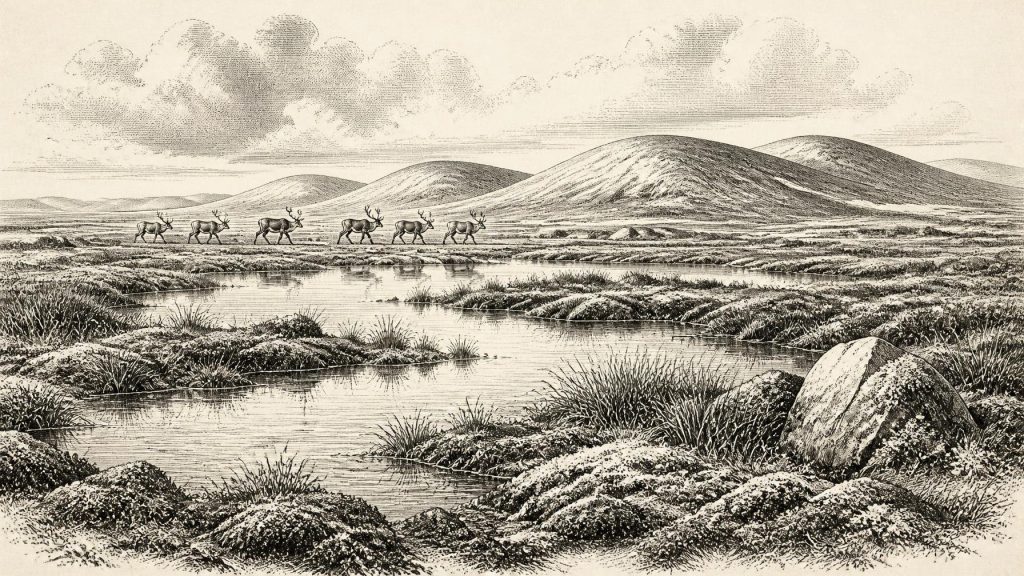
The Derryvree flora and fauna indicate an open tundra environment and a periglacial climate: land subject to severe seasonal freezing and thawing near ice, rather than necessarily covered by ice at that instant. Mosses, sedges, dwarf-shrub and herbaceous plants, together with aquatic remains, show that a freshwater habitat existed in this sheltered Fermanagh basin. Water-milfoil and bogbean are among the plants reported from the deposits. Their presence is especially revealing because they show that cold conditions did not preclude pools, marshy margins and seasonally productive wet ground.
This was not an Ireland of forests, enclosed fields or familiar blanket bog. Tree cover was absent or extremely limited locally. The broader setting was probably a mosaic of open ground, wet hollows, sparse tundra vegetation, exposed mineral soils and snow-affected slopes. Such terrain could alter rapidly with season, meltwater, frost action and changing ice margins. The Derryvree assemblage is direct evidence for one locality, not a complete map of the island. Conditions in the south-west, on uplands, along coasts or beneath ice could have differed greatly at the same broad time.
Caves and Cold-Stage Animals
County Cork supplies the other major line of evidence. Castlepook Cave, near Doneraile, has yielded Ireland’s richest known assemblage of pre-Last Glacial Maximum vertebrate remains. Its collections include mammoth, giant deer, reindeer, brown bear, wolf, fox, Arctic fox, lemmings and spotted hyaena. Taken together, they show that Ireland was intermittently accessible to a varied cold-stage fauna during the last Ice Age. They do not show that every species occupied the cave together, nor that each animal belongs to 30,167 BCE.
That qualification matters. Much of the Castlepook material was excavated in the early twentieth century, before modern recovery and recording standards. Bones came from different chambers, deposits and disturbed contexts. Later radiocarbon work has shown that the assemblage spans a long period, while newer reassessment has warned that some earlier determinations were affected by the limitations of older dating methods and sample treatment. Castlepook is an exceptionally important archive, but not a single undisturbed hunting camp or a snapshot of one Pleistocene year.
Nevertheless, the fauna gives the Derryvree landscape a wider ecological setting. Reindeer and lemmings are consistent with cold, open habitats; large herbivores such as mammoth and giant deer required extensive feeding grounds; wolves, bears and hyaenas point to a food web in which carcasses, predation and scavenging all mattered. Cave deposits also have their own history. Carnivores may have carried bones in, animals may have died naturally in shelter, and water or later disturbance may have moved material. A bone in a cave is evidence of an animal’s presence in the regional landscape, but not automatically of human hunting.
The Uncertain Human Question
A reindeer femur from Castlepook has attracted particular attention because it bears a deep linear mark interpreted by zoologist Ruth Carden as damage made by a sharp stone tool on fresh bone. Public reporting associated the specimen with an age of roughly 33,000 years ago. If the modification is confirmed as human-made and securely linked to the bone’s age, it would indicate that people processed a reindeer carcass in Ireland during the Upper Palaeolithic, far earlier than the long-established terminal-Pleistocene evidence from County Clare.
For 30,167 BCE, however, this remains a possibility rather than a foundation for a social history. Castlepook has not produced a securely associated stone-tool assemblage, hearth, dwelling floor, burial, human bone, art or occupation surface of this age. Nor does one potentially modified bone establish a resident population, a repeated migration route, a language or a community. It may record a brief visit, a single episode of carcass processing, or an interpretation that requires further testing. The distinction between an intriguing trace and demonstrated settlement is central to this period.
Ice, Sea and Regional Difference
Ireland stood on the Atlantic edge of north-west Europe during an unstable phase of the last glacial cycle. Sea level was lower than today because large quantities of water were locked in ice sheets, changing the extent of the Irish and Celtic Sea basins. This would have altered coasts and potential routes for animals, but it does not prove a permanent land bridge, a particular crossing point or regular human travel. The geography of access changed through time alongside sea level, ice flow and local uplift or depression of the land.
Nor was the island simply either ‘frozen’ or ‘ice-free’. Derryvree proves a local ice-free freshwater interval between two episodes of glacial deposition. Other evidence from Ireland’s western seaboard and the surrounding shelf indicates substantial ice-sheet activity during parts of the wider MIS 3 period. Recent British–Irish Ice Sheet reconstructions also suggest rapid expansion in some sectors around and after 31,000 years ago. The safest conclusion is regional complexity: cold habitats could persist in some places while advancing ice, meltwater and marine incursions transformed others.
No Politics, But a Living World
There is no evidence on which to write responsibly of political affairs, diplomacy, warfare, chiefs, kin groups or territorial boundaries in Ireland at this date. There is likewise no direct evidence for ritual, formal religion, music, visual art, trade networks, houses, clothing or learned traditions. It would be misleading to fill those silences with general knowledge of Upper Palaeolithic Europe. People elsewhere in Europe certainly possessed sophisticated technologies and cultural practices, but Irish evidence has not demonstrated their presence here in 30,167 BCE.
If people did reach Ireland during this broad interval, their immediate concerns would have been practical: moving through an exposed, seasonally severe landscape; finding shelter and fresh water; assessing animal movements; and obtaining food, fuel and workable stone. Yet these are reasonable ecological possibilities, not excavated facts about a known Irish group. No settlement economy can be reconstructed. The only possible hint of direct human activity is the disputed or still uncorroborated Castlepook bone modification, which would imply no more than the handling of one carcass.
What the Drumlin Preserves
The importance of Derryvree lies precisely in its modest but resilient evidence. Later glaciers overran much of Ireland, stripping surfaces, reworking sediment and obscuring the places where camps or animal tracks might once have been. The drumlin’s paired tills sealed a fleeting freshwater archive beneath later glacial debris. Its silts preserve a world otherwise almost erased: open vegetation, cold-adapted life and standing water during an interval when the island’s climate and accessibility were changing profoundly.
Thus 30,167 BCE should not be imagined as a date with a recorded Irish happening. It belongs instead to a long Late Pleistocene environmental chapter. Around this point in time, Fermanagh’s Derryvree basin provides evidence for tundra wetland between ice advances, while Castlepook demonstrates that large cold-stage mammals had reached Ireland and preserves a tantalising, unproven prospect of human contact. The history is fragmentary, but it is not empty: it is written in silt, bone, water and ice.
Primary Sources
- Middle Midlandian Freshwater Series at Derryvree, Maguiresbridge, County Fermanagh, Northern Ireland
- Middle Midlandian Freshwater Series at Derryvree, Maguiresbridge, County Fermanagh, Northern Ireland
- Early Midlandian–Middle Midlandian, Pleistocene, Northern Ireland
- Cork Geological Sites Report: Castlepook Cave
- A Reconsideration of the Radiocarbon Dating of the Marine Isotope Stage 3 Fauna from Southern Ireland
- The Irish Quaternary Fauna Project
- Radiocarbon, Volume 16, Number 1: Geological Samples
- Pleistocene Vertebrates in the British Isles
- Pleistocene Glaciations in Ireland
- Irish Pleistocene Biostratigraphy
- Radiocarbon Constraints on the History of the Western Irish Ice Sheet Prior to the Last Glacial Maximum
- Growth and Retreat of the Last British–Irish Ice Sheet, 31,000 to 15,000 Years Ago: the BRITICE-CHRONO Reconstruction
- The Timing and Magnitude of the British–Irish Ice Sheet Between Marine Isotope Stages 5d and 2
- Stratigraphic and Palaeo-Geomorphological Evidence for the Glacial-Deglacial History of the Last British-Irish Ice Sheet in the North-Western Irish Sea
- Timing and Pace of Ice-Sheet Withdrawal Across the Marine–Terrestrial Transition West of Ireland During the Last Glaciation
- Trimlines, Blockfields and the Vertical Extent of the Last Ice Sheet in Southern Ireland
- Middle Midlandian Interstadial Deposits at Greenagho, Near Belcoo, County Fermanagh, Northern Ireland
- The Colonization of Ireland: A Human Ecology Perspective
- New Insights on the Fauna of Ireland’s Younger Dryas and Early Holocene from Alice and Gwendoline Cave
- The IntCal20 Northern Hemisphere Radiocarbon Age Calibration Curve (0–55 cal kBP)
- The IntCal20 Approach to Radiocarbon Calibration Curve Construction: A New Methodology Using Bayesian Splines and Errors-in-Variables
- The Last Glacial Maximum