
Castlepook’s Reindeer Dilemma31006 BCE
About 31,006 BCE, Ireland lay within the fluctuating cold conditions of Marine Isotope Stage 3, not a datable historical year. Organic deposits at Derryvree, Fermanagh, preserved between glacial tills, indicate treeless freshwater wetlands during an ice-free interval, while related northern sites confirm episodic, uneven glaciation. Castlepook Cave, Cork, contains reindeer, mammoth, giant deer and predators, demonstrating access for large mammals across changing landscapes. A marked reindeer femur, possibly cut by a stone tool, may indicate brief Upper Palaeolithic human activity, but lacks secure archaeological context. No settlement, community or culture is established. Subsequent ice, erosion and rising seas obscured evidence.
Dateline
A Date Without a Dated Event
31,006 BCE cannot be treated as a year in the ordinary historical sense. No Irish written record, settlement sequence or archaeological deposit can be resolved to that exact calendar year. The number is useful only as a modern point within a much wider Late Pleistocene interval: roughly 32,955 calibrated years before AD 1950, in Marine Isotope Stage 3 (MIS 3), during the last glacial cycle. The responsible account of Ireland at this depth of time is therefore built from calibrated ranges, cave bones, sediments, pollen, insects and glacial landforms—not from named people, events or annual chronicle.
It was not yet the Last Glacial Maximum, when the British–Irish Ice Sheet reached its greatest later extent. Around the broad period containing 31,006 BCE, conditions were severe but highly variable. Greenland ice-core records and Irish cave deposits show that the last glacial period was punctuated by abrupt shifts: comparatively milder interstadials alternated with colder stadials. Ireland’s climate, vegetation and ice cover did not change everywhere at once. A single nationwide picture—whether of a wholly frozen island or a habitable green refuge—is misleading.
The chief evidence relevant to this nominal year comes from two very different kinds of archive. In County Fermanagh, water-laid organic deposits beneath later glacier sediments record a cold, treeless freshwater environment. In north County Cork, Castlepook Cave near Doneraile preserves bones from a striking Ice Age fauna and one especially debated reindeer femur. Together they illuminate an Ireland of open ground, wetlands, large mammals and advancing climatic instability. They do not establish a permanent human population.
Derryvree Between the Ice Sheets
The most informative environmental evidence lies at Derryvree near Maguiresbridge, County Fermanagh. There, researchers found organic-rich freshwater sediments sandwiched between two tills: compacted deposits left by glaciers. The sequence has an obvious historical importance. First, ice had occupied the locality and laid down the lower till. Then, during an interval when the site was free of overriding glacier ice, shallow freshwater and wet ground accumulated silt, plant remains and insects. Finally, renewed glaciation deposited the upper till and sealed the earlier landscape.
A conventional radiocarbon determination from Derryvree was published as 30,500 +1,170/−1,030 radiocarbon years BP. Radiocarbon years are not calendar years, and the wide uncertainty matters. Later discussion has calibrated the age broadly to about 36,900–31,700 calibrated years BP, approximately 34,950–29,750 BCE. Thus 31,006 BCE falls near the younger end of a range that can responsibly be associated with this record, rather than being a moment identifiable within it.
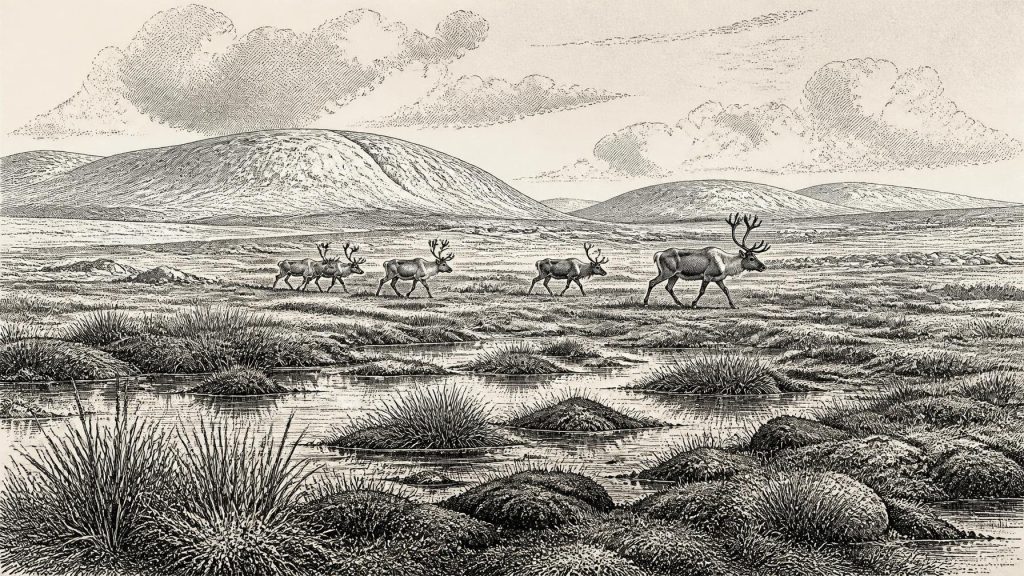
The Derryvree flora and fauna describe a cold northern landscape, not woodland. Freshwater mosses, sedges and aquatic plants indicate wet margins, pools and sluggish water; insect evidence likewise points to chilly conditions. The landscape is often characterised as muskeg or tundra wetland: patchy, waterlogged ground with low vegetation, open water and seasonally difficult terrain. Such a setting could sustain specialised plants and animals, but it offered neither the stable forest resources nor the agricultural potential familiar from much later Irish prehistory.
Related deposits at Hollymount and Greenagho in County Fermanagh, and at Aghnadarragh in County Antrim, reinforce the crucial point that glaciation was episodic and regionally varied. They are not all precisely contemporary with Derryvree, nor can their dates be compressed into a single climatic episode. Yet they demonstrate that parts of northern Ireland retained or regained ice-free ground during portions of the long cold stage. Their pollen, plant and insect assemblages consistently suggest open, cold environments rather than dense forest.
Open Country and Unstable Seasons
Around this period, Ireland’s geography also differed fundamentally from that of the modern island. Global sea level was lower because immense volumes of water were held in continental ice sheets. The Irish Sea basin was therefore shallower and land connections or narrowed crossings between Ireland, Britain and continental Europe varied through time. That does not mean a simple, dependable land bridge existed at the precise date in question. Coastlines, sea levels and ice margins changed repeatedly, and the routes available to animals or people remain matters for regional reconstruction rather than assumption.
Evidence from southern Irish caves confirms that cold-adapted and large mammals reached Ireland during MIS 3. Castlepook has produced reindeer, giant deer, woolly mammoth, brown bear, hare, fox and spotted hyaena remains. The cave collection is exceptionally important because it shows that the island supported, at different times, a more varied Ice Age fauna than its modern ecology suggests. Reindeer particularly suit an open, treeless setting, while hyaenas and other carnivores indicate a food web containing substantial herbivores.
That fauna should not be imagined as a fixed herd grazing one unchanging plain in 31,006 BCE. Cave deposits accumulated over long intervals and may combine material brought in by carnivores, water, natural deaths and excavation practices that predated modern recording. Individual animals did not necessarily live together or occupy exactly the same local habitat. Nevertheless, the assemblage makes one conclusion secure: southern Ireland was accessible to large mammals during parts of the pre-maximum glacial period, and it contained landscapes capable of sustaining them.
The Reindeer Femur Question
Castlepook’s relevance to this date centres on a reindeer femur held in the National Museum of Ireland’s Natural History collections. County Cork heritage material describes it as a Palaeolithic bone of about 31,000 BC and identifies a deep mark as one made with a sharp stone tool while the animal was butchered. If that diagnosis proves sound, the object would be potentially momentous: evidence that one or more people handled a reindeer carcass in Ireland during the Upper Palaeolithic, many millennia earlier than the island’s long-established post-glacial archaeological record.
Yet the qualifications are as important as the possibility. The femur comes from an old cave archive, not from a modern excavation in which its precise sedimentary position, associated artefacts and activity surface were recorded together. A date on bone establishes when the animal lived or died, not the exact instant when the mark was made, the location of any killing, or the length of any human visit. The bone may have been processed outside the cave and later transported underground by scavengers. Carnivore damage, breakage and excavation history all require close taphonomic scrutiny.
Most importantly, Castlepook has not yielded a securely associated hearth, stone-tool assemblage, dwelling floor, burial, refuse deposit or repeated occupational layer of this age. The National Museum of Ireland continues to state that clear evidence for Palaeolithic human presence in Ireland has not yet emerged. It is therefore best to describe the marked femur as a serious and potentially transformative claim, rather than as proof of an established Irish Palaeolithic community. Ongoing work at the cave may clarify the issue, but it cannot be anticipated as a conclusion.
People, Society and Belief: What Cannot Be Recovered
There is no evidential basis for political affairs, diplomacy, territorial communities, warfare, leaders, languages or kin groups in Ireland in 31,006 BCE. Nor can archaeology identify Irish religion, ritual, art, learning, trade networks or social organisation at this date. It would be tempting to import images of Upper Palaeolithic hunting societies from France, Iberia or central Europe. Such comparisons can suggest what mobile hunter-gatherers elsewhere were capable of—co-operative hunting, hide-working, stone-tool production and seasonal movement—but they do not fill Ireland’s silence with facts.
If people did reach Ireland during this broad interval, the Castlepook evidence would be consistent only with a brief, small-scale episode of access to an animal carcass. Reindeer could have supplied meat, fat, hide, sinew and bone; a sharp stone edge would have been an effective implement for cutting tissue. These are general observations from hunter-gatherer technology, not documented details of a Castlepook camp. No Irish tool from this time has been securely recovered, and no exchange or trade can be demonstrated.
For the same reason, there is no known permanent settlement. The most defensible human-scale image is not of villages but of a landscape that may occasionally have been visited by highly mobile people, just as it was used by mobile animals. Even that remains conditional. Ireland’s archaeological record has been heavily reduced by subsequent glaciation, erosion, rising seas and early excavations, so absence of evidence is not absolute proof of absence. But the sparse record cannot justify claims of continuous habitation.
An Island Approaching Greater Cold
The larger development was environmental. The climatic oscillations of MIS 3 were giving way towards the more extensive glaciation that would follow. Irish ice-sheet histories remain debated in detail, especially before the Last Glacial Maximum, but the evidence agrees that ice growth was uneven, dynamic and capable of overriding earlier soils, wetlands and archaeological traces. Derryvree’s freshwater bed survives precisely because it was buried between tills; most exposed surfaces from its time have not survived so clearly.
Thus the best history of Ireland around 31,006 BCE is one of fragile evidence and powerful environmental change. Derryvree preserves a cold wetland under later ice. Castlepook preserves an animal world of reindeer and predators, plus an unresolved mark that may record human butchery. These are not the foundations for a conventional national narrative. They are, however, enough to show that Ireland was neither archaeologically blank nor environmentally uniform: it was a changing north-western edge of Ice Age Europe, intermittently open to freshwater life, large mammals and perhaps fleeting human encounter.
Primary Sources
- Heritage Artefacts of County Cork
- A Reconsideration of the Radiocarbon Dating of the Marine Isotope Stage 3 Fauna from Southern Ireland
- Prehistoric Details
- 2022:564 – Castlepook Cave, Castlepook South, Cork
- Early Midlandian–Middle Midlandian, Pleistocene, Northern Ireland
- Middle Midlandian Interstadial Deposits at Greenagho, Near Belcoo, County Fermanagh, Northern Ireland
- Freshwater Organic Deposits and Stratified Sediments Between Early and Late Midlandian (Devensian) Till Sheets, at Aghnadarragh, County Antrim, Northern Ireland
- Trimlines, Blockfields and the Vertical Extent of the Last Ice Sheet in Southern Ireland
- Radiocarbon Constraints on the History of the Western Irish Ice Sheet Prior to the Last Glacial Maximum
- Growth and Retreat of the Last British–Irish Ice Sheet, 31,000 to 15,000 Years Ago: the BRITICE-CHRONO Reconstruction
- Episodic Speleothem Deposition Tracks the Terrestrial Impact of Millennial-Scale Last Glacial Climate Variability in SW Ireland
- Timing and Pace of Ice-Sheet Withdrawal Across the Marine–Terrestrial Transition West of Ireland During the Last Glaciation
- Exploring Controls of the Early and Stepped Deglaciation on the Western Margin of the British Irish Ice Sheet
- Oscillating Retreat of the Last British-Irish Ice Sheet on the Continental Shelf Offshore Galway Bay, Western Ireland
- The Irish Quaternary Fauna Project
- Figure 6.— The Subdivision of the Quaternary Period in Ireland
- The Mesolithic in Ireland: When Was It?
- First Evidence of a Late Upper Palaeolithic Human Presence in Ireland
- Palaeolithic Ireland – New Evidence Emerges from the Emerald Isle
- The IntCal20 Northern Hemisphere Radiocarbon Age Calibration Curve (0–55 cal kBP)
- A Stratigraphic Framework for Abrupt Climatic Changes During the Last Glacial Period Based on Three Synchronized Greenland Ice-Core Records
- Radiocarbon Constraints on the History of the Western Irish Ice Sheet Prior to the Last Glacial Maximum