Castlepook’s Narrow Window31086 BCE
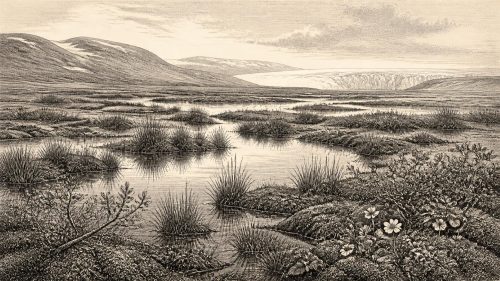
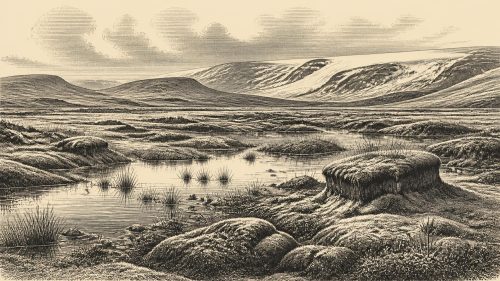
Around 33,000 calendar years before present, Ireland experienced increasingly severe, unstable conditions as the British-Irish Ice Sheet expanded towards its later maximum. Low sea levels allowed intermittent ecological connections, though routes remained uncertain. Derryvree, County Fermanagh, preserves freshwater evidence of treeless tundra wetlands supporting plants and insects. Castlepook Cave, County Cork, contains a disturbed assemblage including reindeer, mammoth, giant deer, hyaena, lemmings and Arctic fox, demonstrating repeated cold-adapted faunas. A possibly cut-marked reindeer femur may indicate brief Upper Palaeolithic human activity, but lacks secure context. No settlements, tools, institutions or continuous occupation can be established; erosion and glaciation obscured evidence.
Dateline
“31,086 BCE” is a useful modern filing label, not a date at which an Irish event can be placed. No written calendar existed, and the archaeological record cannot distinguish one year from the next at this depth of time. In radiocarbon and palaeoclimate research, the relevant evidence is expressed in ranges, usually in years before AD 1950 and, where possible, calibrated calendar ranges. This article therefore considers Ireland broadly around 33,000 calendar years before present, in the later part of the Pleistocene and near the transition from Marine Isotope Stage 3 towards the colder conditions of Marine Isotope Stage 2. It describes a changing landscape, a small but remarkable fossil record, and a tantalising rather than settled question about human presence.
A Country on the Edge of Glaciation
Ireland at this time was not the familiar green, wooded island of later millennia. It lay within the climatic world of the North Atlantic Ice Age. The British–Irish Ice Sheet was growing, although its expansion was neither simple nor simultaneous in every region. Major syntheses place the main build-up after roughly 35,000–32,000 years ago, with maximum ice extent later, broadly between about 27,000 and 21,000 years ago. Those ranges should not be converted into a claim that every valley or coast in Ireland was ice-covered in 31,086 BCE. Dating former ice margins remains difficult, and local conditions could differ sharply.
The best responsible picture is therefore one of an increasingly severe, unstable cold-stage environment. Some areas may have remained exposed for a time while ice accumulated in uplands and spread across lowlands; elsewhere, older deposits were overridden, eroded or buried. The future ice sheet would radically remake the surface of Ireland, scouring bedrock, moving enormous loads of sediment and leaving the drumlins, tills and meltwater landforms that structure much of the modern landscape. That destructive power also explains why evidence for any human activity of this age is so scarce: campsites on open ground were especially vulnerable to removal or deep burial.
Sea level was much lower than today because vast quantities of water were held in northern ice sheets. Yet low sea level did not automatically create a straightforward, dry route from Ireland to Britain or continental Europe. The geometry of the Irish Sea basin, changing ice margins, isostatic movements of the crust and the presence of glaciers all mattered. Animal movements into Ireland during the Pleistocene demonstrate that access was possible at certain times, but the precise routes and dates remain debated. It is safer to speak of intermittent ecological connectivity than to imagine a permanent road across a single exposed plain.
Two Uneven Archives
Two very different Irish records help illuminate the broader interval. At Derryvree near Maguiresbridge in County Fermanagh, an organic freshwater bed was found between glacial deposits. Its radiocarbon age of about 30,500 radiocarbon years before present is not an exact equivalent of 31,086 BCE, and calibration would place the sediment appreciably earlier in calendar years. Nevertheless, it is relevant evidence for the kind of cold, pre-maximum landscape that existed in Ireland during this phase of the last glaciation.
The Derryvree deposit contained plant and insect remains indicating open tundra or muskeg: sedges and grasses, mosses, herbs, dwarf willow, mountain avens, juniper and aquatic plants including bogbean. Open pools occurred amid wet, plant-rich ground. This was not a uniformly lifeless frozen desert. Summer thaw sustained shallow water, wetland vegetation and insects, while the wider setting was treeless and subject to long, cold winters. The evidence is local, from one protected sedimentary pocket in Fermanagh, not a complete map of the island. Still, it provides firmer footing than a generalised image of Ireland as blanketed everywhere by snow and ice.
Castlepook Cave, also called Mammoth Cave, near Doneraile in north County Cork, offers a complementary animal archive. Excavations conducted mainly between 1904 and 1908 recovered a large and complicated collection of bones. The cave deposits were accumulated, disturbed and excavated long before modern recording standards. Consequently, the bones cannot safely be treated as a single moment, a single living community or a neatly layered sequence. Recent redating has made some Castlepook animals substantially older than earlier measurements suggested, and has underlined the need to separate a bone’s date from assumptions about its original context.
Reindeer Country and Carnivore Caves
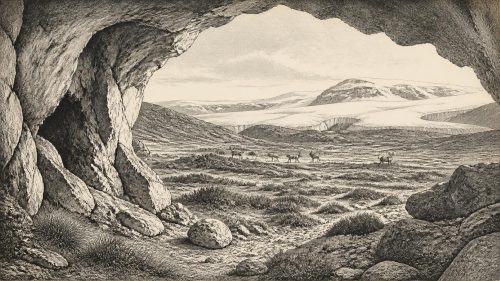
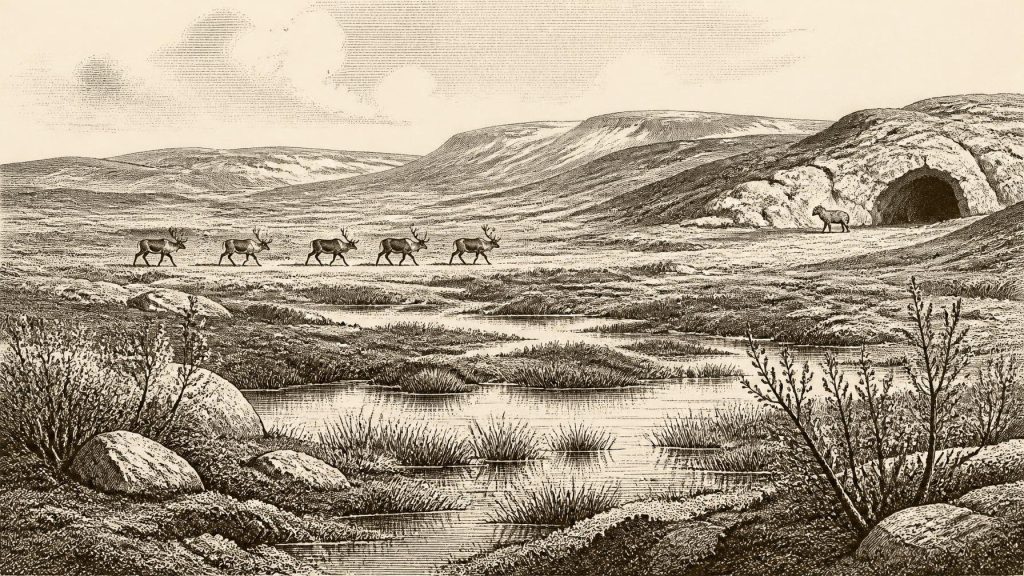
Despite those qualifications, Castlepook confirms that Ice Age Ireland supported a richer mammal fauna than the later island. Its assemblage includes reindeer, woolly mammoth, giant deer, brown bear, wolf, fox, Arctic fox, mountain hare, collared lemming, Norwegian lemming and spotted hyaena. Some species need not have overlapped precisely, but together they demonstrate repeated episodes in which cold-adapted animals reached and occupied Ireland. Reindeer are especially evocative of open ground, seasonal movement and sparse forage; lemmings and Arctic fox point towards severe conditions. Mammoths and giant deer show that sizeable herbivores could use parts of the landscape.
Spotted hyaena deserves particular emphasis. A skull and other remains from Castlepook are the only secure Irish evidence for this formidable scavenger and hunter. Caves were not necessarily domestic shelters for people. They could be carnivore dens, traps, places where animals died naturally, water channels, or repositories into which bones were washed. Tooth marks, breakage, weathering and sediment movement may all alter an assemblage. The presence of hyaena at Castlepook is evidence for a Pleistocene carnivore landscape, not proof that people and hyaenas regularly confronted one another in the cave.
The living landscape beyond the cave probably varied seasonally between exposed herb-rich ground, wet hollows, streams and patches of more sheltered vegetation. Large animals would have been drawn to forage and water; predators and scavengers followed the opportunities those herds created. This is an interpretation grounded in the faunal and environmental evidence, rather than a direct observation of a particular Cork valley in this numbered year. Ireland’s changing climate, terrain and ice margins would have made such habitats temporary, fragmented and often hazardous.
The Human Question
Castlepook matters to Irish history because one reindeer femur has been reported as bearing a mark consistent with cutting by a sharp stone tool. County Cork heritage material has presented the find as possible evidence that Upper Palaeolithic hunters processed a reindeer in Ireland around 33,000 years ago. If sustained, that would place human activity on the island far earlier than the previously established post-glacial evidence. It is an important proposition, but it must be stated at the right level of confidence.
The bone comes from an old cave collection, rather than a securely excavated occupation floor with tools, hearths, structures and tightly associated animal remains. A radiocarbon measurement dates the animal’s death, not automatically the making of a surface mark, the location of carcass processing, or the duration of a human visit. Identifying a cut mark also requires taphonomic judgement: animal damage, sediment abrasion and excavation damage must be excluded. Current research at Castlepook has rightly sought surviving deposits, fresh samples, microscopic analysis, improved dating, cave survey and a better reconstruction of the old excavations.
Accordingly, it is not responsible to write of a settled Irish population, a named hunting band or a continuous Palaeolithic tradition in 31,086 BCE. Nor is there securely associated stone-tool assemblage from which to assign a culture. At most, the marked femur offers a potentially consequential indication of brief human handling of a carcass somewhere in the Castlepook landscape. It is evidence worth testing, not a licence to fill the island with imagined camps.
Society Without a Record
There is no evidence for political institutions, rulers, borders, diplomacy, organised warfare, formal religion, artistic traditions, trade networks or permanent settlements in Ireland at this date. The absence is meaningful: none can be reconstructed from the present record. If people did enter Ireland, they would have belonged to mobile Upper Palaeolithic hunter-gatherer worlds known elsewhere in north-western Europe, where food, shelter, fuel and movement were organised around highly seasonal conditions. But that wider comparison is context, not proof of what occurred in Ireland.
Likewise, no Irish economy can be described beyond the ecological possibilities suggested by fauna and landscape. Reindeer, hare and other animals could have been resources for any visitors; hides, bone, antler and fat would have had value in cold climates. Yet Castlepook has not yielded a demonstrable local toolkit, dwelling, storage place or exchange good of this age. The most substantial “infrastructure” visible today is geological: cave chambers preserving fragments of a lost world, freshwater sediments beneath later till, and the glacial deposits that both record and obscure the period.
What This Date Can Mean
Around the notional year 31,086 BCE, Ireland was entering a harsher chapter of the last Ice Age. Its landscapes included cold open wetlands and ranges used at different times by reindeer, mammoths, hyaenas and other mammals. Glaciation was advancing towards its later maximum, while erosion and burial were already limiting what posterity could recover. Derryvree and Castlepook do not tell a year-by-year story; they provide dated windows of differing resolution. Their importance lies precisely in that restraint: they show an inhabited ecosystem and a possible human trace, while reminding us how much of Ireland’s deepest past remains beyond recovery.
Primary Sources
- A Reconsideration of the Radiocarbon Dating of the Marine Isotope Stage 3 Fauna from Southern Ireland
- The Irish Quaternary Fauna Project
- Extent and Timing of the Last Glacial Maximum (LGM) in Britain and Ireland: A Review
- Growth and Retreat of the Last British–Irish Ice Sheet, 31,000 to 15,000 Years Ago: the BRITICE-CHRONO Reconstruction
- Growth and Retreat of the Last British–Irish Ice Sheet, 31,000 to 15,000 Years Ago: the BRITICE-CHRONO Reconstruction
- Maximum Extent and Dynamic Behaviour of the Last British–Irish Ice Sheet West of Ireland
- Last Glacial Maximum Cirque Glaciation in Ireland and Implications for Reconstructions of the Irish Ice Sheet
- Stratigraphic and Palaeo-Geomorphological Evidence for the Glacial-Deglacial History of the Last British-Irish Ice Sheet in the North-Western Irish Sea
- Irish Pleistocene Biostratigraphy
- BSBI: Menyanthes trifoliata
- BSBI: Salix herbacea
- BSBI: Dryas octopetala
- BSBI: Myriophyllum alterniflorum
- Archaeology Research Excavation Grant 2022
- Castlepook Cave, County Cork, 2022
- Spotted Hyena Skull
- Heritage Artefacts of County Cork
- The Problem of a Late Quaternary Landbridge Between Britain and Ireland
- Stoats (Mustela erminea) Provide Evidence of Natural Overland Colonization of Ireland
- First Evidence of a Late Upper Palaeolithic Human Presence in Ireland
- The Colonization of Ireland: A Human Ecology Perspective
- Spatio-Temporal Dynamics of Speleothem Growth and Glaciation in the British Isles
- New Insights on the Fauna of Ireland's Younger Dryas and Early Holocene from Alice & Gwendoline Cave